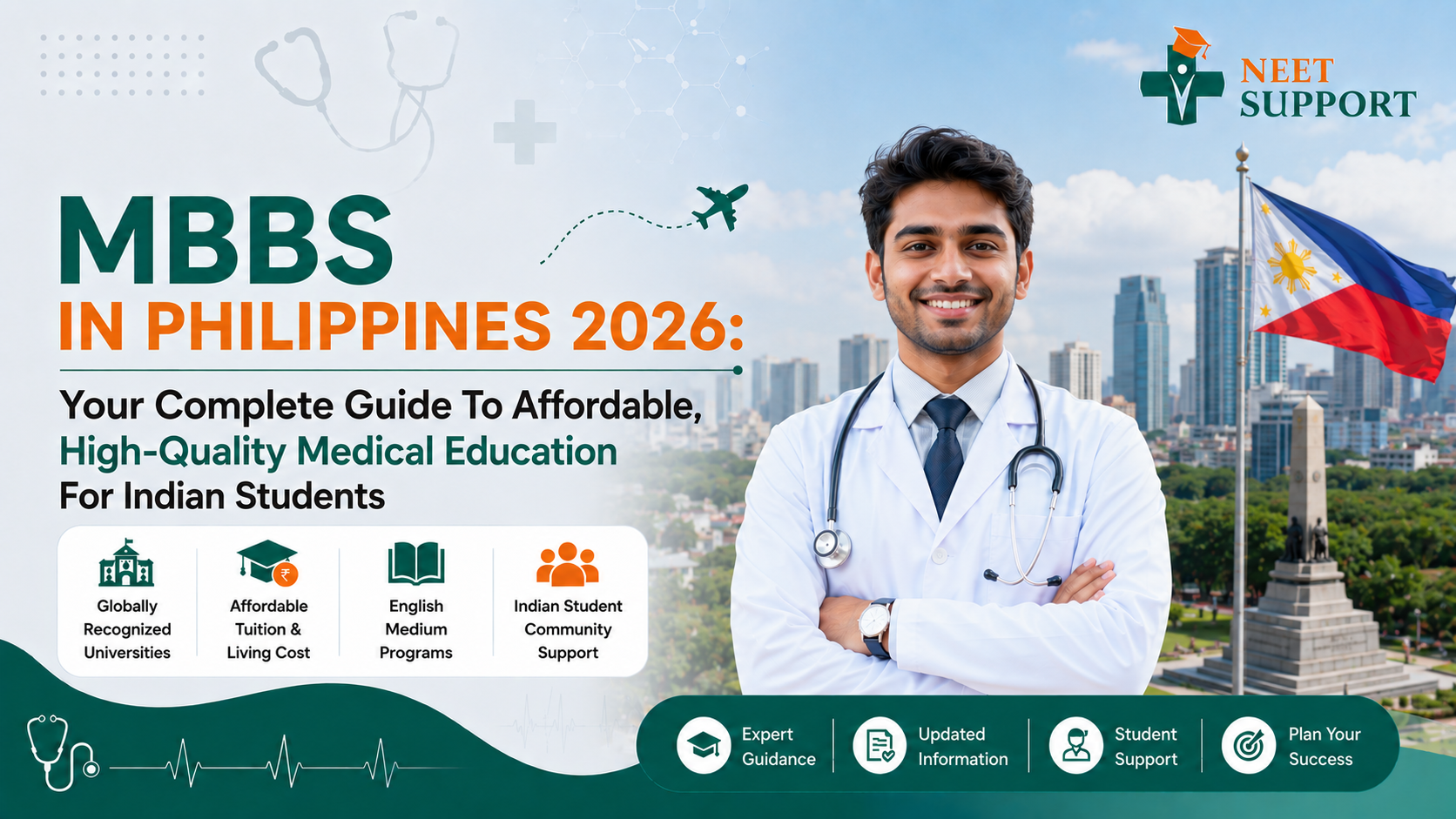
MBBS in the Philippines 2026: Your Complete Guide to Affordable, High-Quality Medical Education for Indian Students
Explore MBBS in the Philippines 2026 for Indian students, including fees, NEET eligibility, NMC-approved colleges, admission process, scholarships, FMGE/NEXT, living costs, and career opportunities.
Introduction
Every year, over 50,000 Indian students appear for NEET but fail to secure a seat in a government medical college. With private MBBS seats in India costing anywhere from ₹50 lakh to over ₹1 crore, pursuing medicine has become financially out of reach for countless families.
Enter the Philippines—a Southeast Asian nation that has rapidly become one of the most preferred destinations for Indian medical aspirants. With English-medium instruction, a US-modeled curriculum, NMC-approved universities, and a total course cost of ₹32–57 lakh (far lower than Indian private colleges), the Philippines offers a practical, credible path to becoming a doctor.
Why Indian Students Choose MBBS in the Philippines
The Philippines isn't just affordable—it's strategically advantageous for Indian students. The country offers a unique combination of factors that make it stand out among other destinations. English is the primary language of instruction, which means there's absolutely no language barrier. All lectures, clinical training, and exams are conducted in English, unlike China, Russia, or Germany, where students face significant language challenges.
The Philippines follows a US-modeled medical curriculum that aligns with the USMLE system. This is particularly beneficial if you plan to practice in the United States later, as your education will be directly relevant to US licensing requirements. Additionally, several Philippine medical colleges are on the National Medical Commission's recognized list, making graduates eligible to appear for India's FMGE and the upcoming NEXT exam.
Key Advantages at a Glance
| Factor | What It Means for You |
|---|---|
| English medium of instruction | No language barrier. All lectures, clinical training, and exams are in English |
| US-modeled medical curriculum | Follows USMLE-aligned system; ideal if you plan to practice in the USA |
| NMC-approved universities | Graduates eligible for NEXT/FMGE in India |
| No capitation or donation fees | Only standard tuition charges; no hidden costs |
| Lower total cost | Full MBBS costs approximately ₹32–57 lakh |
| Large Indian student community | Thousands of Indian students ensure smooth cultural adjustment |
| WHO-listed institutions | Most colleges listed in World Directory of Medical Schools |
| Cultural compatibility | Similar food, warm climate, and friendly hospitality |
MBBS Course Duration & Structure in the Philippines
The Philippines awards the Doctor of Medicine (MD) degree, which is equivalent to MBBS in India, provided the university is NMC-approved. The total duration ranges from 5.5 to 6 years, including pre-medical education, the MD program itself, and mandatory internship.
The course structure is well-organized and follows a progressive learning approach. The first phase involves a pre-medical bachelor's program lasting 1 to 2 years, depending on the university. During this phase, students study foundational sciences including biology, chemistry, physics, English, and mathematics. This pre-medical foundation prepares students for the rigorous medical curriculum that follows.
The second phase is the pre-clinical MD program, spanning 2 years. Students dive deep into basic medical sciences such as anatomy, physiology, biochemistry, histology, and neuroscience. This phase builds the theoretical foundation necessary for understanding human health and disease. Following this is the para-clinical phase lasting 1 to 1.5 years, where students study disease mechanisms and diagnostics through subjects like pathology, pharmacology, microbiology, forensic medicine, and medical ethics.
The clinical phase is where students gain hands-on hospital experience. Lasting 1.5 to 2 years, this phase covers internal medicine, surgery, pediatrics, obstetrics and gynecology, psychiatry, ENT, and ophthalmology. Students rotate through various hospital departments under supervision, gaining practical experience that prepares them for real-world medical practice. The final phase is the mandatory one-year rotating internship, where students complete supervised clinical practice across all major departments.
Complete Course Breakdown
| Year / Phase | Focus Area | Key Subjects | Duration |
|---|---|---|---|
| Pre-Med (BS Program) | Foundational sciences | Biology, Chemistry, Physics, English, Mathematics | 1–2 years |
| MD Year 1–2 (Pre-clinical) | Basic medical sciences | Anatomy, Physiology, Biochemistry, Histology, Neuroscience | 2 years |
| MD Year 2–3 (Para-clinical) | Disease mechanisms & diagnostics | Pathology, Pharmacology, Microbiology, Forensic Medicine, Medical Ethics | 1–1.5 years |
| MD Year 3–4.5 (Clinical) | Hospital-based training | Internal Medicine, Surgery, Pediatrics, OBG, Psychiatry, ENT, Ophthalmology | 1.5–2 years |
| Internship (Clerkship) | Supervised clinical practice | Rotations across all major departments | 1 year (mandatory) |
Total: 5.5 years (4.5 years academic + 1-year rotating internship)
Important Note: Some universities require a 1-year BS pre-medical program before the MD program, making the total duration 6–6.5 years. Always verify this detail with the university before applying.
Eligibility Criteria & NEET Requirements for Indian Students (2026–27)
To secure admission in 2026, Indian students must meet specific eligibility criteria mandated by the National Medical Commission. First and foremost, students must have completed Class 12 with Physics, Chemistry, and Biology as essential subjects. The minimum aggregate required is 50 percent in PCB for the general category, while SC/ST/OBC students need 40 percent as per NMC norms.
NEET qualification is absolutely mandatory. As per the Foreign Medical Graduate Licentiate regulations of 2021, students must qualify for NEET before enrolling in any foreign medical program to be eligible for FMGE or NEXT in India. There is no specific cutoff score required for admission to the Philippines, but having a valid NEET scorecard is non-negotiable.
The minimum age requirement is 17 years on or before 31 December 2026. Some universities also specify a maximum age limit of 25 years. After completing the pre-medical BS program, students must take the NMAT (National Medical Admission Test) to enter the MD program. The minimum requirement is the 40th percentile as per Commission on Higher Education regulations.
Good news for English-speaking students: IELTS or TOEFL is not required since English is the primary medium of instruction in all Philippine medical schools.
Essential Documents Checklist for Indian Students
| Document | Requirement |
|---|---|
| Class 10 & 12 mark sheets | Originals plus attested copies (MEA + Philippine Embassy) |
| NEET scorecard | Original from NTA plus multiple photocopies |
| Passport | Valid for minimum 18 months from travel date |
| Birth certificate | Issued by municipal authority; apostilled by MEA |
| Notice of Acceptance (NOA) | Issued by university after application approval |
| Certificate of Eligibility for Admission (CEA) | Issued by CHED Philippines; required for 9(f) student visa |
| Bank statement | Last 3 months showing funds for first year tuition + living expenses |
| Police Clearance Certificate | From local police; apostilled by MEA |
| Medical certificate | From registered physician using standard format |
| Passport-size photographs | As per Philippine Embassy specifications |
MBBS in Philippines: Comprehensive Fee Structure for Indian Students (2026–27)
The Philippines offers highly affordable medical education compared to private Indian colleges. Understanding the complete fee structure helps you plan your finances effectively and avoid unexpected expenses.
The average tuition fee ranges from USD 3,000 to 5,000 per year, which translates to approximately ₹2.5 to 4.2 lakh annually. Accommodation in university hostels costs between USD 1,200 and 2,400 per year (₹1–2 lakh). Food and daily expenses range from USD 1,200 to 2,000 annually (₹1–1.7 lakh). Students should also budget for books, equipment, and lab fees, which cost approximately USD 300–600 per year (₹0.25–0.5 lakh).
Visa and travel expenses typically amount to USD 400–800 (₹0.33–0.67 lakh), while miscellaneous expenses add another USD 300–500 (₹0.25–0.42 lakh). When you add all these components together, the total annual cost ranges from USD 6,400 to 11,300, or approximately ₹5.3 to 9.5 lakh per year.
Over the complete 5.5-year duration of the program, the total cost ranges from USD 35,000 to 62,000, which translates to ₹32–57 lakh. This is significantly lower than private medical college fees in India, which can range from ₹50 lakh to over ₹1 crore.
Annual Expenses Breakdown
| Expense Head | Est. Cost (USD/Year) | Est. Cost (INR/Year) |
|---|---|---|
| Tuition (average) | USD 3,000–5,000 | ₹2.5–4.2 lakh |
| Accommodation (hostel) | USD 1,200–2,400 | ₹1.0–2.0 lakh |
| Food & daily expenses | USD 1,200–2,000 | ₹1.0–1.7 lakh |
| Books, equipment & lab | USD 300–600 | ₹0.25–0.5 lakh |
| Visa & travel | USD 400–800 | ₹0.33–0.67 lakh |
| Miscellaneous | USD 300–500 | ₹0.25–0.42 lakh |
| Total (per year) | USD 6,400–11,300 | ₹5.3–9.5 lakh |
| Total (full 5.5 years) | USD 35,000–62,000 | ₹32–57 lakh |
Exchange rate reference: 1 USD ≈ ₹92 (March 2026)
Tuition Fees at Top Universities (Annual)
| University | City | Annual Tuition (INR approx.) |
|---|---|---|
| University of Santo Tomas (UST) | Manila | ₹4.1–5.1 lakh |
| Davao Medical School Foundation (DMSF) | Davao City | ₹2.8–3.7 lakh |
| Our Lady of Fatima University (OLFU) | Valenzuela/Pampanga | ₹3.2–4.1 lakh |
| AMA School of Medicine | Quezon City | ₹2.8–3.7 lakh |
| UV Gullas College of Medicine | Cebu City | ₹2.6–3.5 lakh |
| Lyceum Northwestern University | Dagupan City | ₹2.6–3.2 lakh |
| Emilio Aguinaldo College (EAC) | Manila | ₹2.8–3.7 lakh |
The total course cost ranges from ₹15–22 lakhs for tuition only, and ₹25–35 lakhs when including accommodation and living expenses.
Top NMC-Approved Medical Colleges in the Philippines for Indian Students
Choosing an NMC-approved college is absolutely non-negotiable. Only graduates of NMC-recognized foreign medical colleges are eligible to appear for India's National Exit Test (NEXT), the gateway to practicing medicine in India. The Philippines has several excellent medical universities that meet international standards and NMC requirements.
The University of Santo Tomas, established in 1611, is the oldest university in Asia and holds NMC approval. It offers strong clinical exposure and has a prestigious reputation. Davao Medical School Foundation in Davao City is another NMC-approved college with affordable fees and a track record of high FMGE success among its graduates.
Our Lady of Fatima University has campuses in Valenzuela and Pampanga. It's NMC-approved and hosts a large Indian student community, making cultural adjustment easier. AMA School of Medicine in Quezon City is also NMC-approved and offers scholarships of PHP 60,000 per semester without requiring students to maintain specific grades.
UV Gullas College of Medicine in Cebu City is particularly popular among Indian students, with over 1,400 Indian students currently enrolled. The college charges approximately ₹2.8 lakhs per year and follows an FMGE-focused curriculum. Lyceum Northwestern University in Dagupan City is NMC-approved, affordable, and provides strong clinical rotations.
Emilio Aguinaldo College in Manila is NMC-approved and listed in the World Directory of Medical Schools, making it ECFMG eligible for US pathways. Silliman University Medical School in Dumaguete City is a private Christian university established in 1901, offering English-medium education and strong hospital exposure. Cebu Doctors' University in Cebu City follows an American curriculum and charges approximately 149,000 PHP per semester. De La Salle University Medical Center in Cavite is ISO 9001 certified and operates the largest private tertiary hospital in Region IV-A.
Top 10 Medical Colleges for Indian Students
| University | City | Key Highlights |
|---|---|---|
| University of Santo Tomas (UST) | Manila | Oldest university in Asia (1611); NMC-approved; strong clinical exposure |
| Davao Medical School Foundation (DMSF) | Davao City | NMC-approved; affordable fees; high FMGE success |
| Our Lady of Fatima University (OLFU) | Valenzuela/Pampanga | NMC-approved; large Indian student community |
| AMA School of Medicine | Quezon City | NMC-approved; scholarship available (PHP 60,000/semester) |
| UV Gullas College of Medicine | Cebu City | ₹2.8 lakhs/year; 1,400+ Indian students; FMGE-focused curriculum |
| Lyceum Northwestern University | Dagupan City | NMC-approved; affordable; strong clinical rotations |
| Emilio Aguinaldo College (EAC) | Manila | NMC-approved; listed in WDOMS; ECFMG eligible |
| Silliman University Medical School | Dumaguete City | Private Christian university (1901); English medium; strong hospital exposure |
| Cebu Doctors' University | Cebu City | NMC-approved; American curriculum; 149k PHP/semester |
| De La Salle University Medical Center | Cavite | ISO 9001 certified hospital; largest private tertiary in Region IV-A |
Verification tip: Always verify college listing at wdoms.org (World Directory of Medical Schools) before paying any fees.
Step-by-Step Admission Process: From NEET to MD Program
The application process involves six distinct stages and requires approximately 8–10 months of lead time before your first class begins. Understanding this timeline helps you plan effectively and avoid last-minute delays.
Stage 1: Clear NEETA
NEET qualification is mandatory before enrolling in any foreign medical program. You don't need a specific score for Philippines admission, but you must have a valid NEET scorecard. This is the first and most critical step in your journey.
Stage 2: Apply to the University for the BS Program
Submit your application to the shortlisted colleges for the BS pre-medical program. You'll need to submit your Class 12 marksheet, NEET scorecard, and passport. The university will review your application and issue a Notice of Acceptance (NOA) if you qualify.
Stage 3: Obtain CHED Certificate of Eligibility for Admission (CEA)
For Medicine, the Philippine Commission on Higher Education requires a Certificate of Eligibility for Admission. Your university's international admissions office will guide you through this process. The CEA is essential for obtaining your student visa.
Stage 4: Apply for 9(f) Student Visa
Apply at the Philippine Embassy or Consulate in India (New Delhi, Mumbai, or Chennai). Processing takes 2–10 working days. It's recommended to apply at least 3–4 weeks before your planned travel date to avoid any delays. The visa fee ranges from ₹3,000 to ₹4,000.
Stage 5: Complete BS Program & Clear NMAT
After spending 1–2 years in the BS program, you must sit for the National Medical Admission Test. The NMAT is conducted by the Center for Educational Measurement, and you need to score at least the 40th percentile as per CHED regulations.
Stage 6: Begin MD Program
After clearing NMAT and receiving MD admission, you enter the 4.5-year Doctor of Medicine program. This is followed by a mandatory 1-year clinical internship before you can practice as a doctor.
Scholarships & Financial Aid for Indian Students
Full scholarships for MBBS in the Philippines are rare for international students, but several partial funding options exist that can significantly reduce your financial burden.
Many individual Philippine universities offer merit-based scholarships that provide 10–30 percent tuition waivers. These are awarded based on strong Class 12 marks and NEET scores. The Indian Council for Cultural Relations occasionally offers ICCR scholarships that cover both tuition and stipend, but MBBS slots are limited, and you need to check the ICCR portal annually.
Some state governments in India offer scholarships for students studying abroad. These are typically means-tested, so check with your home state's education department for available programs. Education loans from major Indian banks like SBI, Bank of Baroda, and Axis Bank are another viable option. Students can avail loans up to ₹40–75 lakh at subsidized interest rates, though a co-applicant is required, and collateral may be needed for amounts above ₹7.5 lakh.
AMA School of Medicine offers a particularly attractive scholarship program, providing PHP 60,000 per semester covering all-in fees, with no requirement to maintain specific grades.
Available Financial Aid Options
| Scholarship/Funding | Provider | Benefit | Eligibility |
|---|---|---|---|
| University Merit Scholarship | Individual Philippine universities | 10–30% tuition waiver | Strong Class 12 marks & NEET score |
| ICCR Scholarships | Indian Council for Cultural Relations | Covers tuition + stipend | Indian nationals; check ICCR portal annually |
| State Government Scholarships | Various state governments | Variable | Means-tested; check your home state |
| Education Loans | SBI, Bank of Baroda, Axis Bank | Up to ₹40–75 lakh at subsidized rates | Co-applicant required; collateral may be needed above ₹7.5 lakh |
| AMA School of Medicine Scholarship | AMA School of Medicine | PHP 60,000/semester (all-in fee) | No maintaining grade required |
Tip: Contact your chosen university directly for detailed scholarship programs and eligibility criteria.
Is an MBBS from the Philippines Valid in India? NMC Recognition & NEXT Exam
Yes, an MBBS from the Philippines is valid in India, provided you graduate from an NMC-approved college and clear the National Exit Test. This is the most crucial point for Indian students planning to practice medicine back home.
Understanding the Transition from FMGE to NEXT
The landscape for foreign medical graduates in India has changed significantly. The old system required students to clear the Foreign Medical Graduates Examination (FMGE), which was administered by the National Board of Examinations. Moving forward, the new system is the National Exit Test (NEXT), which will be administered by the National Medical Commission.
What's important to understand is that NEXT is not just for foreign medical graduates. All MBBS graduates, whether from India or abroad, will need to clear NEXT to practice medicine in India. The exam will be taken after completing your internship, and while the exact pass threshold has not yet been officially notified by NMC, it's expected to be similar to the current FMGE threshold of 50 percent.
As of March 2026, NEXT has been notified by the NMC, but the final rollout date for foreign medical graduates is still pending. Students should regularly check nmc.org.in for updates.
FMGE Pass Rates for Philippines Graduates
Philippines graduates have historically performed better than graduates from many other foreign countries in the FMGE exam. In June 2024, the overall pass percentage for foreign medical graduates was 20.19 percent, with Philippine graduates achieving 18.48 percent. While this may seem low, it's important to note that the Philippines graduates performed better than their counterparts from Romania (12.50 percent), Ukraine (18.81 percent), and China (19.01 percent).
In the December 2024 session, the overall FMGE pass rate increased to 29.62 percent, while the June 2025 session saw an overall pass rate of 18.61 percent. Philippines graduates consistently retain an edge in FMGE compared to students from other countries, particularly those who start India-syllabus preparation in Year 2 of their MD program.
Steps to Practice in India After the Philippines MBBS
- Complete your MD degree at an NMC-approved Philippine university
- Return to India and complete any mandatory internship (confirm with NMC if the Philippines internship counts)
- Appear for and clear NEXT Step 1 and Step 2
- Register with your State Medical Council or NMC upon clearing NEXT
- Begin your career in private practice, join a government hospital, or prepare for postgraduate entrance exams like NEET PG or INI CET
Career Opportunities After MBBS in the Philippines
Clearing MBBS in the Philippines and NEXT opens wide-ranging pathways in India and globally. The flexibility to practice in multiple countries makes the Philippines MBBS an attractive option for students with international ambitions.
Career Options in India
After clearing NEXT, you can start your own private practice as a general practitioner or set up a clinic. This pathway typically takes 6–12 months post-internship, with average starting salaries ranging from ₹4–8 lakh per year. Alternatively, you can join government hospitals or public sector undertakings, which typically require clearing government exams 1–2 years after completing NEXT, with starting salaries between ₹7–12 lakh per year.
For those interested in specialization, you can pursue postgraduate MD or MS programs by clearing NEXT and NEET PG or INI CET. This pathway takes 2–3 years post-NEXT, and PG stipends typically range from ₹50,000 to ₹80,000 per month. If research or academia appeals to you, you can pursue a PhD or fellowship after clearing NEXT, entering this field 3–5 years after graduation, with salaries ranging from ₹6–15 lakh per year.
Career Scope in Other Countries
| Country | Career Path | Exam Required | Why Philippines MBBS Helps |
|---|---|---|---|
| United States | Residency → Specialist/GP | USMLE Steps 1, 2 & 3 | Curriculum is USMLE-aligned; graduates well-prepared |
| United Kingdom | Foundation Programme → NHS Doctor | PLAB 1 & 2 | English-medium education eases language adjustment |
| Australia/NZ | Internship → General Registration → Specialist | AMC MCQ + Clinical | Recognized by AMC if college is WDOMS-listed |
| Middle East (UAE, Saudi) | Government/private hospital doctor | Country-specific licensing | English proficiency + WHO recognition help |
| Canada | Residency matching → Licensed Physician | NAC OSCE + MCCQE | Pathway available with additional steps |
The Philippines' US-aligned curriculum is particularly advantageous for students targeting US residency programs. The English-medium education also makes transitions to the UK, Australia, and New Zealand smoother compared to students from non-English-speaking countries.
MBBS in the Philippines: Pros and Cons for Indian Students
Advantages
English-medium instruction eliminates language barriers entirely. NMC-recognized colleges ensure you're eligible to practice in India post-NEXT. The lower cost compared to Indian private MBBS (₹29–52 lakh total) makes quality medical education accessible. The USMLE-aligned curriculum opens global career options. There are no donation or capitation fees, ensuring transparent pricing. A large Indian student community facilitates faster social integration. Cultural similarities in food, climate, and hospitality make the Philippines feel like home. Philippines graduates consistently maintain an edge in FMGE compared to other countries.
Challenges
The next exam is mandatory and requires serious preparation; passing is not automatic. Quality varies significantly between colleges, so you must choose only NMC-approved institutions. The distance from family is considerable—approximately 4–5 hours by flight from major Indian cities. The tropical climate and food may require adjustment for some students. You need to confirm with NMC whether an internship completed in the Philippines counts toward Indian requirements. The typhoon season from June to October poses risks in certain cities.
Student Life: Campus Life, Accommodation, Food & Living Costs
Campus Life
Campus life in the Philippines is vibrant, friendly, and welcoming for Indian students. Most medical universities offer modern classrooms and advanced laboratories, digital libraries and simulation centers, and safe, multicultural, student-friendly campuses. Comfortable hostel facilities with CCTV security are standard, and Indian food options are available in mess halls covering both vegetarian and non-vegetarian preferences. Cultural events, sports activities, and student clubs add to the enriching experience.
Food & Accommodation
Almost all medical colleges have hostels for international students. While not compulsory, hostel accommodation is highly recommended for safety and convenience. Some universities have hostels within or adjacent to campus, making commuting easy. Indian food is available in mess facilities at top universities, covering vegetarian and non-vegetarian tastes. Affordable grocery stores are widely available, making cooking at home a budget-friendly option. Hostels are monitored by CCTV, especially for female students, ensuring a secure environment.
Living Costs
| Expense | Cost (INR/month) | Notes |
|---|---|---|
| Accommodation (hostel) | ₹10,000–20,000 | Varies by city |
| Food & daily expenses | ₹10,000–17,000 | Groceries + dining out |
| Transportation | ~₹3,000–5,000 | ~25% of India costs |
| Total monthly | ₹15,000–20,000 | Relatively low vs Western countries |
Living expenses are approximately 40% higher than in India, but still far lower than in Western countries.
Final Checklist: 3 Things Every Indian Student Must Do Before Applying
1. Verify two things before paying any fee:
- MD program duration is 54 months (4.5 years)
- College is listed in the World Directory of Medical Schools at wdoms.org
- Agent assurances are not verification
2. Budget correctly:
- If college requires 1-year BS pre-med: ₹36–64 lakh (6.5 years total)
- MD + internship only: ₹32–57 lakh (5.5 years total)
- All figures at the March 2026 exchange rate (₹92/USD)
3. Start FMGE/NEXT preparation early:
- Country-wide FMGE pass rate for Philippines grads: ~24%
- Students who clear in the 1st or 2nd attempt start India-syllabus prep in Year 2 of MD
- Build this into your plan from Day 1
FAQs
Is MBBS in the Philippines valid in India?
Yes, degrees from the Philippines are valid in India, provided the National Medical Commission recognizes the institution. The program must include 54 months (4.5 years) of academic coursework plus a 12-month internship in the same institution.
Is NEET required for MBBS in the Philippines?
Yes, NEET qualification is mandatory for Indian students. As per FMGL 2021 regulations, you must qualify NEET before enrolling in any foreign medical program to be eligible for FMGE/NEXT in India.
Is Philippines visa-free for Indians?
Indian nationals can enjoy visa-free entry for up to 14 days for tourism with a valid passport and return ticket. With a valid visa or residence permit from select countries like the USA, UK, or Japan, you may qualify for a 30-day visa-free stay.
Are doctors in demand in the Philippines?
Yes, there's a severe shortage of healthcare professionals, with a projected need for 94,000 additional doctors. Demand is especially high in public hospitals and rural health units.
Can Indian doctors work in the Philippines?
Yes. Following a 2024 amendment to the Philippine Medical Act, Indian medical graduates who complete their degree plus 12-month internship in the Philippines can register to practice there. You must pass the Philippine Physician Licensure Examination (PLE).
Conclusion: Your Path to Becoming a Doctor Starts Here
The Philippines offers Indian students a practical, affordable, and globally recognized pathway to becoming a doctor. With English-medium instruction, US-aligned curriculum, NMC-approved universities, and total costs of ₹32–57 lakh (half the price of private Indian colleges), MBBS in the Philippines is a smart choice for 2026 aspirants.
Remember these critical points: verify NMC approval before applying, qualify NEET as it's mandatory, start FMGE/NEXT preparation early from Year 2 of MD, choose colleges with strong clinical exposure, and budget realistically, including tuition, living, visa, and travel expenses.
If you're planning MBBS in the Philippines for the 2026–27 cycle and need guidance on college shortlisting, scholarship applications, or education loans, consider booking a free counseling session with a certified study-abroad counselor.
Your dream of becoming a doctor is within reach—the Philippines can be your gateway to a globally competent medical career.