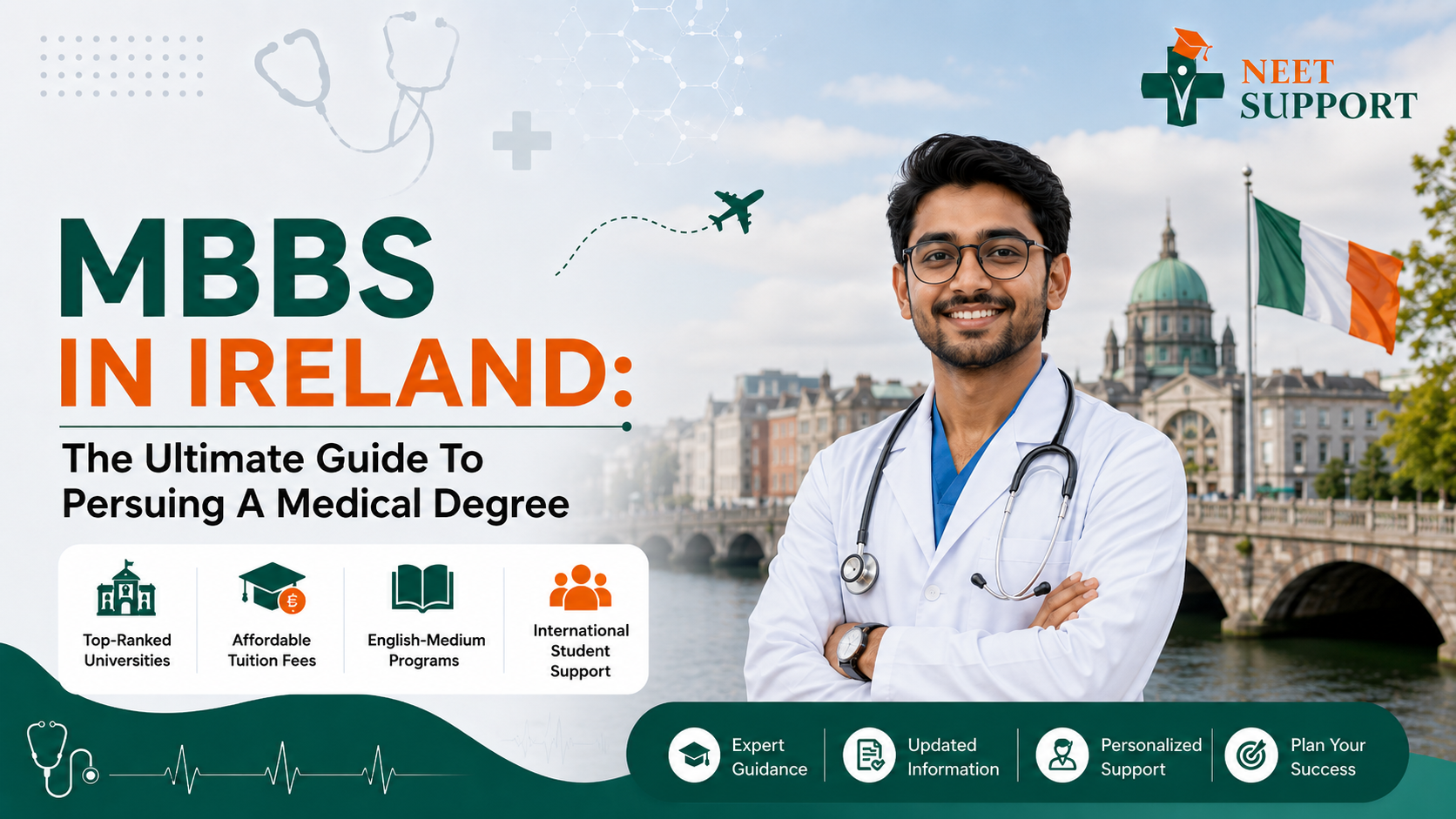
MBBS in Ireland: The Ultimate Guide to Pursuing a Medical Degree
MBBS in Ireland offers globally recognized medical degrees in English, with early clinical exposure, top universities, competitive admissions, NEET/NMC compliance, and career pathways for Indian and international students.
Introduction
Choosing where to study medicine is one of the most significant decisions of your life. If you are looking for an English-speaking country that combines world-class medical education, rich historical tradition, globally recognized degrees, and a high quality of life, Ireland stands out as a premier destination.
While the program is locally referred to as an undergraduate medical degree (granting degrees like MB, BCh, BAO), it is entirely equivalent to the MBBS degree recognized globally and in India. Every year, thousands of international students look toward the "Emerald Isle" to fulfill their dreams of becoming clinical pioneers.
This comprehensive guide breaks down everything you need to know about pursuing an MBBS in Ireland—from the top universities and eligibility criteria to costs, the application process, and post-graduation career pathways.
Why Choose Ireland for Your Medical Education?
Ireland has earned a formidable reputation as a global hub for education, research, and healthcare innovation. For an international medical aspirant, the country offers unique structural advantages.
1. Universally Recognized Medical Degrees
Medical degrees from Irish universities are highly prestigious and globally accredited. Programs are fully certified by the Medical Council of Ireland. For international students, this qualification opens doors worldwide. Graduates are eligible to sit for major licensing examinations, including:
- USMLE (United States Medical Licensing Examination) for the USA.
- PLAB / UKMLA for the United Kingdom.
- NExT / FMGE requirements for India.
- Licensing pathways in Canada, Australia, and the Middle East.
2. Standardized English-Medium Instruction
Unlike many European destinations where you must learn the local language (such as Russian, Polish, or Spanish) to interact with patients during clinical rotations, Ireland is a natively English-speaking nation. The entire curriculum, classroom lectures, and hospital patient interactions are conducted in English, removing a massive cognitive barrier for international students.
3. Early Clinical Exposure
Irish medical schools are famous for integrating hands-on clinical experience early in the curriculum. Instead of spending the first three years purely memorizing textbooks, you will find yourself entering teaching hospitals, interacting with real patients, and developing communication skills from your very first or second year.
4. Cutting-Edge Research and Facilities
Ireland is a global epicenter for the pharmaceutical and medical device industries. This commercial ecosystem directly feeds into university infrastructure. Students train in high-tech simulation labs, work with anatomical models, and learn from top-tier clinicians who are actively leading global clinical trials.
Structure of Medical Programs in Ireland
Medical schools in Ireland cater to different academic backgrounds by offering two distinct entry pathways:
The Undergraduate Entry Pathway (5 to 6 Years)
This path is designed for students straight out of high school or secondary education (e.g., Grade 12, CBSE, ICSE, IB, or A-Levels).
- 6-Year Program: Includes a foundational/pre-medical year focusing on basic sciences (Biology, Chemistry, Physics) before transitioning into core medical sciences.
- 5-Year Program: Students with exceptionally strong backgrounds in high school chemistry and biology are sometimes exempted from the foundational year and jump straight into regular medical studies.
The Graduate Entry Medicine (GEM) Pathway (4 Years)
If you have already completed a bachelor’s degree in a relevant field (like Biomedical Sciences, Nursing, or even an unrelated field with proper prerequisites), you can apply for the 4-year Graduate Entry Medicine program. This is an intensive, fast-tracked curriculum.
Top Medical Universities in Ireland
Ireland is home to six major medical schools that regularly feature in global university rankings. Each school is attached to prominent public teaching hospitals.
1. Trinity College Dublin (TCD)
Founded in 1592, Trinity College Dublin is Ireland’s oldest and highest-ranking university. Located right in the heart of Dublin city, TCD’s School of Medicine is internationally revered for its academic rigor and extensive historical network of teaching hospitals, including St. James’s Hospital and Tallaght University Hospital.
2. University College Dublin (UCD)
UCD boasts one of the largest medical schools in Ireland and is a favorite among North American and Asian students. It offers a highly modular, modern curriculum with deep roots in medical research. Its clinical training takes place across the Ireland East Hospital Group, including the Mater Misericordiae and St. Vincent’s University Hospitals.
3. Royal College of Surgeons in Ireland (RCSI)
Based in Dublin, RCSI is unique because it is an institution completely dedicated to health sciences. It has a highly diverse international student body, with students from over 60 countries. RCSI features some of the most advanced clinical simulation centers in Europe, giving students an unparalleled practical edge.
4. University of Galway
Situated on the scenic west coast of Ireland, the University of Galway offers a deeply community-focused medical program. It provides fantastic student support structures and brilliant modern facilities like the Human Biology Building. Clinical rotations are largely carried out at University Hospital Galway.
5. University College Cork (UCC)
UCC's School of Medicine emphasizes a highly patient-centered approach to healthcare. Located in the vibrant southern city of Cork, the university combines excellent academic delivery with a warm, personal student environment. Primary teaching locations include Cork University Hospital.
6. University of Limerick (UL)
The University of Limerick is renowned for its innovative Problem-Based Learning (PBL) model. While traditionally a major hub for Graduate Entry Medicine, UL provides an exceptionally modern campus, a highly interactive curriculum, and robust clinical training networks across the Midwest region of Ireland.
Eligibility Criteria for International Students
Gaining admission into an Irish medical school is highly competitive. Universities assess applications holistically, looking at academic records, standardized test scores, and personal achievements.
For Undergraduate Entry (Directly after High School)
- Academic Qualifications: You must possess an outstanding academic record in your secondary school leaving examinations. For Indian students, an aggregate score of 90% or above in CBSE/ICSE Grade 12 is typically expected.
- Subject Prerequisites: Chemistry is mandatory across almost all Irish medical universities. Additionally, you must have studied Biology, Physics, or Mathematics as core subjects.
- The HPAT-Ireland Exam: For European Union (EU) applicants, the HPAT (Health Professions Admission Test) is compulsory. However, for Non-EU international students, many universities waive the HPAT and instead evaluate alternative standardized criteria or look at exams like the SAT or ACT. Always confirm the exact requirement with your target school, as policies can vary based on your citizenship status.
- English Language Proficiency: If English is not your first language, you must prove your proficiency via standard tests. Typical target scores are:
- IELTS: An overall score of 7.0 (with no individual band lower than 6.5).
- TOEFL iBT: An overall score of 100 or higher.
For Graduate Entry Medicine (GEM)
- Undergraduate Degree: A minimum of an upper second-class honors degree (2:1) or an equivalent GPA in your bachelor's degree.
- Aptitude Tests: Applicants must take specific graduate medical admissions tests, such as the GEMSAT (Graduate Medical School Admissions Test) or the MCAT (Medical College Admission Test), depending on their home country and university rules.
A Note for Indian Students (NEET-UG)
If you intend to return to India to practice medicine in the future, you must successfully qualify for the NEET-UG examination conducted by the National Testing Agency (NTA). The National Medical Commission (NMC) requires Indian citizens studying medicine abroad to be NEET-qualified to remain eligible for licensing exams back home.
The Application Process Step-by-Step
Applying abroad requires careful planning and meticulous documentation. Here is a step-by-step breakdown of how the admission process flows:
Admission Process Steps
- Choose Your Pathway and Universities: Step 1.
Decide whether you fit into the 5-year or 6-year undergraduate track or the 4-year graduate track. Shortlist your target medical schools among the six top institutions based on your budget and preference.
- Take Required Standardized Tests: Step 2.
Register for and clear your English proficiency tests (IELTS or TOEFL). If required by your chosen university or specific background, prepare for and sit for relevant entrance or aptitude tests like the SAT, ACT, MCAT, or GEMSAT.
- Submit Your Applications: Step 3.
Gather your academic transcripts, letters of recommendation, and personal statement. Non-EU international students usually apply directly through the university’s international application portals or via authorized institutional placement agencies.
- Attend the Admissions Interview: Step 4.
If your application meets the initial academic cut-off, you will be invited for an interview. Most Irish medical universities conduct these virtually, using either a standard panel interview format or Multiple Mini Interviews (MMIs).
- Accept Your Offer and Secure Finances: Step 5.
Once you receive a successful admission offer, you must pay a tuition deposit to formally secure your seat. Use this time to gather all financial documentation and bank balances needed for your upcoming student visa application.
- Apply for Your Student Visa: Step 6.
Submit your visa application through the Irish immigration online portal or your local embassy. Provide your official university acceptance letter, proof of paid tuition fees, a valid passport, and financial statements before booking your flights.
Essential Documents Checklist
When preparing your application file, ensure you have clean copies of the following documents:
- Certified academic transcripts from Grade 10 and Grade 12 (or a university degree).
- English proficiency test report card (IELTS/TOEFL).
- Valid passport copy.
- A well-crafted Letter of Recommendation (LOR) from science teachers.
- A compelling Statement of Purpose (SOP) outlining your motivation to study medicine in Ireland.
Cost of Studying Medicine in Ireland
Studying medicine in Western Europe is a premier investment. Tuition fees for international (Non-EU) students in Ireland are noticeably higher than for regular degrees due to the resource-intensive nature of medical training.
Annual Tuition Fees
Tuition fees vary by university but generally fall within the following brackets for Non-EU international students:
- Royal College of Surgeons (RCSI): Approximately €55,000 to €58,000 per year.
- University College Dublin (UCD): Approximately €50,000 to €55,000 per year.
- University of Limerick (UL): Approximately €48,000 to €52,000 per year.
- Trinity College Dublin (TCD): Approximately €45,000 to €50,000 per year.
- University College Cork (UCC): Approximately €45,000 to €48,000 per year.
- University of Galway: Approximately €45,000 to €48,000 per year.
Note: Tuition fees are subject to annual revisions. Always consult the university's official international fee ledger for the exact current rates.
Cost of Living
Beyond tuition, you must account for accommodation, food, utilities, health insurance, and personal travel. The cost of living depends heavily on your location. Dublin is significantly more expensive than regional cities like Cork, Galway, or Limerick.
On average, an international student requires €12,000 to €18,000 per year to cover living expenses:
- Accommodation (Monthly): €600 to €1,200 (Student halls are generally pricier than shared off-campus housing).
- Food & Groceries (Monthly): €250 to €350.
- Utilities & Internet (Monthly): €80 to €120.
- Local Transport (Monthly): €50 to €80 (Discounted rates are available via the student Leap Card).
Scholarships and Financial Support
Because medicine is a highly subsidized and expensive program globally, fully-funded scholarships for international students are incredibly rare. However, many Irish universities offer merit-based partial scholarships ranging from €2,000 to €10,000 off the first-year tuition fee to exceptional students.
Additionally, organizations like the Government of Ireland International Education Scholarships offer funding opportunities for high-achieving students from non-EU countries for one year of study. Students are highly encouraged to explore regional banking options for educational loans or look into home-country government sponsorships.
Student Life and the Campus Experience
Living in Ireland is an unforgettable experience. Renowned for their hospitality, Irish people are widely regarded as some of the friendliest in the world.
A Welcoming, Safe Environment
Ireland consistently ranks high on global safety and peace indices. For young students moving far from home, the tight-knit, community-driven nature of Irish university campuses offers immense peace of mind.
Clubs and Societies
Irish university life is vibrant. Medical schools feature dedicated medical societies (like BioSoc or MedSoc) where you can attend guest lectures, join surgical skills workshops, or participate in global health debates. Beyond academics, you can join sports clubs, traditional Irish music groups, debating clubs, and international student forums.
Part-Time Work Regulations
Under Irish immigration rules, non-EU international students holding a valid Stamp 2 student visa are legally permitted to work part-time:
- Up to 20 hours per week during regular academic terms.
- Up to 40 hours per week during scheduled university holiday periods (summer and winter breaks).
While part-time jobs in retail, hospitality, or campus tutoring help offset personal day-to-day pocket expenses, medical school demands immense dedication. It is vital to balance your study hours carefully to keep up with the intense medical curriculum.
Post-Graduation Career Pathways
What happens once you complete your final examinations and walk across the stage with your medical degree? Ireland offers incredibly structured professional development routes.
1. The Irish Intern Year
Upon successful graduation, international students can apply for an Internship Post within the Irish Health Service Executive (HSE). The intern year is a 12-month period of paid clinical employment split across medical and surgical rotations. Completing this year grants you Full Registration with the Medical Council of Ireland.
2. The Stay-Back Visa (Third Level Graduate Scheme)
Ireland provides an excellent 2-year Post-Study Work Visa (Stamp 1G) for non-EU undergraduate and postgraduate university graduates. This stay-back pathway allows you to remain in the country, seek medical employment, complete your internship, or enter basic specialist training programs without needing immediate work permit sponsorships.
3. Specialty Residency Training
After your intern year, you can apply for specialty training tracks in Ireland, known as Basic Specialist Training (BST), followed by Higher Specialist Training (HST). Whether your dream is Cardiology, Pediatrics, General Surgery, or Psychiatry, Ireland's training bodies—such as the Royal College of Physicians of Ireland (RCPI)—offer world-renowned specialty qualification frameworks.
4. Returning to Your Home Country
If your plan is to return home, your Irish qualification stands tall. You will need to fulfill the respective administrative steps of your country's medical board, such as clearing the required national screening test, before registering as a practicing medical professional.
Key Challenges to Keep in Mind
To present an honest, comprehensive picture, it is essential to consider the logistical challenges alongside the benefits:
- High Financial Investment: The overall expenditure over 5-6 years is substantial. Families must plan long-term financial backing carefully.
- Competitive Admissions: Meeting the minimum requirements does not guarantee a seat. Medical schools look for standout applicants with well-rounded portfolios.
- Weather Adjustments: If you are moving from a tropical country, Ireland’s oceanic climate—marked by frequent rain, overcast skies, and chilly winters—will require some adjusting. However, a good jacket and a warm cup of tea quickly bridge the gap!
FAQs
Is an Irish medical degree recognized in India by the NMC?
Yes, medical degrees from recognized Irish universities are fully valid in India. However, to get a license to practice medicine in India, you must meet the National Medical Commission (NMC) foreign graduate criteria: the course must be taught completely in English, last at least 54 months, and include a mandatory 12-month internship at the same institution. Once you graduate, you will need to clear the FMGE (Foreign Medical Graduates Examination) or NExT (National Exit Test) screening exam.
Do I need to qualify for NEET-UG to study medicine in Ireland?
If you are an Indian citizen or an Overseas Citizen of India (OCI) and you plan to return to India to practice or pursue post-graduation, qualifying for the NEET-UG is mandatory before you head abroad. Irish universities might not use your NEET scorecard to decide your admission, but the NMC requires a qualifying NEET score to let you sit for licensing exams in India later.
Can international students stay and work in Ireland after graduation?
Yes. Ireland offers a highly attractive 2-year Post-Study Work Visa (Stamp 1G) for international graduates of higher education. This gives you ample time to complete your paid 12-month hospital intern year, gain full registration with the Medical Council of Ireland, and apply for basic specialist training or residency programs.
Do non-EU international students have to take the HPAT-Ireland exam?
In most cases, no. The HPAT (Health Professions Admission Test) is typically a strict requirement for Irish and European Union (EU) applicants applying through the Central Applications Office (CAO) system. For non-EU international students applying directly to the universities, admissions boards usually evaluate alternative standardized academic markers like the SAT, ACT, or high school board scores alongside online interviews.
Can I work part-time while studying medicine in Ireland?
Legally, an international student on a Stamp 2 visa can work up to 20 hours a week during the academic term and up to 40 hours a week during university holidays. However, practically speaking, medical school demands an intense, full-time academic commitment. While you might manage light part-time work in your foundational or early pre-clinical years to offset minor personal expenses, it becomes highly challenging once extensive hospital rotations begin.
What is the medium of instruction and patient communication in Ireland?
The entire curriculum, all classroom lectures, examinations, and laboratory work are conducted strictly in English. Crucially, because Ireland is a natively English-speaking nation, all your interactions with patients, nurses, and senior consultants during hospital postings will be in English. This is a massive advantage compared to non-English speaking countries where students must learn a new local language just to speak with patients at the bedside.
When do applications open for international students?
While exact dates shift slightly by university, international applications for the entry cycle typically open around October or November of the preceding year and close between January and February for early rounds, extending up to May or June depending on remaining seat availability. It is highly recommended to submit applications early, as non-EU seats are capped and highly competitive.
Conclusion: Is an Irish Medical Degree Worth It?
Pursuing an MBBS (undergraduate medicine) in Ireland is undoubtedly an elite academic pathway. The blend of premier educational traditions, an English-speaking clinical ecosystem, global degree recognition, and a deeply supportive cultural environment makes it an exceptional launchpad for a lifetime career in medicine.
If you possess a stellar academic record, a deep passion for clinical care, and the financial readiness to fund an international education, the universities of Ireland offer a transformative journey that turns dedicated students into world-class doctors.
Take the first step by reviewing the specific admissions timelines on your chosen university's web portal, organizing your academic transcripts, and preparing to embark on an incredible medical adventure in one of Europe's most dynamic nations!