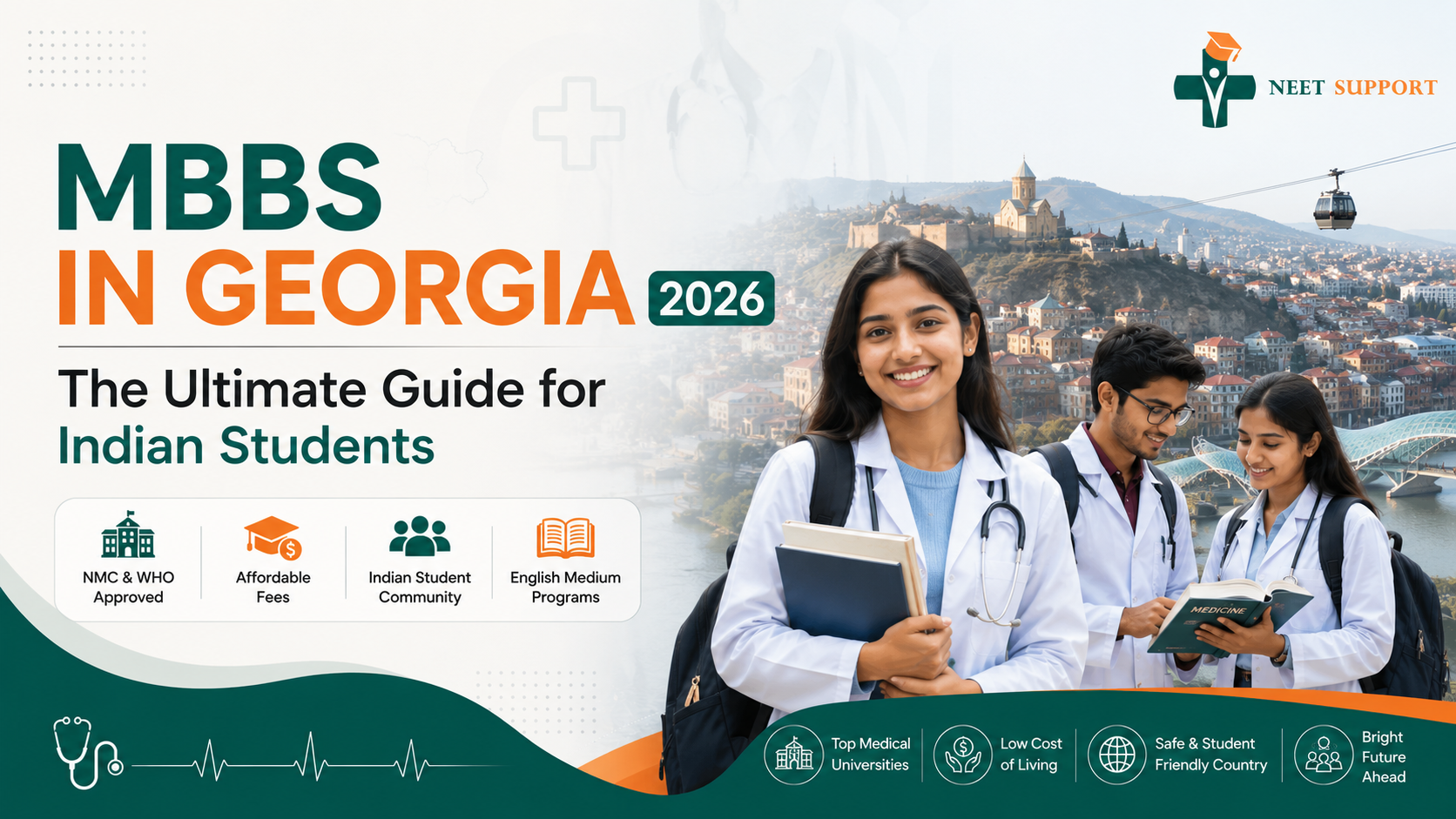
MBBS in Georgia 2026: The Ultimate Guide For Indian Students
MBBS in Georgia 2026 is becoming a popular option for Indian students due to affordable fees, English-medium education, and NMC-recognised universities. This guide covers eligibility, costs, admission process, NEXT/FMGE reality, and top Georgian medical universities.
Introduction
Every year, thousands of Indian students who clear NEET but miss a government medical seat face the same crossroads. Private medical colleges in India are expensive — often ₹60–80 lakh for the full course. Ukraine closed as an option in 2022. China has restrictions. The Philippines has a different structure. And then there is Georgia — a small country in the South Caucasus that has quietly become one of the most popular MBBS destinations for Indian students.
But the real question is not just "Can I study MBBS in Georgia?" The real question is: Is MBBS in Georgia a smart decision for your specific situation in 2026?
This guide does not just sell you on the dream. It gives you the honest picture — the costs, the universities, the recognition status, the clinical training realities, the FMGE and NEXT challenges, and the career outcomes — so you can make a decision you will not regret five years from now.
Why Indian Students Are Choosing Georgia for MBBS
Georgia has seen a dramatic rise in Indian medical students over the past decade, and the reasons go beyond just affordability.
English-medium instruction is one of the biggest draws. Unlike Russia, Kyrgyzstan, or Kazakhstan — where clinical rotations often happen in the local language — Georgian medical universities teach the entire MBBS curriculum in English. For Indian students, this means no language barrier in lectures or practicals.
NMC recognition is another key factor. Several Georgian medical universities are listed on the World Directory of Medical Schools (WDOMS), which is the benchmark used by India's National Medical Commission (NMC) for recognising foreign medical degrees. Without this listing, a degree is practically unusable in India. Most reputable Georgian universities clear this requirement.
Affordable total cost compared to Indian private colleges is also a major attraction. When you factor in tuition, hostel, food, and travel over six years, the total expenditure for MBBS in Georgia typically falls between ₹25–40 lakh — significantly lower than the ₹60–80 lakh demanded by many Indian private institutions.
European academic standards add further appeal. Georgia is part of the Bologna Process, meaning its medical degrees are structured in line with European higher education frameworks. This gives the degree a degree of international credibility that some other low-cost destinations cannot offer.
Finally, safety and a student-friendly environment matter. Georgia ranks consistently well on global peace indices and has a growing Indian student community, which makes the transition easier for first-time travellers from India.
Is an MBBS in Georgia Valid in India? The NMC, FMGE, and NEXT Reality
This is the most important section you will read, and it needs to be answered carefully.
NMC Recognition
The National Medical Commission of India does not maintain a list of "approved" foreign universities in the traditional sense. Instead, it requires that the university be listed on the World Directory of Medical Schools (WDOMS), co-managed by the WHO and the World Federation for Medical Education. Most established Georgian medical universities — including Tbilisi State Medical University, David Tvildiani Medical University (AIETI), and New Vision University — are listed on WDOMS, making their degrees eligible for recognition in India.
Important: Before you enrol in any Georgian university, verify its current WDOMS listing yourself at wdoms.org. This status can change, and you should not rely solely on what a consultancy tells you.
The Screening Test Requirement
To practice medicine in India after completing MBBS abroad, you must pass a screening examination. Until 2024, this was the Foreign Medical Graduate Examination (FMGE), conducted by the National Board of Examinations (NBE). From 2025 onwards, the NMC is phasing in the NEXT (National Exit Test), which will serve as the common licensing exam for both Indian and foreign graduates.
This is a significant shift. FMGE was already challenging — pass rates historically hovered around 15–20% per attempt, though top Georgian universities with structured preparation programmes have reported higher rates for their graduates. NEXT is expected to be equally rigorous. The clinical exposure during your MBBS abroad will directly impact how well you are prepared for this exam.
The Clinical Exposure Gap
Here is the honest part that many consultancies skip. Georgia is a small country with a healthcare system that, while improving, does not expose students to the same volume and variety of patients that a government hospital in India would. If your university's clinical rotations are well-structured and hospital-affiliated, you will gain good foundational exposure. But some students return to India underprepared for the depth of clinical questions in NEXT.
This is not a reason to avoid Georgia — it is a reason to choose your university very carefully and to plan for additional NEXT preparation after returning.
MBBS in Georgia: Fees and Total Cost in 2026
One of the most searched questions about MBBS in Georgia is the fee structure. Here is a realistic breakdown.
Tuition Fees (Per Year)
Tuition fees across Georgian medical universities vary depending on the institution's ranking, infrastructure, and reputation. As of 2026:
- Top-tier universities (e.g., Tbilisi State Medical University, David Tvildiani Medical University): USD 5,000–8,000 per year
- Mid-tier universities: USD 4,000–6,000 per year
- Budget universities: USD 3,000–4,500 per year
The MBBS programme in Georgia is typically 6 years (including a one-year internship in some cases, or 5 years plus a mandatory clinical year).
Total Cost Estimation (6 Years)
| Expense | Approximate Cost (INR) |
|---|---|
| Tuition fees (6 years) | ₹15–30 lakh |
| Hostel/accommodation | ₹4–7 lakh |
| Food and daily expenses | ₹4–6 lakh |
| Travel (flights, visa, etc.) | ₹1–2 lakh |
| Books, equipment, misc. | ₹1–2 lakh |
| Total estimate | ₹25–47 lakh |
This total is significantly lower than the cost of a private MBBS in India. However, you must also factor in the post-return cost of NEXT coaching, which many students pursue for 6–12 months after completing their degree.
Hidden Costs to Be Aware Of
- Some universities charge a separate registration or documentation fee at the time of admission.
- NMC eligibility certificate applications and attestation of documents have their own costs.
- Exchange rate fluctuations between INR and USD/GEL (Georgian Lari) can affect your total expenditure.
- Travel home during summer and winter breaks is an expense many students underestimate.
Top Medical Universities in Georgia for Indian Students
Not all Georgian medical universities are equal. Here are the most established and widely recognised institutions for Indian students in 2026.
| University | Established | WDOMS Listed | Annual Fees (USD) | Key Strength | Best For |
|---|---|---|---|---|---|
| Tbilisi State Medical University (TSMU) | 1918 | Yes | 6,000–8,000 | Oldest and most prestigious; multiple hospital affiliations in Tbilisi; long track record with international students | Students who want the highest-reputation Georgian degree and can handle competitive admission |
| David Tvildiani Medical University (AIETI Medical School) | 1990 | Yes | 5,500–7,000 | Dedicated international student support; structured FMGE/NEXT preparation culture; strong reputation among Indian graduates | Indian students who want structured support and a proven pathway to clearing NEXT |
| New Vision University | 2013 | Yes | 5,000–6,500 | Modern simulation labs; European-style pedagogy; growing hospital affiliations | Students who prefer a contemporary academic environment with modern facilities |
| University of Georgia (Medical Faculty) | 2004 | Yes | 4,500–6,000 | European-trained faculty; strong private university infrastructure | Students who want a balance of reputation and cost with a modern campus |
| Geomedi Medical University | 2000 | Yes | 4,000–5,500 | Own teaching hospital — the key differentiator; strong practical clinical training focus | Students for whom clinical exposure during the degree is the top priority |
| East European University | 2012 | Yes* | 3,500–5,000 | Budget-friendly; English-medium; growing Indian student community | Cost-conscious students — but verify current WDOMS status independently before enrolling |
*Verify current listing at wdoms.org before enrolling. Recognition status can change.
Important: Always confirm WDOMS listing and NMC eligibility directly and independently — do not rely solely on university marketing material or consultancy claims.
Eligibility Criteria for Indian Students
To be eligible for MBBS admission in Georgia, Indian students must meet the following criteria:
- Age: Minimum 17 years at the time of admission (as per NMC guidelines)
- Academic qualification: 10+2 with Physics, Chemistry, and Biology as mandatory subjects
- Minimum marks: 50% aggregate in PCB for the general category; 40% for SC/ST/OBC (as per NMC norms)
- NEET qualification: This is mandatory. As per the NMC's Regulations on Graduate Medical Education (Amendment) 2021, Indian students must have a valid NEET score to be eligible to study MBBS abroad and subsequently return to practice in India. There is no NEET cutoff for studying abroad, but the exam must be cleared.
- English proficiency: Since instruction is in English, no separate test like IELTS or TOEFL is typically required, though some universities may ask for a basic language assessment.
Admission Process: Step by Step
The admission process for MBBS in Georgia is relatively straightforward compared to some other countries. Here is how it typically works for Indian students:
Step 1 — Clear NEET: Ensure your NEET score is valid (within the applicable year). This is a non-negotiable requirement.
Step 2 — Research and shortlist universities: Based on recognition status, fees, clinical exposure, and your budget, prepare a shortlist of 2–3 universities.
Step 3 — Submit application: Most Georgian universities accept direct online applications. You will need to submit your 10th and 12th mark sheets, NEET scorecard, passport copy, and passport-size photographs.
Step 4 — Receive offer letter: Universities typically process applications within 1–4 weeks. An offer/admission letter will be sent on acceptance.
Step 5 — Apply for a student visa: With the offer letter, apply for a Georgian student visa at the Georgian embassy or consulate in India. Georgia has a relatively simple visa process for Indian students.
Step 6 — Pay initial fees and confirm enrollment: Pay the first year's tuition and any registration fees as required by the university to confirm your seat.
Step 7 — Travel and registration: Arrive in Georgia, complete university registration formalities, and begin the orientation and academic session.
Step 8 — NMC eligibility certificate: Within 30 days of enrollment, the university typically helps students apply for the NMC Eligibility Certificate — a requirement for Indian students studying MBBS abroad.
Living in Georgia: Accommodation, Food, and Safety
Accommodation
Most Georgian medical universities offer on-campus or university-arranged hostel facilities for international students. Monthly hostel costs typically range from USD 100–250 (approximately ₹8,000–20,000 per month), depending on the university and room type. Some students prefer renting private apartments with flatmates in Tbilisi, which can be cost-effective at USD 200–350 per month for a shared apartment.
Food
Georgia has a rich and varied cuisine, with many affordable dining options. A full meal at a local restaurant costs USD 3–6. Cooking at home is even more economical. Indian students often form communities and prepare Indian food together, and Indian grocery items are increasingly available in Tbilisi's international grocery stores. Monthly food expenses typically range from USD 150 to 250.
Safety
Georgia is consistently ranked as one of the safer countries in the Eastern European and Caucasian region. Tbilisi, the capital where most medical universities are located, is a modern city with a low violent crime rate. Indian students generally report feeling safe. However, as in any foreign country, standard precautions apply — especially at night and in unfamiliar areas.
Climate
Georgia has a temperate climate with four distinct seasons. Winters can be cold (0–5°C in Tbilisi), and students from warmer Indian cities may need time to adjust. Summers are warm and pleasant, making it a comfortable country for most of the year.
Advantages and Disadvantages of MBBS in Georgia
Advantages
- Affordable compared to Indian private colleges: The total cost of MBBS in Georgia is often 30–50% lower than private medical colleges in India.
- English-medium teaching: No language barrier during lectures, which is a significant advantage over many other MBBS-abroad destinations.
- NMC-recognised universities: Most established Georgian universities are WDOMS-listed, making the degree valid for practice in India after clearing NEXT.
- European academic framework: Georgia follows the Bologna Process, adding an element of international credibility.
- Relatively quick and simple admission: No entrance test beyond NEET; the admission process is less bureaucratic than in some other countries.
- Growing Indian student community: A supportive peer network helps with cultural adjustment.
Disadvantages
- Clinical exposure limitations: Georgia's smaller healthcare system means students may see fewer complex or diverse cases than they would in India's government hospitals. This is the most significant academic concern.
- NEXT is not guaranteed: Even after completing MBBS in Georgia, you must pass NEXT to practice in India. Many students underestimate the preparation required.
- Quality varies significantly between universities: Not all Georgian universities offer the same standard of education or clinical training. Choosing the wrong university based on low fees alone can have long-term consequences.
- Distance and cultural adjustment: Georgia is not a neighbouring country. Homesickness, cultural differences, and being far from family can affect academic performance.
- Language in daily life: While university instruction is in English, daily life — shops, public transport, government offices — operates in Georgian. Some local hospital staff may not speak English fluently, which can affect the quality of clinical interactions during rotations.
- Post-return coaching cost: Almost all returning foreign medical graduates invest in 6–12 months of dedicated NEXT preparation, which adds ₹2–5 lakh to the total cost.
FMGE, NEXT, and Career Outcomes
The FMGE/NEXT Challenge
The Foreign Medical Graduate Examination (FMGE) has historically been the biggest challenge for students returning from abroad. With pass rates that have averaged 15–20% nationally, it reflects the difficulty of bridging the gap between foreign MBBS training and the standards required for Indian medical practice.
NEXT, which began phased implementation in 2025, is a more comprehensive exam — covering both theoretical knowledge and clinical skills — and is designed to create a common standard for all medical graduates, domestic and foreign. Early indicators suggest it will be at least as challenging as FMGE for students who have not had rigorous clinical preparation.
Students who complete MBBS in Georgia at reputed universities with structured clinical training, and who invest seriously in NEXT preparation on their return, have managed to clear the exam within the first or second attempt. Students who choose budget universities primarily for lower fees and do not invest in post-return preparation tend to struggle significantly.
Career Pathways After NEXT
Once you clear NEXT and receive your registration, the career pathways are the same as any MBBS graduate in India:
- General practice/clinic setup
- PG entrance preparation (INI-CET, NEET-PG)
- Government hospital jobs
- Public health and the NGO sector
- Postgraduate medical education in India or abroad
MBBS from Georgia does not disqualify you from any of these paths — as long as you have cleared NEXT.
MBBS in Georgia vs Other Countries: A Quick Comparison
| Parameter | Georgia | Russia | Philippines | Ukraine (pre-2022) | India (Private) |
|---|---|---|---|---|---|
| Total cost (approx.) | ₹25–47 lakh | ₹25–40 lakh | ₹35–55 lakh | ₹20–35 lakh | ₹60–80 lakh |
| Medium of instruction | English | Mixed (Russian in clinics) | English | Mixed | English |
| NMC recognition | Yes (major universities) | Yes (major universities) | Yes (major colleges) | Disrupted (conflict) | Automatic |
| Clinical exposure | Moderate | Moderate–Good | Moderate | Moderate | High |
| NEXT requirement | Yes | Yes | Yes | Yes | Yes |
| Safety (2026) | High | Moderate | High | Disrupted | High |
FAQs
Is MBBS in Georgia recognised by the NMC (National Medical Commission) of India?
Yes — but only for universities listed on the World Directory of Medical Schools (WDOMS). You must verify this independently before enrolling. Completing MBBS from a WDOMS-listed Georgian university makes you eligible to appear for NEXT and practice in India after clearing it.
Is NEET mandatory for MBBS in Georgia?
Yes. As per the NMC's amended regulations, Indian students must have a valid NEET qualification to study MBBS abroad and to apply for the NMC Eligibility Certificate. There is no minimum NEET score for admission to Georgian universities, but the exam must be passed.
Can I do PG (MD/MS) in India after MBBS from Georgia?
Yes — once you clear NEXT and obtain your registration in India, you are eligible to appear for postgraduate entrance exams like NEET-PG and INI-CET.
What is the FMGE/NEXT pass rate for Georgian university graduates?
This varies significantly between universities. Nationally, FMGE pass rates for foreign graduates have been 15–20%. Students from well-structured Georgian programmes who also invest in dedicated NEXT coaching tend to perform better. Ask specific universities for their graduates' pass rate data before enrolling.
Can I apply to Georgian universities without a consultancy?
Yes. Most universities accept direct applications through their official websites. However, a reliable consultancy can help with document verification, visa guidance, and university selection — provided you verify their claims independently.
Conclusion
Georgia is a genuinely good option for Indian students who cannot afford Indian private medical college fees, have cleared NEET, and are realistic about the journey ahead. It is not a shortcut. You will need to work hard through a 5–6 year degree, manage clinical exposure proactively, return to India and invest 6–12 months in serious NEXT preparation, and then clear a competitive licensing exam before you can practice.
But for a student who approaches it with clear eyes, chooses a WDOMS-listed university carefully, engages seriously with their clinical training, and prepares diligently for NEXT — MBBS from Georgia is a legitimate, cost-effective path to becoming a doctor in India. The students who struggle are those who chose the cheapest university without checking recognition status, expected the degree to automatically translate into a career, and underestimated NEXT. Do not be that student.
Research thoroughly. Verify independently. Choose wisely. And go in prepared.