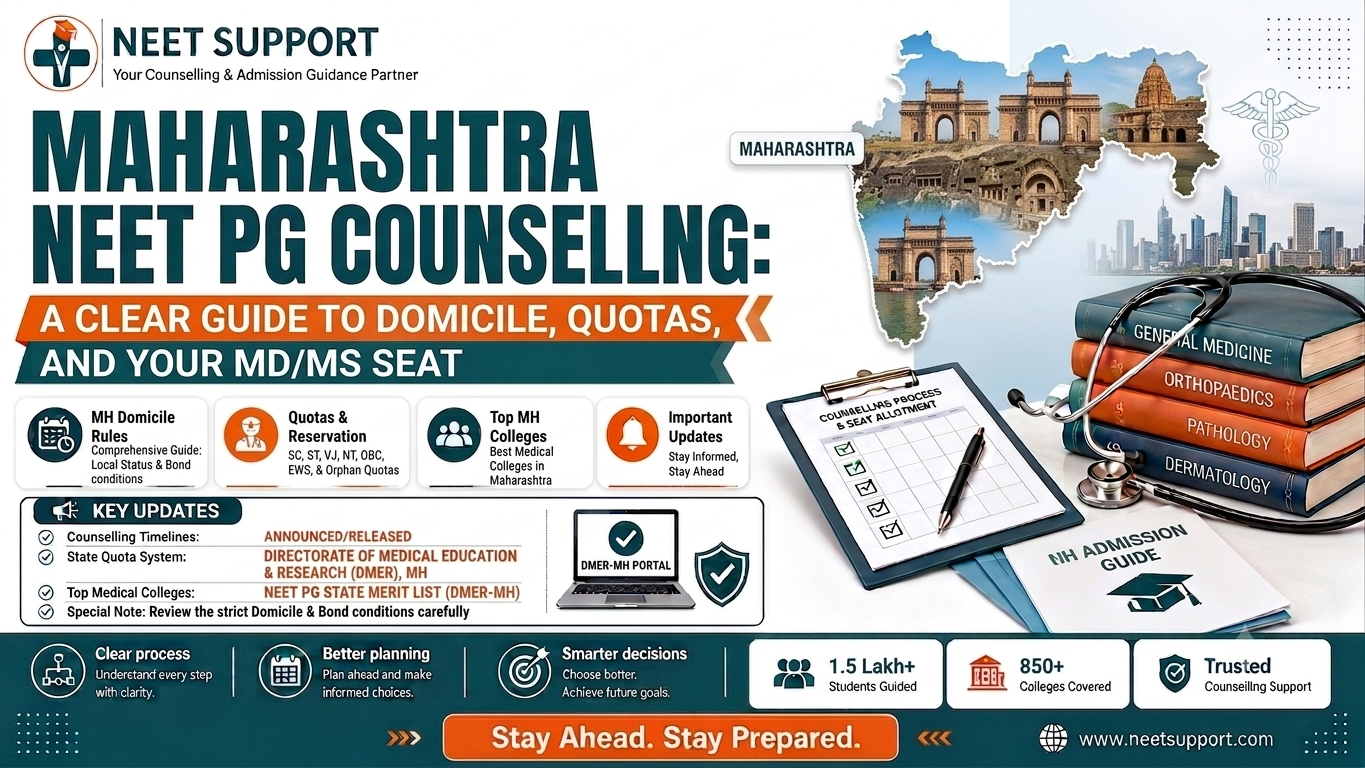
Maharashtra NEET PG Counselling: A Clear Guide To Domicile, Quotas, And Your MD/MS Seat
Nishat
 WhatsApp
 Email
 Facebook
 Twitter/X
 LinkedIn
Table of Contents
Predict Your Rank Now
Enter your NEET score to get an estimated rank
Find the Best Colleges For You
Based on your NEET rank, Category & more

Get Your Dream Medical College
Secure your seat with expert counselling
Introduction
Here's something that's been quietly unsettling Maharashtra's PG counselling landscape: the Supreme Court has held that residence-based reservation in NEET PG seats is unconstitutional, ruling that state quota seats should be filled on merit rather than domicile, with only a "reasonable number" of institution-based reservations permitted going forward. For a state like Maharashtra — which has built one of the country's most domicile-dependent counselling systems, locking non-domiciled candidates almost entirely out of its subsidised 85% seat pool — that ruling isn't a footnote. It's a live question mark hanging over how this year's counselling might actually run.
This guide covers Maharashtra's PG counselling as it has historically worked, flags exactly where this ruling could change things, and tells you what's worth double-checking before you build your strategy around assumptions from a previous cycle.
Who Runs This, And Where To Check?
The State Common Entrance Test Cell, Maharashtra (CET Cell), functioning under the Directorate of Medical Education and Research (DMER), conducts PG counselling for MD, MS, and PG Diploma seats. The official portal is cetcell.mahacet.org, alongside a cycle-specific NEET-PGM admission subdomain that changes each year — so don't bookmark a specific portal URL from a past cycle; navigate through the main CET Cell site instead.
With upwards of 5,700 PG seats across government and private colleges, Maharashtra runs one of the largest PG seat banks in the country — Grant Medical College, Mumbai, and B.J. Medical College, Pune sit among its most competitive names, alongside a substantial private sector including DY Patil and several others.
Maharashtra NEET PG 2026 Timeline
Maharashtra is a "closed state", meaning only Maharashtra-domicile candidates can compete for the 85% state quota (non-domicile candidates are limited to 15% AIQ or management/NRI seats). Counselling is run by MUHS (Nashik) through the State CET Cell, and PG counselling is expected to begin around November 2026, after the NEET PG 2026 exam (held Aug 30) and result.
| Stage | Tentative timing |
|---|---|
| NEET PG 2026 exam | Aug 30, 2026 (held) |
| Result declaration | Expected mid-Sept 2026 |
| Maharashtra PG merit list | Expected Oct 2026 |
| Registration & document verification | Expected late Oct 2026 |
| Round 1 – choice filling & allotment | Expected November 2026 |
| Round 2 – choice filling & allotment | Expected December 2026 |
| Mop-up round | Expected January 2027 |
| Stray vacancy round | Expected February 2027 |
Maharashtra's NEET PG counselling is a state-run CAP (Centralized Admission Process) covering roughly 10,000+ government and private MD/MS/PG Diploma seats. Because the state quota is closed to non-domiciles, the process leans heavily on domicile verification during document checks, so out-of-state candidates should plan around AIQ (via MCC) or management/NRI quota routes instead. As with Andhra Pradesh, the official 2026 schedule hasn't been notified yet — this is based on the exam date and how last year's cycle unfolded — so keep an eye on cetcell.mahacet.org for the real dates once released.
The "Closed State" Model: Maharashtra's Defining Feature
This is the single most important thing to understand before anything else. Maharashtra runs what's informally called a "closed state" system — unlike open states such as Karnataka or Uttar Pradesh, where outside candidates can freely compete for standard private seats, Maharashtra restricts its subsidised 85% state quota pool entirely to domicile holders. Non-domiciled candidates, however strong their NEET PG score, cannot touch it.
| Seat Pool | Who's Eligible | Approximate Share |
|---|---|---|
| All India Quota | Any NEET PG qualified candidate, no domicile needed | ~15–20% of government seats |
| State Quota (Government + Private) | Maharashtra domicile holders only | ~50% of total seats |
| Institutional Quota | Open to all India, including NRI/OCI, on pure merit | ~15–35% of private college seats |
The practical consequence: a modest-scoring domiciled candidate can still land a heavily subsidised state quota seat, while a strong-scoring outsider is pushed entirely into the pricier Institutional Quota. This is exactly the mechanism the Supreme Court ruling is putting pressure on — if domicile-based reservation genuinely can't survive as currently structured, this entire table could look different by the time your counselling cycle opens. Track CET Cell's notifications specifically for this.
Three Ways To Establish Maharashtra Domicile
Historically, eligibility for state quota has run through one of three routes:
- Type A — Completed both Class 10 and Class 12 from a school in Maharashtra.
- Type B — Completed Class 12 in Maharashtra, with a parent holding Maharashtra domicile.
- Type C — Completed Class 10 and 12 in Maharashtra, with a parent in central government service posted within the state.
If your situation doesn't cleanly fit one of these three, it's worth getting a direct ruling from CET Cell before you build your entire counselling strategy around an assumption.
The In-Service Doctor Advantage — And Its Real Weight
Roughly 20% of state quota government college seats are reserved specifically for in-service doctors — those currently working in rural or tribal government postings. It's not just a reserved seat pool either: these candidates receive incentive marks added to their merit based on years and location of service, and are allotted seats before non-incentive candidates are considered for the remaining pool.
If you're weighing whether a rural posting is worth it purely from an admissions angle, this is genuinely one of the more consequential trade-offs in the state's system — a few years of rural service can meaningfully outweigh a modest NEET PG score gap.
The Fee Detail Almost Nobody Explains Properly
Here's something genuinely unusual to Maharashtra that's worth knowing if you're comparing colleges: private college fees for the same seat can differ by category, even within state quota. It's common to see something like an OPEN category candidate paying roughly ₹12 lakh a year at a given private college, while an OBC candidate at that same college, same seat type, pays closer to ₹5 lakh — the category-based differential applies specifically to state quota seats. Institutional Quota seats, by contrast, carry no such differential — everyone pays the same higher rate there, category or no category, since no reservation applies to that pool at all.
This means two candidates from the same college and course can be looking at wildly different total costs purely based on category, and that's worth factoring into any private-college comparison you're doing rather than assuming a college has one flat fee.
Registration Fees And Security Deposit
| Item | Amount |
|---|---|
| Registration Fee | ₹3,000 (non-refundable) |
| Security Deposit | Payable alongside registration; amount varies by quota — confirm current figure at registration |
Both are paid online during the application window, and as with virtually every state counselling system, treat the registration fee as gone the moment you pay it.
How Does the Process Run?
- Register online through CET Cell's portal with NEET PG credentials.
- Pay the registration fee and security deposit.
- Upload and verify documents — scorecard, internship certificate, domicile proof (where claiming state quota), category certificate.
- Merit list published, based on NEET PG rank, domicile status, and category.
- Fill and lock choices against the published seat matrix.
- Seat allotment released per round.
- Report to the allotted institute with originals — this is the one step in an otherwise fully online process that requires physical presence.
Expect four or more CAP rounds — Round 1, Round 2, Mop-Up, and Stray Vacancy — with upgradation options available for candidates unsatisfied with an early allotment.
Documents Worth Having Ready
- NEET PG scorecard and admit card
- MBBS degree and internship completion certificate
- Maharashtra domicile certificate, matching your specific Type A/B/C route
- Category certificate, where claiming reservation
- NRI/OCI sponsorship and passport documents, specifically for Institutional Quota NRI applicants
- Photo ID and recent photographs
What To Actually Watch For This Cycle?
Given the live legal uncertainty around domicile-based reservation, treat this cycle with a bit more caution than usual. Specifically:
- Check whether CET Cell has issued any revised notification addressing how state quota eligibility will be determined this year, given the Supreme Court's position.
- Don't assume your Type A/B/C domicile route guarantees the same seat pool access it has in previous years — verify against the current notification rather than last year's structure.
- If you're a non-domicile candidate who's historically been restricted to Institutional Quota, it's worth watching whether this ruling opens up any part of the state quota pool this cycle — this is exactly the kind of change worth checking for actively rather than assuming continuity.
FAQs
Can I apply for Maharashtra PG state quota without Maharashtra domicile?
Historically, no — state quota has been restricted to domicile holders, though a recent Supreme Court ruling against domicile-based reservation could affect this; check CET Cell's current notification before assuming either way.
What are the three types of Maharashtra domicile for PG counselling?
Type A (Class 10 and 12 in Maharashtra), Type B (Class 12 in Maharashtra plus a domiciled parent), and Type C (Class 10 and 12 in Maharashtra plus a parent in central government service posted in-state).
What is Institutional Quota in Maharashtra PG counselling?
It's a merit-only seat pool in private colleges, open to candidates from anywhere in India including NRI/OCI applicants, with no domicile requirement and no category reservation.
Why do private colleges in Maharashtra charge different fees for the same seat?
State quota seats at private colleges apply a category-based fee differential — an OPEN category candidate can pay considerably more than an OBC or SC candidate for the same seat; Institutional Quota seats don't have this differential.
What is the in-service doctor quota in Maharashtra PG counselling?
Roughly 20% of state quota government seats are reserved for doctors serving rural or tribal government postings, who also receive incentive marks added to their NEET PG merit.
Is document verification done online or in person?
The process is fully online except for physical reporting and document verification at the allotted institute after seat confirmation.
Does AIQ counselling in Maharashtra require domicile?
No, All India Quota seats are open to any NEET PG qualified candidate nationwide, with no domicile restriction, since this portion is conducted by MCC.
How many total PG medical seats does Maharashtra offer?
Upwards of 5,700 seats across government and private medical colleges, making it one of the largest PG seat banks in the country.
Bringing It Together
Maharashtra's PG counselling has long run on a genuinely distinctive closed-state model — 85% of seats reserved for domicile holders through one of three defined routes, a 20% in-service carve-out with real merit incentives attached, and a category-based fee differential at private colleges that most guides don't explain clearly. All of that structure is now sitting under a live Supreme Court ruling that could reshape how domicile factors into this year's counselling. Track CET Cell's notifications closely, verify your domicile route explicitly, and don't assume this cycle mirrors the last one until the official notification confirms it does.
Reviews
No reviews yet. Be the first to write one!