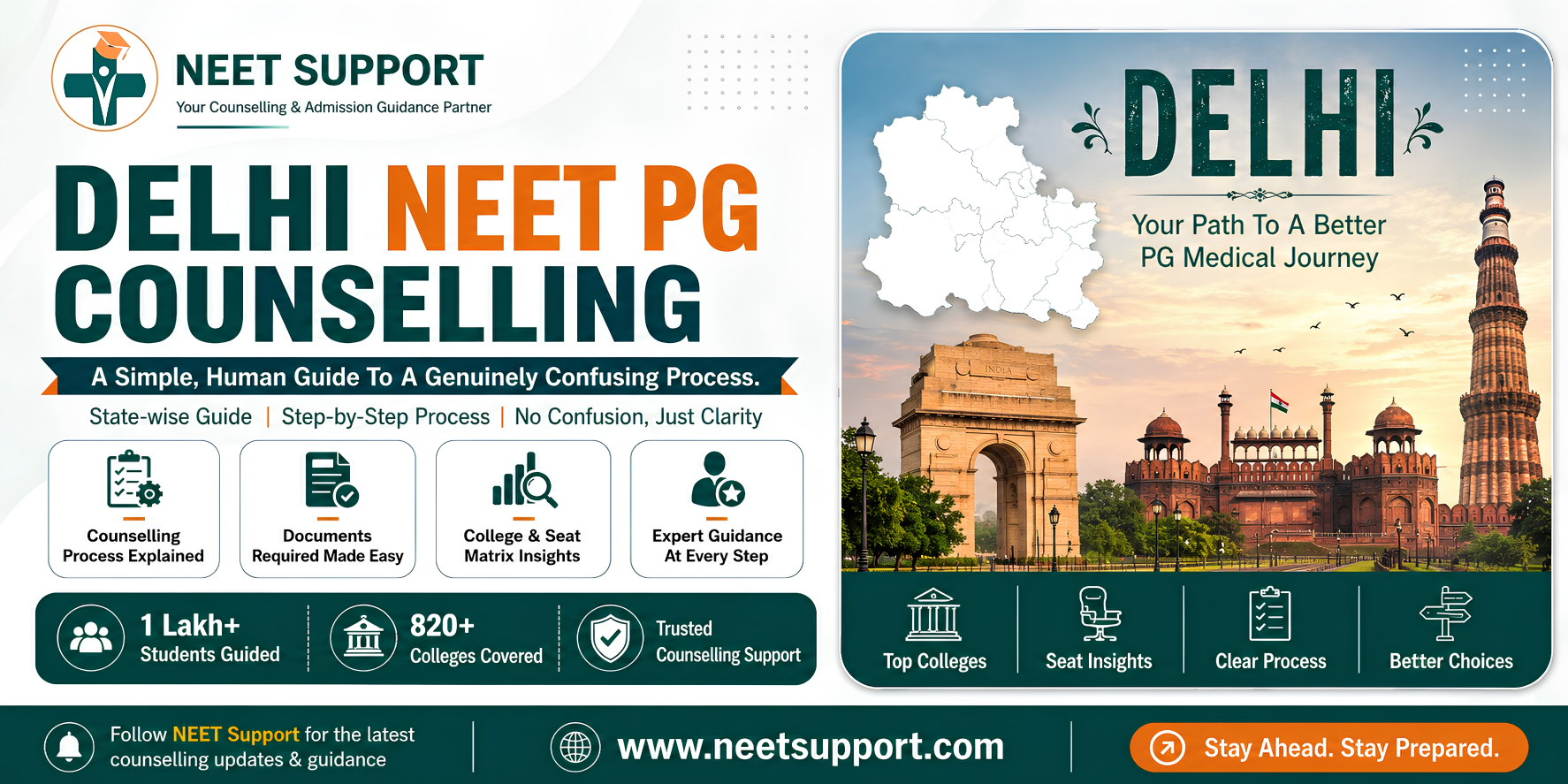
Delhi NEET PG Counselling: A Simple, Human Guide To A Genuinely Confusing Process
Nishat
 WhatsApp
 Email
Email Facebook
 Twitter/X
 LinkedIn
Table of Contents
Predict Your Rank Now
Enter your NEET score to get an estimated rank
Find the Best Colleges For You
Based on your NEET rank, Category & more

Get Your Dream Medical College
Secure your seat with expert counselling
Introduction
Ask anyone who's been through Delhi's NEET PG counselling, and they'll probably laugh a little before answering. Not because it's impossible, but because it's just... more layered than most people expect walking in. Different authorities, different quotas, different portals — and somewhere in the middle of all that, a candidate just trying to figure out where their MD or MS seat is actually going to come from.
This guide is meant to make that a lot less confusing. No jargon dumps, no assuming you already know what "institutional quota" means — just a clear, honest walkthrough of how Delhi's postgraduate medical counselling actually works, who runs which part of it, and what to keep in mind as you go through the process yourself.
Delhi has a unique significance when it comes to medical education in India. The remarkable Maulana Azad Medical College and the Lady Hardinge Medical College have produced numerous successful doctors in the past. Today, it is acknowledged that once a student obtains a PG degree from these colleges, it serves as an immense accomplishment during future job searches. Therefore, it is important to study the application and admissions process and understand it well, rather than just relying on the information found on internet forums.
Why Delhi's PG Counselling Feels More Complicated Than Other States?
Most states run postgraduate medical counselling through a single, central authority. Delhi doesn't quite work that way, and that's really the root of most of the confusion.
Postgraduate MD, MS, PG Diploma, and MDS seats in Delhi's government medical colleges are split across two parallel counselling systems. Half the seats — the 50% All India Quota — are filled through the Medical Counselling Committee (MCC), the same national body that runs AIQ counselling for every other state. The other half — the 50% Delhi/University Quota — is handled separately by the Faculty of Medical Sciences, University of Delhi (FMSC), through its own dedicated portal, fmsc.ac.in.
So right from the start, a Delhi PG aspirant is really dealing with two different processes, two different registrations, and two different timelines, even though both are ultimately competing for seats in the same set of colleges.
Which Colleges Actually Fall Under This Counselling?
Delhi's PG medical education network is built around a handful of well-established government institutions, and knowing which ones fall under FMSC's counselling versus other routes helps avoid a lot of early confusion.
| College | Counselling Route |
|---|---|
| Maulana Azad Medical College (MAMC) | FMSC (Delhi Quota) + MCC (AIQ) |
| Lady Hardinge Medical College (LHMC) | FMSC (Delhi Quota) + MCC (AIQ) |
| University College of Medical Sciences (UCMS) | FMSC (Delhi Quota) + MCC (AIQ) |
| Vardhman Mahavir Medical College (VMMC) & Safdarjung Hospital | MCC (100% counselling) |
| Atal Bihari Vajpayee Institute of Medical Sciences (ABVIMS) & Dr. RML Hospital | MCC (100% counselling) |
| ESIC Medical College, PGIMSR, Basaidarapur | MCC (both AIQ and State Quota) |
Worth noting straightaway — AIIMS Delhi and other central institutes run entirely separate admission processes of their own, outside both MCC's Delhi-specific counselling and FMSC's process. If AIIMS is on your list, that's a different application altogether.
Understanding The Two Counselling Tracks
The 50% All India Quota (MCC)
This portion works exactly like AIQ counselling everywhere else in the country. Candidates register centrally on mcc.nic.in, fill their choices, and get allotted based on their NEET PG rank, open to candidates from anywhere in India, regardless of Delhi domicile.
The 50% Delhi/University Quota (FMSC)
This is where Delhi's process genuinely differs from most other states. The remaining half of the seats — often referred to as the Delhi Quota or University Quota — is filled through FMSC's own, independently run counselling, based on its own registration, its own merit list, and its own choice-filling and allotment schedule. This portion also includes what's sometimes called the Institutional Quota, which has its own specific eligibility rules tied to service or academic history within Delhi's medical institutions, and candidates should check carefully whether they actually qualify for it before assuming eligibility.
Registering with MCC does not automatically register a candidate with FMSC, and the reverse is equally true. If a candidate wants to be considered for both tracks, both registrations need to be completed independently, on their respective official portals.
A Quick Side-By-Side Comparison
| Aspect | MCC (AIQ) | FMSC (Delhi Quota) |
|---|---|---|
| Seats Covered | 50% AIQ across participating colleges | 50% Delhi/University Quota, including Institutional Quota |
| Official Portal | mcc.nic.in | fmsc.ac.in |
| Eligible Candidates | Any NEET PG qualified candidate, nationwide | Primarily Delhi-linked candidates, subject to FMSC's own eligibility rules |
| Registration | Independent, separate from FMSC | Independent, separate from MCC |
| Merit List & Allotment | Managed by MCC | Managed by FMSC |
What The Process Generally Looks Like On FMSC's Side?
Since FMSC's process tends to be the part candidates are less familiar with, it's worth breaking down what it typically involves, step by step:
- Registration and fee payment — Candidates register on fmsc.ac.in and pay the counselling fee to begin the process.
- Document verification — Submitted documents are checked against FMSC's requirements before a candidate is confirmed as eligible to participate further.
- Choice filling and locking — Candidates select their preferred colleges and courses in order of preference, and lock these choices before the deadline.
- Seat allotment — Based on NEET PG rank, category, and the choices filled, FMSC releases its own allotment result.
- Reporting at the institute — Allotted candidates report to their assigned college with original documents to confirm admission.
Each of these stages runs on its own specific dates for every counselling cycle, and FMSC releases its own Information Bulletin ahead of each session laying out exact timelines — this is genuinely the document worth reading in full, rather than relying on a general sense of "how it usually works."
Documents You'll Likely Need
While the exact list should always be confirmed against FMSC's official bulletin for the current cycle, candidates going through Delhi PG counselling typically need to keep the following ready:
- NEET PG scorecard and admit card
- MBBS degree certificate and internship completion certificate
- Permanent registration with the State Medical Council or NMC
- Delhi domicile certificate, where relevant to the quota being claimed
- Category certificate, if applying under a reserved category
- Valid photo identification and recent passport-size photographs
- Any additional certificates specified in the bulletin, such as those relevant to Institutional Quota eligibility
Getting these ready well before registration opens — rather than scrambling once dates are announced — genuinely makes the rest of the process smoother.
A Few Things Worth Knowing Before You Begin
Delhi has introduced a one-year compulsory service bond for both UG and PG medical students admitted through AIQ and State Quota routes at its government institutions, requiring service in a GNCT of Delhi medical institution for a year after completing the course, including internship. This is a genuinely important commitment to factor into your decision, not a minor administrative footnote.
Freeze and float rules matter here too, much like they do in most PG counselling systems — once a seat is allotted and confirmed in a round, a candidate needs to decide whether to freeze it (locking it in and exiting further rounds) or float it (staying eligible for a better option in the next round while holding onto the current seat as a fallback, depending on the specific rules of that cycle).
And perhaps most importantly — because two separate authorities are involved, a candidate genuinely needs to track two separate sets of deadlines simultaneously. Missing an FMSC registration window because attention was focused entirely on the MCC portal, or vice versa, is one of the most avoidable mistakes in this entire process.
Common Mistakes Candidates Make During This Process
A handful of recurring issues tend to trip up candidates in Delhi's PG counselling more than anything else, and most of them come down to simple oversight rather than any real complexity.
Assuming one registration covers both tracks is probably the single most common mistake — candidates sometimes register on MCC, get comfortable with the process, and only realise weeks later that FMSC required a completely separate application they never submitted.
Underestimating document verification timelines is another frequent issue. Both MCC and FMSC treat document verification as a genuine checkpoint, not a formality, and incomplete or mismatched documentation at this stage can hold up a candidate's participation in choice filling even if their rank and eligibility are otherwise solid.
Confusing eligibility for the Institutional Quota with general Delhi Quota eligibility is a subtler but equally common trap. These aren't interchangeable categories, and assuming eligibility for one because you qualify for the other can lead to a rejected or flagged application late in the process, when there's little time left to correct it.
Finally, treating the service bond as a minor detail rather than a genuine multi-year commitment is something candidates sometimes regret only after admission. It's worth factoring this into the decision at the very start, not after a seat has already been accepted.
Where To Check For Official Updates?
Given how much confusion tends to circulate around Delhi's counselling every year, sticking to verified sources really does matter here:
- mcc. nic.in — for All India Quota registration, schedule, and allotment
- fmsc.ac.in — for Delhi/University Quota registration, schedule, and allotment
- Directorate General of Health Services (DGHS), Delhi — for broader policy notices affecting Delhi's medical education landscape
Third-party pages and forwarded messages can be useful for quick summaries, but any date, fee, or eligibility detail that actually matters to your application should be cross-checked against one of these three sources directly.
FAQs
Who Conducts Delhi's NEET PG Counselling?
Delhi's PG counselling runs through two parallel authorities — the Medical Counselling Committee (MCC) for the 50% All India Quota, and the Faculty of Medical Sciences, University of Delhi (FMSC) for the 50% Delhi/University Quota.
Do I Need To Register Separately For MCC And FMSC?
Yes. Registering with MCC does not automatically register you with FMSC, and vice versa — each runs an entirely independent registration, choice-filling, and allotment process.
Which Colleges Fall Under FMSC's Counselling?
Maulana Azad Medical College, Lady Hardinge Medical College, and University College of Medical Sciences fall under FMSC's Delhi Quota counselling, alongside their AIQ seats filled through MCC.
Are VMMC-Safdarjung And ABVIMS-RML Part Of FMSC's Process?
No, these institutions have 100% of their PG seats counselled through MCC rather than FMSC.
What Is The Institutional Quota In Delhi's PG Counselling?
It's a specific quota category within FMSC's counselling process, generally tied to service or academic history within Delhi's medical institutions, with its own defined eligibility criteria that candidates should verify before applying.
Is There A Service Bond For PG Students In Delhi?
Yes, a one-year compulsory service bond currently applies to both AIQ and State Quota UG and PG students at Delhi's government medical institutions, requiring service at a GNCT of Delhi institution after course completion.
What Happens If A Candidate Misses The FMSC Registration Window?
Missing FMSC's registration deadline generally means forfeiting the opportunity to be considered for Delhi/University Quota seats for that round, since each authority strictly follows its own published timeline.
Does AIIMS Delhi Come Under This Counselling Process?
No, AIIMS Delhi and other central institutes conduct entirely separate admission processes, distinct from both MCC's Delhi-specific counselling and FMSC's process.
Bringing It All Together
The NEET PG counselling process in Delhi is not complicated due to poor structuring, but rather because there are actually two entirely distinct processes happening at the same time, with both systems having their own portal, merit list, and timelines. Once this basic fundamental is understood, the rest of the process becomes easier: you need to complete your registration at both mcc.nic.in and fmsc.ac.in for you to be able to apply on both fronts, go through the FMSC Information Bulletins instead of just skimming them, keep your paperwork in order very well ahead of time, and to stay focused on the timelines of both processes.
Understand that structure early, and Delhi's PG counselling stops feeling like a maze and starts feeling like what it actually is — a genuinely solid pathway into some of the country's most respected government medical institutions, once you know exactly where to look.
Reviews
No reviews yet. Be the first to write one!