
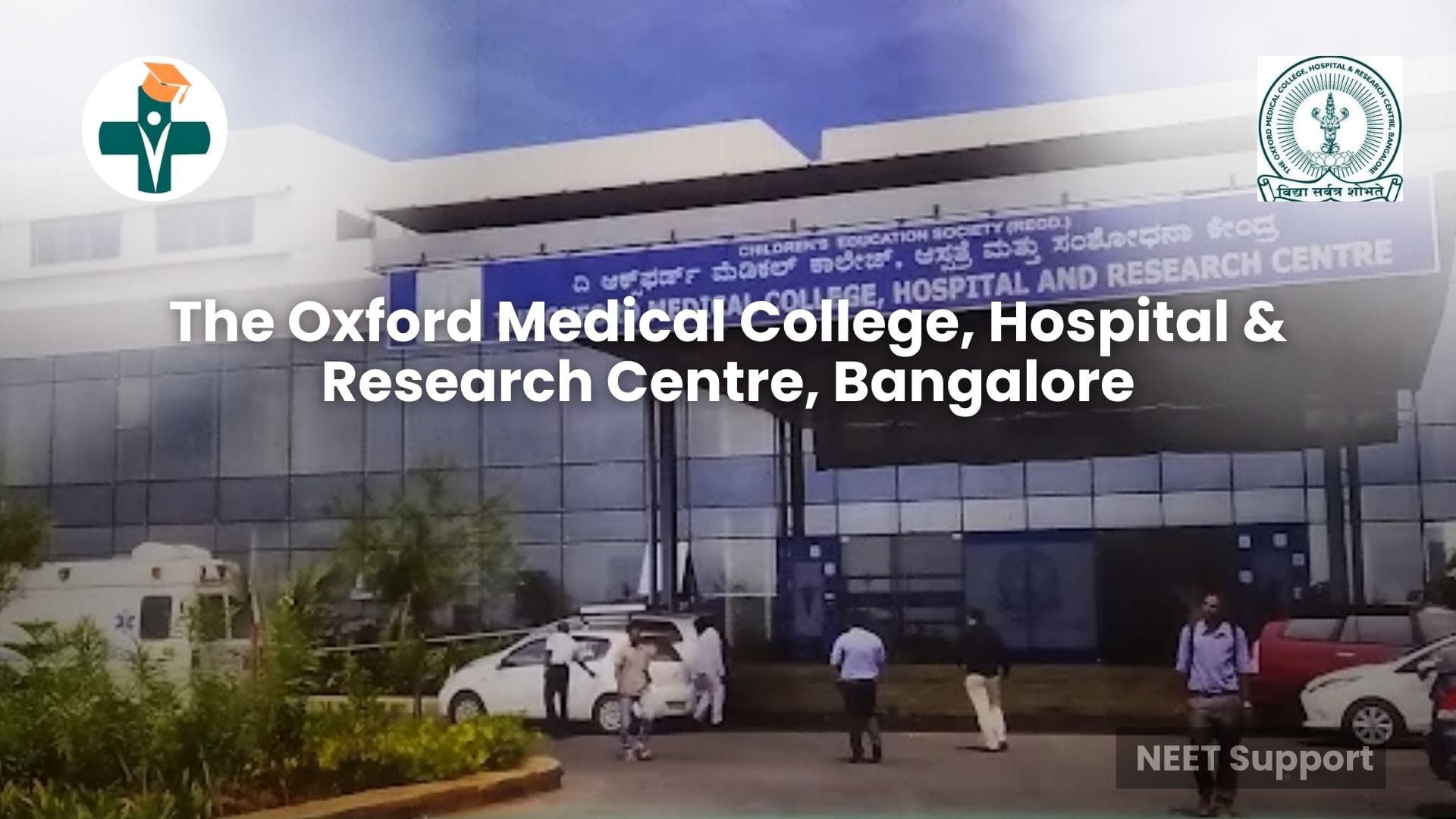
The Oxford Medical College, Hospital & Research Centre, Bangalore: Admission, Fees, NEET Cutoff, Courses, Hostel & More
Rashi Goyal
 WhatsApp
 Email
Email Facebook
 Twitter/X
 LinkedIn
Table of Contents
Predict Your Rank Now
Enter your NEET score to get an estimated rank
Find the Best Colleges For You
Based on your NEET rank, Category & more

Get Your Dream Medical College
Secure your seat with expert counselling
Choosing the right medical college after NEET is an important decision because MBBS involves a long-term commitment to academics, clinical training, and financial planning. The Oxford Medical College, Hospital & Research Centre, Bangalore is one of the private medical colleges in Karnataka that students may consider while preparing their MBBS preference list. Located in Yadavanahalli, Attibele Hobli, Anekal Taluk, Bengaluru, the institution is affiliated with Rajiv Gandhi University of Health Sciences (RGUHS), Karnataka. The National Medical Commission lists the college as a private medical institution, with its MBBS programme recognised and regulated under the applicable medical education framework.
The college is situated on the Bengaluru–Hosur side of the city and has an attached teaching hospital. According to the institution's citizen charter, the hospital has 695 teaching beds and 75 non-teaching beds, including emergency and ICU beds. The college also states that it operates urban and rural training centres and primary health centres, which are important components of undergraduate medical education and community medicine training.
For NEET aspirants, the important areas to understand include MBBS eligibility, admission through counselling, seat intake, previous cutoff trends, category-wise fees, hostel facilities, infrastructure, hospital exposure, and postgraduate opportunities. This article provides a detailed overview of The Oxford Medical College, Hospital & Research Centre, Bangalore, to help students make a more informed choice.
Medical College Overview
The Oxford Medical College, Hospital & Research Centre is a private medical institution located at Yadavanahalli, Attibele Hobli, Anekal Taluk, Bengaluru, Karnataka. The National Medical Commission's college listing identifies it as affiliated with Rajiv Gandhi University of Health Sciences, Karnataka. The college's first letter of permission for MBBS was issued in July 2014, and undergraduate recognition was granted in March 2019.
The institution offers undergraduate MBBS education along with postgraduate medical programmes. Its official website describes the MBBS course as 4½ years of academic study followed by one year of compulsory internship. Candidates must qualify NEET for admission.
The college is part of the wider Oxford Educational Institutions group. The medical campus includes academic facilities, a teaching hospital, clinical departments, student accommodation, and other campus amenities.
The official college website lists facilities such as a central library, lecture halls, common rooms, hostels for boys and girls, indoor and outdoor sports facilities, gymnasium and cafeteria.
College Highlights
| Particular | Details |
|---|---|
| College Name | The Oxford Medical College, Hospital & Research Centre |
| Location | Yadavanahalli, Attibele Hobli, Bengaluru, Karnataka |
| Type | Private Medical College |
| Established | 2014 |
| Affiliation | Rajiv Gandhi University of Health Sciences, Karnataka |
| Recognition | National Medical Commission |
| Undergraduate Course | MBBS |
| Postgraduate Courses | MD/MS |
| MBBS Entrance | NEET UG |
| PG Entrance | NEET-PG |
| MBBS Duration | 4.5 years + 1 year internship |
| MBBS Intake for AY 2026–27 | 250 seats |
| Teaching Hospital | Attached teaching hospital |
| Teaching Beds | 695 |
| Non-Teaching Beds | 75 |
| Location | Yadavanahalli, Attibele, Bengaluru |
One of the most important recent developments is the increase in MBBS intake. The NMC seat matrix for academic year 2026–27 lists 250 MBBS seats for The Oxford Medical College, Hospital & Research Centre, with 200 seats renewed and 50 additional seats increased.
Courses Offered
The Oxford Medical College offers medical education at undergraduate and postgraduate levels.
The main undergraduate programme is MBBS. According to the college's official course information, the programme consists of 4½ years of academic education followed by a one-year internship.
At the postgraduate level, the institution offers various MD and MS programmes. The college's academic information includes clinical and non-clinical postgraduate education, giving MBBS graduates opportunities to pursue specialisation through NEET-PG.
Some of the postgraduate disciplines associated with the institution include General Medicine, Paediatrics, Dermatology, Radio-Diagnosis, Anaesthesiology, General Surgery, Obstetrics and Gynaecology, and other specialities.
The exact number of seats in each speciality can vary according to the academic year and regulatory approvals. Therefore, candidates planning for PG admission should check the latest NMC postgraduate seat matrix and KEA counselling information.
MBBS Course and Seat Intake
The MBBS programme is designed to provide students with a combination of theoretical education, practical laboratory training and clinical exposure.
Students progress through basic medical sciences, para-clinical subjects and clinical disciplines. During the later stages of the course, clinical postings become increasingly important as students begin applying their theoretical knowledge to actual patient-care situations.
The official college website lists the duration as 4½ years plus one year of internship.
Current MBBS Intake
The NMC's latest MBBS seat matrix for academic year 2026–27 lists 250 seats at The Oxford Medical College, Hospital & Research Centre. The college had previously been permitted to increase its intake from 150 to 200 seats for AY 2024–25, and 200 seats were renewed for AY 2025–26. The 2026–27 matrix records another increase of 50 seats.
| Academic Year | MBBS Seats |
|---|---|
| Earlier intake | 150 |
| AY 2024–25 | 200 |
| AY 2025–26 | 200 |
| AY 2026–27 | 250 |
This increase is relevant for students because the number of seats available during counselling can affect preference planning and allotment possibilities.
Eligibility Criteria
Candidates seeking MBBS admission must meet the eligibility requirements prescribed by the relevant authorities.
The official college information states that candidates should have passed PUC/10+2 or an equivalent examination with Physics, Chemistry, Biology, and English. The college lists 50% marks as the general requirement and 40% for specified Karnataka SC/ST/OBC candidates. Candidates must also qualify NEET and meet the minimum age requirement of 17 years by 31 December of the admission year.
The broad requirements include:
- Completion of 10+2 or equivalent education
- Physics, Chemistry and Biology/Biotechnology as applicable
- English as a required language
- Minimum qualifying marks according to category
- NEET-UG qualification
- Fulfilment of age requirements
- Eligibility for the relevant counselling process
Students should always verify the current NTA, NMC, and KEA eligibility rules for the particular admission year because admission regulations can be revised.
Admission Process
Admission to the MBBS course is based on NEET-UG performance and the applicable counselling process.
The general process involves several stages.
Step 1: Appear for NEET-UG
Candidates must appear for NEET-UG and obtain a qualifying score and rank.
Step 2: Register for Counselling
After the NEET result, eligible candidates need to register for the appropriate counselling authority.
For Karnataka admissions, KEA plays an important role in counselling and seat allotment for the applicable categories.
Step 3: Choice Filling
Students select colleges and courses according to their eligibility, preferred seat categories, and expected rank.
The Oxford Medical College can be included in the preference list when the candidate is eligible for the relevant seat category.
Step 4: Seat Allotment
The counselling authority allocates seats based on factors such as NEET rank, category, preferences, seat availability, and applicable rules.
Step 5: Document Verification
Candidates who receive an allotment need to complete document verification and other formalities within the prescribed timeline.
Step 6: Fee Payment and Reporting
After accepting the seat, students need to pay the applicable fee and report to the college as instructed by the counselling authority.
Candidates should remember that NEET qualification alone does not guarantee admission. A valid counselling allotment and completion of the required admission formalities are essential.
NEET UG Counselling
Karnataka NEET counselling is especially important for students considering private medical colleges.
The Oxford Medical College has different seat categories, and the cutoff and fee can vary significantly according to the category. Therefore, students should not rely on a single general cutoff or fee figure.
The 2024 KEA allotment data, for example, shows an MBBS private-category allotment at an All India Rank of 69,784 with a course fee of ₹12,00,867, while a government-category allotment at AIR 69,803 carried a course fee of ₹1,54,321.
This illustrates how important it is to identify the exact category before evaluating admission chances and financial requirements.
The Oxford Medical College NEET Cutoff
The NEET cutoff for The Oxford Medical College changes every year.
There is no single rank that guarantees admission because the closing rank depends on the category, seat type, counselling round, candidate preferences, number of applicants, and available seats.
Historical Karnataka counselling data for 2025 shows that a 1G government-quota seat had a reported Round 2 closing AIR of 85,892. Other reserved categories had different closing ranks.
Private-category closing ranks can be different from government-quota closing ranks, and management or NRI-related categories can still have different admission patterns.
Therefore, candidates should compare their NEET rank with the cutoff for the exact category they are eligible for.
Previous Cutoff Trends
Previous-year cutoff data can be helpful when creating a NEET preference list.
However, historical cutoff figures should be treated as reference points rather than fixed future requirements. A change in seat intake can also influence counselling outcomes. For The Oxford Medical College, the published 2025 counselling data reports the following examples:
| Category | Counselling Round | Historical Closing AIR |
|---|---|---|
| 1G Government Quota | Round 2 | 85,892 |
| SCG Government Quota | Round 2 | 2,11,657 |
| SCH Government Quota | Round 2 | 2,22,781 |
| SCR Government Quota | Round 2 | 2,22,002 |
| STG Government Quota | Round 2 | 2,12,386 |
| STR Government Quota | Round 2 | 2,20,205 |
These are historical 2025 counselling references and should not be interpreted as the official 2026 cutoff. Cutoffs can change between rounds and admission years.
For a more realistic assessment, candidates should compare their rank with previous Round 1, Round 2, and mop-up results wherever available.
The Oxford Medical College Fees Structure
Fees are an important consideration for students choosing a private medical college.
The applicable fee depends on the seat category. The published Karnataka 2026–27 fee reference for The Oxford Medical College lists different annual tuition figures for government, private, management and NRI categories.
MBBS Fee Reference
| Seat Category | Annual Fee Reference |
|---|---|
| Government | ₹1,53,571 |
| Private | ₹12,00,117 |
| Management | ₹36,11,950 |
| NRI | ₹34,11,950 |
The above figures are reported as the 2026–27 annual tuition fee references based on the Karnataka fee notification. Hostel, mess, caution deposit, university and examination-related charges may be separate.
Students should confirm the complete payable amount with the counselling authority and college before admission because the total cost of attendance is more than tuition alone.
For postgraduate courses, fees vary considerably by speciality and category. A 2025 KEA PG allotment record, for example, shows an MD General Medicine allotment at The Oxford Medical College with a course fee of ₹13,87,994 for the particular category, while an MD Paediatrics allotment in another category carried a fee of ₹7,83,108.
Hostel and Accommodation
Hostel facilities are important for students who are relocating to Bengaluru for medical education.
The Oxford Medical College's official website lists separate hostel facilities for boys and girls. Other campus facilities include common rooms, sports facilities, a gymnasium, and a cafeteria.
Students should confirm the current hostel fee directly before admission. Important points to check include:
- Room occupancy
- AC or non-AC options
- Hostel fee
- Mess charges
- Security deposit
- Electricity charges
- Internet availability
- Laundry facilities
- Hostel timings
- Transportation
- Rules for first-year students
Hostel and mess charges can change between academic years, so students should obtain the latest written fee details before finalising accommodation.
Campus and Infrastructure
The Oxford Medical College provides academic and student facilities designed around undergraduate and postgraduate medical education.
The official college website lists a central library, lecture halls, common rooms, hostels, sports facilities, gymnasium, and cafeteria.
A medical college's infrastructure should be evaluated from an academic perspective rather than only by looking at campus buildings. Students should consider the availability of laboratories, dissection facilities, clinical skills training, library resources, lecture halls, and department-specific teaching facilities.
The college also maintains a Medical Education Unit and other academic structures that support teaching and curriculum implementation. Its website provides information about academic activities, departments, and student results.
The institution has also published MBBS examination results for different years and MD/MS batch results, giving students access to information about academic performance.
Hospital and Clinical Exposure
Clinical exposure is one of the most important components of MBBS education.
The Oxford Medical College is attached to a teaching hospital that provides clinical services across multiple specialties. According to the college's citizen charter, the hospital has 695 teaching beds and 75 non-teaching beds, including emergency and ICU beds.
The official hospital information includes facilities such as:
- Emergency services
- OPD
- ICU
- Central diagnostic laboratories
- Blood bank
- Pharmacy
- Ambulance service
- Clinical departments
The college also operates urban and rural training centres and primary health centres, providing opportunities for community medicine exposure.
For MBBS students, the actual quality of clinical education depends on patient numbers, department workload and the extent to which students participate in clinical postings.
Before taking admission, students may therefore want to ask about:
- OPD attendance
- Inpatient occupancy
- Emergency cases
- Surgical workload
- Obstetrics cases
- Paediatric cases
- ICU exposure
- Radiology access
- Department-wise clinical postings
These factors can have a direct impact on practical learning.
Postgraduate MD/MS Courses
The Oxford Medical College also provides postgraduate medical education.
The college's official programme information lists clinical MD/MS programmes, including specialities such as:
- MD General Medicine
- MD Dermatology, Venereology and Leprosy
- MD Paediatrics
- MD Anaesthesiology
- MD Radio-Diagnosis
- MS General Surgery
- MS Orthopaedics
- MS Obstetrics & Gynaecology
- MS Ophthalmology
- MS ENT
The exact postgraduate intake can vary according to speciality and academic year, so students interested in PG admission should consult the latest NMC seat matrix.
Admission to MD/MS programmes is through NEET-PG followed by the relevant counselling process.
An institution offering postgraduate programmes can provide an additional academic environment for MBBS students, particularly because undergraduate students can observe different specialties and postgraduate departments during their clinical education.
Academic Environment
The academic environment of a medical college plays an important role in a student's overall development.
At The Oxford Medical College, students undergo classroom teaching, practical training, clinical postings, and internship. The official course information describes the MBBS programme as a combination of academic education and compulsory clinical internship.
The college also maintains academic departments across basic sciences, para-clinical disciplines and clinical specialities.
Students should expect MBBS to be a demanding course that requires regular attendance, consistent revision, practical learning and active participation in clinical postings.
A good academic strategy involves preparing simultaneously for university examinations and developing the knowledge required for future postgraduate entrance examinations.
Documents Required for Admission
Candidates should keep their admission documents organised before counselling and college reporting.
Commonly required documents include:
- NEET-UG scorecard
- NEET-UG admit card
- Class 10 certificate
- Class 12 marksheet
- Class 12 passing certificate
- Identity proof
- Category certificate, if applicable
- Domicile-related documents, where required
- Counselling allotment letter
- Transfer certificate
- Migration certificate, if applicable
- Passport-size photographs
- Medical fitness certificate, where required
- Other documents mentioned in the counselling notification
Students should carry both original documents and the required number of photocopies.
The exact document list can change according to the counselling authority, so candidates should follow the latest KEA/NTA instructions.
Career Opportunities After MBBS
After completing MBBS and the compulsory internship, graduates have several career options.
One of the most popular routes is postgraduate education through NEET-PG. Students can pursue MD, MS, or other recognised postgraduate programmes depending on their rank and preferences.
Other opportunities include:
Hospital employment as a medical officer or junior doctor is one possible career route after completing the required registration and internship requirements.
Government medical services can provide another pathway when medical officer or other relevant vacancies are announced.
Public health programmes offer opportunities in community healthcare and government or non-government healthcare organisations.
Research is another option for students interested in clinical studies, medical science and academic work.
Medical education can become a longer-term career path after completing appropriate postgraduate qualifications.
Students who want to specialise can also consider the MD/MS programmes available at The Oxford Medical College or other institutions through NEET-PG counselling.
Why Consider The Oxford Medical College?
There are several factors that may make The Oxford Medical College an option for NEET aspirants.
The institution is affiliated with RGUHS, Karnataka, and operates within the NMC regulatory framework.
The MBBS intake has increased to 250 seats for AY 2026–27 according to the latest NMC seat matrix.
The college has an attached teaching hospital with a substantial bed capacity and multiple clinical services.
The institution also offers postgraduate medical programmes, allowing students to pursue different specialties through NEET-PG.
Its location in the Bengaluru region can also be an advantage for students who prefer studying in or around the city.
The campus provides hostels, library facilities, lecture halls, sports facilities, a gymnasium, and a cafeteria according to the college's official information.
Important Things to Check Before Admission
Before accepting an MBBS seat, candidates should verify the current admission information instead of relying exclusively on previous-year data.
The first factor is the seat category. A government-quota seat and a management seat at the same institution can have a very large difference in tuition fees.
The second factor is the actual total cost. Students should calculate tuition, hostel, mess, examination, university, and other institutional expenses over the full course duration.
The third factor is clinical exposure. Students should assess patient flow and clinical workload rather than judging the hospital only by its bed count.
The fourth factor is the current cutoff. Previous-year ranks can help with preference planning but cannot guarantee admission in a new counselling cycle.
Finally, candidates should compare The Oxford Medical College with other Karnataka medical colleges on the basis of rank suitability, total expenses, clinical exposure, location, hostel facilities, and postgraduate opportunities.
Frequently Asked Questions
What is the NEET cutoff for The Oxford Medical College?
There is no single fixed cutoff. It varies according to category and counselling round. A 2025 reference records a Round 2 closing AIR of 85,892 for the 1G government-quota category.
What is the MBBS fee at The Oxford Medical College?
For 2026–27, published Karnataka fee references list ₹1,53,571 for government seats, ₹12,00,117 for private seats, ₹36,11,950 for management seats and ₹34,11,950 for NRI seats. These figures should be verified against the latest official fee notification before admission.
Does the college provide hostel facilities?
Yes. The official college website lists hostel facilities for both boys and girls.
Does The Oxford Medical College offer postgraduate courses?
Yes. The institution offers various MD and MS postgraduate programmes.
Final Verdict
The Oxford Medical College, Hospital & Research Centre, Bangalore is a private medical college that offers MBBS and postgraduate medical education in the Bengaluru region. Its RGUHS affiliation, NMC recognition, 250 MBBS seats for AY 2026–27, attached teaching hospital, postgraduate programmes and campus facilities make it an institution worth considering when preparing a Karnataka NEET preference list.
For students, however, the final decision should depend on more than the college's name. NEET rank, category, annual fee, total course expenditure, clinical exposure, hostel cost, hospital workload and future postgraduate plans should all be considered together.
The cutoff figures mentioned above are historical counselling references, while the fee information reflects the latest published 2026–27 references available at the time of writing. Candidates should verify the final seat matrix, fee notification, and counselling rules with the relevant authorities before taking admission.
Reviews
No reviews yet. Be the first to write one!