
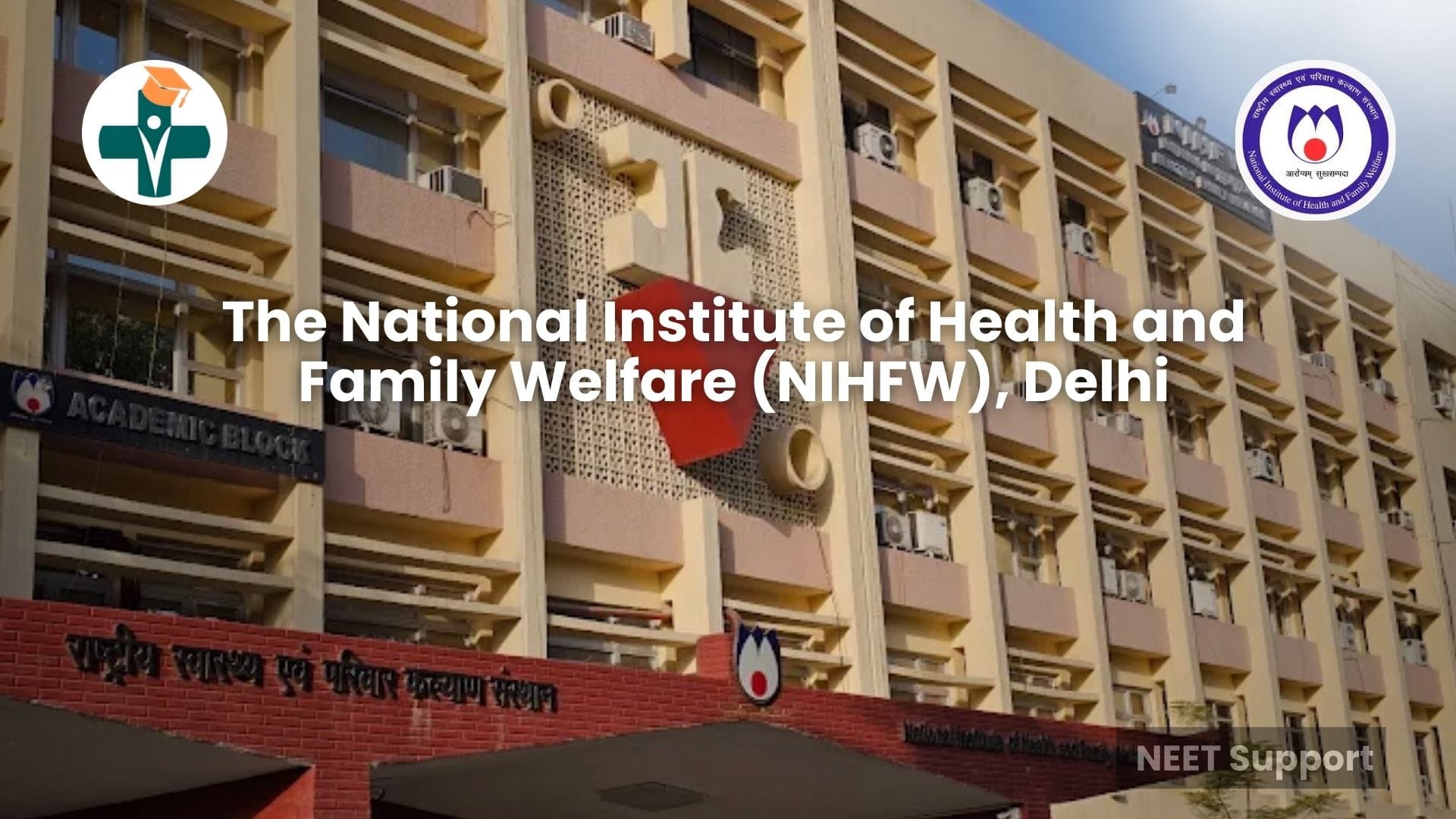
The National Institute of Health and Family Welfare (NIHFW), Delhi: A Complete Guide for 2026
RISHIKESH KUMAR
 WhatsApp
 Email
Email Facebook
 Twitter/X
 LinkedIn
Table of Contents
Predict Your Rank Now
Enter your NEET score to get an estimated rank
Find the Best Colleges For You
Based on your NEET rank, Category & more

Get Your Dream Medical College
Secure your seat with expert counselling
Overview
For the students aspiring for medical administrators and public health in India, the National Institute of Health and Family Welfare (NIHFW) in New Delhi is considered the prestigious "Think Tank" in the field. Founded in 1977 as an autonomous body under the Ministry of Health and Family Welfare (MoHFW), it has transformed from a primary training centre into an institution of international standing. NIHFW provides a rare combination of academic excellence and practical policy impact, whether through its specialised MD programs, PG Diplomas, or advanced research initiatives.
The institute is situated on a 15-acre campus in Munirka, South Delhi. It was created by merging two major entities: the National Institute of Health Administration and Education (NIHAE) and the National Institute of Family Planning (NIFP).
Today, it serves as the Apex Technical Institute for the Indian Government, providing vital technical assistance, conducting specialised research, and training high-ranking health officials. The institute maintains affiliations with the University of Delhi (DU) and holds recognition from both the University Grants Commission (UGC) and the National Medical Commission (NMC).
Key Highlight
| Feature | Details |
|---|---|
| Established | 1977 |
| Institute Type | Autonomous (Ministry of Health & Family Welfare, GoI) |
| Affiliation | University of Delhi (DU) |
| Location | Munirka, New Delhi |
| Campus Area | 15 Acres |
| Nodal Role | Nodal Institute for NHM, RCH-II, and IMNCI training |
| Primary Entrance | NEET PG / CUET PG / UGC NET |
Courses Offered
The National Institute of Health and Family Welfare (NIHFW) doesn't just open its doors to everyone; they are very picky about who they admit because they care much more about the calibre of their students than having a large number of them.
Instead of filling seats for the sake of it, they keep their classes small and specialised to ensure that the training remains top-tier. Their academic programs are specifically built for a very particular crowd, focusing on people who are already deep in the field—mainly medical doctors, social scientists, and those who manage healthcare systems.
On-Campus Full-Time Programs
* MD (Community Health Administration): A 3-year advanced residency program for MBBS trainees.
* MPH (Master of Public Health): Focused on tracking disease (epidemiologic) and management of public health.
* Diploma in Health Administration (DHA): A 2-year course that facilitates a clinical and administrative diploma.
* PG Diploma in Public Health Management (PGDPHM): A 1-year residency-style course.
* Ph.D. Programs: Available in various public health disciplines.
Seat Matrix
| Course | Total Seats |
|---|---|
| MD (Community Health Administration) | 10 |
| Diploma in Health Administration (DHA) | 6 |
| Master of Public Health (MPH) | 40 |
| PG Diploma (Public Health Management) | 10 - 15 |
| Ph.D. | 17 |
Fee Structure
The cost of education at NIHFW is kept remarkably low because the government covers a significant portion of the expenses. This means that the tuition and additional fees are highly subsidised, allowing students to access world-class training without the burden of heavy student loans or high out-of-pocket costs.
| Course Name | Total Tuition Fee (Approx.) |
|---|---|
| MD (CHA) | ₹47,700 (for 3 years) |
| DHA | ₹31,800 (for 2 years) |
| MPH | ₹2.5 Lakhs (total) |
| PG Diploma (General) | ₹31,800 - ₹1.25 Lakhs |
| Ph.D. | ₹1.35 Lakhs |
Note: These fees are for tuition. Hostel charges and miscellaneous fees (like the library deposit or University of Delhi enrollment fees) are additional.
Cut-off Trends (NEET PG)
Admission to the MD and Diploma programs is extremely competitive. The cut-off ranks vary significantly based on the category (General, OBC, SC, ST, EWS).
Recent Closing Ranks (General Category - Round 4)
* MD (Community Health Administration): Historically ranges between 20,000 and 45,000. In 2024, the closing rank for the General category was approximately 23,554.
* Diploma in Health Administration (DHA): Closing ranks usually hover around 37,000 to 48,000.
* MPH (CUET PG): For the MPH program, the CUET PG score cut-off was around 151 in recent rounds.
Admission & Counselling Process
The admission pathway depends strictly on the course type:
A. MD & Diploma (DHA)
* Entrance: Candidates must qualify for NEET PG.
* Counselling: All-India Quota (AIQ) seats are filled through the Medical Counselling Committee (MCC). Since the institute is affiliated with Delhi University, there is also a "DU Quota" for students who completed their MBBS from DU-affiliated colleges.
B. Master of Public Health (MPH)
* Entrance: Admission is based on the CUET PG entrance exam.
* Registration: Candidates must register on the DU CSAS-PG portal once scores are released.
C. Ph.D. Programs
* Candidates are selected through UGC-NET (Categories 1, 2, or 3) followed by a synopsis presentation and a personal interview at NIHFW.
Infrastructure and Facilities
NIHFW offers a professional environment tailored for research and senior-level training.
* National Documentation Centre (NDC): A world-class library housing thousands of books, journals, and reports on health and population.
* Hostels: Well-maintained hostel facilities for residential students and in-service trainees.
* Computer Centre: Equipped with the latest statistical software for data analysis and health epidemiology.
* Clinical Services: The institute maintains a clinic for research in reproductive health and genetic disorders.
* Auditorium & Classrooms: Modern lecture halls equipped with advanced audio-visual aids for national-level conferences.
Frequently Asked Questions (FAQs)
Q1: Is NIHFW a private or government institute?
It is an autonomous government institute under the Ministry of Health and Family Welfare, Government of India.
Q2: Does NIHFW offer distance learning courses?
Yes. NIHFW is famous for its Distance Learning Cell (DLC), offering PG Diplomas in Public Health Nutrition, Health Communication, and Hospital Management.
Q3: Is there a bond for the MD program?
Yes, like most Delhi University medical programs, there is typically a service bond or a penalty for leaving the seat after the admission cutoff date. Candidates should check the latest MCC bulletin for specific bond amounts.
Q4: Can non-medical students apply for MPH?
Yes, graduates with BDS, B.Sc. Nursing, or even Social Sciences backgrounds are often eligible, provided they meet the specific CUET PG and DU criteria.
Conclusion
The National Institute of Health and Family Welfare is more than just a college; it is a gateway to the corridors of health policy in India. For those who want to move beyond bedside medicine and impact the health of millions through administration and policy, NIHFW provides the perfect launchpad. With its affordable fee structure, DU affiliation, and proximity to the Ministry of Health, it remains a top-tier choice for public health enthusiasts.
Reviews
No reviews yet. Be the first to write one!