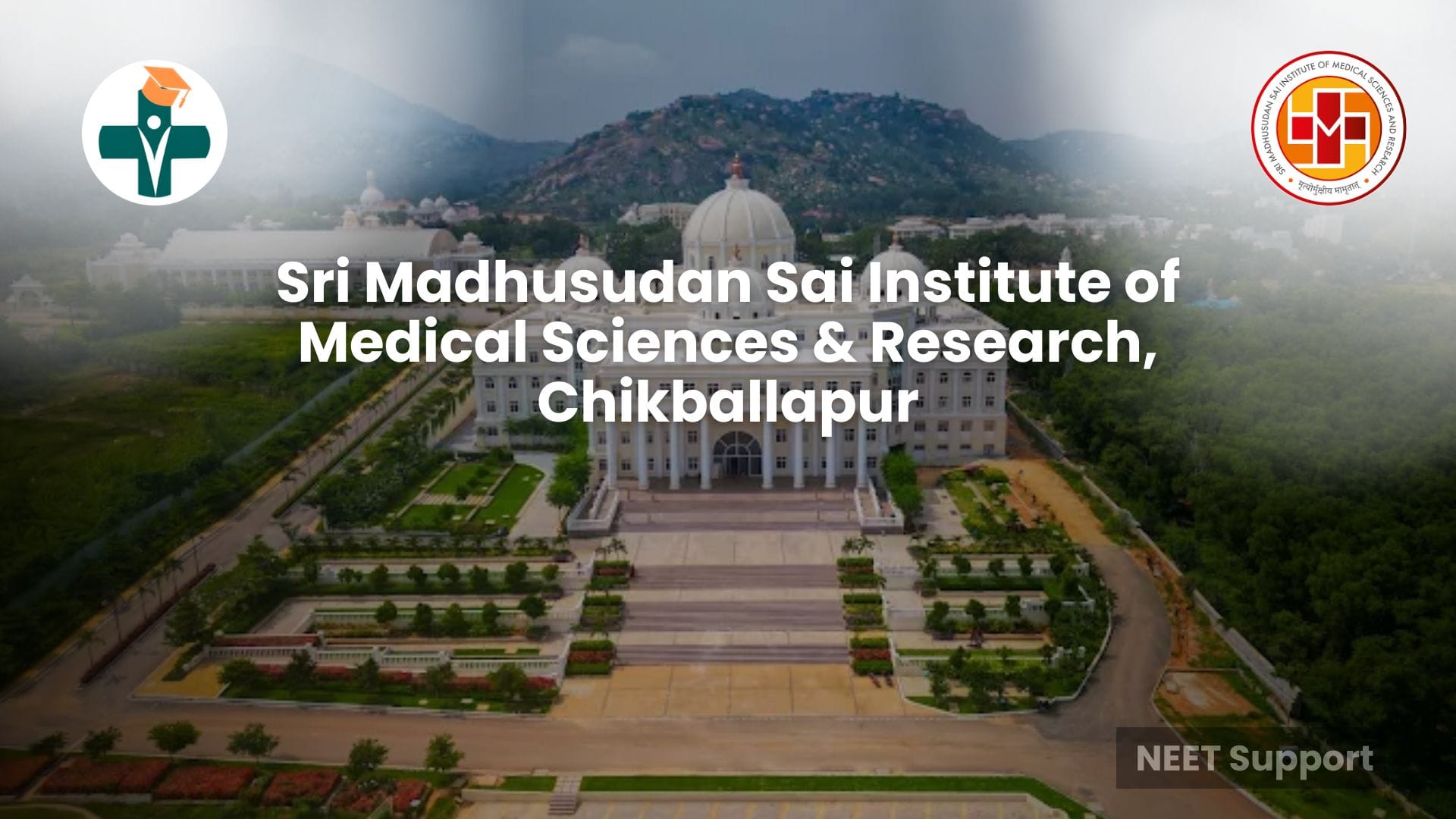
Sri Madhusudan Sai Institute of Medical Sciences & Research, Chikkaballapur: Fees, Cutoff, Courses, Admission and FAQs
Rashi Goyal
 WhatsApp
 Email
Email Facebook
 Twitter/X
 LinkedIn
Table of Contents
Predict Your Rank Now
Enter your NEET score to get an estimated rank
Find the Best Colleges For You
Based on your NEET rank, Category & more

Get Your Dream Medical College
Secure your seat with expert counselling
Overview
Sri Madhusudan Sai Institute of Medical Sciences and Research (SMSIMSR) is a unique medical institution located at Sathya Sai Grama, Muddenahalli, in Chikkaballapur district of Karnataka. Established with the vision of making medical education and healthcare accessible to students and communities that need them most, the institute follows a distinctive model of values-based, residential medical education.
Unlike most private medical colleges, SMSIMSR's central philosophy is to de-commercialise medical education and healthcare. The institute states that medical education is provided completely free of cost to deserving students, while its associated healthcare services are also offered free of charge.
The institute is a constituent college of Sri Sathya Sai University for Human Excellence (SSSUHE), Karnataka, and its MBBS programme is accredited/approved by the National Medical Commission (NMC). Admission to MBBS is based on NEET-UG merit through Karnataka Examination Authority (KEA) counselling.
For students searching for an MBBS college in Karnataka with a low or zero tuition-cost model, SMSIMSR is therefore an especially important institution to consider. However, admission also comes with specific conditions, including compulsory residential education and a five-year service commitment after MBBS.
Sri Madhusudan Sai Institute of Medical Sciences Highlights
| Particular | Details |
|---|---|
| College Name | Sri Madhusudan Sai Institute of Medical Sciences & Research |
| Abbreviation | SMSIMSR |
| Location | Sathya Sai Grama, Muddenahalli, Chikkaballapur, Karnataka |
| District | Chikkaballapur |
| State | Karnataka |
| Type | Private / charitable medical institution |
| University | Sri Sathya Sai University for Human Excellence |
| Recognition | National Medical Commission (NMC) |
| Principal Medical Course | MBBS |
| MBBS Intake | 50 seats per academic year |
| MBBS Duration | 4.5 years + 1 year internship |
| Entrance Exam | NEET-UG |
| Counselling | Karnataka Examination Authority (KEA) |
| Mode of Education | Residential |
| MBBS Tuition Fee | Free of cost under the institute's scholarship/free-education model |
| Service Bond | 5 years after MBBS |
| Teaching Hospital | Sri Sathya Sai Sarla Memorial Hospital |
The NMC information submitted by the institution records the first Letter of Permission for MBBS on 27 April 2023 with an intake of 50 seats. The institute's own admission and media pages also currently state an annual MBBS intake of 50 students.
About Sri Madhusudan Sai Institute of Medical Sciences and Research
SMSIMSR was established at Sathya Sai Grama, Muddenahalli, Chikkaballapur, with a vision of providing quality medical education in a rural setting. Its philosophy is expressed through the idea of being "In the Rural, Of the Rural and For the Rural."
The institution aims to address two major challenges in Indian healthcare: the shortage of trained doctors in rural areas and the high cost of medical education. Its model combines medical education, healthcare delivery, rural exposure, and values-based learning.
The institute describes its educational model as a revival of the traditional Gurukulam system, in which education is not treated simply as a commercial service but as a means of developing knowledge, skills, values and social responsibility.
The college was inaugurated in 2023 and began its MBBS programme with 50 seats. According to the institute, its medical education is completely free for eligible students, and students are expected to serve in free hospitals associated with the university or its allied trusts after graduation.
Sri Madhusudan Sai Medical College Fees Structure
One of the most distinctive features of SMSIMSR is its free medical education model.
The institute states that it provides medical education completely free of cost to deserving and economically disadvantaged students, particularly those from rural areas. The model extends beyond tuition and includes residential requirements.
MBBS Fee Structure
| Fee Component | MBBS |
|---|---|
| Tuition Fee | ₹0 |
| Academic Fee | Free |
| Hostel/Residential Education | Provided under the institute's free-education model |
| Food/Boarding | Provided under the residential model |
| Books/educational support | As per institutional provisions |
| Total tuition cost | ₹0 |
The institute's official information describes its medical education as completely free of cost. Students are required to reside in the university hostel during their studies.
This makes SMSIMSR very different from conventional private medical colleges, where MBBS tuition can run into several lakhs or even crores of rupees.
Important: Free Education Does Not Mean No Conditions
Candidates should carefully understand that the free education model is associated with certain institutional obligations.
Students admitted to MBBS must:
- Stay compulsorily in the university hostel.
- Follow university and hostel rules.
- Sign the applicable service bond.
- Complete five years of compulsory service after MBBS.
- Serve in free hospitals established by or associated with the university, allied trusts, institutions or foundations.
- Accept posting or transfer to rural or medically underserved areas as determined by the university.
During the compulsory service period, the university states that students will receive a salary according to its applicable norms and regulations.
Therefore, students should not consider the college simply because the fee is ₹0. The service commitment is an important part of the admission agreement.
Hostel and Residential Education
SMSIMSR follows a compulsory residential model. Students admitted to the MBBS programme are required to live in the university hostel.
The residential system is designed to create an integrated educational environment where students participate not only in medical studies but also in activities related to values, communication, community service, physical wellbeing and professional development.
The institution describes its courses as state-of-the-art, compulsory residential programmes based on the Gurukulam model.
The 2025 institutional code of conduct also confirms that the university's education model includes boarding and lodging provisions and that students are required to stay in designated hostels.
Courses Offered at Sri Madhusudan Sai Institute
SMSIMSR offers programmes at undergraduate and postgraduate levels. Its official course page currently lists MBBS at the undergraduate level and multiple DNB postgraduate programmes. The broader institutional information also refers to nursing and allied health sciences programmes.
Undergraduate Course
1. MBBS
The Bachelor of Medicine and Bachelor of Surgery (MBBS) is the primary undergraduate medical programme.
The course covers:
- Anatomy
- Physiology
- Biochemistry
- Pharmacology
- Pathology
- Microbiology
- Forensic Medicine
- Community Medicine
- General Medicine
- General Surgery
- Paediatrics
- Obstetrics and Gynaecology
- Orthopaedics
- Ophthalmology
- ENT
- Psychiatry
- Anaesthesiology
- Other clinical and allied subjects prescribed by NMC
The curriculum combines lectures, practical training, clinical postings, community-based learning and professional development.
Postgraduate DNB Courses
SMSIMSR's official course page currently lists the following DNB programmes:
- DNB General Surgery
- DNB General Medicine
- DNB Paediatrics
- DNB Obstetrics and Gynaecology
- DNB Anaesthesiology
These are full-time three-year postgraduate programmes for eligible MBBS graduates.
DNB General Surgery
The DNB General Surgery programme aims to train doctors in surgical diagnosis, emergency care, trauma management, operative procedures, research methodology and patient communication.
DNB General Medicine
DNB General Medicine focuses on the diagnosis and management of medical conditions and prepares doctors to provide preventive, promotive, curative and rehabilitative healthcare.
DNB Paediatrics
The DNB Paediatrics programme focuses on the healthcare needs of infants, children and adolescents, including diagnosis, treatment and preventive care.
DNB Obstetrics and Gynaecology
This programme covers reproductive health, obstetrics, gynaecology and management of normal and complicated pregnancy-related conditions.
DNB Anaesthesiology
DNB Anaesthesiology provides training in anaesthesia, critical care, pain management and resuscitation.
Nursing and Allied Health Sciences
The institute's broader academic information states that it offers medical, nursing and allied health sciences education as part of its institutional model.
However, the dedicated SMSIMSR course page provides detailed programme information primarily for MBBS and DNB courses. Therefore, candidates interested specifically in nursing or allied-health programmes should verify the current course-wise admission notification and intake directly with the institution before applying.
Sri Madhusudan Sai Medical College MBBS Cutoff
Admission to MBBS at SMSIMSR is based on NEET-UG merit and Karnataka KEA counselling. All seats, including NRI and management-category seats, are allotted through online counselling based on NEET rank and candidate preference.
Because SMSIMSR has a very small intake of 50 MBBS seats and its fee structure is highly attractive, competition can vary significantly from year to year.
2025 MBBS Cutoff
Different published sources report slightly different closing-rank figures depending on the counselling round and dataset.
Careers360 reports the following General category trend:
| Year | Opening Rank | Closing Rank |
|---|---|---|
| 2025 | 20,671 | 58,778 |
| 2024 | — | 72,370 |
Careers360 notes that its cutoff figures are based on available student inputs and historical data, so they should be treated as indicative.
Another Karnataka counselling-based source reports the 2025 General-All India last-round closing rank as 56,442, compared with 79,046 in 2024.
Because these datasets can differ by round, category, and reporting methodology, students should use the official KEA allotment results as the final authority.
2025 Cutoff Reference Table
| Category/Quota | 2025 Cutoff Reference |
|---|---|
| General – reported closing rank | 56,442–58,778 |
| General – opening rank | 20,671 |
| 2024 General closing rank | 72,370–79,046 |
The range above reflects figures reported by different counselling/cutoff databases rather than a single official consolidated closing-rank table.
Category-wise NEET Score Reference
A published 2025 Karnataka cutoff source reports the following approximate category-wise scores for SMSIMSR:
| Karnataka Category | 2025 Cutoff Score |
|---|---|
| GM | 500 |
| GMR | 494 |
| GMRH | 473 |
| 1G | 476 |
| 2AG | 487 |
| 3BG | 500 |
| STG | 420 |
| STRH | 417 |
These figures are third-party counselling references and should be treated as historical guidance rather than guaranteed future cutoffs.
NEET Qualifying Cutoff vs SMSIMSR Admission Cutoff
Students should understand that the NEET qualifying cutoff and the SMSIMSR college cutoff are not the same.
The NEET qualifying cutoff determines whether a candidate is eligible to participate in counselling. The SMSIMSR cutoff represents the level at which candidates actually secured seats during counselling.
For example, merely qualifying NEET does not guarantee admission to SMSIMSR. Because the institute offers 50 seats and provides free medical education, candidates should aim for a strong NEET rank.
2025 MBBS Cutoff Trend
The available data indicates that SMSIMSR's General-category closing rank has moved as follows:
| Admission Year | Approx. General Closing Rank |
|---|---|
| 2023 | New college / limited historical data |
| 2024 | 72,370–79,046 |
| 2025 | 56,442–58,778 |
The improvement in closing rank from 2024 to 2025 indicates stronger competition in the later admission cycle. However, cutoff movement depends on NEET difficulty, candidate preferences, counselling rounds, and seat availability.
MBBS Eligibility
Candidates applying for MBBS at SMSIMSR must satisfy the prescribed NEET and academic requirements.
According to the institute's admission information:
- The candidate must be at least 17 years old on or before 31 December of the admission year.
- The candidate must have passed Physics, Chemistry, Biology/Biotechnology and English individually.
- General candidates must have at least 50% marks in Physics, Chemistry and Biology/Biotechnology taken together.
- For SC/ST/OBC candidates, the minimum qualifying percentage is 40%, subject to the applicable rules.
- The candidate must qualify NEET-UG.
- Candidates must participate in the Karnataka KEA counselling process.
SMSIMSR MBBS Admission Process
The admission process is based on NEET-UG and KEA counselling.
Step 1: Appear for NEET-UG
Candidates must register for and appear in NEET-UG.
Step 2: Qualify NEET
The candidate must meet the qualifying criteria prescribed for MBBS admission.
Step 3: Register for KEA Counselling
Eligible candidates who want to apply to SMSIMSR must register for Karnataka Examination Authority counselling.
Step 4: Choice Filling
Candidates can include SMSIMSR among their preferred medical colleges during choice filling.
Step 5: Seat Allotment
Seats are allotted according to NEET merit and candidate preferences.
Step 6: Document Verification
The candidate must complete the prescribed verification and admission formalities.
Step 7: Join the Residential Programme
Selected students must reside in the university hostel and follow the institution's residential rules.
Five-Year Compulsory Service Bond
One of the most important aspects of SMSIMSR admission is its compulsory service requirement.
Students who complete the MBBS programme are required to serve for five years in free hospitals established by or associated with the university or its allied trusts, institutions or foundations.
The university can post or transfer students to rural or medically underserved areas. During this service, the university states that the graduate will receive a salary according to its applicable norms.
This condition reflects the institute's objective of creating doctors who are willing to work in underserved communities.
Students and parents should read the complete bond and admission regulations before accepting a seat.
Teaching Hospital
The primary teaching hospital associated with SMSIMSR is Sri Sathya Sai Sarla Memorial Hospital.
The hospital was established at Sathya Sai Grama and serves as a clinical training environment for students. The institution describes its healthcare model as completely free of cost and without discrimination.
The NMC information available for the institution records the hospital with 220 beds, including 10 emergency beds, in the relevant inspection information.
The institution has also been expanding its hospital infrastructure, including additional multi-speciality facilities intended to support free healthcare and medical education.
Clinical Departments and Facilities
SMSIMSR provides students with exposure to a wide range of clinical and para-clinical departments.
Examples include:
- General Medicine
- General Surgery
- Paediatrics
- Obstetrics and Gynaecology
- Orthopaedics
- Ophthalmology
- ENT
- Psychiatry
- Anaesthesiology
- Cardiology
- Cardiothoracic and Vascular Surgery
- Radiology
- Microbiology
- Pathology
- Community Medicine
The institution has specialised services including cardiology and cardiothoracic and vascular surgery. Its cardiology department states that cardiac services are provided completely free of cost and include procedures such as coronary angiography, angioplasty, and device closure procedures.
Academic Approach
SMSIMSR follows an integrated approach to medical education.
The MBBS curriculum combines:
- Classroom teaching
- Practical sessions
- Clinical postings
- Community-based learning
- Skill development
- Communication training
- Medical ethics
- Professional development
- Research exposure
- Sports and extracurricular activities
The foundation course includes orientation, skills modules, community health-centre visits, AETCOM, sports, yoga, and language/computer skills.
Research Opportunities
The institute has a strong focus on medical research and evidence-based healthcare.
Students can be exposed to research methodology and interdisciplinary healthcare practices as part of their medical education. Postgraduate DNB programmes also explicitly include research methodology and evidence-based clinical practice as part of their objectives.
Why Choose Sri Madhusudan Sai Institute of Medical Sciences?
1. Free MBBS Education
The biggest attraction is the institute's free medical education model for deserving students.
2. Low Financial Burden
Unlike conventional private medical colleges, students do not have to pay the usual high MBBS tuition fees.
3. Rural Healthcare Exposure
The college is located in a rural environment and specifically aims to prepare doctors for underserved areas.
4. Residential Education
Students receive an immersive campus-based education through the compulsory residential model.
5. Values-Based Learning
The institute integrates professional ethics, human values, and service into medical education.
6. Clinical Training
Students receive clinical exposure through the institute's teaching hospital and specialised departments.
7. Service-Oriented Career
The five-year rural service commitment gives graduates an opportunity to work directly with underserved communities.
Things Students Should Consider Before Admission
Although SMSIMSR's fee structure is highly attractive, students should consider the following before choosing the college:
- The programme is compulsory residential.
- Students must follow hostel and university regulations.
- There is a five-year compulsory service commitment after MBBS.
- Students may be posted to rural or medically underserved areas.
- The service bond should be understood carefully before admission.
- Students should verify the latest KEA seat matrix and cutoff.
- Course and admission rules may change from one academic year to another.
Therefore, students should not compare SMSIMSR only on tuition fees. The service obligation and residential nature of the programme are equally important.
Career Opportunities After MBBS
After completing MBBS, graduates can explore several career paths.
Medical Practice
Graduates can work as doctors in hospitals, healthcare centres and clinics after completing the required internship and registration formalities.
Rural Healthcare
SMSIMSR specifically prepares students for service in rural and underserved areas.
Postgraduate Medical Education
MBBS graduates can pursue postgraduate qualifications such as MD, MS or DNB after qualifying the relevant entrance requirements.
Government Healthcare
Graduates can apply for eligible government medical officer and public-health positions.
Research
Students interested in medical research can pursue careers in clinical research, public health and biomedical sciences.
Hospital Administration
With additional qualifications, MBBS graduates can also explore healthcare administration and management.
Frequently Asked Questions
1. Is Sri Madhusudan Sai Institute of Medical Sciences a government or private college?
SMSIMSR is a private/charitable medical institution and a constituent college of Sri Sathya Sai University for Human Excellence. Its MBBS programme is approved by the NMC.
2. Where is Sri Madhusudan Sai Medical College located?
The institute is located at Sathya Sai Grama, Muddenahalli, Chikkaballapur, Karnataka – 562101.
3. Is MBBS free at Sri Madhusudan Sai Medical College?
Yes. The institute states that its medical education is provided completely free of cost to deserving students under its education model.
4. What is the MBBS fee at SMSIMSR?
The tuition fee for the institute's free MBBS education model is ₹0. Students should nevertheless read the latest admission notification and institutional regulations for any applicable administrative requirements.
5. How many MBBS seats are available?
The institute currently states an MBBS intake of 50 students per academic year.
Conclusion
Sri Madhusudan Sai Institute of Medical Sciences and Research, Chikkaballapur, stands apart from conventional private medical colleges because of its free medical education and free healthcare model. The institute was created with a focus on rural healthcare and aims to train doctors who can serve communities where access to healthcare remains limited.
The college currently offers 50 MBBS seats per academic year, with admission based on NEET-UG merit through Karnataka Examination Authority counselling. The MBBS programme is recognised by the NMC and is conducted as a residential programme.
For students, the most important attraction is the ₹0 tuition fee, but this comes with important obligations. Students must stay in the university hostel and agree to five years of compulsory service after MBBS, potentially in rural or medically underserved areas.
In terms of admission trends, published 2025 data places the General-category closing rank roughly around 56,000–59,000, although the exact figure varies by counselling round and source. Students should therefore check the latest KEA allotment results before making their choice.
The institute also offers postgraduate DNB programmes in General Surgery, General Medicine, Paediatrics, Obstetrics and Gynaecology, and Anaesthesiology.
For students who are academically strong, interested in medicine and genuinely willing to serve rural and underserved communities, SMSIMSR can be a distinctive alternative to high-cost private MBBS colleges in Karnataka.
Reviews
No reviews yet. Be the first to write one!