
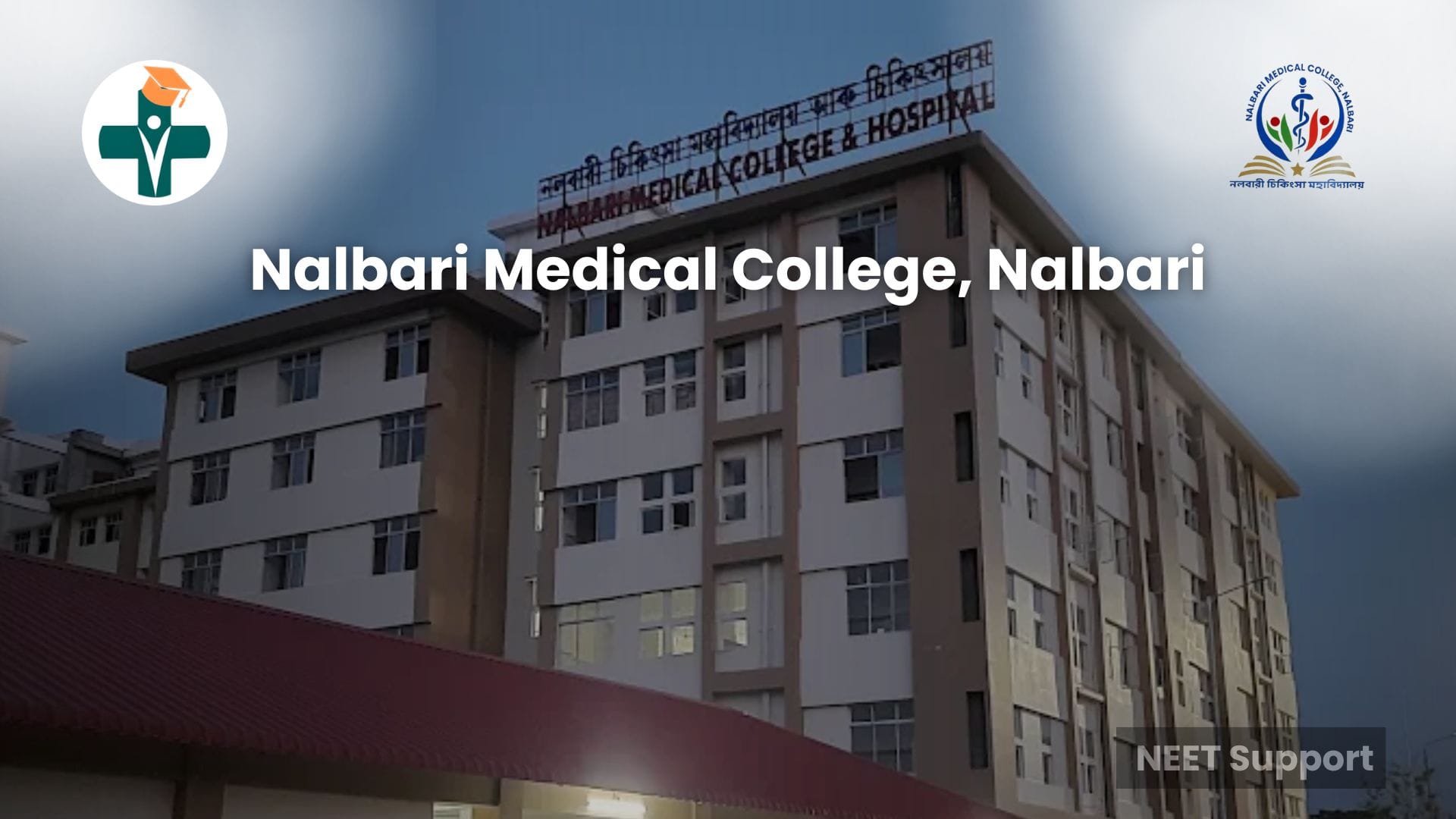
Nalbari Medical College & Hospital, Assam: Complete Guide to MBBS Admission, Fee Structure, NEET Cutoff, Courses, Hostel & Campus Life (2026)
Rashi Goyal
 WhatsApp
 Email
Email Facebook
 Twitter/X
 LinkedIn
Table of Contents
Predict Your Rank Now
Enter your NEET score to get an estimated rank
Find the Best Colleges For You
Based on your NEET rank, Category & more

Get Your Dream Medical College
Secure your seat with expert counselling
Introduction
Nalbari Medical College & Hospital (NMCH) is one of Assam's newest government medical colleges, established to strengthen healthcare services and expand medical education across the state. Located in Nalbari district, the institution was developed by the Government of Assam to meet the growing demand for qualified medical professionals while improving access to quality healthcare in Lower Assam.
The college is affiliated with the Srimanta Sankaradeva University of Health Sciences (SSUHS) and is recognized by the National Medical Commission (NMC). It follows the Competency-Based Medical Education (CBME) curriculum, ensuring that students receive modern medical training through classroom teaching, laboratory sessions, clinical postings, and community healthcare exposure.
Nalbari Medical College currently offers the MBBS programme with an annual intake of 100 students. With modern infrastructure, well-equipped laboratories, experienced faculty, and a teaching hospital, the institution is rapidly becoming one of the preferred destinations for NEET aspirants seeking affordable government medical education in Assam.
History of Nalbari Medical College & Hospital
The Government of Assam established Nalbari Medical College as part of its mission to strengthen healthcare infrastructure throughout the state. Before the college was established, students from Nalbari and neighbouring districts often had to travel to Guwahati or other parts of Assam for medical education and specialized treatment.
The institution was developed with the objective of improving healthcare accessibility while creating opportunities for students from the region to pursue medical education closer to home.
Since its establishment, the college has continued to expand its academic facilities, hospital services, and infrastructure. It now serves as an important healthcare centre for thousands of patients while providing quality undergraduate medical education.
Recognition and Affiliation
Nalbari Medical College & Hospital is officially recognized by the National Medical Commission (NMC).
The college is affiliated with the Srimanta Sankaradeva University of Health Sciences (SSUHS), Guwahati, which conducts examinations and awards the MBBS degree. The university oversees the academic curriculum for government medical colleges throughout Assam.
The institution follows all NMC regulations regarding:
- Medical curriculum
- Faculty requirements
- Laboratory standards
- Clinical training
- Internship programme
- Student assessment
Campus and Infrastructure
The Nalbari Medical College campus has been designed to provide an ideal environment for medical education, patient care, and research.
Major facilities include:
- Academic block
- Administrative building
- Modern lecture theatres
- Departmental laboratories
- Central library
- Teaching hospital
- Hostel complexes
- Auditorium
- Cafeteria
- Sports facilities
- Faculty residences
The infrastructure meets NMC standards and supports competency-based medical education.
Smart Classrooms and Lecture Theatres
The college has spacious lecture halls equipped with modern teaching technologies.
Features include:
- Audio-visual teaching systems
- LCD projectors
- Smart classrooms
- Interactive learning sessions
- Comfortable seating
Faculty members use digital teaching methods to improve students' understanding of medical concepts.
Central Library
The central library serves as the primary academic resource for undergraduate students.
The library includes:
- Standard MBBS textbooks
- Medical reference books
- National journals
- International journals
- Digital learning resources
- Reading halls
- Computer facilities
Students also have access to online educational resources and medical databases to support academic learning and research.
Laboratory Facilities
Practical learning is an essential component of medical education.
The college has modern laboratories for:
- Anatomy
- Physiology
- Biochemistry
- Pathology
- Pharmacology
- Microbiology
- Forensic Medicine
Students receive practical training under experienced faculty members, enabling them to develop laboratory skills and understand disease processes effectively.
Hospital Facilities
The attached teaching hospital provides comprehensive healthcare services while serving as the clinical training centre for MBBS students.
The hospital offers:
- Outpatient Department (OPD)
- Inpatient wards
- Emergency services
- Operation theatres
- Intensive Care Unit (ICU)
- Blood bank
- Pharmacy
- Diagnostic laboratories
- Radiology services
- Labour room
Students receive hands-on clinical exposure through supervised hospital postings.
Courses Offered
At present, Nalbari Medical College offers the following undergraduate programme:
| Course | Duration | Annual Intake |
|---|---|---|
| MBBS | 5.5 Years (4.5 Years Academic + 1-Year Internship) | 100 |
Currently, the college does not offer MD, MS, DM, M.Ch., nursing, or paramedical programmes. These may be introduced in the future after receiving the necessary approvals.
MBBS Course Details
The MBBS programme is designed to prepare students for careers in medicine, surgery, public health, research, and higher medical education.
Course Duration
- Academic Study: 4.5 Years
- Compulsory Rotating Internship: 1 Year
Total Duration: 5.5 Years
Subjects Covered
Pre-Clinical Phase
- Anatomy
- Physiology
- Biochemistry
Para-Clinical Phase
- Pathology
- Pharmacology
- Microbiology
- Forensic Medicine
- Community Medicine
Clinical Phase
- General Medicine
- General Surgery
- Pediatrics
- Obstetrics & Gynaecology
- Orthopaedics
- Ophthalmology
- ENT
- Dermatology
- Psychiatry
- Anaesthesiology
- Radiology
The curriculum emphasizes practical learning, communication skills, ethics, and patient-centered care.
MBBS Seat Intake
Nalbari Medical College currently has an annual intake of 100 MBBS seats.
| Course | Seats |
|---|---|
| MBBS | 100 |
The seats are generally distributed as:
- 15% All India Quota (AIQ)
- 85% Assam State Quota
Admissions are conducted through the NEET-UG counselling process.
Admission Process
Admission to the MBBS programme is based entirely on the NEET-UG examination.
The admission process includes:
- Qualify NEET-UG.
- Register for the counselling process.
- Fill in college preferences.
- Participate in seat allotment.
- Complete document verification.
- Pay admission fees.
- Report to the college within the prescribed timeline.
Candidates applying under the Assam State Quota must also satisfy the domicile and eligibility requirements specified by the state counselling authority.
Academic Departments
Nalbari Medical College & Hospital has established 22 academic departments as required under the National Medical Commission (NMC) guidelines for undergraduate medical education. These departments cover pre-clinical, para-clinical, and clinical disciplines, ensuring students receive comprehensive theoretical knowledge and practical exposure throughout the MBBS programme.
Pre-Clinical Departments
The first phase of the MBBS curriculum focuses on building a strong foundation in medical sciences.
Department of Anatomy
The Department of Anatomy introduces students to the structure of the human body through:
- Human dissection
- Histology practicals
- Embryology
- Osteology
- Museum demonstrations
Students gain an in-depth understanding of the human body's anatomical structures before beginning clinical training.
Department of Physiology
Physiology helps students understand how different organs and body systems function under normal conditions.
Major areas include:
- Cardiovascular physiology
- Respiratory physiology
- Neurophysiology
- Endocrinology
- Blood physiology
- Practical laboratory exercises
Department of Biochemistry
Biochemistry explains the chemical and molecular basis of human health and disease.
Students learn about:
- Enzymes
- Proteins
- Metabolism
- Molecular biology
- Clinical biochemistry
- Laboratory investigations
Para-Clinical Departments
During the second phase of MBBS, students develop knowledge about diseases, medicines, and preventive healthcare.
Major departments include:
- Pathology
- Pharmacology
- Microbiology
- Forensic Medicine
- Community Medicine
These departments provide practical laboratory training alongside classroom teaching.
Department of Pathology
Students study:
- Disease mechanisms
- Histopathology
- Blood disorders
- Laboratory diagnosis
- Clinical pathology
Department of Pharmacology
Students learn:
- Drug classifications
- Mechanism of action
- Therapeutic uses
- Adverse drug reactions
- Rational prescribing
Department of Microbiology
Topics covered include:
- Bacteriology
- Virology
- Mycology
- Immunology
- Infection prevention
Department of Forensic Medicine
Students are introduced to:
- Medical jurisprudence
- Toxicology
- Medico-legal procedures
- Post-mortem studies
Department of Community Medicine
The department emphasizes preventive healthcare through:
- Rural health surveys
- Disease prevention programmes
- Vaccination awareness
- Public health education
- Epidemiology
Clinical Departments
Clinical training is conducted in the attached teaching hospital across multiple specialties.
Major departments include:
- General Medicine
- General Surgery
- Pediatrics
- Obstetrics & Gynaecology
- Orthopaedics
- Ophthalmology
- ENT
- Dermatology
- Psychiatry
- Anaesthesiology
- Radiodiagnosis
- Emergency Medicine
Students participate in ward postings, outpatient departments, operation theatre observations, and bedside teaching under faculty supervision.
Faculty and Teaching Methodology
Nalbari Medical College has appointed experienced professors, associate professors, assistant professors, tutors, and resident doctors across its departments.
The college follows the Competency-Based Medical Education (CBME) curriculum prescribed by the National Medical Commission.
Teaching methods include:
- Interactive classroom lectures
- Practical demonstrations
- Laboratory sessions
- Clinical case discussions
- Small-group learning
- Seminars
- Tutorials
- Bedside teaching
- Internal assessments
The emphasis is on developing not only medical knowledge but also communication skills, professionalism, ethics, and patient-centered care.
Clinical Training
Clinical exposure begins during the later phase of the MBBS programme and is an integral part of medical education.
The attached teaching hospital has:
- 500 beds
- 45 ICU beds (26 operational)
- Around 500–600 OPD patients daily
- 24×7 emergency and trauma care
- Specialty clinics including dialysis, de-addiction, adolescent health, ICTC, tuberculosis services, and family planning counselling.
Students receive hands-on training in:
- Patient history taking
- Physical examination
- Clinical diagnosis
- Ward management
- Emergency care
- Operation theatre protocols
- Patient counselling
- Medical ethics
This practical exposure prepares students for internship and independent medical practice.
Internship Programme
After successfully completing the academic curriculum, every MBBS student undergoes a one-year compulsory rotating internship.
Internship postings generally include:
- General Medicine
- General Surgery
- Pediatrics
- Obstetrics & Gynaecology
- Orthopaedics
- Community Medicine
- Emergency Medicine
- Ophthalmology
- ENT
The internship develops confidence in clinical decision-making and patient management.
Research and Academic Development
Although Nalbari Medical College is a relatively new institution, it encourages evidence-based medicine and research-oriented learning among students and faculty. The college aims to strengthen research activities as it expands its academic programmes.
Students are encouraged to participate in:
- Scientific seminars
- Medical conferences
- Research projects
- Poster presentations
- Community health studies
Research exposure enhances analytical thinking and prepares students for postgraduate education.
Hostel Facilities
The college provides separate hostel accommodation for male and female students. A dedicated hostel committee oversees hostel management, discipline, and student welfare.
Hostel facilities include:
- Furnished rooms
- Study tables
- Common rooms
- Mess facilities
- Wi-Fi access
- 24-hour security
- Clean drinking water
- Recreational spaces
Hostel accommodation allows students to remain close to academic departments and the teaching hospital, making clinical postings and study schedules more convenient.
Library and Digital Learning Resources
The central library supports academic learning through a wide collection of educational resources.
Available facilities include:
- Standard MBBS textbooks
- National journals
- International journals
- Digital databases
- Reading halls
- Computer access
Students use these resources for:
- University examinations
- NEET-PG preparation
- Research
- Clinical learning
Student Life
Life at Nalbari Medical College extends beyond academics. Students participate in various extracurricular and co-curricular activities throughout the year.
Popular activities include:
- Freshers' programmes
- Cultural festivals
- Sports competitions
- Medical quizzes
- Debate competitions
- Blood donation camps
- Health awareness campaigns
- Scientific workshops
These activities help students develop leadership, teamwork, communication skills, and overall personality.
Community Outreach Programmes
The Department of Community Medicine organizes healthcare outreach programmes that allow students to understand public health challenges.
Activities include:
- Rural health camps
- School health programmes
- Vaccination drives
- Maternal and child healthcare awareness
- Screening programmes
- Health education campaigns
These experiences help students appreciate the importance of preventive medicine and community healthcare.
Career Opportunities After MBBS
Graduates from Nalbari Medical College have multiple career pathways after completing their MBBS degree.
Career opportunities include:
- Government Medical Officer
- Private Hospital Doctor
- Junior Resident
- Medical Research
- Public Health Specialist
- Hospital Administration
- Armed Forces Medical Services
- Medical Education
- International licensing examinations such as USMLE and PLAB
- Postgraduate studies through NEET-PG
Many graduates pursue MD or MS specializations in disciplines such as General Medicine, Surgery, Pediatrics, Orthopaedics, Radiology, Dermatology, and Anaesthesiology.
Why Choose Nalbari Medical College?
Nalbari Medical College offers several advantages for aspiring doctors:
- Government medical college with affordable fees
- NMC-recognized MBBS programme
- SSUHS affiliation
- 100 MBBS seats annually
- Modern infrastructure
- 500-bed teaching hospital
- Experienced faculty
- Separate hostels for boys and girls
- Competency-Based Medical Education curriculum
- Strong clinical exposure
- Growing opportunities for research and future postgraduate programmes
With its modern facilities, expanding healthcare services, and commitment to quality medical education, Nalbari Medical College is emerging as an excellent choice for students aspiring to build a successful medical career in Assam and beyond.
MBBS Fee Structure
Nalbari Medical College & Hospital is a government medical college under the Government of Assam, offering medical education at an affordable cost. The fee structure includes government fees, institutional charges, and one-time payments collected during admission. The latest published fee details are available on the college's official admission page.
MBBS Admission Fee Structure
| Fee Component | Amount (₹) |
|---|---|
| Admission Fee | 1,000 |
| Tuition Fee | 1,200 |
| Examination Fee | 200 |
| Government Fee Total | 2,400 |
| Security Deposit (One Time) | 2,000 |
| Examination Fund | 500 |
| Student Union Fee | 1,000 |
| Games Fee | 1,000 |
| Magazine Fee | 500 |
| Common Room Fee | 1,000 |
| Student Welfare Fund | 5,000 |
| Wi-Fi & Logbook | 1,000 |
| Library Fee | 1,000 |
| Correspondence Fee | 2,000 |
| Non-Government Fee Total | 15,500 |
| Total Admission Fee | 17,900 |
| Hostel Fee (One Time, if allotted) | 6,000 |
| Grand Total (With Hostel) | 23,900 |
The above fee structure is subject to revision by the Government of Assam and the college authorities. Students should verify the latest fee notification before admission.
Hostel Facilities and Charges
The college provides separate hostel accommodation for male and female MBBS students.
Hostel facilities include:
- Furnished rooms
- Study tables
- Reading rooms
- Common rooms
- Mess facility
- Safe drinking water
- Round-the-clock security
- Recreation areas
Students allotted hostel accommodation are required to pay the prescribed hostel fee and mess charges as notified by the college administration.
Courses Offered
At present, Nalbari Medical College offers only the undergraduate MBBS programme.
| Course | Duration | Annual Intake |
|---|---|---|
| MBBS | 5.5 Years (Including Internship) | 100 |
Currently, the college does not offer:
- MD
- MS
- DM
- M.Ch.
- B.Sc. Nursing
- Allied Health Sciences
- Paramedical Courses
These programmes may be introduced in the future after receiving the required approvals from the National Medical Commission and the state government.
MBBS Seat Distribution
The annual intake for the MBBS course is 100 students.
| Quota | Seat Distribution |
|---|---|
| All India Quota | 15% |
| Assam State Quota | 85% |
Admissions are conducted through NEET-UG counselling under the Medical Counselling Committee (MCC) and the Directorate of Medical Education, Assam.
Nalbari Medical College NEET Cutoff (2025 Trend)
Admission to Nalbari Medical College is highly competitive due to the limited number of seats available.
The available NEET UG 2025 trend is:
| Category | Opening Rank | Closing Rank |
|---|---|---|
| General (AIQ) | 18,291 | 75,575 |
The cutoff varies every year depending on:
- Number of NEET applicants
- Difficulty level of the examination
- Seat availability
- Reservation policy
- Counselling rounds
- Candidate preferences
Expected NEET Score
Based on recent government medical college admission trends, candidates may consider the following score ranges as indicative targets.
| Category | Expected NEET Score |
|---|---|
| General | 610–650 |
| EWS | 600–640 |
| OBC | 590–630 |
| SC | 470–540 |
| ST | 430–510 |
These are only estimated ranges and should not be considered official cutoffs.
Scholarships
Students studying at Nalbari Medical College may be eligible for several scholarship schemes offered by the Central and Assam State Governments.
Major scholarship schemes include:
- National Scholarship Portal (NSP)
- Post-Matric Scholarship for SC students
- Post-Matric Scholarship for ST students
- OBC Scholarship
- Economically Weaker Section (EWS) assistance
- Minority Scholarship Schemes
- Government of Assam merit-based scholarships
Students should check the eligibility criteria and application deadlines on the respective scholarship portals.
Documents Required for Admission
Candidates reporting for admission should generally carry the following documents:
- NEET-UG Admit Card
- NEET Scorecard
- Allotment Letter
- Class 10 Mark Sheet and Certificate
- Class 12 Mark Sheet and Certificate
- Aadhaar Card
- Passport-size photographs
- Category Certificate (if applicable)
- EWS Certificate (if applicable)
- Domicile/PRC (for State Quota candidates)
- Medical Fitness Certificate
The exact document list is notified by the college before each admission session.
Career Opportunities After MBBS
Graduates from Nalbari Medical College have a wide range of career opportunities after completing the MBBS programme.
Career options include:
- Government Medical Officer
- Junior Resident
- Private Hospital Doctor
- Primary Health Centre Medical Officer
- Armed Forces Medical Services
- Medical Research
- Public Health Specialist
- Hospital Administration
- Medical Teaching
- Postgraduate studies through NEET-PG
- International licensing examinations such as USMLE and PLAB
Many graduates pursue MD or MS specializations in fields such as General Medicine, General Surgery, Pediatrics, Orthopaedics, Obstetrics & Gynaecology, Radiology, Dermatology, and Anaesthesiology.
Frequently Asked Questions (FAQs)
Is Nalbari Medical College a government medical college?
Yes. Nalbari Medical College & Hospital is a government medical college established by the Government of Assam and recognized by the National Medical Commission.
How many MBBS seats are available?
The college offers 100 MBBS seats every academic year.
Which entrance examination is required?
Admission is based solely on the NEET-UG examination followed by counselling.
Does the college offer postgraduate courses?
Currently, the college offers only the MBBS programme. MD and MS courses have not yet commenced.
What is the admission fee?
The total admission fee is ₹17,900, while students allotted hostel accommodation pay ₹23,900, including the one-time hostel fee.
Conclusion
Nalbari Medical College & Hospital has quickly emerged as one of Assam's promising government medical institutions, offering affordable and quality medical education through its MBBS programme. With National Medical Commission recognition, affiliation with Srimanta Sankaradeva University of Health Sciences, a 100-seat annual intake, modern infrastructure, experienced faculty, and a well-equipped teaching hospital, the college provides an excellent academic environment for aspiring doctors.
Its affordable fee structure, expanding clinical services, competency-based curriculum, and growing infrastructure make it an attractive option for NEET aspirants seeking admission to a government medical college in Northeast India. As the institution continues to develop with enhanced facilities and future postgraduate programmes, Nalbari Medical College is expected to play a significant role in medical education and healthcare delivery across Assam.
Reviews
No reviews yet. Be the first to write one!