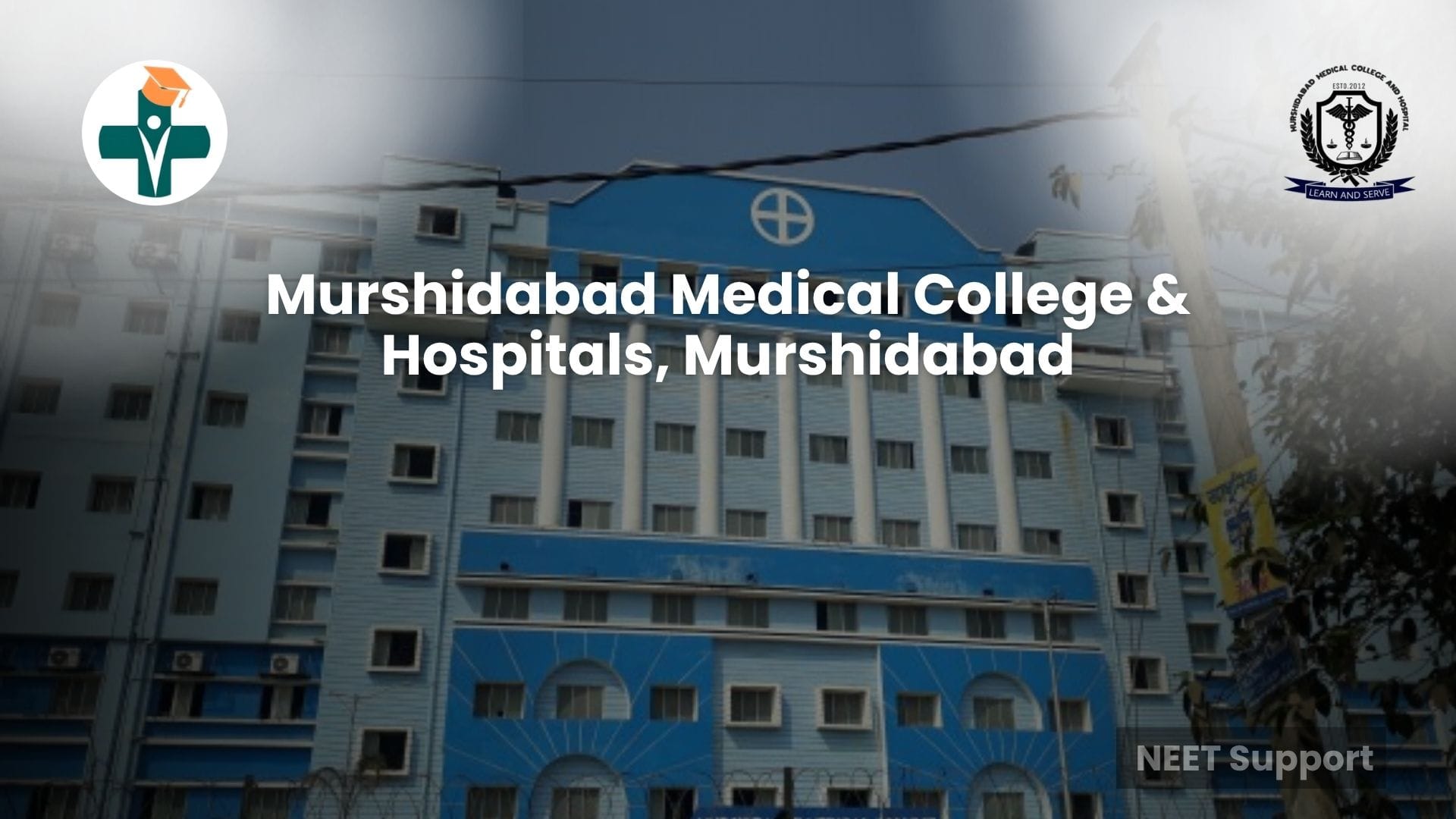
Murshidabad Medical College & Hospital, Murshidabad: Complete Admission Guide 2026
Rashi Goyal
 WhatsApp
 Email
Email Facebook
 Twitter/X
 LinkedIn
Table of Contents
Predict Your Rank Now
Enter your NEET score to get an estimated rank
Find the Best Colleges For You
Based on your NEET rank, Category & more

Get Your Dream Medical College
Secure your seat with expert counselling
Introduction
Murshidabad Medical College & Hospital, Murshidabad, is one of the prominent government medical colleges in West Bengal that provides quality medical education along with advanced healthcare services. Established with the aim of strengthening medical infrastructure in the Murshidabad district, the college has become a preferred choice among NEET UG aspirants looking for an affordable and reputed government medical college in West Bengal.
The college offers undergraduate MBBS education and postgraduate medical courses in various specialties. With its attached teaching hospital, students receive valuable clinical exposure and practical training during their academic journey. The institution follows the curriculum guidelines prescribed by the National Medical Commission (NMC) and focuses on developing competent healthcare professionals.
For students planning MBBS admission in West Bengal through NEET UG 2026, Murshidabad Medical College & Hospital can be a good option because of its government status, experienced faculty, reasonable fee structure, large patient inflow, and growing academic facilities. This complete admission guide covers all important details, including courses, fees, cutoff, admission process, hostel facilities, infrastructure, internship opportunities, and career prospects.
About Murshidabad Medical College & Hospital
Murshidabad Medical College & Hospital was established in 2012 in Berhampore, Murshidabad district of West Bengal. The college was developed by the Government of West Bengal to improve medical education facilities and provide specialized healthcare services to the people of Murshidabad and surrounding districts.
The college campus is located in Berhampore, which is an important educational and administrative centre of Murshidabad district. The institution has modern academic buildings, lecture halls, laboratories, departmental facilities, library resources, hostels, and a teaching hospital that provides healthcare services across multiple specialties.
The attached Murshidabad Medical College Hospital serves as the main clinical training centre for MBBS and postgraduate students. The hospital receives a large number of patients from rural and urban areas, giving students exposure to diverse medical conditions. This practical experience helps students develop confidence in diagnosis, treatment planning, emergency management, and patient communication.
The college is affiliated with the West Bengal University of Health Sciences (WBUHS), Kolkata, and recognized by the National Medical Commission (NMC). It follows the Competency-Based Medical Education (CBME) pattern to ensure students receive balanced theoretical and practical medical training.
College Highlights
| Particular | Details |
|---|---|
| College Name | Murshidabad Medical College & Hospital |
| Popular Name | MMC Murshidabad |
| Location | Berhampore, Murshidabad, West Bengal |
| Establishment Year | 2012 |
| College Type | Government Medical College |
| Ownership | Government of West Bengal |
| Affiliated University | West Bengal University of Health Sciences (WBUHS) |
| Approved By | National Medical Commission (NMC) |
| Courses Offered | MBBS, MD, MS |
| Admission Basis | NEET UG and NEET PG |
| Counselling Authority | WBMCC and MCC |
| Teaching Hospital | Murshidabad Medical College Hospital |
| Campus Type | Urban |
| Hostel Facility | Available |
| MBBS Seats | 125 (subject to annual approval) |
Why Choose Murshidabad Medical College & Hospital?
Murshidabad Medical College & Hospital is considered a good choice for students who want to pursue MBBS from a government institution with affordable fees and good clinical exposure. Government medical colleges generally provide better financial accessibility compared to private medical colleges, and this college is no exception.
One of the major advantages of studying here is the attached teaching hospital. Since the hospital caters to a large population of Murshidabad district and nearby regions, students get exposure to a wide variety of clinical cases. This helps them understand real-world medical situations during their MBBS training.
The college also provides a disciplined academic environment with qualified faculty members, well-equipped departments, practical laboratories, and regular academic activities. Students get opportunities to participate in seminars, workshops, medical camps, research activities, and community health programs.
Another advantage is its location in West Bengal. Students studying here can access the educational and healthcare ecosystem of the state while enjoying the comparatively lower cost of living in Murshidabad compared to metropolitan cities.
Affiliation, Recognition, and Accreditation
Murshidabad Medical College & Hospital is affiliated with the West Bengal University of Health Sciences (WBUHS), Kolkata. The university is responsible for academic regulations, examinations, curriculum implementation, and awarding medical degrees.
The college is recognized by the National Medical Commission (NMC), which regulates medical education standards in India. NMC approval ensures that the institution follows required norms related to faculty strength, infrastructure, hospital facilities, curriculum, and student training.
The MBBS program follows the Competency-Based Medical Education curriculum introduced by NMC. This approach focuses not only on theoretical knowledge but also on clinical skills, ethical medical practice, communication abilities, and practical decision-making.
Students completing MBBS from Murshidabad Medical College become eligible for postgraduate entrance examinations such as NEET PG and can pursue careers in government hospitals, private healthcare organizations, research institutions, and other medical fields according to prevailing regulations.
Courses Offered
Murshidabad Medical College & Hospital offers undergraduate and postgraduate medical programs. The MBBS course is the main attraction for NEET UG aspirants, while postgraduate programs provide opportunities for specialization after completing MBBS.
Undergraduate Course
| Course | Duration | Admission Through |
|---|---|---|
| MBBS | 5.5 Years including 1-year Internship | NEET UG |
The MBBS program includes four and a half years of academic education followed by one year of compulsory rotating internship. During the internship period, students work in different departments and gain practical experience under senior doctors.
Postgraduate Courses
| Course | Duration | Admission Through |
|---|---|---|
| MD | 3 Years | NEET PG |
| MS | 3 Years | NEET PG |
The availability of postgraduate courses depends on annual approval by the National Medical Commission. The number of seats and specialties may change according to institutional requirements and regulatory permissions.
MBBS Seat Matrix
Murshidabad Medical College & Hospital has approximately 125 MBBS seats. The final seat distribution is decided according to government reservation policies and counselling guidelines.
| Category | Seat Distribution |
|---|---|
| Total MBBS Seats | 125 |
| All India Quota (AIQ) | 15% |
| State Quota | 85% |
| Reserved Categories | As per Government norms |
The seat matrix may change depending on the latest approval issued by the National Medical Commission and counselling authorities for the 2026 admission session.
Department-Wise Medical Specialties
The college has multiple departments that support undergraduate medical education and postgraduate training. These departments provide both classroom teaching and clinical training.
| Department Type | Major Departments |
|---|---|
| Pre-Clinical | Anatomy, Physiology, Biochemistry |
| Para-Clinical | Pathology, Pharmacology, Microbiology, Forensic Medicine |
| Clinical | General Medicine, General Surgery, Pediatrics, Orthopaedics, Obstetrics & Gynaecology, ENT, Ophthalmology, Anaesthesiology, Radiology, Psychiatry |
Each department contributes to the overall medical education system by providing lectures, demonstrations, practical sessions, clinical postings, and research opportunities.
Academic Environment
The academic environment at Murshidabad Medical College focuses on creating skilled doctors through a combination of classroom learning, laboratory practice, and hospital-based clinical training. Faculty members guide students through lectures, practical demonstrations, seminars, case discussions, and bedside teaching.
The college follows a structured academic calendar that includes internal assessments, university examinations, clinical postings, and extracurricular academic activities. Students are encouraged to participate in conferences, workshops, health awareness programs, and research-related activities.
The combination of academic learning and clinical exposure helps students develop the knowledge and confidence required for professional medical practice.
MBBS Fee Structure
Murshidabad Medical College & Hospital is a government medical college; therefore, its MBBS fee structure is significantly lower compared to private medical colleges. This makes it an attractive option for students who want quality medical education at an affordable cost. The total expenses mainly include tuition fees, admission charges, university fees, hostel charges, security deposit, examination fees, and other institutional expenses.
The exact fee structure may change according to notifications released by the Government of West Bengal, West Bengal University of Health Sciences (WBUHS), and counselling authorities. Students should verify the latest official fee details before admission.
MBBS Fee Structure (Approximate)
| Fee Component | Amount (Approx.) |
|---|---|
| Tuition Fee | ₹30,000–₹35,000 per year |
| Admission Fee | As applicable |
| University Registration Fee | As applicable |
| Caution Deposit | ₹2,000–₹5,000 (Refundable) |
| Examination Fee | As per university rules |
| Miscellaneous Charges | As notified |
The total MBBS academic fee for the complete course remains comparatively low because the college is a government institution. Candidates should also consider personal expenses such as books, instruments, travel, food, and other daily requirements.
MBBS Fee Structure According to Admission Quota
Murshidabad Medical College & Hospital mainly admits students through government counselling channels. There is no management quota or NRI quota because it is a government medical college.
| Admission Category | Fee Structure |
|---|---|
| All India Quota (AIQ) | Government prescribed fee |
| West Bengal State Quota | Government prescribed fee |
| Reserved Categories | As per government rules |
| Management Quota | Not Available |
| NRI Quota | Not Available |
The final payable amount may vary slightly depending on university charges and annual revisions.
MD/MS Fee Structure
After completing MBBS, students can apply for postgraduate medical courses through NEET PG. Murshidabad Medical College & Hospital offers MD and MS programs in different specialties, depending on approval from the National Medical Commission.
The postgraduate fee structure is much lower than that of private medical colleges because it is a government institution.
MD/MS Fee Structure (Approximate)
| Course | Duration | Estimated Fee |
|---|---|---|
| MD | 3 Years | Around ₹45,000–₹50,000 Total |
| MS | 3 Years | Around ₹45,000–₹50,000 Total |
| Hostel Charges | Extra | As applicable |
| University Fees | As applicable | As per rules |
Fees may differ according to specialization and government notifications.
Hostel Fee Structure
Murshidabad Medical College & Hospital provides hostel facilities for MBBS and postgraduate students. Separate hostel arrangements are generally available for male and female students. Hostel accommodation helps students stay close to academic buildings and the teaching hospital.
The hostel provides basic facilities, including:
- Furnished rooms
- Electricity and water supply
- Common areas
- Security arrangements
- Study environment
- Mess facility
Hostel Fees (Approximate)
| Particular | Amount |
|---|---|
| Hostel Fee | ₹10,000–₹15,000 per year |
| Security Deposit | As applicable |
| Mess Charges | As per actual usage |
| Electricity/Other Charges | As notified |
Hostel charges may vary depending on accommodation type and institutional policies.
Other Charges
Apart from tuition and hostel fees, students may need to pay several additional charges during admission and throughout the course.
| Charge Type | Approximate Details |
|---|---|
| Admission Fee | As prescribed |
| College Registration Fee | As applicable |
| Library Fee | As notified |
| Laboratory Charges | As applicable |
| Examination Fee | University prescribed |
| Identity Card Fee | As applicable |
| Miscellaneous Charges | As per college rules |
Candidates should keep additional funds available for medical books, practical instruments, uniforms, transportation, and personal expenses.
Eligibility Criteria for MBBS Admission
Students who wish to take admission to MBBS at Murshidabad Medical College & Hospital must fulfill the eligibility criteria prescribed by the National Medical Commission (NMC) and NEET UG counselling authorities.
Educational Qualification
Candidates must have:
- Passed Class 12 or equivalent examination from a recognized board.
- Studied Physics, Chemistry, Biology/Biotechnology, and English as compulsory subjects.
- Obtained the minimum required percentage according to their category.
NEET UG Qualification
Admission is completely based on NEET UG performance. Candidates must:
- Appear for the NEET UG examination.
- Qualify according to NTA and NMC eligibility criteria.
- Participate in counselling conducted by MCC or WBMCC.
Age Criteria
Candidates must fulfill the age requirements mentioned in the NEET UG information bulletin.
The eligibility rules may change for the 2026 admission session depending on updates from NTA, NMC, and counselling authorities.
Admission Process Through NEET UG 2026
Admission to the Murshidabad Medical College & Hospital MBBS program is conducted through centralized counselling based on the NEET UG rank.
The admission process includes the following steps:
Step 1: Appear for the NEET UG Examination
Students must register for and appear in the NEET UG examination conducted by the National Testing Agency (NTA).
Step 2: Declaration of NEET Result
After the examination, NTA releases:
- NEET scorecard
- All India Rank
- Category rank
- Qualifying status
Step 3: Counselling Registration
Eligible candidates must register for counselling:
- MCC counselling for All India Quota seats
- West Bengal Medical Counselling Committee (WBMCC) for state quota seats
Step 4: Choice Filling
Candidates select preferred medical colleges according to their NEET rank and eligibility.
Step 5: Seat Allotment
Seats are allotted based on:
- NEET rank
- Category
- Reservation rules
- Choice preference
- Availability of seats
Step 6: Reporting to College
Selected candidates must report to Murshidabad Medical College & Hospital with original documents and complete admission formalities.
Admission Process Through NEET PG
Students seeking MD/MS admission must qualify for NEET PG conducted by the National Board of Examinations (NBE).
The process includes:
- Qualifying NEET PG examination.
- Registering for MCC or state counselling.
- Selecting Murshidabad Medical College according to preference.
- Participating in seat allotment rounds.
- Completing document verification.
- Paying admission fees and joining the allotted department.
Postgraduate admission depends on NEET PG rank, category, specialty preference, and available seats.
Documents Required for Admission
Candidates should carry original documents along with photocopies during counselling and college reporting.
Required Documents List
| Document | Required |
|---|---|
| NEET UG Admit Card | Yes |
| NEET UG Score Card | Yes |
| NEET Allotment Letter | Yes |
| Class 10 Certificate | Yes |
| Class 12 Mark Sheet | Yes |
| Class 12 Passing Certificate | Yes |
| Transfer Certificate | Yes |
| Migration Certificate | If applicable |
| Character Certificate | Yes |
| Caste Certificate | If applicable |
| EWS Certificate | If applicable |
| Domicile Certificate | For State Quota |
| Aadhaar Card | Yes |
| Passport Size Photographs | Yes |
| Medical Fitness Certificate | Yes |
Candidates belonging to reserved categories must carry valid certificates issued by competent authorities.
Important Dates for Admission 2026
The exact NEET UG 2026 counselling schedule will be announced after the NEET UG result declaration.
| Event | Expected Timeline |
|---|---|
| NEET UG Examination | May 2026 |
| NEET Result Declaration | June 2026 |
| MCC Counselling Registration | July–August 2026 |
| WBMCC Counselling | July–August 2026 |
| Seat Allotment Rounds | August–September 2026 |
| College Reporting | After Allotment |
Dates are tentative and may change according to official announcements.
NEET UG Cutoff 2026 (Expected)
Murshidabad Medical College & Hospital is a government medical college; therefore, admission competition remains high every year. Students are selected through NEET UG counselling based on their All India Rank, category, reservation rules, and availability of seats. The college had 125 MBBS seats approved for the 2025–26 academic session according to the NMC MBBS seat matrix.
The actual NEET UG 2026 cutoff will be released only after completion of the MCC and West Bengal counselling rounds. The expected cutoff can be estimated by analysing previous admission trends, but it should not be considered final.
Expected NEET UG Cutoff 2026 (Approximate)
| Category | Expected NEET Score Range | Expected Rank Range |
|---|---|---|
| General (AIQ) | 620–650+ | Below 30,000 |
| EWS | 610–640+ | Below 40,000 |
| OBC | 610–640+ | Below 45,000 |
| SC | 500–560 | Depends on counselling |
| ST | 450–520 | Depends on counselling |
The cutoff can change depending on NEET difficulty level, number of applicants, seat availability, and overall performance of candidates.
Previous Year Cutoff Trends
The previous year's cutoff trends help students understand the level of competition for admission. Government medical colleges in West Bengal generally receive a high number of applications because of their low fee structure and good clinical exposure.
For accurate closing ranks, candidates should refer to official MCC and WBMCC counselling results after each round. Educational portals also publish year-wise cutoff trends based on counselling data.
Previous Year Admission Trend (Approximate)
| Year | Admission Trend |
|---|---|
| 2023 | High competition among government colleges |
| 2024 | Similar demand due to affordable fees |
| 2025 | Strong competition for MBBS seats |
| 2026 | Expected to remain competitive |
Students should focus on securing a good NEET rank rather than depending only on previous cutoff marks because yearly trends can vary.
Infrastructure and Campus Facilities
Murshidabad Medical College & Hospital has developed a modern academic campus to support undergraduate and postgraduate medical education. The campus includes academic blocks, lecture theatres, departmental facilities, laboratories, administrative sections, hostels, and healthcare facilities.
The college provides spacious classrooms equipped with teaching aids, demonstration rooms, practical laboratories, and seminar halls. The infrastructure is designed according to medical education requirements prescribed by regulatory authorities.
Students have access to departmental museums, practical training facilities, skill development areas, and clinical learning environments. The continuous development of infrastructure has helped the college improve its academic standards since its establishment.
Teaching Hospital and Clinical Exposure
The attached Murshidabad Medical College Hospital is one of the biggest advantages for students studying here. The hospital provides healthcare services to a large population from Murshidabad district and neighbouring areas.
During MBBS training, students get exposure to various departments, including:
- General Medicine
- General Surgery
- Pediatrics
- Obstetrics and Gynaecology
- Orthopaedics
- ENT
- Ophthalmology
- Anaesthesiology
- Radiology
- Emergency Medicine
The hospital receives patients from both rural and urban backgrounds. This allows students to understand different disease patterns and gain practical experience in diagnosis and treatment.
Clinical postings begin during the MBBS course, where students learn patient examination, history taking, clinical decision-making, and basic medical procedures under the guidance of faculty members and senior doctors.
Library Facilities
The central library of Murshidabad Medical College provides academic resources required for MBBS and postgraduate studies. Medical education requires extensive reading and regular reference work, and the library supports students with textbooks, journals, medical databases, and study spaces.
Major library facilities include:
| Facility | Availability |
|---|---|
| Medical Textbooks | Available |
| Reference Books | Available |
| National & International Journals | Available |
| Reading Room | Available |
| Digital Resources | Available |
| Internet Facility | Available |
Students can use library resources for preparing lectures, seminars, practical examinations, research projects, and postgraduate entrance examinations.
Laboratory Facilities
Medical education requires strong practical training, and the college provides laboratories for various departments. These laboratories help students understand concepts through practical demonstrations and experiments.
Major Laboratories
| Department | Laboratory Facilities |
|---|---|
| Anatomy | Dissection Hall, Specimen Museum |
| Physiology | Practical Laboratory |
| Biochemistry | Diagnostic Laboratory |
| Pathology | Histopathology Facilities |
| Microbiology | Microbiology Laboratory |
| Pharmacology | Experimental Learning Facilities |
Clinical departments also provide practical learning through hospital-based training and patient interaction.
Hostel Facilities
Murshidabad Medical College provides hostel facilities for undergraduate and postgraduate students. Separate accommodation arrangements are available for male and female students.
Hostel facilities generally include:
- Furnished rooms
- Electricity supply
- Drinking water
- Common rooms
- Security arrangements
- Study environment
- Mess facility
Hostel life allows students to interact with classmates from different regions and creates a supportive academic environment.
Hostel Life at Murshidabad Medical College
Medical education requires long study hours and regular hospital postings. Staying inside or near the campus helps students manage their academic schedule efficiently. Students can easily attend early morning clinical postings, practical classes, and examinations.
Sports and Extracurricular Activities
Although medical education is academically demanding, extracurricular activities are an important part of student life. The college encourages students to participate in sports, cultural programs, health awareness campaigns, and social activities.
Common student activities include:
- Cricket
- Football
- Badminton
- Volleyball
- Cultural events
- Medical camps
- Blood donation programs
- Health awareness drives
These activities help students maintain physical fitness and develop teamwork and leadership skills.
Cafeteria and Student Facilities
The college campus provides basic student facilities required for a comfortable academic life. A cafeteria or canteen facility helps students access affordable meals and refreshments during busy academic schedules.
Other facilities may include:
- Internet connectivity
- Student common areas
- Transportation facilities
- Banking facilities nearby
- Medical assistance
- Security services
The availability of these facilities makes campus life more convenient for students.
Faculty and Academic Environment
Murshidabad Medical College has experienced faculty members across various departments. Professors, associate professors, assistant professors, and resident doctors participate in teaching and clinical training activities.
The teaching methodology includes:
- Classroom lectures
- Practical demonstrations
- Clinical postings
- Case discussions
- Seminars
- Tutorials
- Internal assessments
Faculty members guide students throughout their MBBS journey and help them develop both theoretical understanding and clinical skills.
The academic environment focuses on producing competent doctors who can handle healthcare challenges effectively. Regular assessments ensure that students remain consistent with their studies.
Internship and Career Opportunities
After completing the academic portion of MBBS, students must complete a compulsory one-year rotating internship. Internship is an important phase where students apply their theoretical knowledge in real hospital settings.
During the internship, students work in different departments such as:
- Medicine
- Surgery
- Pediatrics
- Obstetrics and Gynaecology
- Community Medicine
- Emergency Services
After completing MBBS from Murshidabad Medical College, graduates can choose several career paths:
- NEET PG preparation
- MD/MS specialization
- Government Medical Officer jobs
- Junior Residency
- Private hospital employment
- Research opportunities
- Public health services
The clinical exposure received during an internship helps students become confident medical professionals.
Research Activities
Research and academic development are encouraged among students and faculty members. Medical students can participate in:
- Research projects
- Medical conferences
- Poster presentations
- Health surveys
- Community medicine programs
- Scientific seminars
Research activities help students develop analytical thinking and improve their understanding of medical science beyond textbooks.
Advantages and Disadvantages
Before selecting any medical college, students and parents should carefully evaluate both the positive aspects and possible limitations of the institution. Murshidabad Medical College & Hospital offers several advantages because of its government status, affordable education, clinical exposure, and academic environment. However, students should also consider certain factors before making a final decision.
Advantages of Murshidabad Medical College & Hospital
Government Medical College Status
Murshidabad Medical College is a government medical college under the Government of West Bengal. Government medical colleges are preferred by many students because they provide quality education at a much lower cost compared to private medical institutions.
Affordable Fee Structure
One of the biggest advantages of this college is its low MBBS fee structure. Students can complete their medical education at a reasonable cost, reducing the financial burden on families.
Good Clinical Exposure
The attached teaching hospital provides students with practical experience in various medical specialties. The hospital serves a large population, allowing students to observe different types of cases during clinical postings and internships.
Recognized Medical Degree
The MBBS degree from Murshidabad Medical College is recognized by the National Medical Commission. Graduates can appear for postgraduate entrance examinations and pursue medical careers across India.
Experienced Faculty
The college has qualified teaching staff who guide students through lectures, practical sessions, clinical postings, and research activities.
Hostel Facility
The availability of hostel accommodation provides students with a comfortable residential environment close to academic and hospital facilities.
Location Advantage
Being located in Berhampore, Murshidabad, the college provides a peaceful academic environment with a lower cost of living compared to major metropolitan cities.
Disadvantages of Murshidabad Medical College & Hospital
Developing Infrastructure
Compared to some older government medical colleges in West Bengal, Murshidabad Medical College is relatively new. Some facilities may still be developing and expanding.
Distance from Kolkata
Students who prefer studying in a metropolitan city may find the location slightly distant from Kolkata. However, Berhampore has good connectivity with the major cities of West Bengal.
Limited Entertainment Options
Since the college is located outside a major urban centre, entertainment and recreational options may be fewer compared to medical colleges located in Kolkata or other large cities.
High Academic Pressure
Like all medical colleges, the MBBS course requires consistent effort, long study hours, regular examinations, and dedication.
Placement and Career Opportunities
Medical colleges generally do not follow traditional placement systems like engineering or management institutions. Instead, graduates build careers through postgraduate education, government services, clinical practice, and healthcare organizations.
Students completing MBBS from Murshidabad Medical College & Hospital have multiple career opportunities.
Career Options After MBBS
| Career Path | Description |
|---|---|
| NEET PG | Admission to MD/MS specialization |
| Junior Residency | Hospital-based clinical experience |
| Government Doctor | State and Central healthcare services |
| Private Hospitals | Medical practice opportunities |
| Research | Clinical and academic research |
| Public Health | Healthcare programs and administration |
After completing MBBS, many students prepare for NEET PG to specialize in fields such as:
- General Medicine
- General Surgery
- Pediatrics
- Radiology
- Dermatology
- Anaesthesiology
- Orthopaedics
- Obstetrics and Gynaecology
Internship Opportunities
The compulsory one-year internship is an important part of MBBS training. Students rotate through various departments and gain practical experience under supervision.
During the internship, students learn:
- Patient examination
- Clinical diagnosis
- Emergency management
- Medical procedures
- Patient counselling
- Hospital administration
The large patient flow at the attached hospital provides valuable exposure, especially in general medicine, surgery, emergency care, and community healthcare.
Scholarships and Financial Assistance
Students of Murshidabad Medical College may be eligible for different scholarship schemes provided by government authorities. Eligibility depends on category, family income, academic performance, and government rules.
Available Scholarship Options
| Scholarship Type | Eligibility |
|---|---|
| National Scholarship Portal (NSP) Schemes | Eligible students according to criteria |
| SC/ST Scholarship | Reserved category students |
| OBC Scholarship | Eligible OBC candidates |
| EWS Assistance | Economically weaker section students |
| State Government Scholarships | As per West Bengal government rules |
| Minority Scholarships | Eligible minority students |
Students should check official scholarship portals regularly for updated information, application dates, and eligibility conditions.
Frequently Asked Questions (FAQs)
1. Is Murshidabad Medical College a government medical college?
Yes, Murshidabad Medical College & Hospital is a government medical college established by the Government of West Bengal.
2. Is Murshidabad Medical College recognized by NMC?
Yes, the college is recognized by the National Medical Commission and follows NMC guidelines for medical education.
3. What is the MBBS admission process?
Admission to MBBS is through NEET UG followed by counselling conducted by MCC for All India Quota and WBMCC for West Bengal State Quota seats.
4. How many MBBS seats are available at Murshidabad Medical College?
The college has approximately 125 MBBS seats, subject to annual approval by the National Medical Commission.
Conclusion
Murshidabad Medical College & Hospital is a reputed government medical college in West Bengal that provides students with an excellent opportunity to pursue MBBS at an affordable cost. The college offers a balanced combination of medical education, clinical training, experienced faculty, and hospital exposure.
For NEET UG aspirants looking for a government medical college in West Bengal, Murshidabad Medical College can be a valuable choice. The attached teaching hospital provides practical learning opportunities, while the government fee structure makes medical education accessible to students from different financial backgrounds.
Although the college is relatively new compared to some century-old medical institutions, it has shown continuous growth in infrastructure, academics, and healthcare services. Students who are willing to work hard and take advantage of available opportunities can build a successful medical career after graduating from this institution.
Candidates planning admission in 2026 should regularly check official notifications from NMC, MCC, WBMCC, and the college website because seat matrix, fee structure, cutoff, and counselling schedules may change every year.
Murshidabad Medical College & Hospital remains one of the important choices for students aiming for MBBS in West Bengal through NEET UG 2026. Its affordable education, clinical exposure, and government recognition make it a strong option among medical colleges in eastern India.
Reviews
No reviews yet. Be the first to write one!