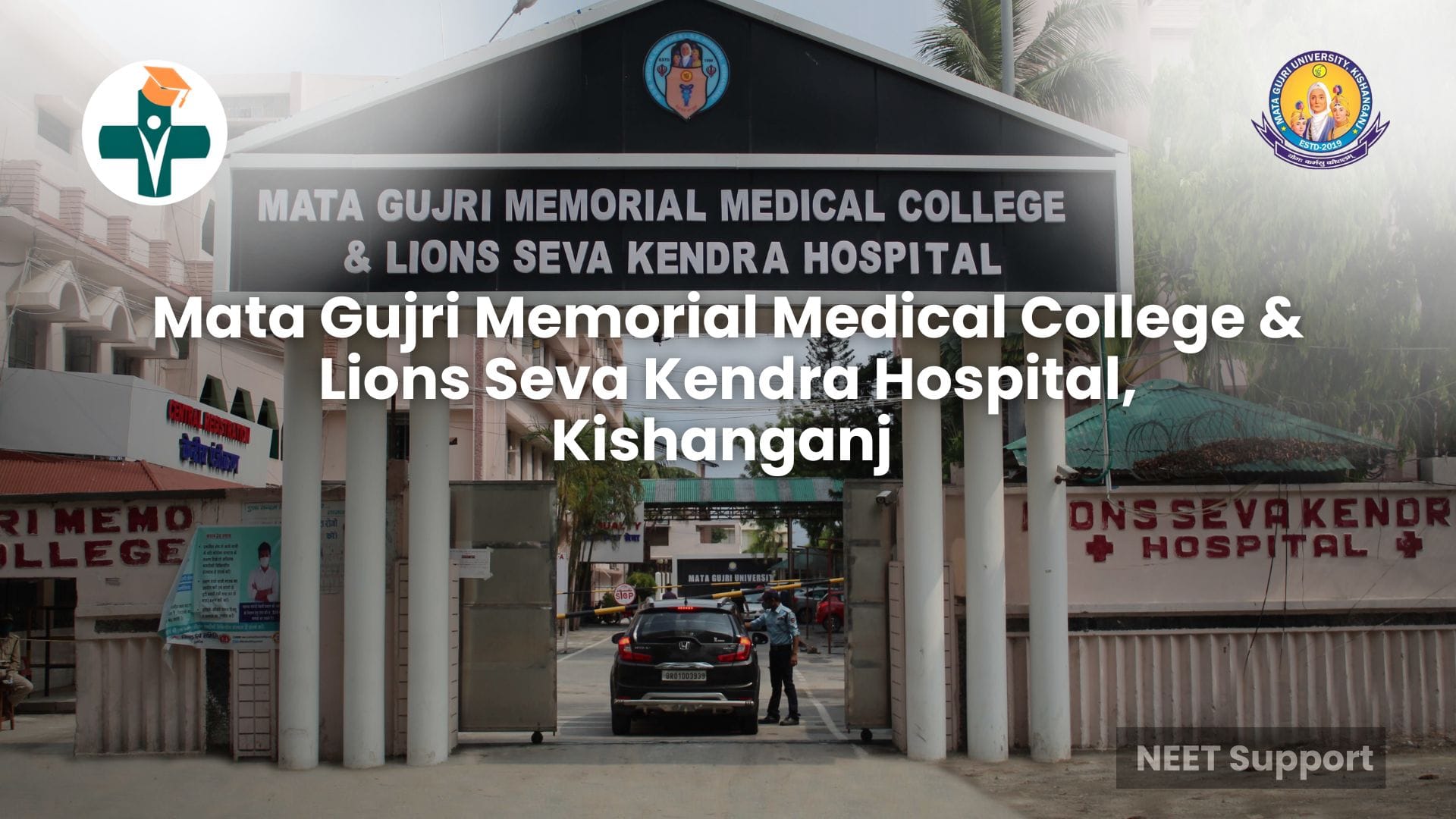
Mata Gujri Memorial Medical College & Lions Seva Kendra Hospital, Kishanganj – Complete Admission Guide 2026
Nishat
 WhatsApp
 Email
Email Facebook
 Twitter/X
 LinkedIn
Table of Contents
Predict Your Rank Now
Enter your NEET score to get an estimated rank
Find the Best Colleges For You
Based on your NEET rank, Category & more

Get Your Dream Medical College
Secure your seat with expert counselling
Introduction
Lions Seva Kendra Hospital and Mata Gujri Memorial Medical College, Kishanganj, is one of the leading private medical schools in Bihar with a view to providing high-quality education and healthcare services to an underserved area. The school has grown over time.
There is ample opportunity for students to gain hands-on experience while also treating a high volume of patients. Many rural/semirural communities can benefit from this type of education. NEET applicants who want to attend a private medical school in North India should consider this institution because it is an affordable (compared to deemed medical schools) option that offers real-world skills.
Quick Overview
Key Highlights
- Established in 1990
- Located in a semi-urban healthcare hub of Bihar
- Offers UG, PG, and Diploma programs in medical sciences
- Approx. 150 MBBS seats (latest trends)
- Strong clinical exposure due to large patient inflow
- Principal: Dr. Panchanan Ghosh
- NAAC accredited institution with growing infrastructure
- Minority institution with structured academic environment
Accreditation & Recognition
Mata Gujri Memorial Medical College is registered with the National Medical Commission (NMC) and has an affiliation to Mata Gujri University, Bihar. It is also NAAC accredited (as per the latest available information) thereby complying with academic and infrastructure standards. This recognition allows graduates to sit for licensing examinations (NEXT/NEET PG) and practice medicine both in India and outside of India.
Courses Offered
UG
- MBBS (Bachelor of Medicine & Bachelor of Surgery) – 5.5 years
PG
The college offers multiple MD/MS programs in core clinical and non-clinical branches:
- MD: General Medicine, Paediatrics, Anaesthesia, Dermatology, Microbiology, Pharmacology, Community Medicine, etc.
- MS: General Surgery, Orthopaedics, ENT, Ophthalmology
Super-Speciality
- Currently not widely available (as per latest available information)
Diploma / Allied
- Diploma in Anaesthesia
- Diploma in Child Health (DCH)
- Diploma in Obstetrics & Gynaecology (DGO)
- Diploma in Ophthalmology
- Diploma in Orthopaedics
Seat Matrix
UG Seat Matrix (MBBS)
(Exact distribution may vary yearly as per counselling rules)
PG Seat Matrix (MD/MS)
(As per latest available information)
Paramedical / Allied Seat Matrix
Fee Structure (MBBS)
| Quota | Tuition Fee (Per Year) | Hostel Fee | Caution Money | Misc/Other Charges | Bond |
|---|---|---|---|---|---|
| NRI Quota | $25,000 | ₹2,00,000 | ₹50,000 | ₹1,00,000 | No Bond |
| Open Seat Quota | ₹9,63,000 | ₹2,00,000 | ₹50,000 | ₹1,00,000 | No Bond |
| Sikh Minority Quota | ₹9,63,000 | ₹2,00,000 | ₹50,000 | ₹1,00,000 | No Bond |
(Varies based on quota and policy changes)
Estimated Total MBBS Cost (5.5 Years)
- Tuition Fees: ₹50–75 Lakhs
- Hostel & Mess: ₹12–18 Lakhs
- Books, Exams & Misc: ₹3–5 Lakhs
- Travel & Personal Expenses: ₹2–4 Lakhs
- Total Estimated Cost: ₹65–95 Lakhs
MBBS Cutoff (Round 1 & Round 2 Combined) 2024
| Category | Round | Marks | Rank |
|---|---|---|---|
| UR (General) | Round 1 | 516 | 1,82,714 |
| UR (General) | Round 2 | 645 | 31,410 |
| State Merit (SM) | Round 1 | 240 | 8,05,793 |
| State Merit (SM) | Round 2 | 467 | 2,55,122 |
| NRI | Round 1 | 178 | 10,80,606 |
| NRI | Round 2 | 414 | 3,46,663 |
MBBS Cutoff (All Quotas Combined) 2025
| Quota | Round | Category | Closing Rank |
|---|---|---|---|
| NRI | Round 1 | UR | 8,51,445 |
| NRI | Round 1 | EB | 7,93,703 |
| NRI | Round 2 | UR | 10,37,011 |
| NRI | Round 2 | BC | 8,51,445 |
| NRI | Round 3 | GN | 8,50,673 |
| NRI | Round 3 | BC | 5,92,928 |
| NRI | Round 4 | NRI | 7,11,007 |
| Open Seat | Round 1 | UR | 1,25,161 |
| Open Seat | Round 1 | BC | 1,16,892 |
| Open Seat | Round 1 | EWS/EW | 1,16,907 |
| Open Seat | Round 2 | UR | 1,30,092 |
| Open Seat | Round 2 | BC | 1,28,656 |
| Open Seat | Round 3 | GN | 61,290 |
| Sikh Minority | Round 1 | UR | 3,75,740 |
| Sikh Minority | Round 1 | SM | 3,66,150 |
| Sikh Minority | Round 2 | UR | 3,91,662 |
| Sikh Minority | Round 3 | GN | 3,03,448 |
| Sikh Minority | Round 4 | SM | 3,42,064 |
Teaching Methodology & Academic Strength
The medical school uses a CBME curriculum – as required by NMC – which combines lectures on theoretical topics with hands-on labs, basic patient encounters, and internal ongoing evaluations.
Benefits include:
- Regular ward rotation every semester since beginning semester one
- Case based problem solving in class and an assessment of knowledge/skills during viva's;
- Practical skills acquired in sim lab settings; access to expert instructors in all departments; and access to AMT.
Combining these educational strategies provides students a clear conceptual framework upon which to build their own level of confidence in the delivery of care to patients.
Infrastructure and Facilities
The campus of the college has all the essential infrastructure necessary to support medical learning in one location (academic blocks, hospital, and accommodation). The infrastructure may be somewhat dated but is very functional and continues to upgrade to meet the requirements of the NMC.
- Lecture theatres equipped with multimedia/audio-visual instructional equipment.
- A central library containing medical books, journals and reading halls.
- Departmental laboratories for practical experience.
- Separate gender-segregated dormitory facilities contained within the educational institution and providing basic services.
- A campus that has access to the internet (Wi-Fi) throughout the facility, with digital classrooms.
- An auditorium available for academic purposes, including hosting academic seminars and meetings.
- There are also sporting and recreational facilities available on the campus.
The infrastructure of the college supports balanced learning (clinical and academic).
Attached Hospital & Clinical Exposure
The Lions Seva Kendra Hospital supports all clinical training at this medical college the students attending this medical college & its associated Lions Seva Kendra Hospital will receive complete clinical experience. There are a significant number of teaching cases available to the students at this Lions Seva Kendra Hospital due to the large catchment area of patients treated (northern Bihar and West Bengal) as well as a large variety of cases presented. The Lions Seva Kendra Hospital's multiple specialty areas, fully-equipped operating rooms, Intensive Care Units, and emergency department all contribute to providing comprehensive clinical experience in a single centre.
Students are directly involved in caring for patients while engaged in patient care activities such as outpatient clinics (OPD), visiting patients/clinical rounds in their assigned inpatient care unit (ward) and providing emergency care under supervision of faculty areas. The medical students begin interacting with patients and observing them through diagnostic tests and communication skills from the first year of MBBS. The medical students will also benefit by having interactions with post-graduate medical students who will assist them by mentoring and working as clinical partners through case discussions.
- 500–700+ bedded multi-specialty hospital
- Major patient volumes in OPD & IPD
- ICU, NICU, emergency services
- Multiple specialty departments
- Extensive hands-on clinical training
- Diverse case mix of rural and semi-urban patients
Patient Load & Practical Training
One of the major advantages of this college is its large number of patients contributing to increased clinical education. As a result, students get to learn about different kinds of illnesses and how to manage actual / live cases.
- High outpatient population daily
- Exposure to both communicable and non-communicable illnesses
- Frequent surgical case load
- Comprehensive internship with level of responsibility
- PG driven clinical education environment
Hostel & Campus Life
On-Campus Hostel Facilities- The College provides hostel facilities on campus for students to live in a safe, clean and focused academic environment. Separate hostels are available for boys and girls with twin share accommodation that has basic furnishing such as beds, study tables and storage.
- The hostels have 24 hour a day, 7 day a week security through security personnel and CCTV monitoring at the entry/exit which is ideal for students from out of town.
- Hostels include dining halls and a mess which provides regular meals (breakfast, lunch and dinner) as part of the hostel package.
- Hostels include common areas for relaxing and socialising such as TV rooms and indoor games (carom, table tennis etc.).
- Rooms are generally large and have adequate ventilation, but comfort levels will vary slightly (e.g., construction age).
- Functional Living
In conclusion, hostel life is simple, safe, secure and allows students to focus on academics and clinical training.
Location & Connectivity
Kishanganj has an extensive rail and road system which connects it to many other large towns/cities such as Patna, Kolkata, and Siliguri. Also, there is a major advantage to the student commute due to the proximity of Kishanganj College to the Kishanganj Railway Station.
The nearest airport to Kishanganj is the Bagdogra Airport (90-100KMs) which allows for convenient air travel between many of the major cities in India.
Notable Alumni
At this time, there are no well-known alumni from the college (some private medical colleges have this same issue); however, many of the graduates are practicing physicians or residents and/or working as specialists in various parts of India and overseas. A significant number of graduates were able to pass NEET PG and continue with their medical education; this indicates that the college is providing a strong clinical education and a solid academic background for their graduates.
Why Choose Mata Gujri Memorial Medical College?
Affordable, clinically oriented and academically supported, Mata Gujri Memorial Medical College is a good alternative for aspiring MBBS students. While the college may not have the same level of infrastructure as the top deemed universities, the institution has sufficient numbers of patients visiting so that students get plenty of hands-on experience with real patients. Students seeking real clinical experience and preparing for NEET PG will find Mata Gujri Memorial Medical College to be an excellent choice.
- Significant clinical exposure as a result of high patient volume
- NMC eligible
- Well established institution with several years of experience
- PG courses available will aid in student education
- Affordable compared to deemed institutions
- Provides excellent preparation for NEET PG
Counselling Process
Mata Gujri Memorial Medical College in Bihar conducts the MBBS admission process through NEET UG and subsequent counselling. As a minority medical college in the state, seats will typically be allocated through state level counselling and similar quota allocations for those who are inward on a management/NRI basis/highly ranked.
Counselling Authority
- Bihar Combined Entrance Competitive Examination Board (BCECEB) conducts counselling for private medical colleges in Bihar.
- Some seats (especially management/NRI) may also be filled at the institutional level as per rules.
Step-by-Step Counselling Process
- Qualify NEET UG
- Candidates must secure the minimum qualifying percentile in NEET UG.
- Register for Counselling
- Apply through Bihar state counselling (BCECEB portal).
- Choice Filling & Locking
- Select Mata Gujri Memorial Medical College as a preferred choice.
- Arrange choices based on priority.
- Seat Allotment
- Seats are allotted based on NEET rank, category, and availability.
- Document Verification
- Candidates must report for verification with original documents.
- Fee Payment & Admission Confirmation
- Pay tuition and other fees to confirm admission.
- Reporting to College
- The final step includes joining the college within the stipulated time.
Types of Seats Available
- Management Quota Seats (Majority)
- NRI Quota Seats
- State Quota (limited, if applicable)
(Distribution may vary as per yearly counselling rules)
Important Points to Remember
- NEET qualification is mandatory for all categories.
- Fees for management/NRI quota are higher than general seats.
- Cutoff ranks vary significantly each year depending on demand.
- Keep multiple backup options during choice filling.
- Stay updated with official counselling notifications to avoid missing deadlines.
Documents Required During Counselling
- NEET UG Scorecard & Admit Card
- Class 10 & 12 Marksheet and Certificates
- Domicile Certificate (for state quota, if applicable)
- Caste/EWS Certificate (if applicable)
- ID Proof (Aadhaar/PAN)
- Passport-size photographs
- Migration & Transfer Certificate
Counselling Tips
- Prefer this college if your priority is clinical exposure over infrastructure
- Compare fee structure with other private colleges before locking choices
- Keep documents ready in advance to avoid last-minute issues
- Track round-wise cutoffs to make better decisions in later rounds
This counselling process ensures a transparent and merit-based admission system, while also giving flexibility through private quota options for students aiming to secure an MBBS seat.
FAQs
Is Mata Gujri Memorial Medical College NMC approved?
Yes, the college is approved by the National Medical Commission (NMC), which is essential for any medical college in India. This approval ensures that the MBBS degree is valid for practice and higher education. Students graduating from here are eligible for exams like NEXT/NEET PG. It also allows them to apply for medical licensing abroad, subject to country-specific rules. Always verify approval status for your admission year.
What is the MBBS intake of the college?
The MBBS intake is around 150 seats as per the latest available information. This intake has increased over time with infrastructure development and NMC approvals. However, seat numbers may slightly vary depending on yearly inspections and regulatory decisions. Students should confirm the exact intake during counselling. Higher intake also means more competition internally.
Is hostel accommodation compulsory?
While not always officially mandatory, most students opt for hostels due to convenience. Being on campus helps in attending early classes and clinical postings. It also ensures better discipline and academic focus. Some colleges strongly recommend hostel stay in initial years. Overall, hostel living is practical for medical students.
Does the college offer postgraduate (PG) courses?
Yes, the college offers MD and MS courses in various branches. This improves the academic environment and exposure for MBBS students. PG students assist in teaching and clinical work, which enhances learning. It also creates a competitive atmosphere. Availability of PG courses is a strong advantage.
What kind of clinical exposure do students get?
Students get strong clinical exposure due to high patient inflow. They participate in OPDs, ward rounds, and emergency duties. Exposure includes common as well as complex cases. Early clinical postings help build confidence. This is one of the biggest strengths of the college.
Conclusion
Kishanganj's Mata Gujri Memorial Medical College is an excellent private medical college that provides clinical exposure as a top priority, as opposed to having luxurious facilities. With this college having a sound established reputation with approval from the National Medical Commission, and a large number of patients utilizing its facilities; this College has a great foundation for obtaining the necessary training to become a physician and for training after the completion of an MBBS degree. Thus, for those wanting a practical, career-oriented MBBS program, there is no better option than this College in the State of Bihar — especially for NEET aspirants.
Reviews
No reviews yet. Be the first to write one!