
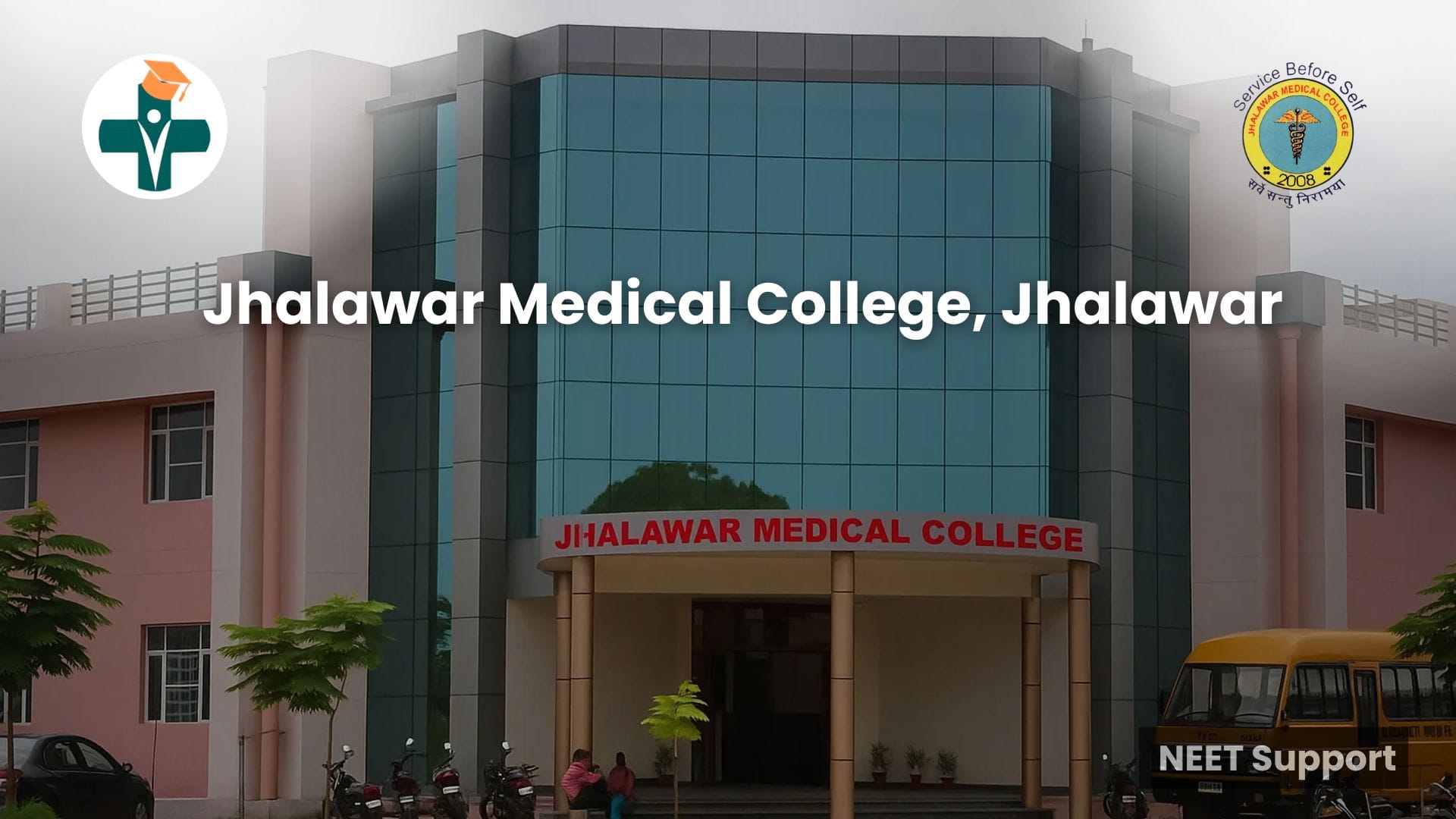
Jhalawar Medical College, Jhalawar – Complete Guide for Students (2026)
Nishat
 WhatsApp
 Email
Email Facebook
 Twitter/X
 LinkedIn
Table of Contents
Predict Your Rank Now
Enter your NEET score to get an estimated rank
Find the Best Colleges For You
Based on your NEET rank, Category & more

Get Your Dream Medical College
Secure your seat with expert counselling
Overview
Jhalawar Medical College is located on the Kota Road in Jhalawar, Rajasthan. The medical college is generally run by the Rajasthan State Government and has a good quality educational system in addition to the associated clinical training. The establishment of the Institution occurred in the month of August in the year 2007 with the awarding of the first graduate degree (M.B.B.S.) to the 1st graduating class of 2008 on the date of March 27th of 2008.
The college is affiliated with the Rajasthan University of Health Sciences (RUHS), Jaipur and is accredited by the National Medical Council of India (NMC). The medical degree awarded will also be considered and acknowledged as valid, recognised and approved for the whole of India.
Additionally, Jhalawar Medical College offers numerous interdisciplinary degrees through the course schedule for all faculty members and students. This is to include offering postgraduate medical degree programmes (Master's or Doctorate) in a variety of specialties. Therefore, Jhalawar Medical College will be an excellent option for those who are interested in completing an undergraduate or postgraduate medical degree program.
Key Highlights
Here are some important highlights that every student and parent should know:
- Established Year: 2007 (Started admissions in 2008)
- Affiliated to: Rajasthan University of Health Sciences (RUHS), Jaipur
- Recognised by: National Medical Commission (NMC)
- Type: Government Medical College
- Current Dean: Dr Sanjay Prowal
- Annual MBBS Intake: 200 students (increased from the initial 100)
- Postgraduate Seats: Multiple MD and MS seats across specialities
Courses Offered
Jhalawar Medical College offers academic programs at both undergraduate and postgraduate levels. The courses are designed to train future doctors and specialists in medical sciences.
Undergraduate Programs
- MBBS (Bachelor of Medicine and Bachelor of Surgery) – 5.5 years (including internship)
Postgraduate Programs
The college also offers postgraduate courses (MD and MS) in several specialities, such as:
- MD – General Medicine
- MD – Paediatrics
- MD – Pathology
- MD – Physiology
- MS – Orthopaedics
- MS – ENT
- MS – Obstetrics & Gynaecology (and more across clinical & non-clinical subjects)
This variety helps students choose a field that suits their interests, whether it's working in surgery, community health, or internal medicine.
Seat Matrix
| Course | Total Seats | Notes |
|---|---|---|
| MBBS | 200 | UG seats per year |
| MD – General Medicine | Varies | PG program |
| MD – Paediatrics | Varies | PG program |
| MD – Pathology | Varies | PG program |
| MD – Physiology | Varies | PG program |
| MS – Orthopaedics | Varies | PG program |
| MS – ENT | Varies | PG program |
| MS – Obstetrics & Gynaecology | Varies | PG program |
Fee Structure
| Quota Type | Annual Tuition Fee |
| Government Quota | ₹70,340 |
| Management Quota | ₹9,57,191 |
| NRI Quota | $40,111.71 |
Infrastructure and Facilities
The well-planned campus of Jhalawar Medical College embraces both the academic and student life of its students. The College's physical facilities met or exceeded the (NMC) norms for both theoretical and practical training and education of the students in the calm, relaxed campus environment, conducive to students focusing on their medical college education.
Academic Facilities
The academic facilities include:
- Sizeable lecture theatres provided with all audiovisual teaching aids available
- Smart classrooms allow interactive participation in learning activities
- Demonstration rooms build a small group discussion
- Completely equipped laboratories to support the disciplines of Anatomy, Physiology, Biochemistry, Pathology, Microbiology and other disciplines
- The skill training laboratory allows practical learning of clinical skills before exposure to computers
Library and Learning Resources
The library and learning resources provided at Jhalawar Medical College include:
- Central library containing thousands of medical textbooks
- National and international journals of medicine
- Digital library and e-resources available to support research and study for examinations
- Quiet study hall to study in peace
Hostel and Campus Life
The on-campus hostel facilities for students include:
- Separate hostels for male and female students on campus
- Option for furnished rooms
- Cafeteria providing balanced and nutritious meals
- The campus is protected by outside fences and has 24-hour security and electrical backup
- Common areas available for study, recreation and relaxation.
Other Facilities
Additional facilities provided for students on campus include:
- Auditorium for academic and professional meetings and events
- Meeting rooms for workshops and Continuing Medical Education (CME)
- Sports facilities, both outdoor and indoor, for students to enjoy
- Cafeteria and other common areas for socialising
- Banking and transportation facilities are close to the campus.
The overall ambience of Jhalawar Medical College creates a very strong, comfortable balance between academia and the personal lives of the students.
Attached Hospital – Beds, Specialities & Clinical Exposure
The teaching hospital affiliated with Jhalawar Medical College is integral to the education of future physicians; clinical exposure is one of the most important aspects of becoming a physician, and this hospital is where students will gain that clinical exposure.
Hospital Capacity
- Approx. 500+ teaching beds
- Well-functioning OPD and IPD services
- Emergency and trauma care unit
Major departments:
- General Medicine
- General Surgery
- Obstetrics & Gynaecology
- Paediatrics
- Orthopaedics
- ENT
- Ophthalmology
- Dermatology
- Psychiatry
- Anaesthesia
- Radiology
- ICU and Critical Care Units
Clinical Exposure to Students
- Early clinical exposure starting in the second year
- Daily OPD postings to understand patient flow
- Ward rounds with senior physicians
- Observing and assisting in minor and major surgical procedures
- Hands-on training during the final year of internship
Because the hospital serves a large population of patients in Jhalawar district and its surrounding cities/towns, students will see many different types of medical cases from all backgrounds. This wide variety of patient populations will give students practical experience, much different from anything found in their textbooks. By the end of their internship, students will be competent enough to manage both routine and emergency medical situations.
Why Choose Jhalawar Medical College?
Selecting the right medical school is critical. We think Jhalawar Medical College is a wonderful choice for those interested in pursuing a career in medicine.
- Government Medical College Advantage
As part of the government sector, fees can be substantially lower than those associated with private medical schools, making quality education available to many deserving people.
- Academic Framework
The college is governed by RUHS and NMC-approved curriculum with ongoing internal assessments, practical learning via workshops, simulations and clinical placement that will adequately prepare students for the university examination as well as their future practices as physicians.
- Excellent Clinical Exposure
Due to the government hospital attached to the school, students receive a broad range of clinical experiences from both rural and urban patients, which helps them to develop both diagnostic skills and confidence in working with patients.
- Experienced Faculty
All faculty members have either a doctorate or a specialty and will serve as mentors in both academic and professional matters, shaping the medical careers of students.
- Postgraduate Studies
MD and MS programs are offered through the college, allowing students who wish to further their education to remain at one institution to pursue their specialisation in medicine.
- Growing Reputation
Over the years, the college has built a stable reputation in Rajasthan for producing competent doctors serving across the state and country.
For students looking for affordable, recognised, and clinically strong medical education, Jhalawar Medical College becomes a practical and smart choice.
Admission Process & Documents Required
Admission to Jhalawar Medical College is done through the NEET entrance exams:
For MBBS
- Qualify NEET-UG with a valid score.
- Participate in counselling through the state NEET counselling (Rajasthan) or the All India Quota counselling.
- After seat allotment, report to the college for document verification and fee payment.
For MD/MS
- Qualify NEET-PG with a valid percentile.
- Attend counselling and choose course & college preferences.
- Complete verification and admission formalities.
Documents Required
- 10th & 12th mark sheets and certificates
- NEET scorecard
- Caste/Category certificates (if applicable)
- Passport-size photos
- Identity proof (Aadhaar/Passport)
- Migration/Transfer certificates
- Medical fitness certificate
Always carry original documents along with attested copies for verification.
FAQs
How many MBBS seats are available at Jhalawar Medical College?
The Jhalawar Medical College has 200 MBBS spots available. These are allocated through NEET-UG Counseling each year.
Is Jhalawar Medical College recognized by medical authorities?
Yes, Jhalawar Medical College is endorsed by the NMC (National Medical Commission) and linked with Rajasthan University of Health Sciences (RUHS), Jaipur.
Does the college have postgraduate courses?
Yes, there are postgraduate programmes (MD & MS) available at the college, including clinical and non-clinical disciplines.
Are hostel facilities available?
Yes, hostels for both male and female students with basic requirements are accessible to students.
What is the annual fee for government MBBS seats?
Government MBBS seats have yearly costs of approximately Rupees 70,000 to Rupees 90,000. Government MBBS costs are much lower than those of a private college.
Is there an attached hospital?
Yes, Jhalawar Medical College is adjoined to the Government Hospital, which has 500 beds. It is thus possible for students to learn about theories and procedures encountered in hospitals.
What specialities does the hospital cover?
The Jhalawar hospital covers all kinds of experiences and procedures and has categories for medicine, surgery, obstetrics, paediatric, etc.
How competitive is admission?
Competition is high; however, there is a limited number of seats available, which are allocated based on your NEET ranks. The higher the ranks, the better the chance of being accepted for state quota MBBS seats.
Conclusion
With proven credentials as a respected Government Medical Institution, Jhalawar Medical College provides students with high-quality education delivered by qualified faculty; wide-ranging academic options; state-of-the-art facilities; and rich, meaningful clinical experience thanks to its hospital. JMC also offers prospective students an excellent opportunity to receive both undergraduate (MBBS) and postgraduate medical training from experienced instructors under recognised medical accreditation agencies' standards. If a career in medicine is what you want to do, and you are preparing for JEE or JRE, Jhalawar Medical College is an institution you should seriously contemplate.
Reviews
No reviews yet. Be the first to write one!