Jagannath Gupta Institute of Medical Sciences & Hospital, Kolkata: Complete Guide 2026
Rashi Goyal
 WhatsApp
 Email
Email Facebook
 Twitter/X
 LinkedIn
Table of Contents
Predict Your Rank Now
Enter your NEET score to get an estimated rank
Find the Best Colleges For You
Based on your NEET rank, Category & more

Get Your Dream Medical College
Secure your seat with expert counselling
Introduction
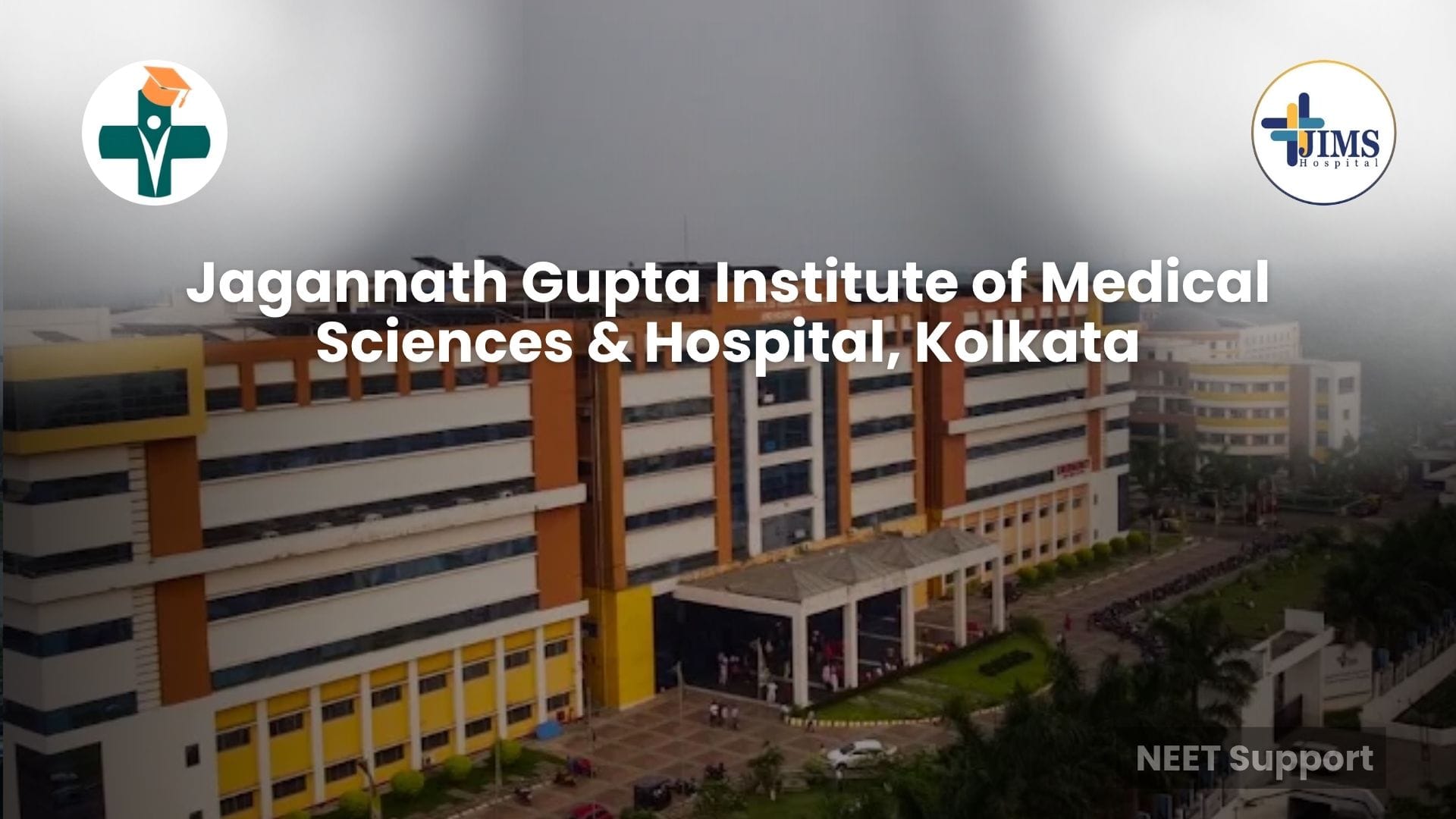
Jagannath Gupta Institute of Medical Sciences & Hospital (JIMSH), Kolkata, is one of the leading private medical colleges in West Bengal. The institution was established with the objective of providing high-quality medical education, advanced healthcare services, and research opportunities to students and healthcare professionals. The college is managed by the Urmila Devi Jagannath Gupta Charitable Trust and has developed into a modern center for medical education equipped with excellent academic infrastructure, well-qualified faculty members, advanced laboratories, and a multi-specialty teaching hospital. The institution is recognized by the National Medical Commission (NMC) and is affiliated with the West Bengal University of Health Sciences (WBUHS). It currently has an approved intake of 250 MBBS seats and also offers several postgraduate MD and MS programs.
The college follows the Competency-Based Medical Education (CBME) curriculum introduced by the National Medical Commission, ensuring that students receive both theoretical knowledge and practical clinical training. From the first year onwards, students are exposed to clinical learning, communication skills, professionalism, and ethics, preparing them to become competent and compassionate doctors.
History of the Institution
Jagannath Gupta Institute of Medical Sciences & Hospital was established in 2016 with the vision of improving medical education and healthcare facilities in eastern India. The institution was founded under the Urmila Devi Jagannath Gupta Charitable Trust with the aim of providing affordable and quality healthcare while training future medical professionals according to international standards.
Since its inception, the college has expanded its academic programs, hospital infrastructure, laboratories, research facilities, and student amenities. Continuous improvements in teaching methods, patient care services, and faculty development have helped the institution gain recognition among the leading private medical colleges in West Bengal.
Vision and Mission
The vision of Jagannath Gupta Institute of Medical Sciences & Hospital is to become a nationally recognized center of excellence in medical education, healthcare delivery, and biomedical research.
The mission of the institution is to produce competent, ethical, and socially responsible medical professionals through quality education, advanced clinical training, scientific research, and community healthcare services. The college also aims to improve healthcare accessibility for underserved populations while promoting innovation and lifelong learning among students.
College Highlights
| Particular | Details |
|---|---|
| College Name | Jagannath Gupta Institute of Medical Sciences & Hospital |
| Popular Name | JIMSH Kolkata |
| Established | 2016 |
| College Type | Private Medical College |
| State | West Bengal |
| Recognition | National Medical Commission (NMC) |
| Affiliation | West Bengal University of Health Sciences (WBUHS) |
| Campus Location | Budge Budge, Kolkata |
| MBBS Seats | 250 |
| Admission | NEET UG |
| PG Admission | NEET PG |
| Medium of Instruction | English |
| MBBS Duration | 5.5 Years including Internship |
Location and Connectivity
The college is situated at Budge Budge in Kolkata, West Bengal. The campus is well connected to different parts of Kolkata through road and railway networks. Students can easily access the campus from Howrah Railway Station, Sealdah Railway Station, and Netaji Subhas Chandra Bose International Airport. Public transport facilities, including buses, taxis, metro connectivity to nearby areas, and app-based cab services, make commuting convenient.
The peaceful campus environment provides students with a suitable atmosphere for learning while remaining connected to the metropolitan facilities of Kolkata.
Campus Infrastructure
The campus has been developed according to National Medical Commission guidelines and provides modern academic as well as residential facilities. The institution has spacious lecture theatres equipped with smart teaching technology, demonstration rooms, departmental museums, skill laboratories, computer laboratories, seminar halls, and research facilities.
Separate administrative buildings, academic blocks, hospital complexes, hostels, cafeterias, auditoriums, sports facilities, and recreational areas are available within the campus. Wi-Fi connectivity is provided throughout the academic blocks to facilitate digital learning and research activities.
The college maintains a safe campus through round-the-clock security services and CCTV surveillance. Students also have access to banking facilities, parking areas, transport services, and emergency medical care within the campus.
Hospital Facilities
The attached Jagannath Gupta Hospital serves as a large multi-specialty teaching hospital that provides extensive clinical exposure to undergraduate and postgraduate students. The hospital offers healthcare services in medicine, surgery, orthopaedics, paediatrics, obstetrics and gynaecology, ophthalmology, ENT, dermatology, psychiatry, anaesthesiology, radiology, emergency medicine, and several other specialties.
The hospital is equipped with intensive care units, neonatal intensive care units, operation theatres, labour rooms, blood bank, dialysis unit, advanced diagnostic laboratories, CT scan, MRI, digital radiology, pharmacy services, physiotherapy unit, and emergency trauma care. The hospital has more than 1,000 beds, allowing students to gain experience across a wide variety of clinical cases.
Academic Departments
The institution offers education through various pre-clinical, para-clinical, and clinical departments.
The pre-clinical departments include Anatomy, Physiology, and Biochemistry.
The para-clinical departments include Pathology, Pharmacology, Microbiology, Community Medicine, and Forensic Medicine.
The clinical departments include General Medicine, General Surgery, Orthopaedics, Obstetrics and Gynaecology, Paediatrics, Ophthalmology, ENT, Dermatology, Psychiatry, Anaesthesiology, Respiratory Medicine, Radiodiagnosis, Emergency Medicine, and several specialty services.
Each department has qualified faculty members, modern laboratories, seminar rooms, demonstration halls, museums, and research facilities.
Courses Offered
Jagannath Gupta Institute of Medical Sciences & Hospital offers undergraduate and postgraduate medical education approved by the National Medical Commission.
Undergraduate Course
| Course | Duration | Intake |
|---|---|---|
| MBBS | 5.5 Years (Including Internship) | 250 |
MD Courses
| Course |
|---|
| MD General Medicine |
| MD Paediatrics |
| MD Anaesthesiology |
| MD Pathology |
| MD Pharmacology |
| MD Community Medicine |
| MD Microbiology |
| MD Physiology |
| MD Anatomy |
| MD Dermatology |
| MD Radiodiagnosis |
MS Courses
| Course |
|---|
| MS General Surgery |
| MS Orthopaedics |
| MS Obstetrics and Gynaecology |
| MS Ophthalmology |
In addition to medical programs, the institution also offers courses in Nursing, Pharmacy, and Allied Health Sciences through its academic divisions.
Admission Process
Admission to Jagannath Gupta Institute of Medical Sciences & Hospital is conducted according to the guidelines of the National Medical Commission (NMC), the West Bengal University of Health Sciences (WBUHS), and the West Bengal Medical Counselling Committee (WBMCC). Candidates seeking admission to the MBBS course must qualify for the National Eligibility cum Entrance Test (NEET-UG), while admission to MD and MS courses is based on the NEET-PG examination.
The admission process begins after the declaration of the NEET results. Eligible candidates must register online for the West Bengal counselling process. During counselling, candidates fill in their preferred colleges and courses. Seats are allotted based on NEET rank, reservation category, seat availability, and the choices filled by the candidates.
After seat allotment, candidates must report to the college within the specified period for document verification and payment of the prescribed admission fees. Once all formalities are completed successfully, admission to the MBBS or postgraduate course is confirmed.
The entire admission procedure is transparent and merit-based. Students are advised to regularly check the official counselling notifications and the college website for important dates, fee notifications, and reporting schedules.
Eligibility Criteria
Candidates seeking admission to the MBBS course must satisfy the eligibility criteria prescribed by the National Medical Commission.
Applicants must have passed the Higher Secondary (10+2) examination or an equivalent examination with Physics, Chemistry, Biology or Biotechnology, and English as compulsory subjects.
The minimum qualifying marks are as follows:
| Category | Minimum PCB Percentage |
|---|---|
| General (UR) | 50% |
| OBC | 40% |
| SC | 40% |
| ST | 40% |
| PwD (General) | 45% |
Candidates must have completed 17 years of age on or before 31 December of the admission year and must qualify for the NEET-UG examination. There is no upper age limit as per the current regulations.
For admission to MD/MS courses, candidates must possess a recognized MBBS degree, complete the compulsory rotating internship within the prescribed time, obtain registration from the National Medical Commission or State Medical Council, and qualify for NEET-PG.
Documents Required
Students must produce original documents along with photocopies during counselling and admission.
The required documents include:
- NEET UG Admit Card
- NEET UG Score Card
- Class 10 Mark Sheet and Certificate
- Class 12 Mark Sheet and Certificate
- Transfer Certificate
- Migration Certificate
- Character Certificate
- Aadhaar Card
- Passport-size Photographs
- Domicile Certificate (if applicable)
- Category Certificate (SC/ST/OBC/EWS)
- PwD Certificate (if applicable)
- Medical Fitness Certificate
- Allotment Letter issued by the counselling authority
For postgraduate admission, candidates must additionally submit:
- MBBS Degree Certificate
- Internship Completion Certificate
- Permanent or Provisional Registration Certificate
MBBS Fee Structure (2025–2026)
The MBBS fee structure is approved according to the West Bengal fee regulations. Students admitted under different quotas are required to pay different fee amounts.
State Quota
| Fee Component | Amount (₹) |
|---|---|
| Tuition Fee per Semester | 2,74,000 |
| Admission Fee (One Time) | 50,000 |
| Refundable Caution Money | 15,000 |
| Sports & Cultural Fee | 25,000 |
| Total MBBS Course Fee | 25,56,000 |
Management Quota
| Fee Component | Amount (₹) |
|---|---|
| Tuition Fee per Semester | 10,94,000 |
| Admission Fee | 50,000 |
| Refundable Caution Money | 15,000 |
| Sports & Cultural Fee | 25,000 |
| Total MBBS Course Fee | 99,36,000 |
NRI Quota
| Category | Amount (₹) |
|---|---|
| Total Course Fee | 1,20,00,000 |
Hostel Fee Structure
The college provides optional hostel accommodation with food and lodging included.
| Room Type | Annual Fee (₹) | Refundable Deposit (₹) |
|---|---|---|
| Triple Sharing Non-AC | 1,80,000 | 15,000 |
| Triple Sharing AC | 2,16,000 | 15,000 |
| Single AC | 2,64,000 | 25,000 |
Electricity charges are collected separately according to usage. Hostel accommodation is not compulsory for students.
MD/MS Fee Structure
The institute offers postgraduate medical education in various specialties.
State Quota
| Particular | Amount |
|---|---|
| Tuition Fee per Year | ₹13,50,000 |
| Admission Fee | ₹50,000 |
| Caution Money | ₹25,000 |
| Sports & Cultural Fee | ₹25,000 |
Management Quota
| Particular | Amount |
|---|---|
| Tuition Fee per Year | ₹40,00,000 |
| Admission Fee | ₹50,000 |
| Caution Money | ₹25,000 |
| Sports & Cultural Fee | ₹25,000 |
The college also requires a bank guarantee or full course fee payment according to the admission category and applicable regulations.
Scholarship Facilities
Although JIMSH is a private medical college, eligible students may apply for scholarships provided by the Government of India and the Government of West Bengal.
Students may be eligible for:
- Swami Vivekananda Merit-cum-Means Scholarship
- National Scholarship Portal Schemes
- SC Scholarship
- ST Scholarship
- OBC Scholarship
- Minority Scholarship
- Economically Weaker Section (EWS) Scholarship
Scholarship eligibility depends upon academic performance, family income, and government rules.
Seat Matrix
The current approved intake for MBBS is 250 students.
| Course | Annual Intake |
|---|---|
| MBBS | 250 |
The distribution of seats among State Quota, Management Quota, and NRI Quota is decided every year according to West Bengal Government counselling guidelines.
MBBS Curriculum
The MBBS course follows the Competency-Based Medical Education (CBME) curriculum prescribed by the National Medical Commission.
First Professional
Subjects include:
- Anatomy
- Physiology
- Biochemistry
Students learn the normal structure and functioning of the human body through lectures, practical classes, and cadaver dissection.
Second Professional
Subjects include:
- Pathology
- Pharmacology
- Microbiology
- Forensic Medicine
The curriculum focuses on disease mechanisms, laboratory diagnosis, pharmacology, and legal aspects of medicine.
Third Professional Part I
Subjects include:
- Community Medicine
- Ophthalmology
- ENT
Students receive training in preventive medicine, national health programs, primary healthcare, and diseases affecting the eye, ear, nose, and throat.
Final Professional
Subjects include:
- General Medicine
- General Surgery
- Obstetrics and Gynaecology
- Paediatrics
- Orthopaedics
- Psychiatry
- Dermatology
- Anaesthesiology
- Radiodiagnosis
Clinical postings occupy a major portion of the final phase, where students gain practical experience in patient care.
MBBS Cutoff
The cutoff for Jagannath Gupta Institute of Medical Sciences & Hospital varies each year depending on the NEET examination difficulty level, number of applicants, counselling rounds, and seat availability.
Indicative trends are shown below:
| Academic Year | Counselling Round | Approximate Closing Rank |
|---|---|---|
| 2024 | Round 1 | Around 5,20,000 |
| 2024 | Round 2 | Around 6,20,000 |
| 2024 | Mop-up Round | Around 7,00,000+ |
| 2025 | Round 1 | Around 4,80,000 |
| 2025 | Round 2 | Around 5,80,000 |
| 2025 | Stray Round | Subject to seat availability |
The cutoff changes every year depending on counselling trends and should be considered indicative rather than fixed. Candidates should refer to the official West Bengal counselling notifications for the latest closing ranks.
Student Life
Student life at Jagannath Gupta Institute of Medical Sciences & Hospital is designed to help students grow academically, professionally, and personally. The college maintains a disciplined academic environment while encouraging participation in cultural, literary, social, and sports activities. Students from different parts of India study together on the campus, creating a diverse learning atmosphere that promotes teamwork, communication, and cultural understanding.
The institution regularly organizes orientation programs, white coat ceremonies, annual cultural festivals, sports competitions, health awareness campaigns, debates, quizzes, seminars, and workshops. These activities help students develop leadership qualities, confidence, communication skills, and organizational abilities. The college also encourages students to participate in community outreach programs, blood donation camps, environmental awareness drives, and medical camps in nearby villages and urban communities.
Clinical Training
Clinical training is one of the strongest aspects of medical education at Jagannath Gupta Institute of Medical Sciences & Hospital. The attached multi-specialty teaching hospital receives a large number of patients every day, enabling students to gain practical experience across various medical specialties.
From the early stages of the MBBS course, students participate in clinical postings under the supervision of experienced faculty members. They learn history taking, physical examination, patient communication, diagnosis, interpretation of laboratory investigations, and treatment planning. Students regularly attend outpatient departments (OPDs), inpatient wards, emergency services, operation theatres, intensive care units, labour rooms, and specialty clinics.
Daily bedside teaching sessions provide opportunities to observe patient management and understand the practical application of theoretical concepts. Clinical discussions, case presentations, grand rounds, and demonstrations enhance students' diagnostic and decision-making abilities.
Internship Programme
The MBBS course concludes with a compulsory rotating internship of one year. During this period, students work in different clinical departments under the supervision of senior consultants and faculty members.
The internship schedule generally includes rotations in the following departments:
| Department | Clinical Training |
|---|---|
| General Medicine | Diagnosis and management of medical disorders |
| General Surgery | Pre-operative and post-operative patient care |
| Obstetrics & Gynaecology | Labour room duties, antenatal care, surgeries |
| Paediatrics | Child healthcare and neonatal management |
| Orthopaedics | Trauma care and fracture management |
| Community Medicine | Rural and urban health services |
| Emergency Medicine | Emergency and trauma management |
| Elective Posting | Specialty exposure according to institutional guidelines |
The internship develops confidence, clinical competence, professionalism, communication skills, and teamwork. It also prepares graduates for postgraduate entrance examinations and independent medical practice.
Faculty
Jagannath Gupta Institute of Medical Sciences & Hospital has qualified professors, associate professors, assistant professors, senior residents, and tutors in all major medical specialties. Faculty members are actively involved in teaching, patient care, research, and academic mentoring.
Teaching methods include classroom lectures, practical demonstrations, seminars, tutorials, problem-based learning, simulation-based training, bedside clinical teaching, journal clubs, and case discussions. Faculty members encourage students to develop critical thinking, clinical reasoning, ethical values, and lifelong learning habits.
Regular academic interactions between faculty and students create a supportive learning environment that helps students improve both academically and professionally.
Research Activities
Research is an important component of medical education at Jagannath Gupta Institute of Medical Sciences & Hospital. Faculty members and postgraduate students actively participate in clinical research, scientific publications, conferences, and workshops.
The college encourages undergraduate students to participate in research methodology workshops, scientific paper presentations, poster competitions, and research projects under faculty guidance. Postgraduate students complete dissertations as part of their academic curriculum, enabling them to develop research skills, scientific writing abilities, and evidence-based clinical decision-making.
Departments regularly organize Continuing Medical Education (CME) programmes, seminars, journal clubs, and interdisciplinary academic meetings to keep students updated with recent advances in medicine.
Library Facilities
The central library is one of the major academic resources of the institution. It contains a large collection of medical textbooks, reference books, journals, dissertations, theses, and digital learning resources covering all disciplines of medicine.
The library provides access to national and international journals, online databases, e-books, and research publications. Reading halls offer a peaceful environment for self-study, while computer systems with internet connectivity help students access online educational materials. The library also supports inter-library loan services and digital learning through memberships such as DELNET and the National Digital Library.
Laboratory Facilities
The institution has well-equipped laboratories that meet National Medical Commission standards.
The Anatomy Department includes modern dissection halls, anatomy museums, osteology collections, and histology laboratories.
Physiology laboratories contain equipment for cardiovascular physiology, respiratory physiology, neurophysiology, hematology, and experimental physiology.
Biochemistry laboratories enable students to perform biochemical investigations and laboratory experiments related to metabolism and clinical biochemistry.
Pathology laboratories provide facilities for histopathology, hematology, cytology, and clinical pathology.
Microbiology laboratories train students in bacteriology, virology, parasitology, immunology, staining techniques, and microbial culture methods.
Pharmacology laboratories focus on drug actions, prescription writing, pharmacovigilance, and simulation-based practical learning.
Sports and Cultural Activities
The college believes that extracurricular activities contribute significantly to the holistic development of medical students. Various sports facilities are available for cricket, football, volleyball, badminton, basketball, table tennis, and indoor games.
Annual sports competitions encourage teamwork, discipline, and physical fitness. Cultural events include music, dance, drama, debates, quizzes, literary competitions, photography, painting, and fashion shows. The annual cultural festival provides students with opportunities to showcase their creative talents.
Students also participate in medical conferences, scientific exhibitions, awareness campaigns, blood donation camps, and social service activities throughout the academic year.
Examination System
The MBBS examination system follows the Competency-Based Medical Education curriculum prescribed by the National Medical Commission and the regulations of the West Bengal University of Health Sciences.
Students undergo continuous internal assessments throughout the academic year. These assessments include written examinations, practical examinations, viva voce, case presentations, seminars, assignments, attendance evaluation, and clinical assessments.
Professional university examinations consist of theory papers, practical examinations, clinical examinations, and oral examinations. Students must satisfy the minimum attendance and internal assessment requirements before becoming eligible for university examinations.
Career Opportunities
Graduates from Jagannath Gupta Institute of Medical Sciences & Hospital have numerous career opportunities after completing the MBBS degree.
Many graduates appear for the NEET-PG examination to pursue postgraduate specialization in disciplines such as General Medicine, General Surgery, Orthopaedics, Obstetrics and Gynaecology, Paediatrics, Dermatology, Radiodiagnosis, Anaesthesiology, Psychiatry, and several other specialties.
Students may also work in government hospitals, private hospitals, corporate healthcare organizations, nursing homes, charitable institutions, and primary healthcare centres. Some graduates establish private clinical practice after obtaining the required registration and experience.
Career opportunities are also available in medical research, public health organizations, teaching institutions, pharmaceutical companies, healthcare administration, and international medical practice after qualifying for the respective licensing examinations.
Advantages of the College
Jagannath Gupta Institute of Medical Sciences & Hospital offers several advantages to medical students.
The college is recognized by the National Medical Commission and affiliated with the West Bengal University of Health Sciences, ensuring national recognition of its medical degrees. The attached teaching hospital provides extensive clinical exposure through a large patient inflow.
Modern lecture theatres, advanced laboratories, simulation facilities, digital learning resources, experienced faculty members, hostel accommodation, sports facilities, and research opportunities create a comprehensive learning environment. The Competency-Based Medical Education curriculum ensures that graduates acquire both theoretical knowledge and practical clinical skills required for modern medical practice.
Limitations
As a private medical college, the tuition fees are considerably higher than those charged by government medical colleges, particularly under the management and NRI quotas.
The academic schedule is rigorous and requires students to maintain regular attendance, consistent academic performance, and active participation in clinical postings. The demanding nature of the medical curriculum requires discipline, dedication, and effective time management throughout the course.
Why Choose Jagannath Gupta Institute of Medical Sciences & Hospital?
Students choose Jagannath Gupta Institute of Medical Sciences & Hospital because it provides quality medical education supported by modern infrastructure, experienced faculty, and comprehensive clinical exposure. The institution follows the Competency-Based Medical Education curriculum recommended by the National Medical Commission and emphasizes ethical practice, patient-centred care, and continuous professional development.
The presence of a well-equipped teaching hospital enables students to gain practical clinical experience throughout their education. Opportunities for research, seminars, conferences, and extracurricular activities further contribute to the overall development of future medical professionals.
Frequently Asked Questions (FAQs)
1. What is the full name of JIMSH Kolkata?
The full name of JIMSH is Jagannath Gupta Institute of Medical Sciences & Hospital, Kolkata.
2. Where is Jagannath Gupta Institute of Medical Sciences & Hospital located?
The college is located at Budge Budge, Kolkata, West Bengal.
3. In which year was JIMSH established?
Jagannath Gupta Institute of Medical Sciences & Hospital was established in 2016.
4. Is JIMSH recognized by the National Medical Commission (NMC)?
Yes, Jagannath Gupta Institute of Medical Sciences & Hospital is recognized by the National Medical Commission (NMC).
Conclusion
Jagannath Gupta Institute of Medical Sciences & Hospital, Kolkata, has established itself as one of the prominent private medical colleges in West Bengal. Since its establishment in 2016, the institution has focused on delivering high-quality medical education, advanced clinical training, scientific research, and comprehensive healthcare services. Recognized by the National Medical Commission and affiliated with the West Bengal University of Health Sciences, the college follows a competency-based curriculum that prepares students for the evolving demands of the medical profession.
The institution offers excellent academic infrastructure, modern laboratories, digital learning facilities, experienced faculty, and a well-equipped multi-specialty teaching hospital that provides extensive clinical exposure. Students benefit from structured academic programs, research opportunities, extracurricular activities, and community health initiatives that promote both professional competence and personal growth.
Although the cost of education is relatively higher than that of government medical colleges, the quality of teaching, clinical training, and modern facilities make Jagannath Gupta Institute of Medical Sciences & Hospital a preferred choice for many aspiring medical students. Graduates of the institution are well prepared to pursue postgraduate education, clinical practice, research, teaching, and healthcare leadership roles in India and abroad.
Reviews
No reviews yet. Be the first to write one!