Government Medical College, Paderu: An Ultimate Guide for 2026
RISHIKESH KUMAR
 WhatsApp
 Email
Email Facebook
 Twitter/X
 LinkedIn
Table of Contents
Predict Your Rank Now
Enter your NEET score to get an estimated rank
Find the Best Colleges For You
Based on your NEET rank, Category & more

Get Your Dream Medical College
Secure your seat with expert counselling
Overview
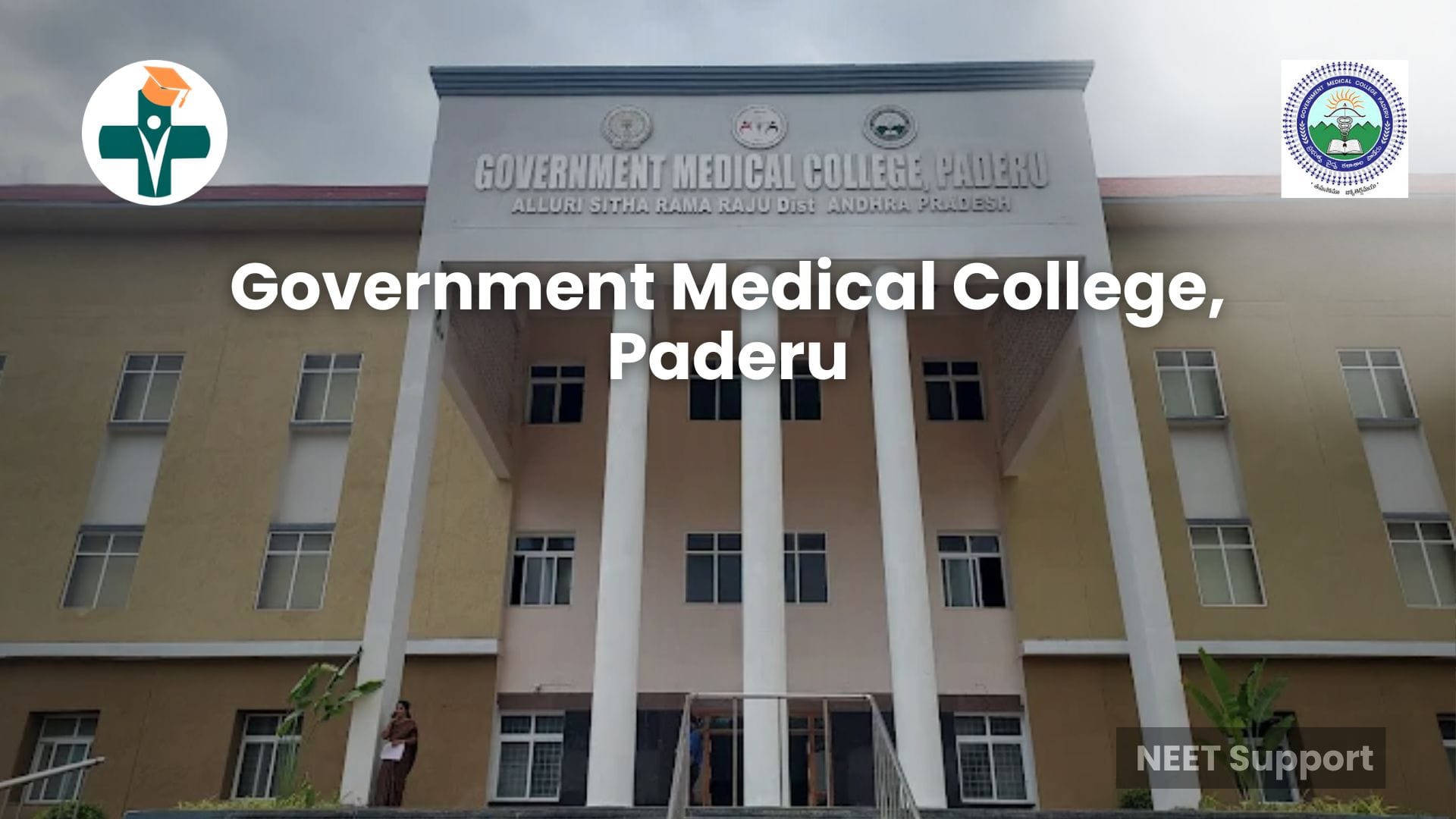
Choosing a suitable medical college is frequently a complex decision for aspiring scholars, as it requires careful consideration of factors such as institutional reputation, case exposure, and affordability. Government Medical College (GMC), Paderu, presents a distinctive option for those seeking a balanced combination of academic quality and meaningful clinical experience, particularly within a rural and tribal environment.
Established by the Government of Andhra Pradesh as part of a broader action to facilitate healthcare access in deprived regions, the institution serves not only as a centre for medical education but also as a pivotal healthcare facility for the Alluri Sitharama Raju district. Since its establishment in 2024 under the Centrally Sponsored Scheme, the council has aimed to deliver quality medical training alongside essential tertiary healthcare services to remote populations.
Located at an elevation of over 900 metres above sea level in the Eastern Ghats, the campus benefits from its calm and moderate climate throughout the year. This setting provides a conducive academic terrain, distinctly different from the warmer and humid conditions set up in the coastal areas of the state.
Key Highlights
| Feature | Details |
|---|---|
| Established | 2024 |
| Affiliation | Dr. YSR University of Health Sciences, Vijayawada |
| Approval | National Medical Commission (NMC) |
| Location | Talarisingi Village, Paderu, ASR District, AP |
| Attached Hospital | Government General Hospital (GGH), Paderu |
| Campus Size | 35 Acres |
Courses Offered
Currently, the institution focuses on undergraduate excellence.
Undergraduate Course
| Course Name | Level | Duration | Affiliation |
|---|---|---|---|
| MBBS (Bachelor of Medicine and Bachelor of Surgery) | Undergraduate | 5.5 Years (includes 1-year internship) | Dr. YSR University of Health Sciences |
Academic Departments
While the MBBS is the only degree currently offered, the college maintains various departments that facilitate clinical training and specialized education:
| Category | Subjects |
|---|---|
| Pre-clinical | Anatomy, Physiology, and Biochemistry |
| Para-clinical | Pathology, Pharmacology, Microbiology, and Forensic Medicine |
| Clinical | General Medicine, General Surgery, Obstetrics & Gynaecology, Paediatrics, Orthopaedics, Ophthalmology, ENT (Otorhinolaryngology), Psychiatry, Dermatology, and Radiology |
Seat Matrix
For the academic session 2026-27, GMC Paderu has been sanctioned an intake of 50 MBBS seats. This smaller batch size often allows for a better student-to-faculty ratio.
MBBS Seats
| Quota | Percentage | Number of Seats (Approx.) | Authority |
|---|---|---|---|
| All India Quota (AIQ) | 15% | 8 | Medical Counselling Committee (MCC) |
| State Quota | 85% | 42 | Dr. YSR University of Health Sciences (YSRUHS) |
All India Quota Reservation (15% Seats)
| Category | Percentage |
|---|---|
| OBC (Non-Creamy Layer) | 27% |
| SC | 15% |
| ST | 7.5% |
| EWS | 10% |
| PwD (Horizontal Reservation) | 5% |
State Quota Reservation (85% Seats)
| Category | Reservation Percentage |
|---|---|
| Open Competition (OC/General) | 40% |
| Scheduled Caste (SC) | 15% |
| Scheduled Tribe (ST) | 6% |
| Backward Classes (BC) - Total | 29% |
| BC-A | 7% |
| BC-B | 10% |
| BC-C | 1% |
| BC-D | 7% |
| BC-E | 4% |
| Economically Weaker Sections (EWS) | 10% |
Fee Structure
One of the primary reasons students go to GMC Paderu is its affordability. As a state government institution, the fees are strictly regulated.
MBBS Course Fees
| Quota Category | Annual Tuition Fee | University/Registration Fee (One-time) |
|---|---|---|
| Category A (Convenor/Govt Quota) | ₹15,000 | ₹10,600 |
| Category B (Management/Self-Finance) | ₹12,00,000 | ₹10,600 |
| Category C (NRI Quota) | ₹20,00,000 | ₹10,600 |
Additional Admission & Campus Charges
| Fee Component | Amount | Frequency |
|---|---|---|
| Total First-Year Academic Fee | ₹78,100 | Includes tuition, registration, and misc. |
| Hostel Establishment Fee | ₹15,000 | One-time deposit |
| Annual Hostel Rent | ₹5,000 – ₹10,000 | Yearly |
| Monthly Mess Charges | ₹3,000 – ₹4,000 | Monthly (Based on consumption) |
| Library & Lab Development | ₹3,000 – ₹5,000 | Yearly |
Cut-off Trends
Being a new college, the cut-offs are slightly more accessible compared to legacy institutions like GMC Guntur or Andhra Medical College. However, the "Government" tag keeps competition high.
All India Quota (AIQ) Cut-off
Year 2025 Cut-Off Analysis
| Category | Round 1 | Round 2 | Round 3 |
|---|---|---|---|
| General (UR) | ~19,500 | ~23,800 | 25,334 |
| OBC | ~21,000 | ~24,500 | 25,539 |
| EWS | ~23,000 | 24,545 | 27,746 |
| SC | ~1,05,000 | 1,24,874 | ~1,30,000 |
| ST | ~1,40,000 | 1,50,789 | ~1,55,000 |
Year 2024 Cut-Off Analysis
| Category | Round 1 | Round 2 | Round 3 (Mop-Up) | Stray Round |
|---|---|---|---|---|
| General (UR) | 18,420 | 21,611 | 23,830 | 24,829 |
| OBC | 20,156 | 22,645 | 24,339 | 25,004 |
| EWS | 22,561 | 25,872 | 27,555 | — |
| SC | 1,00,056 | 1,21,819 | 1,30,106 | 1,39,193 |
| ST | 1,35,676 | 1,54,000 | 1,65,578 | 1,66,206 |
Andhra Pradesh State Quota Cut-Off
Year 2025 Cut-Off Analysis
| Category | Round 1 (Closing Rank) | Round 2 (Closing Rank) | Round 3 / Mop-Up (Closing Rank) | Approx. Closing Score |
|---|---|---|---|---|
| Open (OC) | 48,250 | 54,610 | 61,340 | 539 |
| EWS | 51,320 | 58,100 | 64,890 | 529 |
| OBC | 54,500 | 60,200 | 67,115 | 535 |
| SC | 1,42,100 | 1,48,700 | 1,55,200 | 474 |
| ST | 1,98,400 | 2,10,300 | 2,22,150 | 440 |
Year 2024 (Local - AU Region) Cut-Off Analysis
| Category | Round 1 | Round 3 |
|---|---|---|
| Open-Gen | 43,323 | 61,245 |
| Open-Female | 44,167 | 64,527 |
| BC-D Gen | 61,321 | 62,975 |
| BC-D Female | 61,281 | 66,999 |
| SC Category | 1,48,500 | 1,54,591 |
| ST Category | 1,95,000 | 2,17,509 |
Admission and Counselling Process
Admissions are handled through two main channels:
- The Medical Counselling Committee (MCC) for All-India Quota
- Dr. YSR University of Health Sciences for the State Quota.
The Counselling Rounds
- Round 1: High-ranking students lock their preferences. Upgradation is allowed for Round 2.
- Round 2: Seat vacancies from R1 are filled. This is usually the last chance for "Fresh" registration in some years.
- Mop-Up Round: Crucial for students on the borderline. Vacancies here are often due to students shifting to other states or streams.
- Stray Vacancy: The final "cleanup" round for any remaining seats.
Documents Required for Admission
- NEET UG Admit Card & Scorecard
- Provisional Allotment Letter
- Class 10 & 12 Marksheets/Certificates
- Transfer Certificate (TC) and Migration Certificate
- Study Certificates (6th to 12th)
- Caste/Community Certificate (if applicable)
- Aadhar Card & 10 Passport-size photos
Infrastructure and facility
The campus is designed to be self-sufficient, given its remote location.
Academic block: The academic block is designed to support effective literacy through well- equipped lecture halls that incorporate ultramodern audio-visual technology. In addition, the laboratories are aligned with essential instruments, enabling scholars to gain practical knowledge along with theoretical instruction in a structured environment.
Library: The institution houses a central library that contains a wide collection of updated medical journals and reference materials. It also includes a digital section, allowing scholars to access online resources and research databases, thereby supporting nonstop academic development and evidence-based learning.
Hospital Services: The associated Government General Hospital (GGH) has a capacity of 420 beds and manages daily patient flux exceeding 800 cases. This high patient load ensures that scholars receive extensive clinical exposure, encountering a wide range of medical conditions, including contagious conditions and maternal health issues.
Hostels: Separate hostel facilities are available for male and female scholars. These hostels give secure living arrangements with 24/7 supervision, shared rooms, and organized dining services to ensure a comfortable domestic experience.
Why Choose This College?
- Unmatched Clinical Exposure: You won't just treat patients; you will serve a tribal community that really needs medical aid. This builds empathy and quick diagnostic thinking.
- Healthy Environment: Paderu is often called the "Ooty of Andhra." The fresh air and scenic hills are the perfect area to capture focus.
- NMC Recognition: Being a government college, the degree holds high value for USMLE, PLAB, or NEET PG aspirations.
Pros and Cons of Choosing Government Medical College, Paderu
Pros
- Very affordable education.
- Peaceful campus away from city distractions.
- High patient-to-student ratio.
Cons
- Remoteness: Visakhapatnam (the nearest major city) is about 110 km away.
- Language Barrier: Students from North India may take time to adapt to the local Telugu dialect spoken in tribal areas.
- New Infrastructure: Some specialized labs or sports facilities might still be in the fine-tuning phase.
Nearby Survival Guide
- Transport: The best way to reach Paderu is by bus or car from Visakhapatnam. The winding "Ghat road" is beautiful but requires careful driving.
- Food: Local South Indian cuisine dominates. There are a few decent eateries in Paderu town, but the hostel mess will be your primary source.
- Supplies: Most basic needs can be met in Paderu market, but for major electronics or branded shopping, a trip to Vizag is necessary.
Placement Stats
Medical colleges don't have "placements" in the corporate sense.
- Internship: Every student gets a stipend (currently around ₹20,000 - ₹25,000) during their 1-year internship.
- Career Growth: Graduates from GMC Paderu are highly sought after in the government sector for rural medical officer roles. Many also successfully transition into PG specialties.
Frequently Asked Questions (FAQs)
Q1: Is Paderu safe for non-local students?
Absolutely. The local community is very respectful of doctors and students. The campus has strict security protocols.
Q2: What is the weather like?
It is generally 5-10°C cooler than the coastal regions. Winters can be quite chilly, so bring warm clothes!
Q3: Are there sports facilities?
The campus includes playgrounds and indoor common rooms, though large-scale sports complexes are still developing.
Q4: Is the college connected by rail?
No. The nearest railway station is Visakhapatnam (VSKP) or Anakapalle.
Q5: Can I get North Indian food?
The mess primarily serves South Indian food, but students often form groups to cook their own meals or request the mess for variety.
Q6: Is there a bond for students?
Yes, like all AP government colleges, there is a compulsory rural service bond (usually 1 year) after graduation.
Conclusion
Government Medical College, Paderu, represents more than just a regular educational institution; it embodies a meaningful commitment to service and literacy. Although it doesn't give the urban life or marketable necessities associated with metropolitan cities, it offers a unique and precious opportunity to study the medical field in a setting where it's deeply in demand. The council enables scholars to develop practical skills and a strong sense of responsibility through direct engagement with tribal communities.
For individuals who prioritize academic growth, clinical exposure, and social work, GMC Paderu stands as a largely advisable and preferable choice for pursuing medical education.
Reviews
No reviews yet. Be the first to write one!