Government Medical College, Ongole: An Ultimate Guide for 2026
RISHIKESH KUMAR
 WhatsApp
 Email
Email Facebook
 Twitter/X
 LinkedIn
Table of Contents
Predict Your Rank Now
Enter your NEET score to get an estimated rank
Find the Best Colleges For You
Based on your NEET rank, Category & more

Get Your Dream Medical College
Secure your seat with expert counselling
Overview
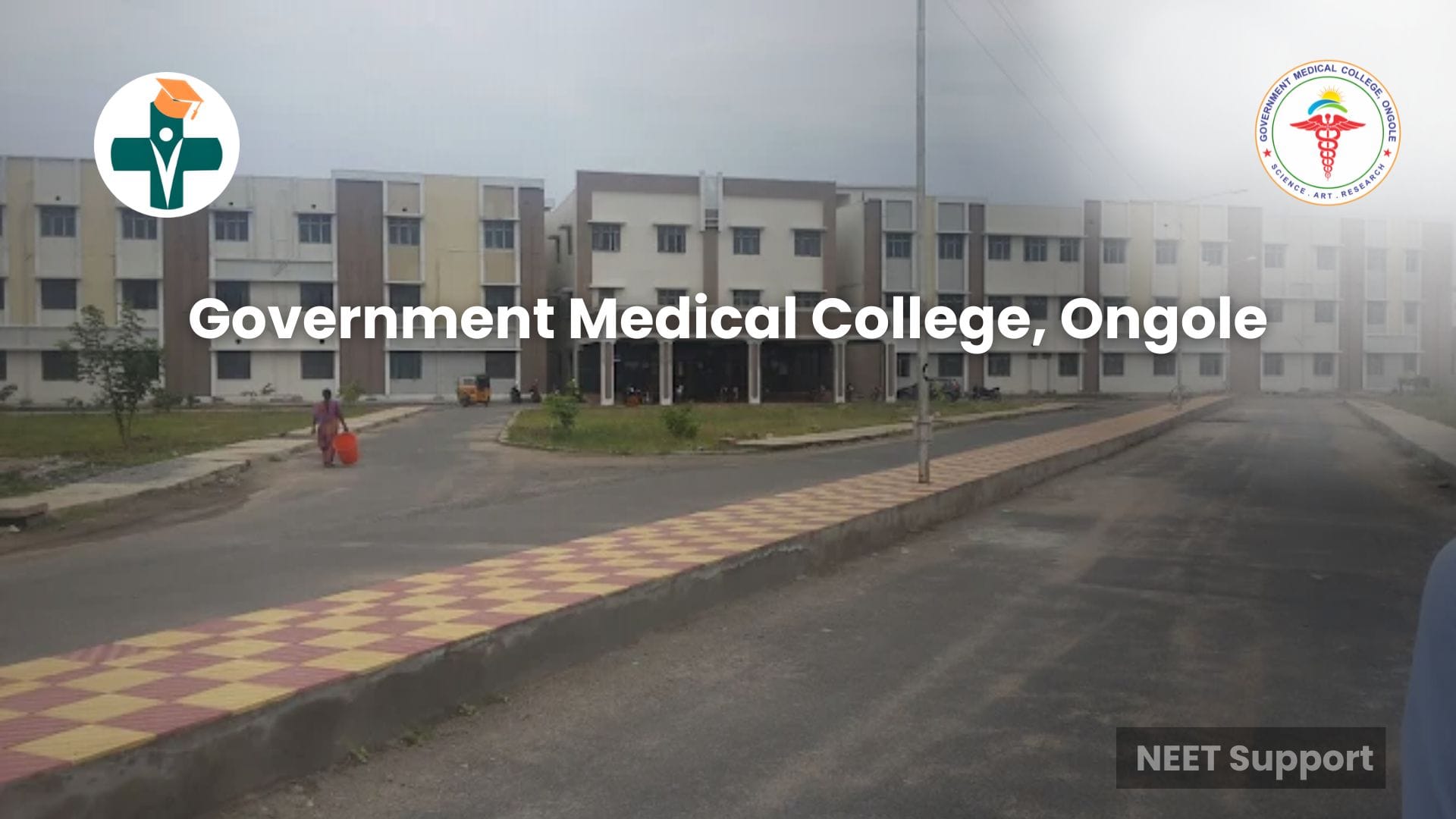
For individuals aspiring to make a medical career in Andhra Pradesh, Government Medical College (GMC), Ongole — earlier known as the Rajiv Gandhi Institute of Medical Science (RIMS) is a prominent and best option. The institution is extensively known for furnishing strong clinical exposure along with the stability and affordability associated with government medical colleges. Owing to these advantages, it has become a favoured choice for scholars applying through both the All-India Quota and the State Quota.
Established in 2011, Government Medical College, Ongole, is a reputed state-run institution located in the Prakasam district of Andhra Pradesh. It's affiliated with Dr YSR University of Health Science and is properly recognised by the National Medical Commission, ensuring adherence to established academic and professional norms. Over time, the council has developed into a well- regarded centre for medical education. It offers structured and comprehensive programs at both undergraduate and postgraduate levels, supported by good faculty members and acceptable clinical installations. Through its harmonious focus on academic excellence and practical training, the institution plays an important part in preparing proficient and responsible healthcare professionals.
Key Highlights
| Feature | Details |
|---|---|
| Year of Establishment | 2011 |
| Affiliated University | Dr. YSR University of Health Sciences, Vijayawada |
| Location | Bhagyanagar, 5th Lane, Ongole, Andhra Pradesh |
| Hospital | Government General Hospital (GGH), Ongole |
| Hospital Facility | 500 beds with 18 modular operation theatres, 30 Emergency beds, well-equipped I.C.Us. |
| Campus Size | 40 Acres |
| Management | Government of Andhra Pradesh |
Courses Offered
GMC Ongole offers a diverse range of medical programs, focusing heavily on clinical mastery.
Undergraduate Courses
| Category | Course Name | Duration | Admission Basis |
|---|---|---|---|
| Undergraduate | MBBS (Bachelor of Medicine and Bachelor of Surgery) | 5.5 Years | NEET UG |
| Undergraduate | B.Sc. Nursing | 4 Years | AP EAPCET |
Postgraduate Courses (MD/MS)
| Category | Course Name | Duration | Admission Basis |
|---|---|---|---|
| Postgraduate (MD) | MD Anaesthesiology | 3 Years | NEET PG |
| Postgraduate (MD) | MD Biochemistry | 3 Years | NEET PG |
| Postgraduate (MD) | MD Community Medicine | 3 Years | NEET PG |
| Postgraduate (MD) | MD Dermatology (DVL) | 3 Years | NEET PG |
| Postgraduate (MD) | MD Forensic Medicine | 3 Years | NEET PG |
| Postgraduate (MD) | MD General Medicine | 3 Years | NEET PG |
| Postgraduate (MD) | MD Microbiology | 3 Years | NEET PG |
| Postgraduate (MD) | MD Paediatrics | 3 Years | NEET PG |
| Postgraduate (MD) | MD Pathology | 3 Years | NEET PG |
| Postgraduate (MD) | MD Pharmacology | 3 Years | NEET PG |
| Postgraduate (MD) | MD Physiology | 3 Years | NEET PG |
| Postgraduate (MD) | MD Psychiatry | 3 Years | NEET PG |
| Postgraduate (MD) | MD Radio Diagnosis | 3 Years | NEET PG |
| Postgraduate (MD) | MD Respiratory Medicine | 3 Years | NEET PG |
| Postgraduate (MS) | MS ENT (Otorhinolaryngology) | 3 Years | NEET PG |
| Postgraduate (MS) | MS General Surgery | 3 Years | NEET PG |
| Postgraduate (MS) | MS Obstetrics & Gynaecology | 3 Years | NEET PG |
| Postgraduate (MS) | MS Ophthalmology | 3 Years | NEET PG |
| Postgraduate (MS) | MS Orthopaedics | 3 Years | NEET PG |
Seat Matrix
Understanding the seat distribution is vital for your counselling strategy.
MBBS Seats Intake
| Quota Type | Percentage | Number of Seats | Counselling Authority |
|---|---|---|---|
| All India Quota (AIQ) | 15% | 18 | MCC Central Counselling |
| State Quota (Andhra Pradesh) | 85% | 102 | Dr. YSRUHS |
| Total Annual Intake | 100% | 120 |
Postgraduate (MD/MS) Seat Matrix
| Specialisation | Clinical Seats | Non-Clinical Seats | Total |
|---|---|---|---|
| MD General Medicine | 6 | - | 6 |
| MS General Surgery | 11 | - | 11 |
| MS Obstetrics & Gynaecology | 9 | - | 9 |
| MD Paediatrics | 7 | - | 7 |
| MS Orthopaedics | 7 | - | 7 |
| MD Pathology | - | 9 | 9 |
| MD Anesthesiology | 7 | - | 7 |
| MD Community Medicine | - | 7 | 7 |
| MD Radiodiagnosis | 5 | - | 5 |
| MS ENT / Ophthalmology | 5 (each) | - | 10 |
| Other Departments | - | - | 21 |
| Total PG seats | - | - | 99 |
State Quota Reservation Percentages
| Category | Reservation Percentage |
|---|---|
| Open Category (OC) | 40% |
| Scheduled Castes (SC) | 15% |
| Scheduled Tribes (ST) | 6% |
| Backward Classes (BC-A/B/C/D/E) | 29% |
| Economically Weaker Section (EWS) | 10% |
Fee Structure
Being a government institution, the fees are highly subsidised compared to private or deemed universities.
UG Fees Structure
| Fee Category | Amount (Approx.) | Frequency |
|---|---|---|
| University Fee | ₹10,600 | One time |
| Tuition Fee | ₹15,000 | Annual |
| Special Fee | ₹2,000 | One-time (Admission) |
| Hostel Rent | ₹6,000 - ₹7,000 | Annual |
| Total First Year (State Quota) | ₹27,600 | — |
PG Fee Structure (MD/MS Courses)
| Fee Category | Annual Amount (INR) | Total Course Fee (3 Years) |
|---|---|---|
| Tuition Fee (PG Degree) | ₹30,000 | ₹90,000 |
| Tuition Fee (PG Diploma) | ₹25,000 | ₹50,000 |
| Miscellaneous/Special Fee | ₹10,000 | ₹30,000 |
| Examination Fee | ₹5,000 | ₹15,000 |
| Estimated Annual Total | ₹45,000 – ₹55,000 | ₹1.35L – ₹1.65L |
Cut-off Trends
The competition is fierce. Here are the approximate closing ranks for the All-India Quota:
MBBS Cutoff Analysis (AIQ)
| Category | Round | 2025 Closing Rank | 2024 Closing Rank | 2023 Closing Rank |
|---|---|---|---|---|
| General (UR) | Round 1 | 15,574 | 14,029 | 15,487 |
| Round 2 | 21,047 | 20,446 | 19,890 | |
| Round 3 | 23,089 | 21,484 | 23,334 | |
| OBC | Round 1 | 17,411 | 16,842 | 16,423 |
| Round 2 | 22,106 | 21,340 | 19,954 | |
| Round 3 | 23,253 | 21,810 | 20,099 | |
| EWS | Round 1 | 22,309 | 19,874 | 20,432 |
| Round 2 | — | 24,132 | 21,890 | |
| Round 3 | 27,619 | 25,114 | 22,556 | |
| SC | Round 1 | 77,084 | 81,325 | 65,024 |
| Round 2 | 105,786 | 120,432 | 87,453 | |
| Round 3 | 105,786 | 136,463 | 107,391 | |
| ST | Round 1 | 108,820 | 114,252 | 76,568 |
| Round 2 | 130,580 | 142,334 | 112,045 | |
| Round 3 | 130,580 | 152,283 | 147,044 |
NEET PG (MD/MS) Course-wise Cutoff (AIQ)
| Course | Round 1 (2025) | Last Round (2025) | Last Round (2024) |
|---|---|---|---|
| MD Radio-Diagnosis | 2,020 | 2,188 | 3,118 |
| MD General Medicine | 2,188 | 3,879 | 4,270 |
| MD Paediatrics | 5,375 | 9,032 | — |
| MS General Surgery | 8,750 | 12,311 | 11,221 |
| MD Psychiatry | 16,458 | 21,959 | 52,413 |
| MD Physiology | 76,496 | 76,496 | 110,632 |
MBBS State Quota Cutoff
| Category | 2024 Closing Rank | 2025 Closing Rank | 2026 Expected Rank |
|---|---|---|---|
| OC (Open Category) | 36,255 | 37,356 | 37,000 – 38,000 |
| EWS | 39,757 | 39,757 | 39,000 – 40,000 |
| BC-A | 62,060 | 62,060 | 62,000 – 63,000 |
| BC-B | 63,142 | 63,142 | 63,000 – 64,000 |
| BC-C | 52,227 | 52,227 | 52,000 – 53,000 |
| BC-D | 42,490 | 42,490 | 42,000 – 43,000 |
| BC-E | 96,987 | 96,987 | 96,000 – 97,000 |
| SC | 102,517 | 102,517 | 1,02,000 – 1,12,000 |
| ST | 153,318 | 153,318 | 1,50,000 – 1,60,000 |
Admission and Counselling Process
The admission process is strictly merit-based, conducted through the National Eligibility cum Entrance Test (NEET).
Round-Wise Analysis
- Round 1: The most competitive phase. High-rankers secure seats here. If you are allotted a seat, you can either report or opt for an upgrade.
- Round 2: Usually sees a slight dip in the cut-off. Candidates who didn't get their first choice in R1 often find seats here.
- Mop-Up Round: Conducted for the remaining vacant seats. This is a "high-risk, high-reward" round for students with borderline ranks.
- Stray Vacancy Round: The final round for any leftover seats, usually conducted online/offline as per MCC/YSRUHS guidelines.
Documents Required
NEET Admit Card & Score Card
Class 10 & 12 Marksheets
Transfer Certificate (TC) & Migration Certificate
Study/Bona Fide Certificates (from 6th to 12th)
Caste Certificate (if applicable)
Income Certificate (for fee concessions)
Aadhar Card & Passport-size photos
Infrastructure and facility
The campus is designed to facilitate a rigorous academic environment combined with practical learning.
Academic Blocks: The institution features ultramodern academic spaces designed to support effective literacy. Classrooms are equipped with smart technology to enhance tutoring and interaction. In addition, there are four large gallery- style lecture halls, each accommodating around 250 scholars, allowing for well- organized delivery of lectures to large groups.
Library: The library serves as a comprehensive resource centre, offering an extensive collection of medical books, journals, and reference materials. It also includes a peaceful and devoted reading area, providing scholars with an ideal terrain for focused study and academic research.
Hospital: The Government General Hospital functions as the primary teaching institution. It ensures practical exposure through a significant patient inflow and different clinical cases, helping scholars develop essential individual and clinical skills.
Hostels: Separate hostel installations are available for male and female scholars. Although the amenities are basic and meet standard government provisions, the close proximity to the council adds convenience and availability for residents.
Why Choose GMC Ongole?
Clinical Exposure: Being the primary government hospital for the district, the "OP" (Out-Patient) count is massive. You will see cases here that you might never see in a private city hospital.
Affordability: You get a world-class education for a fraction of the cost of private colleges.
Location: Ongole is a growing city, well-connected to major hubs like Vijayawada and Chennai.
Pros and Cons of Choosing Government Medical College, Ongole
Pros
High patient load for hands-on learning.
No ragging policy and friendly seniors.
Qualified and enthusiastic faculty.
Active extracurricular scene (Sports and Dance clubs).
Cons
Government hostel maintenance can sometimes be slow.
The city life in Ongole is quieter compared to metros like Hyderabad or Bangalore.
Nearby Survival Guide
Transport: The college is about 4-5 km from the Ongole Railway Station and Bus Stand. Autos are the lifeline here.
Food: While the mess is decent, local eateries like Hotel Mourya and Hotel Narayana Palace are popular for a change of taste.
Accommodation: For parents visiting, Comfort Inn and Hotel Y Palace are nearby reliable options.
Placement Stats
In the medical field, "placements" work differently. Students do not get "recruited" by companies. Instead:
Internship: All students complete a mandatory 1-year internship at GGH Ongole with a government-mandated stipend.
Career Path: Most graduates (80%+) focus on cracking the NEET PG or NExT exam to secure MD/MS seats. The clinical foundation laid at GMC Ongole helps students perform exceptionally well in these competitive exams.
Frequently Asked Questions (FAQs)
Q1: Is there a service bond after MBBS at GMC Ongole?
Yes, as per Andhra Pradesh government policy, students are generally required to serve a one-year compulsory rural service or pay a bond amount.
Q2: How is the mess food?
The mess food is typical of South Indian hostels—nutritious but repetitive. Many students supplement it with local tiffin centers.
Q3: Are there any recreational activities?
Yes! The college celebrates an annual "College Day" in March, which includes a week of cultural and sports events.
Q4: Is the college recognized by the NMC?
Yes, the college and its courses are fully recognized by the National Medical Commission.
Q5: What is the patient inflow like?
Excellent. As a district headquarters hospital, it handles everything from trauma to rare tropical diseases.
Q6: Is the campus safe for girls?
The campus is very safe with 24/7 security and a strict anti-ragging environment.
Conclusion
Government Medical College, Ongole, provides a balanced combination of strong academic training and extensive clinical exposure. Although it may lack the sophisticated infrastructure and visual appeal frequently associated with private medical institutions, it offers a more practical advantage through its real- world literacy terrain. Scholars benefit from consistent interaction with a high number of cases, which enhances their clinical understanding and hands- on skills. This exposure plays a pivotal part in shaping competent and confident medical professionals. The institution emphasises practical literacy alongside theoretical knowledge, ensuring that graduates are well- prepared for medical practice.
For applicants whose NEET scores meet the needed cut- off, this council stands as a dependable and worthwhile option. Choosing this institution can be an important decision for those seeking beneficial medical education and experience. Overall, it fosters both academic growth and professional development effectively.
Reviews
No reviews yet. Be the first to write one!