Government Medical College (GMC), Thalarasingi: A Complete Guide for 2026
RISHIKESH KUMAR
 WhatsApp
 Email
Email Facebook
 Twitter/X
 LinkedIn
Table of Contents
Predict Your Rank Now
Enter your NEET score to get an estimated rank
Find the Best Colleges For You
Based on your NEET rank, Category & more

Get Your Dream Medical College
Secure your seat with expert counselling
Overview
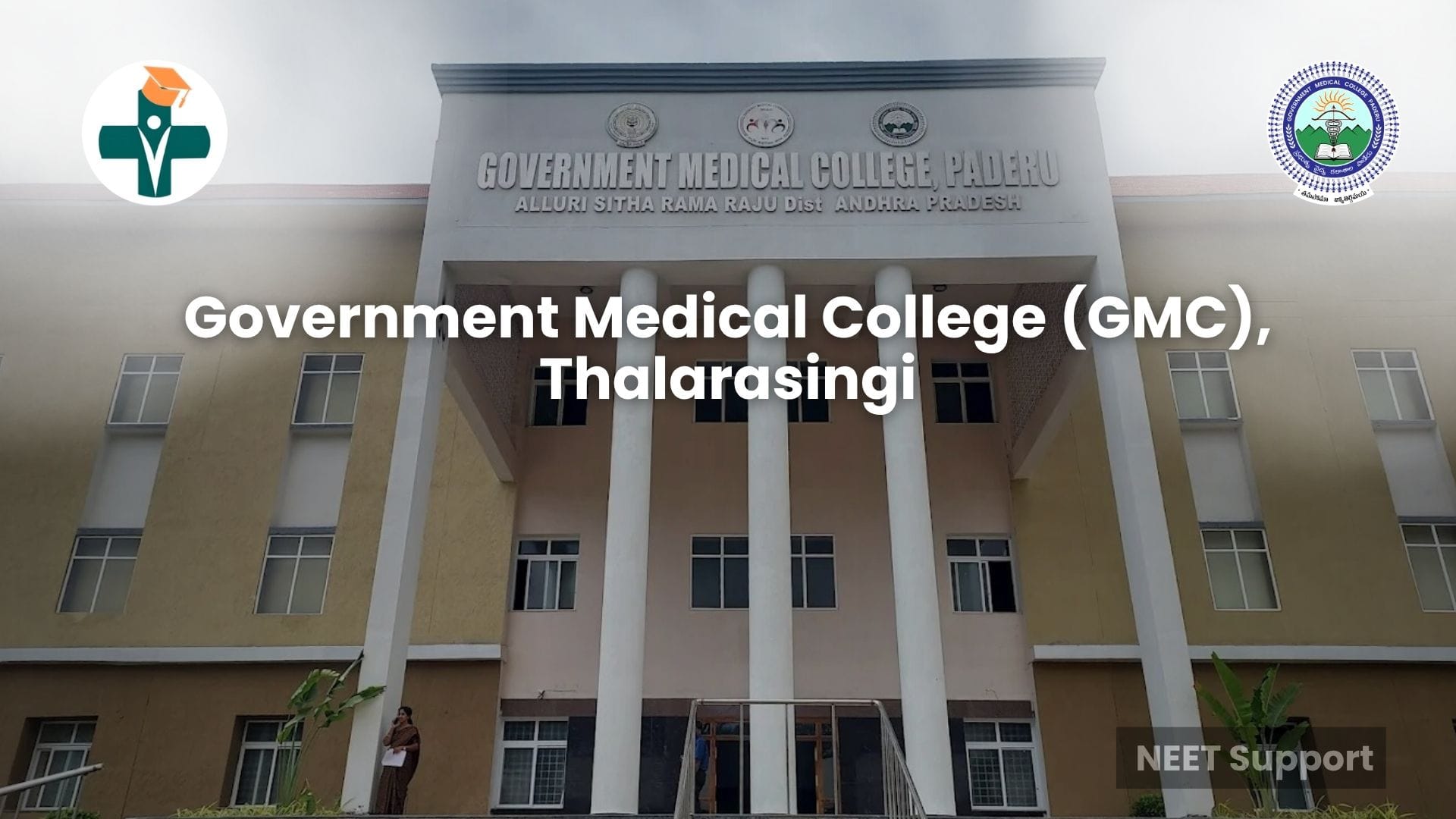
Government Medical College (GMC), Thalarasingi, Andhra Pradesh, is a newly established government medical institution emerging as an important centre for medical education and healthcare services in the region. Located in Thalarasingi near Paderu in Alluri Sitharama Raju district, it has been developed to strengthen healthcare access and medical training in the tribal and underserved areas of the state.
Established in 2023–24 by the Government of Andhra Pradesh, the institution was founded with the objective of expanding quality medical education and improving healthcare delivery in rural and hilly regions. The campus is supported by developing modern infrastructure and is associated with a government teaching hospital that provides clinical exposure to a wide range of patients.
The institution is affiliated with Dr YSR University of Health Sciences and is recognised by the National Medical Commission. It follows national standards of medical education with a strong focus on academic training, clinical practice, and community healthcare services. The college aims to produce competent and socially responsible medical professionals.
Key Highlights
| Feature | Details |
|---|---|
| Established | 2023–24 (approx., newly established phase) |
| Location | Thalarasingi Village, Paderu Mandal, Alluri Sitharama Raju (ASR) District, Andhra Pradesh, India |
| Affiliation | Dr. YSR University of Health Sciences, Vijayawada |
| Approval | National Medical Commission (NMC), New Delhi |
| Attached Hospital | Government Teaching Hospital, Thalarasingi / Paderu area (under development / associated government hospital setup) |
| Hospital Capacity | Expanding government hospital capacity (phase-wise development for MBBS clinical training) |
| Campus Area | Developing integrated government medical campus in tribal region |
| Institution Type | Government Medical College |
Courses Offered
Currently, the college focuses on undergraduate medical education:
| Feature | Details |
|---|---|
| Primary Course | MBBS (Bachelor of Medicine, Bachelor of Surgery) |
| Course Duration | 5.5 Years (4.5 years academic + 1 year mandatory internship) |
| Admission Basis | NEET UG Score |
| Affiliation | Dr. YSR University of Health Sciences (Dr. YSRUHS) |
| Approval | National Medical Commission (NMC) |
| Core Departments | Anatomy, Physiology, Biochemistry, Pathology, Microbiology, Pharmacology, and Community Medicine |
Seat Matrix
The total intake for the MBBS course is 100 seats. These are distributed as per the standard government norms:
MBBS Seats
| Quota Type | Percentage | Total Seats (Estimated) | Counselling Authority |
|---|---|---|---|
| All India Quota (AIQ) | 15% | 15 seats | MCC (mcc.nic.in) |
| State Quota (AP Local) | 85% | 85 seats | Dr. YSRUHS (drntr.uhsap.in) |
| Total Intake | 100% | 100 seats | — |
State Quota Reservation
| Category | Reservation % | Seats (out of 85) |
|---|---|---|
| Open Competition (OC) | 50% | 43 |
| Scheduled Caste (SC) | 15% | 13 |
| Scheduled Tribe (ST) | 6% | 5 |
| Backward Classes - Group A (BC-A) | 7% | 6 |
| Backward Classes - Group B (BC-B) | 10% | 8 |
| Backward Classes - Group C (BC-C) | 1% | 1 |
| Backward Classes - Group D (BC-D) | 7% | 6 |
| Backward Classes - Group E (BC-E) | 4% | 3 |
| Economically Weaker Section (EWS) | 10% | 8 |
All India Quota Reservation
| Category | Reservation % | Seats (out of 15) |
|---|---|---|
| SC | 15% | 2 |
| ST | 7.5% | 1 |
| OBC-NCL (Central List) | 27% | 4 |
| EWS | 10% | 1-2 |
| PwD (Horizontal) | 5% | 1 (across categories) |
| Open / Unreserved | Remaining | 6-7 |
Fee Structure
Being a government institution, the fees are highly subsidised, making it accessible to meritorious students from all economic backgrounds.
MBBS Annual Tuition Fees (2025-26)
| Admission Category | Quota Type | Annual Tuition Fee |
|---|---|---|
| Category A | Competent Authority (Government Quota) | ₹15,000 |
| Category B | Competent Authority (Self-Financing) | ₹12,00,000 |
| Category C | NRI Quota | ₹20,00,000 |
One-Time & Additional Charges
| Fee Type | Amount (Approximate) | Frequency |
|---|---|---|
| University Fee | ₹10,600 | One-time at admission |
| Hostel Admission/Establishment | ₹15,000 | One-time |
| Monthly Hostel Maintenance | ₹1,000 | Monthly (Excludes mess) |
| Mess Charges | ₹3,000 – ₹4,500 | Monthly |
| Other Fees (Library, Lab, etc.) | ₹3,000 – ₹5,000 | Annual |
Cut-off Trends
NEET UG Cutoff Analysis (All India Quota - 15%)
| Year | Category | Round 1 (Closing Rank) | Round 2 (Closing Rank) | Round 3 (Closing Rank) |
|---|---|---|---|---|
| 2025 | General (UR) | ~21,190 | ~23,873 | 26,178 |
| OBC | ~21,452 | ~24,050 | 26,231 | |
| EWS | ~25,599 | ~27,800 | 29,997 | |
| SC | ~1,10,389 | ~1,25,000 | 1,36,445 | |
| ST | ~1,42,000 | ~1,55,000 | 1,62,975 | |
| 2024 | General (UR) | ~20,500 | ~22,100 | 24,842 |
| OBC | ~21,000 | ~23,200 | 24,982 | |
| EWS | ~24,800 | ~26,500 | 28,702 | |
| SC | ~1,08,000 | ~1,21,000 | 1,33,872 | |
| ST | ~1,38,000 | ~1,50,000 | 1,66,849 | |
| 2023 | General (UR) | ~19,200 | ~21,500 | 23,562 |
| OBC | ~19,800 | ~22,000 | 23,850 | |
| EWS | ~22,500 | ~24,800 | 26,100 | |
| SC | ~1,05,000 | ~1,18,000 | 1,28,500 | |
| ST | ~1,35,000 | ~1,48,000 | 1,58,000 |
NEET UG State Quota (85%) Cutoff Analysis
| Year | Category | Round 1 (Closing Rank) | Round 2 (Closing Rank) | Round 3/Mop-up (Closing Rank) |
|---|---|---|---|---|
| 2025 (Est.) | General (OC) | ~40,000 | ~46,500 | ~61,245 |
| OBC (BC-A/B/D) | ~48,000 | ~55,000 | ~65,000 | |
| EWS | ~43,500 | ~51,000 | ~58,000 | |
| SC | ~1,25,000 | ~1,40,000 | ~1,58,000 | |
| ST | ~1,50,000 | ~1,68,000 | ~1,82,000 | |
| 2024 | General (OC) | ~40,500 | ~45,300 | 49,850 |
| OBC (BC-D) | ~48,000 | ~55,200 | 62,400 | |
| SC | ~1,20,000 | ~1,35,000 | 1,52,000 | |
| ST | ~1,45,000 | ~1,60,000 | 1,78,000 |
Admission and Counselling Process
Getting into GMC Thalarasingi requires a strategic approach to the NEET-UG examination and the subsequent counselling rounds.
Step-by-Step Admission Procedure
- NEET UG Qualification: You must clear the NEET-UG exam with a score above the qualifying percentile.
- Registration:
For AIQ (15%): Register on the Medical Counselling Committee (MCC) website.
For State Quota (85%): Register on the Dr. YSR University portal. - Choice Filling: During the counselling window, you must select "Government Medical College, Thalarasingi" as your preferred choice. Tip: Keep it higher in your list if you prefer a peaceful, government-backed environment.
- Seat Allotment: Seats are allotted based on your All India Rank (AIR) and category.
Round-Wise Counselling Analysis
Round 1: High-rankers usually grab seats here. If you get allotted, you can either freeze the seat or opt for an upgrade.
Round 2: If seats remain vacant (due to non-joining in Round 1), they are filled here. Usually, the cutoff drops slightly.
Mop-up Round: This is for any remaining vacancies. It's a high-stakes round for those who didn't secure a seat in the first two rounds.
Stray Vacancy Round: Conducted at the college level or centrally if very few seats are left.
Documents Required
- NEET UG Admit Card & Scorecard.
- Class 10 & 12 Marksheets and Passing Certificates.
- Andhra Pradesh Domicile Certificate (for 85% quota).
- Category Certificate (SC/ST/OBC/EWS) if applicable.
- Transfer Certificate (TC) and Migration Certificate.
- Identity Proof (Aadhar Card).
- 8-10 Passport-size photographs.
Infrastructure and Facility
The campus is designed with a modern architectural approach.
Lecture Halls: The lecture halls are designed to facilitate effective tutoring and literacy. They serve as smart classrooms equipped with ultramodern audio-visual tools, ensuring clarity and better student engagement during academic sessions.
Laboratories: The college provides advanced laboratories for core medical subjects, including Anatomy, Physiology, and Biochemistry. The dissection hall and other lab installations are well- equipped to support practical literacy in agreement with current academic norms.
Library: A well- established central library serves as an essential academic resource. It houses a wide collection of medical handbooks, reference materials, and journals, along with a devoted digital section that provides access to e-resources and research databases.
Hostel: Separate hostel accommodations are available for male and female scholars. These installations are well- voiced and maintained, offering 24/7 security and internet connectivity to ensure a comfortable and safe living terrain.
Hospital: The attached District Headquarters Hospital functions as the primary clinical training centre, furnishing scholars with exposure to different medical conditions, including trauma and tropical conditions.
Why Choose This College?
Government Tag: A degree from a government college carries significant weight in India.
Clinical Exposure: Being the only major medical centre in the district, the patient inflow is high, providing excellent hands-on experience.
Low Cost: High-quality education at a fraction of the cost of private medical colleges.
Peaceful Environment: Away from the hustle of big cities, providing a focused academic atmosphere.
Pros and Cons of Choosing Government Medical College (GMC), Thalarasingi
Pros:
Affordable fee structure.
New infrastructure and equipment.
Strong focus on community medicine.
Cons:
Distance: Located in a remote part of Andhra Pradesh.
Developing Phase: Some recreational facilities (canteens, sports complexes) may still be under development.
Limited "City Life": Fewer hangout spots.
Nearby Survival Guide
Connectivity
Government Medical College (GMC), Thalarasingi, is connected through nearby regional road networks linking it to Paderu and other towns in the Alluri Sitharama Raju (ASR) district. The nearest major railway stations provide access to key cities in Andhra Pradesh, while the closest airports are located in Visakhapatnam and Rajahmundry. From these hubs, the campus can be reached by road within a few hours, ensuring reasonable connectivity for students, staff, and visitors.
Food
The campus and surrounding areas provide basic and affordable food options suitable for students. Local mess facilities and small eateries offer simple South Indian meals such as rice, dal, chapati, and vegetable curries. As the region develops, more canteens and food services are expected to expand within and around the campus.
Weather
Thalarasingi experiences a tropical climate with warm and humid conditions for most of the year. The region receives significant rainfall during the monsoon season due to its hilly and tribal belt location. Students are advised to use light cotton clothing and carry umbrellas or rain protection during the rainy months.
Necessities
Basic daily necessities are available in nearby towns such as Paderu and the surrounding local markets. Grocery stores, pharmacies, stationery shops, and essential services like banking and ATMs are accessible within a reasonable distance. For wider shopping needs, students may travel to larger towns in the district.
Placement and Internship Stats
Medical graduates don't have "placements" in the traditional sense.
Internship: All 100 students are guaranteed a 1-year internship at the attached hospital with a government-mandated stipend (currently approx. ₹20,000 per month in AP).
Post-MBBS: Graduates are eligible to work as Medical Officers (MO) in AP Health Services or pursue NEET-PG. The "Service Bond" usually requires 2 years of state service.
Official Links
For more college comparison: Click here
For 1:1 counselling: Click here
For College predictor: Click here
For Rank predictor: Click here
Frequently Asked Questions (FAQs)
Q1: Is there a rural service bond?
Yes, AP has a mandatory rural service bond.
Q2: How is the faculty-to-student ratio?
It adheres to NMC norms, ensuring personalized attention in labs and clinical postings.
Q3: Are there sports facilities?
The college has basic playgrounds for cricket and volleyball, with an indoor gym facility in the works.
Q4: Is the medium of instruction English?
Yes, like all medical colleges in India, the medium of instruction is English.
Q5: Is the college recognized for USMLE/PLAB?
Yes, once a college is recognized by the NMC, its students are eligible for international licensing exams.
Q6: Can non-Andhra Pradesh students apply?
Yes, through the 15% All India Quota (AIQ) via MCC counselling.
Conclusion
Government Medical College (GMC), Thalarasingi, Andhra Pradesh, is an emerging government medical institution established to strengthen medical education and healthcare services in the tribal and rural regions of the Alluri Sitharama Raju (ASR) district. Since its establishment in 2023–24, the college has been developing its academic framework under government initiatives, supported by evolving infrastructure and an associated government teaching hospital in the Paderu–Thalarasingi region. The institution is focused on providing students with progressive clinical exposure through patient inflow from nearby rural and tribal areas, enabling practical, hands-on medical training.
The college promotes an academic environment that encourages discipline, skill development, and professional growth in the field of medicine. With a strong emphasis on community healthcare and rural service delivery, GMC Thalarasingi is gradually emerging as a promising centre for medical education aimed at producing competent, socially responsible, and community-oriented healthcare professionals.
Reviews
No reviews yet. Be the first to write one!