
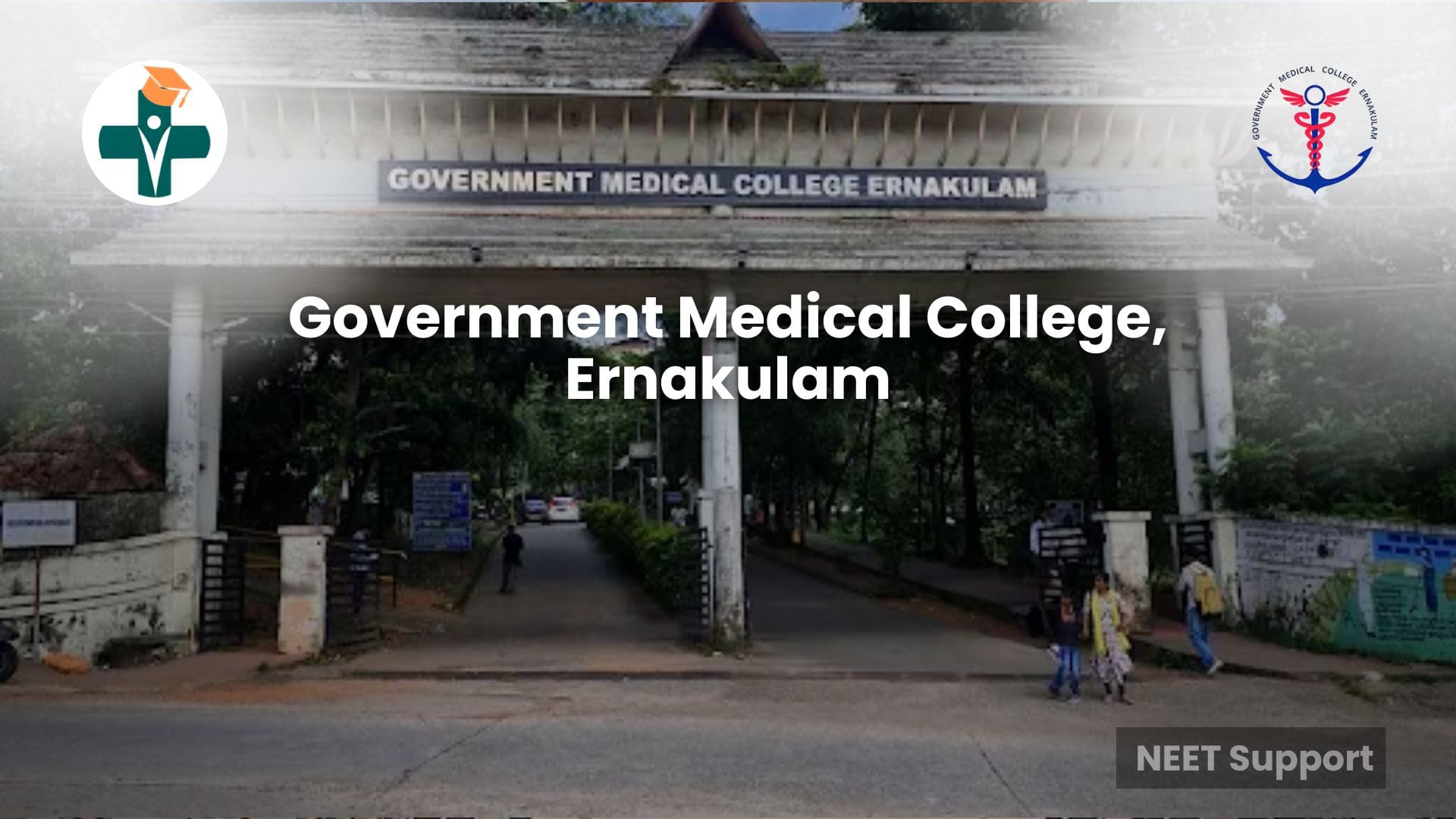
Government Medical College, Ernakulam: A Complete Guide for 2026
RISHIKESH KUMAR
 WhatsApp
 Email
Email Facebook
 Twitter/X
 LinkedIn
Table of Contents
Predict Your Rank Now
Enter your NEET score to get an estimated rank
Find the Best Colleges For You
Based on your NEET rank, Category & more

Get Your Dream Medical College
Secure your seat with expert counselling
Overview
Choosing an appropriate medical college is a major step in the journey of every future doctor. In Kerala, Government Medical College, Ernakulam, also known as GMC Ernakulam, has earned recognition as one of the leading public medical institutions. Positioned in Kalamassery, Kochi, the college has developed significantly over time and converted from a collaborative institution into an established government medical college.
The institution was established in 1999 under the Co-operative Academy of Professional Education (CAPE) and was originally called the Co-operative Medical College. Due to its academic growth and important position in Kerala’s commercial centre, the state government assumed control of the institution in 2013 and granted it government medical council status.
GMC Ernakulam is combined with the Kerala University of Health Science (KUHS), Thrissur, and is approved by the National Medical Commission (NMC). The council is known for maintaining strong academic norms while also furnishing extensive clinical training to scholars. Spread across a green 60-acre campus, the institution operates with a large tutoring hospital that offers healthcare services to a vast number of cases from the Ernakulam district every time. Its ultramodern structure and educated faculty further strengthen its character in medical education across Kerala.
Key Highlights
| Feature | Details |
|---|---|
| Full Name | Government Medical College, Ernakulam (GMC Ernakulam) |
| Formerly Known As | Co-operative Medical College, Kochi |
| Established | 1999 (Taken over by Government in 2013) |
| Location | Kalamassery, Ernakulam, Kochi, Kerala, India |
| Campus Area | 60 Acres |
| Affiliation | Kerala University of Health Sciences (KUHS), Thrissur |
| Approval | National Medical Commission (NMC) & Indian Nursing Council (INC) |
| Institution Type | Fully Government Co-educational |
| Hospital Capacity | 500 Beds |
| Emergency Beds | 100 |
| First Letter of Permission | 10/11/2000 (100 seats) |
| Status of Recognition | Recognized |
| Number of MBBS Students | 110 |
| Number of PG Students | 11 |
| Men's Hostel Rooms | 99 (155 occupants) |
| Women's Hostel Rooms | 130 (303 occupants) |
Courses Offered & Seat Matrix
GMC Ernakulam provides medical and healthcare education across undergraduate, postgraduate, and diploma levels.
1. Undergraduate (UG) Program
The flagship program is the MBBS (Bachelor of Medicine and Bachelor of Surgery). The annual intake for MBBS stands firmly at 110 seats.
| Feature | Details |
|---|---|
| Course Name | MBBS |
| Total Seats | 110 |
| Admission Quota Type |
All India Quota (AIQ via MCC) Kerala State Quota (KEAM via CEE) |
| Seat Split |
17 Seats (15%) – AIQ 93 Seats (85%) – State Quota |
| Course Name | B.Sc Nursing |
| Total Seats | 60 |
| Admission Quota Type | State Merit / LBS Centre Counselling |
| Seat Split | 100% State Quota |
| Course Name | GNM Diploma |
| Total Seats | 40 |
| Admission Quota Type | State Merit / Directorate of Medical Education |
| Seat Split | 100% State Quota |
2. Postgraduate (PG) Programs
The college offers MD (Doctor of Medicine) and MS (Master of Surgery) programs across several clinical and non-clinical specialties.
| Feature | Details |
|---|---|
| Post-Graduate Course | MD Pathology |
| Year Started | 2014 |
| Number of Students | 5 |
| Current Intake | 2 |
| Post-Graduate Course | MD Microbiology |
| Year Started | 2014 |
| Number of Students | 4 |
| Current Intake | 2 |
| Post-Graduate Course | MD General Medicine |
| Year Started | 2014 |
| Number of Students | 3 |
| Current Intake | 3 |
| Post-Graduate Course | MD Psychiatry |
| Year Started | 2014 |
| Number of Students | 4 |
| Current Intake | 2 |
| Post-Graduate Course | MD Paediatrics |
| Year Started | 2014 |
| Number of Students | 4 |
| Current Intake | 2 |
Fee Structure
Being a complete state government institution, the fee structure is heavily regulated, making it highly affordable compared to self-financing and private medical colleges.
Course-wise fee details
| Course Name | Course Duration | Annual Tuition Fee | Total Tuition / Academic Fees |
|---|---|---|---|
| MBBS | 5.5 Years (66 Months) | ₹31,670 | ₹1.16 Lakhs - ₹1.27 Lakhs |
| BDS (Dental) | 5 Years | ₹16,670 | ₹83,360 |
| MD (Medical Specializations) | 3 Years | ₹45,000 - ₹1,00,000 | ₹1.74 Lakhs - ₹2.08 Lakhs |
| MS (Master of Surgery) | 3 Years | ₹69,000 | ₹2.08 Lakhs |
Hostel & Living Costs
| Facility | Billing Frequency | Fee Amount |
|---|---|---|
| Hostel Rent | Monthly | ₹500 |
| Mess Charges | Monthly (Dividing System) | ₹2,500 - ₹3,000 |
| Electricity & Water | Monthly | Variable based on usage |
Cut-off Trends
MBBS All India Quota (AIQ 15%)
| S.No | Year | Category | Round 1 Closing Rank | Round 2 Closing Rank | Round 3 Closing Rank | Score Equivalent |
|---|---|---|---|---|---|---|
| 1 | 2025 | General (GN) | 3,443 | 9,072 | 16,627 | 577 |
| 2 | 2025 | OBC | 5,002 | 9,681 | 11,625 | 574 |
| 3 | 2025 | EWS | 13,730 | 21,898 | 23,291 | 541 |
| 4 | 2025 | SC | 68,848 | 105,309 | 121,348 | 499 |
| 5 | 2025 | ST | 96,760 | 118,536 | 144,121 | 456 |
| 6 | 2024 | General (GN) | 4,601 | 8,552 | 8,928 | 686 |
| 7 | 2024 | OBC | 5,002 | 9,681 | 10,906 | 685 |
| 8 | 2024 | EWS | 13,730 | 21,898 | Seats Filled | 668 |
| 9 | 2024 | SC | 68,848 | 105,309 | 121,348 | 607 |
| 10 | 2024 | ST | 96,760 | Seats Filled | 118,536 | 583 |
| 11 | 2023 | General (GN) | 4,158 | 9,075 | 9,907 | 661 |
| 12 | 2023 | OBC | 4,950 | 9,921 | 10,210 | 656 |
| 13 | 2023 | EWS | 14,493 | 19,571 | 22,793 | 628 |
| 14 | 2023 | SC | 53,765 | 91,240 | 104,550 | 541 |
| 15 | 2023 | ST | 66,647 | 110,891 | 132,440 | 497 |
MBBS Kerala State Quota (SQ 85%)
| S.No | Year | Category | Round 1 Closing Rank | Round 2 Closing Rank | Round 3 Closing Rank | Score Equivalent |
|---|---|---|---|---|---|---|
| 1 | 2025 | SM (State Merit) | 830 | 1,240 | 9,912 | 560 |
| 2 | 2025 | MU (Muslim) | 910 | 1,450 | 7,989 | 555 |
| 3 | 2025 | EZ (Ezhava) | 1,020 | 1,690 | 8,110 | 545 |
| 4 | 2025 | SC | 5,410 | 7,120 | 15,750 | 458 |
| 5 | 2024 | SM (State Merit) | 785 | 1,110 | 2,383 | 675 |
| 6 | 2024 | MU (Muslim) | 820 | 1,012 | Seats Filled | 668 |
| 7 | 2024 | EZ (Ezhava) | 980 | 1,240 | 3,110 | 656 |
| 8 | 2024 | SC | 4,120 | 5,890 | 10,931 | 528 |
| 9 | 2023 | SM (State Merit) | 710 | 954 | 1,838 | 640 |
| 10 | 2023 | MU (Muslim) | 790 | 1,080 | 2,110 | 631 |
| 11 | 2023 | EZ (Ezhava) | 845 | 1,190 | 2,450 | 613 |
| 12 | 2023 | SC | 3,890 | 4,950 | 9,450 | 448 |
Postgraduate Courses (NEET PG All India Quota)
| Course Spec. | Category | 2025 Closing Rank | 2024 Closing Rank | 2023 Closing Rank | Typical Closing Round |
|---|---|---|---|---|---|
| MD General Medicine | General (AIQ) | 1,465 | 2,110 | 1,980 | Round 1 / 2 |
| MD General Medicine | OBC (AIQ) | 2,496 | 3,120 | 2,890 | Round 2 |
| MD Paediatrics | General (AIQ) | 3,890 | 4,450 | 4,120 | Round 1 |
| MD Pathology | General (AIQ) | 21,450 | 22,382 | 19,840 | Round 2 |
| MD Microbiology | General (AIQ) | 59,333 | 57,998 | 48,750 | Round 3 / Stray |
Admission & Counselling Process
- Admission to GMC Ernakulam is strictly merit-based, running transparently through dual-channel counselling paths. There are no management or NRI quota seats available in this institution.
- After clearing the NEET examination, the admission process for medical colleges such as the Government Medical College, Ernakulam, generally follows a structured counselling system divided into two main quotas.
- Firstly, candidates become eligible for counselling based on their NEET rank. From here, the process is split into two categories: the 15% All India Quota and the 85% State Quota of Kerala.
- For the 15% All India Quota, admissions are handled through the Medical Counselling Committee (MCC). Candidates participate in centralized counselling and select their preferred colleges across India.
- For the 85% Kerala State Quota, admissions are conducted through the Commissioner for Entrance Examinations (CEE Kerala) via the KEAM portal. Students apply under the state counselling and choose colleges within Kerala based on merit and reservation rules.
- After counselling in both categories, the next step is seat allotment, where students are assigned to colleges based on rank and preference. Following allotment, candidates must undergo physical document verification at the allotted institution. Once all documents are verified successfully, the admission is officially confirmed, completing the process.
Detailed Round-Wise Counselling Analysis
Step 1: Registration & Option Entry
AIQ Route: Students register on the Medical Counselling Committee (MCC) website.
State Route: Students apply via the Commissioner for Entrance Examinations (CEE), Kerala portal, using their KEAM credentials.
During choice-filling, candidates must actively list the Government Medical College, Ernakulam, higher up in their preference sheets if they wish to bypass outer-district options.
Step 2: Round 1 Allotment
The highest-ranking applicants are assigned seats. If allotted, you can choose to freeze the seat, opt for a free upgrade in Round 2, or reject the allotment.
Step 3: Round 2 and Round 3 (Mop-Up) Shifts
Significant rank shifts occur between Round 1 and Round 2 (often shifting by 3,000 to 5,000 ranks globally). Students sitting close to the cut-off boundary should avoid skipping subsequent rounds, as leftover All India seats are occasionally surrendered back or dynamically re-allocated here.
Step 4: Physical Document Verification
Once a seat is confirmed, you must report physically to the Kalamassery campus with your original documents:
1. NEET Admit Card & Scorecard
2. KEAM/CEE Allotment Memo
3. 10th and 12th Marks Sheets
4. Transfer Certificate (TC) and Conduct Certificate
5. Community/Caste/EWS certificates (if applicable)
6. Physical fitness certificate
Infrastructure and Facilities
1. Clinical Teaching Hospital
The central part of the campus is its multi-specialty teaching hospital, which plays an important part in medical training. It includes specialized wards, ultramodern operating theatres, and a separate casualty department that provides scholars with practical exposure to emergency and patient care services.
2. Lecture Theatres & Digital Labs
The college has commodious lecture halls designed with proper acoustics, sound lecture halls and ultramodern audiovisual facilities. These classrooms support the smooth delivery of the Competency-Based Medical Education (CBME) class and improve the overall literacy experience for scholars.
3. Comprehensive Central Library
The institution maintains a well-equipped central library containing a wide collection of public and international medical journals, reference books, and digital resources. Scholars also benefit from internet-enabled study spaces that support academic research and self-study.
4. Student Hostels
Separate hostel installations are available for male and female scholars. The apartments are well-located and offered on sharing base with essential services such as nonstop water supply, security, and common recreational spaces.
5. Sports & Recreation
The campus also encourages physical fitness by furnishing installations for football, cricket, volleyball, badminton, and indoor gym conditioning for scholars.
Why Choose This College?
Choosing GMC Ernakulam gives you a balance of two major worlds: subsidized government tuition and urban connection.
Unlike colleges situated deep in rural sectors, being in Kochi ensures that you have access to advanced medical tech, medical conferences, and a continuous flow of diverse clinical cases. The student community is famously close-knit, meaning seniors actively guide juniors through both academic survival and competitive postgraduate (NEET-PG/INICET) exam preparation.
Pros & Cons of Choosing Government Medical College, Ernakulam
Pros
Location Advantage: Based in Kalamassery, you are never cut off from the lifestyle perks, transportation, and connectivity of Kochi city.
Affordable Fee Structure: At roughly ₹23k a year, it minimizes the financial burden of medical school.
Stipend Guarantee: Interns receive a competitive government-mandated stipend (approx. ₹20,000 - ₹25,000 per month) during their mandatory rolling internship year.
Cons
Super-Specialty Limitations: While basic clinical departments are incredibly strong, some niche super-specialty departments (like complex neurosurgery or advanced oncology wings) are still expanding compared to century-old legacy institutions.
Compulsory Bond: Students must sign a compulsory rural service bond of 1 year. Failing to fulfill this service attracts a monetary penalty of ₹10,00,000.
Near-By Survival Guide
Exchanging: Kalamassery offers an accessible transport system for scholars and staff. The Kalamassery Metro Station provides direct access to major areas of Kochi. Local cars and bus-cabs are also often available near the college, making daily travel affordable and comfortable.
Food & Hangouts: The area near CUSAT is popular among scholars for its affordable cafés, Kerala cafes, snack shops, and juice centres. These places create a friendly terrain for relaxation and social interaction after classes.
Daily requirements: Scholars can access supermarkets, pharmacies, stationery stores, and other basic essential items near the campus.
Placement & Internship Stats
In the medical field, standard corporate "campus placements" do not exist. Instead, progress relies on internships and licensing examinations.
Mandatory Rotating Internship: Every MBBS graduate must complete a 1-year compulsory internship within the attached GMC Ernakulam hospital.
Employment Destination: Due to the rigorous practical load handled during this internship, graduates find immediate employment as Junior Residents or Medical Officers in major private and government healthcare sectors in Kerala.
PG Selection: A substantial percentage of alumni clear the NEET-PG/INICET boundaries within their first couple of attempts due to strong clinical baselines formed here.
Official Links
For more college comparison: Click here
For 1:1 counselling: Click here
For College predictor: Click here
For Rank predictor: Click here
Frequently Asked Questions (FAQs)
Q1: Are there any Management or NRI seats available at GMC Ernakulam?
No. Being a complete state government medical college, 100% of seats are distributed strictly based on NEET merit through MCC (15%) and CEE Kerala (85%) counseling channels.
Q2: What is the exact penalty amount for breaking the service bond?
If a candidate chooses to skip the mandatory 1-year rural health service after graduation, they are legally required to pay a bond penalty of ₹10,00,000 (Ten Lakhs).
Q3: Is the MBBS degree from this college recognized globally?
Yes. The degree is fully recognized by the National Medical Commission (NMC) and is valid for appearing in international licensing exams like USMLE, PLAB, or the upcoming NExT exam.
Q4: How are the hostel mess facilities managed?
The mess is run on a student-managed dividing system. The total cost of food preparation is divided equally among hostellers each month, offering both vegetarian and non-vegetarian traditional Kerala cuisine.
Q5: How far is the college from the nearest airport?
Cochin International Airport (COK) is approximately 18 to 20 kilometers away from the Kalamassery campus, making it easily reachable within a 35-minute drive.
Q6: Does the college place heavy emphasis on extracurricular activities?
Absolutely. GMC Ernakulam is highly celebrated for its active student union, annual sports meets, and cultural festivals that foster a healthy work-life balance for medical students.
Conclusion
Government Medical College, Ernakulam, is considered a suitable option for scholars seeking quality medical education in a well-connected urban environment. The institution is honoured for its strong clinical exposure, affordable fee structure, and peaceful academic atmosphere. Its position in Kochi also provides scholars with better transportation, healthcare exposure, and access to essential facilities.
Over time, the college has developed a reputation for producing proficient and responsible healthcare professionals through balanced academic and practical training. Scholars who achieve a NEET score matching the council’s admission cut-off may consider this institution a precious choice for pursuing medical education and building a successful career in the healthcare field.
Reviews
No reviews yet. Be the first to write one!