Government Medical College, Ananthapuram: A Complete Guide for 2026
RISHIKESH KUMAR
 WhatsApp
 Email
Email Facebook
 Twitter/X
 LinkedIn
Table of Contents
Predict Your Rank Now
Enter your NEET score to get an estimated rank
Find the Best Colleges For You
Based on your NEET rank, Category & more

Get Your Dream Medical College
Secure your seat with expert counselling
Overview
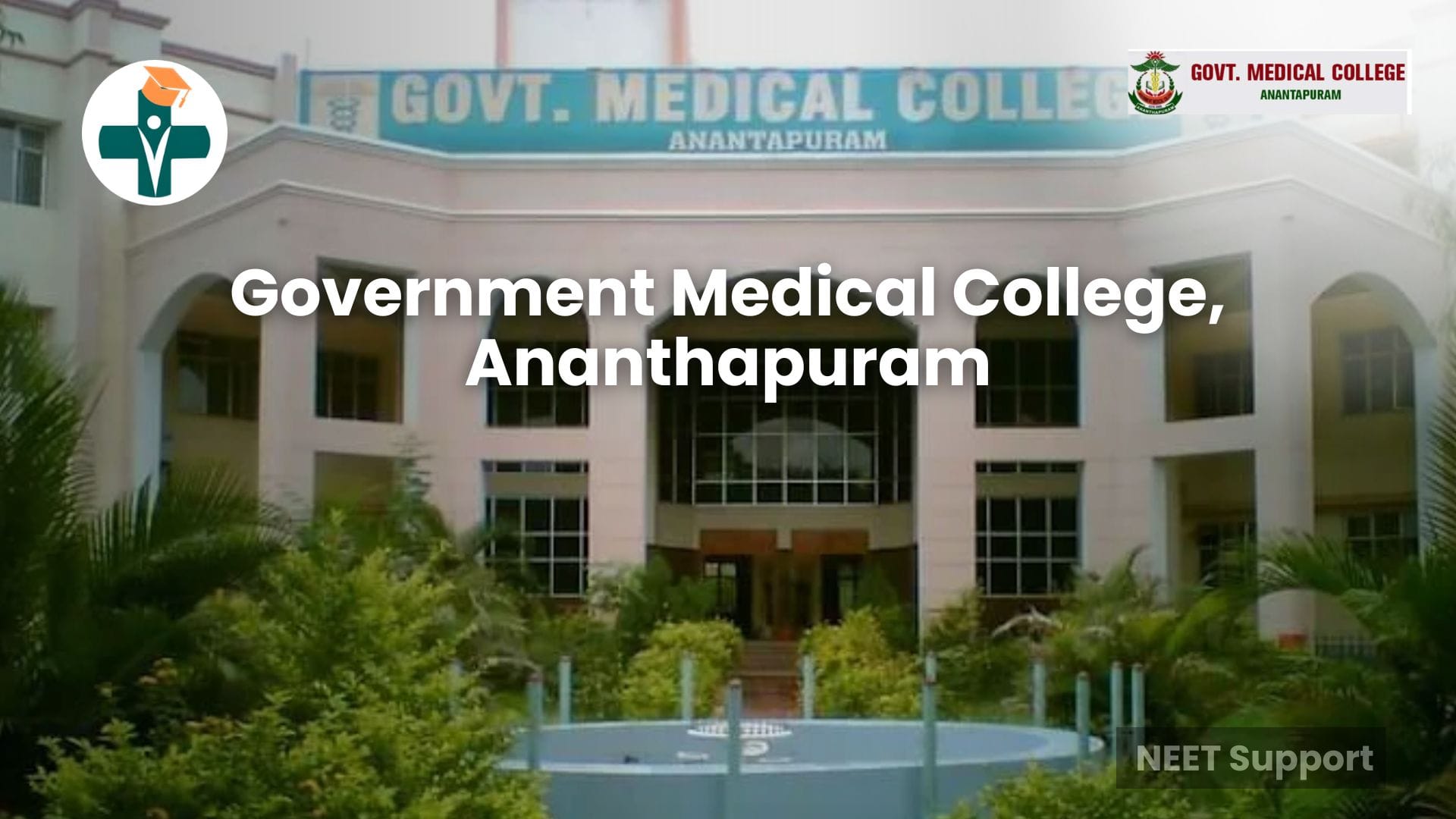
Established in 2000, Government Medical College (GMC), Ananthapuram, is one of the crucial institutions for medical education in the Rayalaseema region of Andhra Pradesh. It's combined with Dr N.T.R. University of Health Science (NTRUHS), Vijayawada, and has steadily grown into a preferred destination for scholars who aspire to make a career in the medical field with a strong foundation in both academics and clinical practice. Over time, the college has developed a character for combining structured literacy with practical exposure.
Generally known as GMC ATP, it's a government- funded institution approved by the National Medical Commission (NMC). The college is positioned on a large campus that provides a suitable terrain for academic growth and skill development. It's directly integrated with the Government General Hospital (GGH), Ananthapuram, which acts as the major care centre for the district and receives a high volume of cases from nearby regions.
This close association between the council and hospital ensures that scholars have nonstop clinical exposure. From the early years of training, they share in hospital- grounded literacy, which helps them gain practical skills, facilitate clinical understanding, and prepare effectively for their future medical careers.
Key Highlights
| Feature | Details |
|---|---|
| Established | 2000 |
| Location | Anantapuramu, Andhra Pradesh |
| Infrastructure | 48.8 acres campus |
| Hospital | 500+ bedded Government General Hospital |
| Status | Government Medical College |
| Recognition | National Medical Commission (NMC) |
| Affiliation | Dr. N.T.R. University of Health Sciences (NTRUHS) |
| Stipend for Interns | Approx. ₹25,000 – ₹26,000 per month |
Courses Offered
The college offers a wide spectrum of undergraduate and postgraduate medical programs.
Undergraduate courses
| Course Level | Degree Name | Specialisations / Departments | Duration |
|---|---|---|---|
| Undergraduate | MBBS | General Medicine & Surgery | 4.5 Years + 1 Year Internship |
Postgraduate (MD/MS)
| Course Level | Degree Name | Specialisations / Departments | Duration |
|---|---|---|---|
| Postgraduate | MD | General Medicine, Pediatrics, Anesthesia, Psychiatry, Radiodiagnosis, Dermatology, Respiratory Medicine, Pathology, Microbiology, Pharmacology, Biochemistry, Physiology, Anatomy, Forensic Medicine, Community Medicine | 3 Years |
| Postgraduate | MS | General Surgery, Orthopaedics, Obstetrics & Gynaecology, Ophthalmology, ENT | 3 Years |
Super Speciality Courses
| Course Level | Degree Name | Specialisations / Departments | Duration |
|---|---|---|---|
| Super Specialty | M.Ch | Neuro Surgery | 3 Years |
Seat Matrix
The distribution of seats is strictly governed by state and national quotas.
MBBS Seat Matrix
| Quota Type | Seat Percentage | Number of Seats (Approx.) | Counseling Body |
|---|---|---|---|
| All India Quota (AIQ) | 15% | 30 | Medical Counselling Committee (MCC) |
| State Quota (Competent Authority) | 85% | 170 | Dr. YSR University of Health Sciences (Dr. YSRUHS) |
| Total | 100% | 200 | - |
Category-Wise Seat Distribution (State Quota - 85%)
| Reservation Category | Seat Percentage | Estimated Seats |
|---|---|---|
| Open Competition (OC) | 40% | 68 |
| Scheduled Caste (SC) | 15% | 25 |
| Scheduled Tribe (ST) | 6% | 10 |
| Backward Classes - A (BC-A) | 7% | 12 |
| Backward Classes - B (BC-B) | 10% | 17 |
| Backward Classes - C (BC-C) | 1% | 2 |
| Backward Classes - D (BC-D) | 7% | 12 |
| Backward Classes - E (BC-E) | 4% | 7 |
| Economically Weaker Section (EWS) | 10% | 17 |
Postgraduate (MD/MS) Seats
| Specialisation | Course Type | Total Intake (Seats) |
|---|---|---|
| General Medicine | MD | 12 |
| General Surgery | MS | 8 |
| Radiodiagnosis | MD | 4 |
| Paediatrics | MD | 4 |
| Obstetrics & Gynaecology | MS | 4 |
| Respiratory Medicine | MD | 5 |
| Dermatology (DVL) | MD | 4 |
| Orthopaedics | MS | 7 |
| Psychiatry | MD | 2 |
| Biochemistry | MD | 2 |
Fee Structure
Being a government institution, the fee is highly subsidised, making it accessible to meritorious students from all economic backgrounds.
MBBS Fees
| Seat Category | Annual Tuition Fee (₹) | Total Course Fee (Tuition Only) |
|---|---|---|
| Government Quota (Cat-A) | ₹15,000 | ~₹47,250 (Full Course) |
| All India Quota (AIQ) | ~₹10,250 – ₹10,500 | ~₹47,250 (Full Course) |
| Management Quota (Cat-B) | ₹12,00,000 | – |
| NRI Quota (Cat-C) | ₹20,00,000 | – |
Postgraduate Fees
| Component | Amount (Annual/Total) |
|---|---|
| Annual Tuition Fee | ₹30,000 – ₹48,600 |
| Total Tuition Fee (3 Years) | ₹90,000 |
| One-Time Admission Fee | ₹10,650 |
Hostel, Mess, and Miscellaneous Charges
| Facility | Estimated Charges (₹) | Frequency |
|---|---|---|
| Hostel Rent | ₹12,000 – ₹55,000+ | Per Year |
| Mess Charges | ~₹3,000 – ₹4,000 | Per Month |
| Total Hostel & Mess | ₹58,000 – ₹70,000 | Per Year |
| Refundable Security Deposit | ₹24,000 | One-Time |
| Monthly Intern Stipend | ~₹19,500 | Monthly (During Internship) |
Cut-off Trends
The cut-offs fluctuate based on the difficulty of the NEET exam. Historically, the closing ranks are as follows:
MBBS Cut-off Trends (All India Quota)
| Category | 2025 Closing Rank | 2024 Closing Rank | 2023 Closing Rank |
|---|---|---|---|
| General | 22,485 | 20,484 | 20,482 |
| OBC | 22,819 | 21,305 | 21,080 |
| SC | 1,23,195 | 1,24,855 | 1,11,883 |
| ST | 1,50,040 | 1,04,292 | 1,19,411 |
| EWS | 26,931 | 24,228 | 21,992 |
2024 MBBS Round-Wise Cut-offs (All India Quota)
| Category | Round 1 | Round 2 | Round 3 |
|---|---|---|---|
| General (Open) | 15,439 | 18,690 | 20,484 |
| OBC | 16,275 | 18,986 | 21,305 |
| EWS | 19,939 | 21,209 | 24,228 |
| SC | 94,063 | 98,513 | 1,24,855 |
| ST | 1,04,292 | —* | 1,04,292 |
2024 NEET PG Specialisation Cut-offs (General Category)
| Course (MD/MS) | Round 1 Closing Rank | Round 2 Closing Rank | Round 3 Closing Rank |
|---|---|---|---|
| MD Paediatrics | 3,142 | 4,208 | 4,701 |
| MS Obstetrics & Gynaecology | 8,172 | 8,421 | 8,799 |
| MS General Surgery | 9,684 | 12,245 | 13,979 |
| MS Orthopaedics | 14,025 | 17,392 | 19,298 |
| MD Pathology | 34,284 | 42,106 | 42,886 |
Admission & Counselling Process
The admission process is entirely merit-based via the NEET-UG (for MBBS) and NEET-PG (for MD/MS) examinations.
Counselling Rounds
1. Round 1: Registration and choice filling on the Dr NTRUHS/MCC portal.
2. Round 2: Fresh choice filling; upgrades allowed for Round 1 candidates.
3. Mop-up Round: For the remaining vacant seats.
4. Stray Vacancy Round: Final physical/online round to fill leftover seats.
Documents Required
- Candidates must carry original sets of the following:
- NEET 2026 Admit Card & Scorecard
- Class 10 (DOB proof) and Class 12 Certificates
- Transfer Certificate (TC) & Study Certificates (Class 6 to 12)
- Caste/Category Certificate (if applicable)
- Domicile/Residence Certificate (for state quota)
- 8 Passport-size photographs
- Aadhar Card/Government ID
Infrastructure and Facility
Central Library: The institution features a well- developed central library that remains accessible throughout the day. It includes air-conditioned reading spaces and an extensive collection of medical journals, supporting both academic study and research features.
Laboratories: Ultramodern laboratories are available for core medical subjects such as Anatomy, Physiology, and Pathology. These installations are equipped with streamlined instruments, enabling scholars to gain practical knowledge alongside their theoretical literacy.
Hostel: Separate hostel accommodations are provided for male and female scholars. These hostels ensure essential amenities, including nonstop water supply and 24/7 Wi- Fi connectivity, creating a comfortable living terrain.
Clinical Exposure: The attached Government General Hospital (GGH) handles a large number of cases daily. This patient flux allows scholars to observe and manage a wide range of clinical conditions, thereby strengthening their practical understanding and individual skills.
Why Choose GMC Ananthapuram?
1. Clinical Exposure: The patient load is massive. You will see conditions here that private college students only read about in textbooks.
2. Experienced Faculty: Many professors have decades of experience in the public health sector.
3. Affordability: The ROI (Return on Investment) is unbeatable.
4. Community: A strong, supportive alumni network across the globe.
Pros and Cons of Choosing Government Medical College, Ananthapuram
| Pros | Cons |
|---|---|
| Minimal Tuition Fees | Aging infrastructure in some blocks |
| High Patient Volume for Practice | Campus is relatively small compared to newer AIIMS |
| High Intern Stipend | Small playground for sports |
| Central Library Facilities | Maintenance issues in some hostel washrooms |
Nearby Survival Guide
Food: Local eateries near the college serve authentic Rayalaseema cuisine (spicy but delicious). There are also several cafes, like The Big Owl, for a change of pace.
Connectivity: The college is well-connected by APSRTC buses and is close to the Anantapur Railway Station.
Essentials: Supermarkets and pharmacies are within a 500m radius.
Placement & Internship Stats
In medicine, "placements" aren't like engineering. Instead, the focus is on Internships and PG success rates.
Internship: 100% of students complete their internship at GGH with a monthly stipend of ~₹25,000.
Higher Studies: Approximately 60-70% of graduates successfully secure MD/MS seats in top national institutes within two years of graduation.
Official Links
For counselling purposes: Click here
For comparison with other colleges: Click here
1:1 Counselling session: Click here
For the prediction of college: Click here
For prediction of rank: Click here
Frequently Asked Questions (FAQs)
1. Is there a rural service bond?
Yes, as per AP state government rules, there is a mandatory one-year rural service bond.
2. How is the mess food?
Reviews suggest it is "average to good," specializing in South Indian meals.
3. Is the campus safe?
Yes, the campus has 24/7 security and is considered very safe for women.
4. Does the college provide Wi-Fi?
Yes, the library and most hostel areas have 24/7 Wi-Fi.
5. What is the student-to-faculty ratio?
It is sufficient, adhering to NMC guidelines (approx. 1:10 for clinical postings).
6. Can I get a single room in the hostel?
Usually, rooms are shared (2-3 per room) in the first few years.
Conclusion
Government Medical College, Ananthapuram, serves not only as an academic institution but also as a centre for developing adaptability and practical capability among medical scholars. Although its structure may not reflect the complications frequently seen in private universities, the institution offers exceptional clinical exposure that's largely valuable for professional growth. Scholars benefit from extensive hands- on training, which strengthens their understanding of real- world medical practice. Also, the council provides quality education at a significantly lower cost, making it accessible to a wider range of applicants. For individuals who prioritise practical literacy, community service, and affordability, GMC Ananthapuram represents a strong and worthwhile choice.
Reviews
No reviews yet. Be the first to write one!