Deccan College of Medical Sciences (DCMS), Hyderabad: Ultimate Guide for 2026
RISHIKESH KUMAR
 WhatsApp
 Email
Email Facebook
 Twitter/X
 LinkedIn
Table of Contents
Predict Your Rank Now
Enter your NEET score to get an estimated rank
Find the Best Colleges For You
Based on your NEET rank, Category & more

Get Your Dream Medical College
Secure your seat with expert counselling
Overview
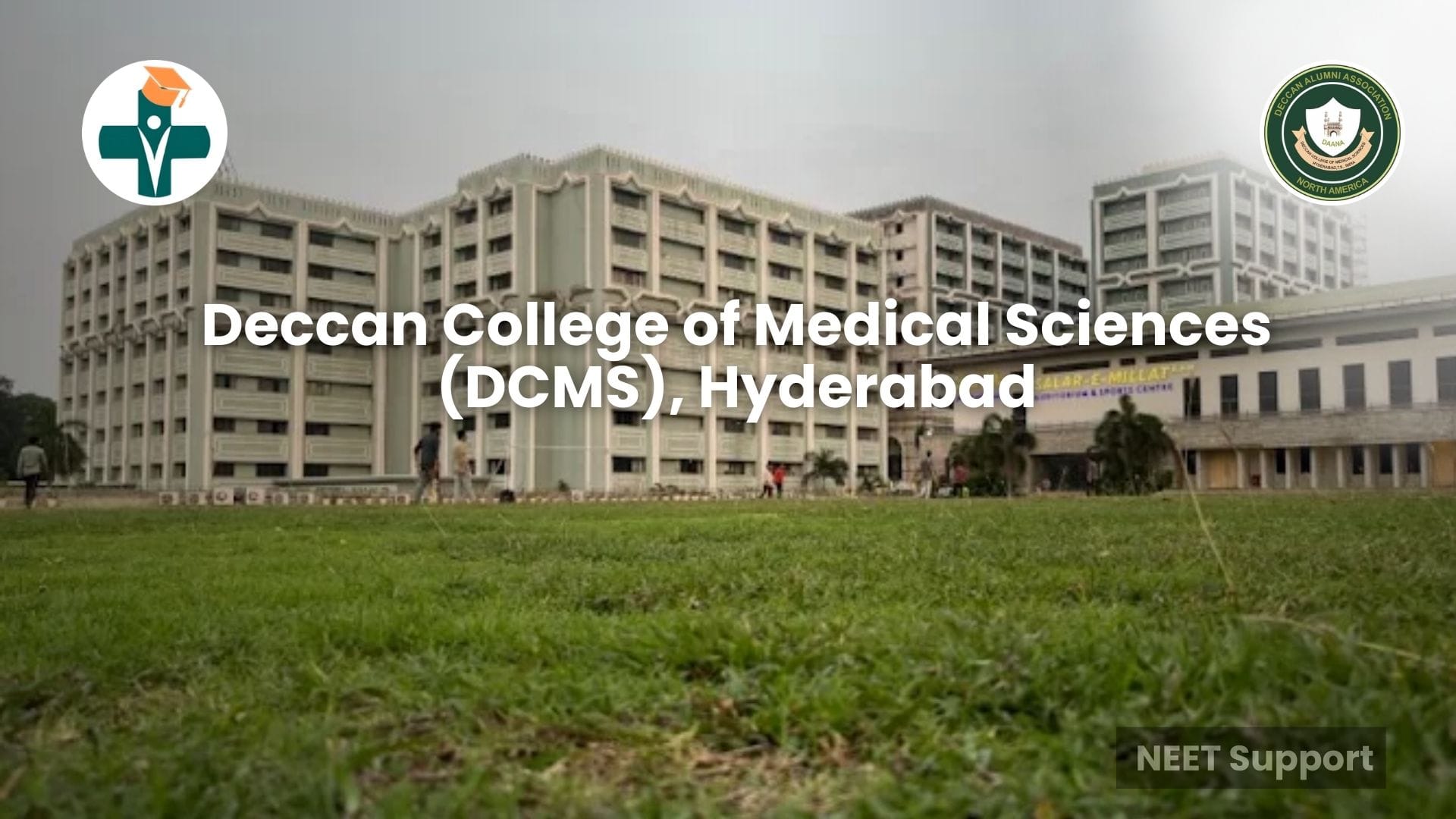
Established in 1984, the Deccan College of Medical Sciences (DCMS) has been a foundation of medical education in Southern India. Located in the major megacity of Hyderabad, it's one of the oldest and most reputed private medical colleges in Telangana. The institution is managed by the Darussalam Educational Trust (DET) and was established with the aim of furnishing high-quality medical education, especially for the Muslim Minority community, while promoting an inclusive environment for all scholars.
DCMS is more than just a council; it's a corner in Hyderabad’s medical geography. The council is combined with Kaloji Narayana Rao University of Health Sciences (KNRUHS), Warangal, and is honoured by the National Medical Commission (NMC), ensuring that its programs meet public norms for medical education.
The council operates across two main premises. The preclinical and paraclinical departments are housed at the major Nawab Lutf-ud-Daula Palace in Zafargarh, furnishing a unique and inspiring literary terrain. The clinical departments function from the Princess Esra Hospital and the Owaisi Hospital & Research Centre, offering scholars expansive hands-on training and exposure to a wide range of medical cases.
Over the decades, DCMS has maintained a strong character for academic excellence, practical training, and community service, making it a favoured destination for aspiring medical professionals in the region.
Key Highlights
| Attribute | Details |
|---|---|
| Established | 1984 |
| Type | Private (Religious Minority - Muslim) |
| Affiliation | KNRUHS, Telangana |
| Approval | National Medical Commission (NMC) |
| Location | Kanchanbagh, Hyderabad |
| Main Hospitals | Owaisi Hospital & Princess Esra Hospital |
Courses Offered
DCMS offers a comprehensive range of programs, from undergraduate degrees to super-speciality fellowships.
Undergraduate (UG):
* MBBS: The flagship course with a duration of 4.5 years plus a 1-year compulsory rotating internship.
Postgraduate (PG - MD/MS):
* Clinical: General Medicine, Pediatrics, Anaesthesia, Radio-Diagnosis, General Surgery, Orthopaedics, Obstetrics & Gynaecology, etc.
* Para-Clinical/Pre-Clinical: Anatomy, Physiology, Biochemistry, Pathology, Microbiology, and Pharmacology.
Super-Specialty (DM/M.Ch):
* Cardiology, Neurology, Plastic Surgery, and Urology.
* PG Diploma: Various specialisations in clinical subjects.
Seat Matrix
For the academic year 2025-2026, the seat distribution is generally categorised as follows:
| Course / Category | Details |
|---|---|
| MBBS Intake | 150 Seats |
| Category A (Convenor Quota) | 50% of seats (Reserved for local/minority candidates through state counseling) |
| Category B (Management Quota) | 35% of seats |
| Category C (NRI Quota) | 15% of seats |
| PG (MD/MS) Intake | Approximately 68–70 seats across various departments |
Fee Structure
Medical education is a significant investment. Here is the approximate annual tuition fee for the MBBS program:
| Category | Annual Tuition Fee |
|---|---|
| Category A (Govt./Convenor) | ₹60,000 |
| Category B (Management) | ₹12,50,000 – ₹13,50,000 |
| Category C (NRI) | ₹28,00,000 – ₹32,00,000 |
Note: In addition to tuition fees, students are required to pay university fees, hostel fees (approx. ₹80,000 - ₹1,00,000/year), and a refundable caution deposit.
Cut-off Trends
Admission to DCMS is highly competitive, especially for Category A seats. As a minority institution, the cut-offs for Muslim Minority candidates are typically lower than the general state pool, but have been rising due to increased competition.
* 2024 Closing Ranks (MBBS - Category A):
* General/Minority: ~85,000 to 95,000 (All India Rank)
* Target Score for 2026:
* For Category A, aim for a NEET score of 520+.
* For Category B, a score of 450+ is generally considered safe.
Admission & Counselling Process
Admission is strictly based on the NEET (National Eligibility cum Entrance Test) score.
- Eligibility
Undergraduate (UG) Courses aspirants must have completed 10+2 with Physics, Chemistry, and Biology as core subjects. For admission, a minimal total of 50 is needed for General order scholars, while 40 is required for Reserved order campaigners.
Postgraduate (PG) Courses aspirants must hold a valid MBBS degree and have endless enrolment with the Medical Council of India (MCI) or National Medical Commission (NMC) to be eligible for admission.
- Counselling Steps
Registration: Interested aspirants should register on the Kaloji Narayana Rao University of Health Sciences (KNRUHS) sanctioned website once the comforting announcement is released.
Verification: Upload all needed documents for online verification. Minority aspirants must also submit a valid Minority Certificate, generally available as part of the SSC Transfer Certificate (TC).
Web Options: Aspirants must exercise their “Web Options,” giving precedence to DCMS if it's their preferred council.
Allotment: Seats are allocated based on merit, reservation order, and the preferences entered during web options.
Reporting: Once a seat is distributed, aspirants must report to the council with original documents and pay the first-time fee to confirm and secure their admission.
Following this way precisely ensures a smooth admission process and avoids any last-nanosecond issues for both UG and PG applicants at DCMS.
Documents Required
- NEET scorecard
- NEET admit card
- Class 10th and 12th mark sheets
- Transfer certificate
- Migration certificate
- Caste certificate (if applicable)
- Identity proof (Aadhaar, passport, etc.)
- Passport-sized photographs
- Allotment letter from the counselling authority
Infrastructure & Facilities
DCMS boasts a blend of heritage architecture and modern medical technology.
Lecture Halls: The council offers air-conditioned, gallery-style classrooms designed for an optimal learning environment. Each hall is equipped with smart boards and ultramodern audio-visual aids, allowing interactive lectures and better abstract understanding for scholars.
Library: DCMS houses a commodious central library with a collection of over 15,000 books covering medical and confederate subjects. It also subscribes to public and transnational journals and features a well-equipped e-resource centre, enabling scholars to access digital literacy accoutrements and exploration papers accessibly.
Laboratories: The council provides state-of-the-art laboratories for crucial subjects, including Biochemistry, Pathology, and Microbiology. These labs are designed to support practical literacy, exploration conditioning, and skill development in a controlled and ultramodern terrain.
Hospitals: Scholars admit practical training at Owaisi Hospital and Princess Esra Hospital, which together offer further than 1,000 beds. These hospitals ensure exposure to a wide variety of medical cases and a high case load, helping scholars gain essential hands-on clinical experience.
Hostels: Separate caravansaries for boys and girls are available, offering a secure and comfortable living environment. Each hotel includes mess installations serving both submissive and non-vegetarian meals, ensuring proper nutrition for scholars.
Sports: DCMS promotes physical fitness with installations for justice, football, basketball, as well as indoor games like table tennis and chess, encouraging scholars to maintain a healthy and balanced life alongside their studies.
Frequently Asked Questions (FAQs)
1. Is DCMS only for Muslim students?
No. While it is a Muslim Minority institution and a significant portion of seats are reserved for minority candidates, seats under the Management and NRI quotas are open to all students regardless of religion.
2. Which hospital is better for clinical postings?
Both are excellent. Owaisi Hospital is a multi-specialty center with advanced surgical units, while Princess Esra Hospital is located in the heart of the city and sees a very high volume of outpatients.
3. Does the college offer any scholarships?
The college itself does not have a formal scholarship program, but students can apply for state government scholarships (like RTF) and national minority scholarships.
4. What is the bond period for MBBS at DCMS?
Telangana state usually mandates a service bond for students in government seats, but private college rules can vary yearly. Currently, most private college students sign a "discontinuation bond" rather than a service bond.
5. How is the campus life?
The campus is disciplined yet vibrant. The annual fest, "Deccan Fest," is a major highlight, featuring sports, cultural events, and academic quizzes.
6. Is there any transport facility?
Yes, the college provides bus services for students and staff connecting the various hospital campuses and major parts of the city.
Conclusion
Deccan College of Medical Sciences continues to be a favoured choice for scholars aiming for a strong medical education, especially those looking for expansive clinical exposure in Hyderabad. With well-equipped installations, experienced preceptors, and a heritage spanning over 40 years, DCMS provides an excellent terrain for developing the chops demanded to become a competent croaker. Although the fees for operation seats are fairly high, the quality of education, hands-on clinical training, and the variety of medical cases available make it a precious investment for scholars’ unborn careers in drug. Choosing DCMS ensures both learning excellence and practical experience in a professional medical setting.
Reviews
No reviews yet. Be the first to write one!