
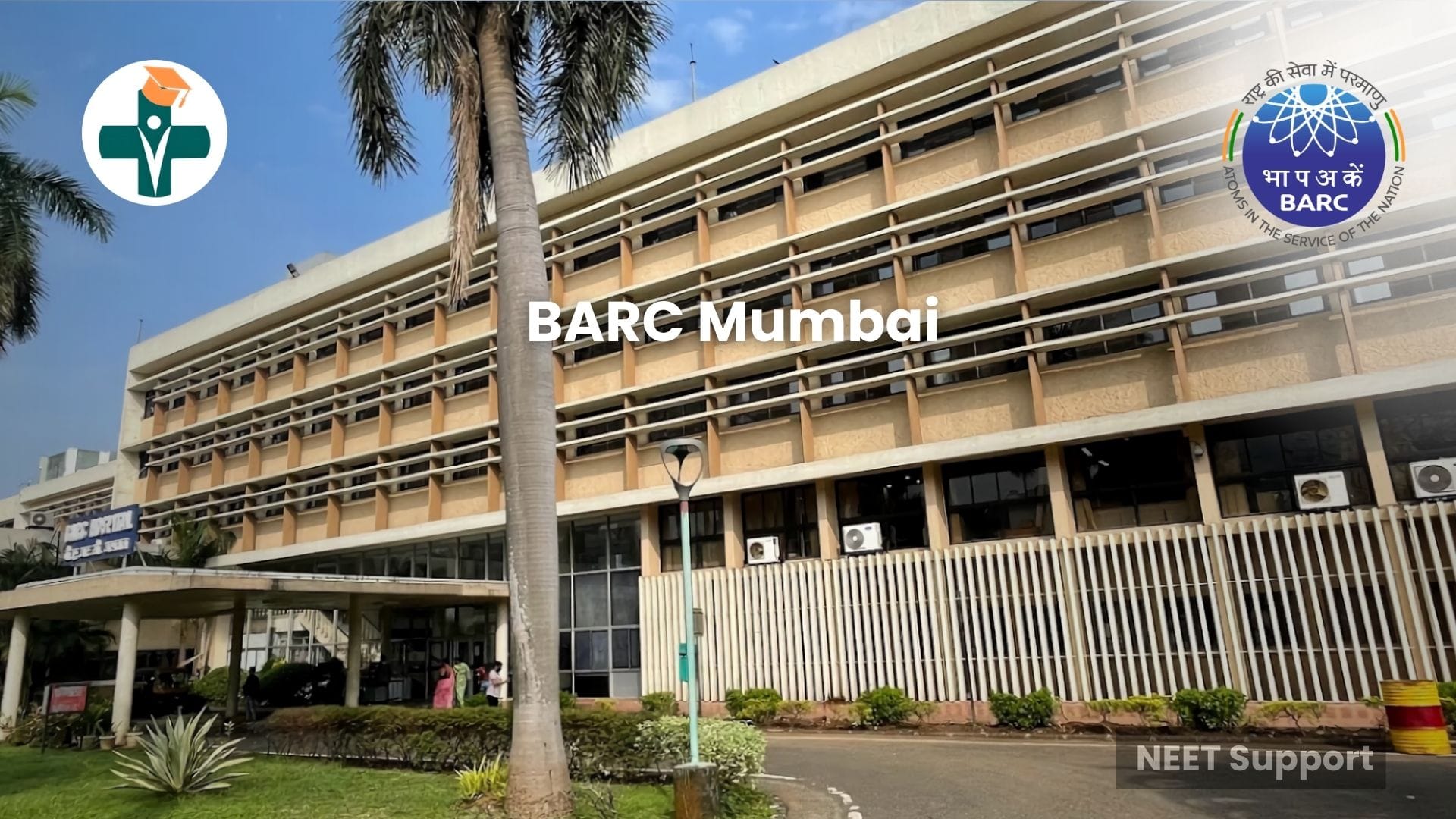
BARC Mumbai: Courses, Admission, Fees, Infrastructure & Hospital Guide
Nishat
 WhatsApp
 Email
Email Facebook
 Twitter/X
 LinkedIn
Table of Contents
Predict Your Rank Now
Enter your NEET score to get an estimated rank
Find the Best Colleges For You
Based on your NEET rank, Category & more

Get Your Dream Medical College
Secure your seat with expert counselling
Overview
The Bhabha Atomic Research Centre, based in Mumbai, India, is a premier government-funded research center that reports to the Department of Atomic Energy (DAE) of the Indian government. Established in 1954, BARC continues to contribute substantially to developments in both nuclear science and clinical radiation medicine, while also providing high-tech solutions to improve the quality of patient care. Besides performing research, BARC also offers medical education and training through postgraduate courses in the clinical applications of nuclear medicine and related nursing specialties.
Academic medical training provided by BARC is offered by way of BARC's Medical Units, as well as from the Radiation Medicine Centre located at BARC, and coordinated through HBNI (Homi Bhabha National Institute). The academic medical training offered by BARC is focused on highly specialized topics, including those associated with the use of nuclear medicine, radiation oncology, and medical physics.
The BARC Medical Training Facilities are supplemented by BARC’s Hospital, a fully equipped facility located in Anushaktinagar, Mumbai, that provides a range of clinical training to postgraduate students, residents, and healthcare services for employees and residents in the area. BARC Hospital is widely recognized for its diagnostic imaging, radiopharmaceutical therapy, and research-based medical education. In addition to providing traditional medicine, the BARC Hospital is unique in its emphasis on highly specialized and technologically advanced areas of medicine related to nuclear medicine and radiation sciences.
The competitive nature of the programs at BARC is a result of their focus on research and the limited number of students accepted into the programs. Most applicants to the programs are those wishing to pursue careers in nuclear medicine, radiology, or medical physics.
Key Highlights
Courses Offered
BARC Mumbai offers specialized postgraduate and super-specialty medical programs primarily in the areas of nuclear medicine, oncology, and hospital-based clinical specialties.
Major courses include:
MD Programs
- MD Nuclear Medicine
Super Specialty Programs
- M.Ch Surgical Oncology
DNB Programs
- DNB Anaesthesiology
- DNB Pathology
- DNB Surgery
- Other clinical specialties, depending on accreditation
Most of these courses are 3 years in duration and require candidates to have completed MBBS from an NMC-recognized institution along with a valid NEET PG score.
Seat Matrix
| Course | Total Seats | Duration | Eligibility |
| MD Nuclear Medicine | 2 | 3 Years | MBBS + NEET PG |
| M.Ch Surgical Oncology | 2 | 3 Years | MS / DNB Surgery |
| DNB Anaesthesiology | 2 | 3 Years | MBBS + NEET PG |
| DNB Pathology | 2 | 3 Years | MBBS + NEET PG |
| DNB General Surgery | 2 | 3 Years | MBBS + NEET PG |
Fee Structure
| Course | Program Type | Tuition Fee | Hostel Fee | Stipend |
| DNB Orthopaedics | DNB Post MBBS | ₹1,25,000 | ₹20,000 | ₹96,000 |
| DNB Ophthalmology | DNB Post MBBS | ₹1,25,000 | ₹20,000 | ₹96,000 |
| DNB Psychiatry | DNB Post MBBS | ₹1,25,000 | ₹20,000 | ₹96,000 |
| DNB ENT | DNB Post MBBS | ₹1,25,000 | ₹20,000 | ₹96,000 |
| DNB Pathology | DNB Post MBBS | ₹1,25,000 | ₹20,000 | ₹96,000 |
| DNB Anaesthesiology | DNB Post MBBS | ₹1,25,000 | ₹20,000 | ₹96,000 |
| DNB General Surgery | DNB Post MBBS | ₹1,25,000 | ₹20,000 | ₹96,000 |
| DNB Paediatrics | DNB Post MBBS | ₹1,25,000 | ₹20,000 | ₹96,000 |
| DNB General Medicine | DNB Post MBBS | ₹1,25,000 | ₹20,000 | ₹96,000 |
| DNB Radio Diagnosis | DNB Post MBBS | ₹1,25,000 | ₹20,000 | ₹96,000 |
| DNB Diploma OBG | NBE Diploma | ₹1,25,000 | ₹20,000 | ₹96,000 |
| MD Nuclear Medicine | MD Program | ₹75,500 | Information Not Available | ₹96,000 |
Infrastructure and Facilities
BARC Mumbai boasts a state-of-the-art facility for research and clinical training. The entire site was designed to foster both research activity and medical education.
Some of the key pieces of equipment at BARC Mumbai include:
- Nuclear medicine labs
- Diagnostic imaging systems
- Radiation therapy equipment
- A fully computerized hospital information system
- Research laboratories & nuclear reactor
- Academic lecture/seminar rooms
- Libraries containing scientific journals
- Living accommodations for employees/residents
- A computerized hospital management system.
All these items will provide students with an excellent mix of clinical experience and research experience not found in most other medical schools.
Attached Hospital
BARC Hospital serves as the primary teaching hospital for medical programs associated with the centre.
The hospital is a 390-bed multispecialty healthcare facility located in Anushaktinagar, Mumbai.
Key features of the hospital
- Around 390 inpatient beds
- Modern operating theatres
- Intensive care units
- Diagnostic imaging units
- Radiation therapy facilities
Major specialties
- General Medicine
- General Surgery
- Anaesthesiology
- Pathology
- Oncology
- Nuclear Medicine
- Urology
- Plastic Surgery
- Gastroenterology
Clinical exposure
Residents get exposure to:
- Diagnostic imaging and radionuclide therapy
- Oncosurgery and cancer care
- Advanced laparoscopic procedures
- Multidisciplinary clinical management
The hospital also operates multiple dispensaries and occupational health centres to serve the community.
Why Choose BARC Mumbai?
By electing BARC as the destination for postgraduate medical training, one can avail oneself of a number of unique advantages.
- Specialization in Medical Training at BARC: BARC offers medical training in a highly innovative and specialized medical training modality, such as nuclear medicine.
- Government Funded Institution: BARC is an agency of the Government of India and is thus committed to providing high-quality education, which is accessible to all.
- The opportunity to work in research-driven settings: Students have the chance to learn about the use of innovative technology and research in the field of radiation.
- Small Class Size: Due to the limited number of seats available in the BARC's postgraduate medical program, students can expect to receive individual attention from faculty.
- Excellent academic reputation: Commonly known for providing a high level of education in nuclear research and/or medical radiation science, it continues to be considered one of India's top institutions.
- Good career prospects: Employment prospects for graduates of the BARC postgraduate medical program are exceptional, and graduates typically secure employment in some of the best hospitals and cancer centres in the world and other leading research organizations.
Admission Process
Admission to postgraduate medical courses at BARC generally follows national entrance examinations.
Step-by-step admission process
- Appear for the NEET PG examination.
- Register for counselling through the appropriate authority.
- Participate in the counselling rounds.
- Choose BARC Hospital or affiliated training centres.
- Seat allotment based on merit and availability.
- Document verification and admission confirmation.
Documents Required
Applicants typically need the following documents:
- NEET PG scorecard
- MBBS degree certificate
- Internship completion certificate
- Medical registration certificate
- Identity proof (Aadhar / Passport)
- Category certificate (if applicable)
- Passport-size photographs
- Counselling allotment letter
Failure to submit the required documents may lead to cancellation of admission.
FAQs
What is BARC Mumbai known for?
BARC Mumbai is famous for nuclear research and radiation sciences. In the medical field, it offers specialized training in nuclear medicine, oncology, and related areas.
Is BARC a medical college?
BARC is primarily a research institution, but it offers specialized postgraduate medical training programs through affiliated hospitals and institutes.
Which courses are offered at BARC in the medical field?
Courses include MD Nuclear Medicine, M.Ch Surgical Oncology, and several DNB programs such as Anaesthesiology and Pathology.
How many seats are available in BARC PG courses?
The number of seats is limited, usually ranging from 1 to 2 seats per course, depending on accreditation.
Does BARC provide hostel facilities?
Accommodation facilities are available for residents depending on availability within the campus.
How big is BARC Hospital?
BARC Hospital has around 390 beds and offers multispecialty healthcare services.
What kind of clinical exposure do students get?
Students gain exposure to nuclear medicine procedures, oncology treatments, diagnostic imaging, and surgical specialties.
Is BARC Hospital accredited for postgraduate training?
Yes, the hospital is accredited by the National Board of Examinations for DNB programs.
Conclusion
BARC Mumbai is an innovative facility that connects medicine, nuclear research, and advanced healthcare technology. Though it does not fit into a conventional model of a medical college, its emphasis is placed on delivering specialized programs in nuclear medicine and clinical science to educate physician graduates through unique opportunities. BARC has provided physicians with the educational environment, research opportunity, and state-of-the-art infrastructure of a Multispecialty Teaching Hospital. As a result, BARC has evolved into one of the premier institutions in India for physicians seeking careers in cutting-edge technologies in medicine or research.
Reviews
No reviews yet. Be the first to write one!