Akash Institute of Medical Sciences & Research Centre, Devanahalli, Bangalore: Admission, Courses, Fees, NEET Cutoff, Hostel & More
Rashi Goyal
 WhatsApp
 Email
Email Facebook
 Twitter/X
 LinkedIn
Table of Contents
Predict Your Rank Now
Enter your NEET score to get an estimated rank
Find the Best Colleges For You
Based on your NEET rank, Category & more

Get Your Dream Medical College
Secure your seat with expert counselling
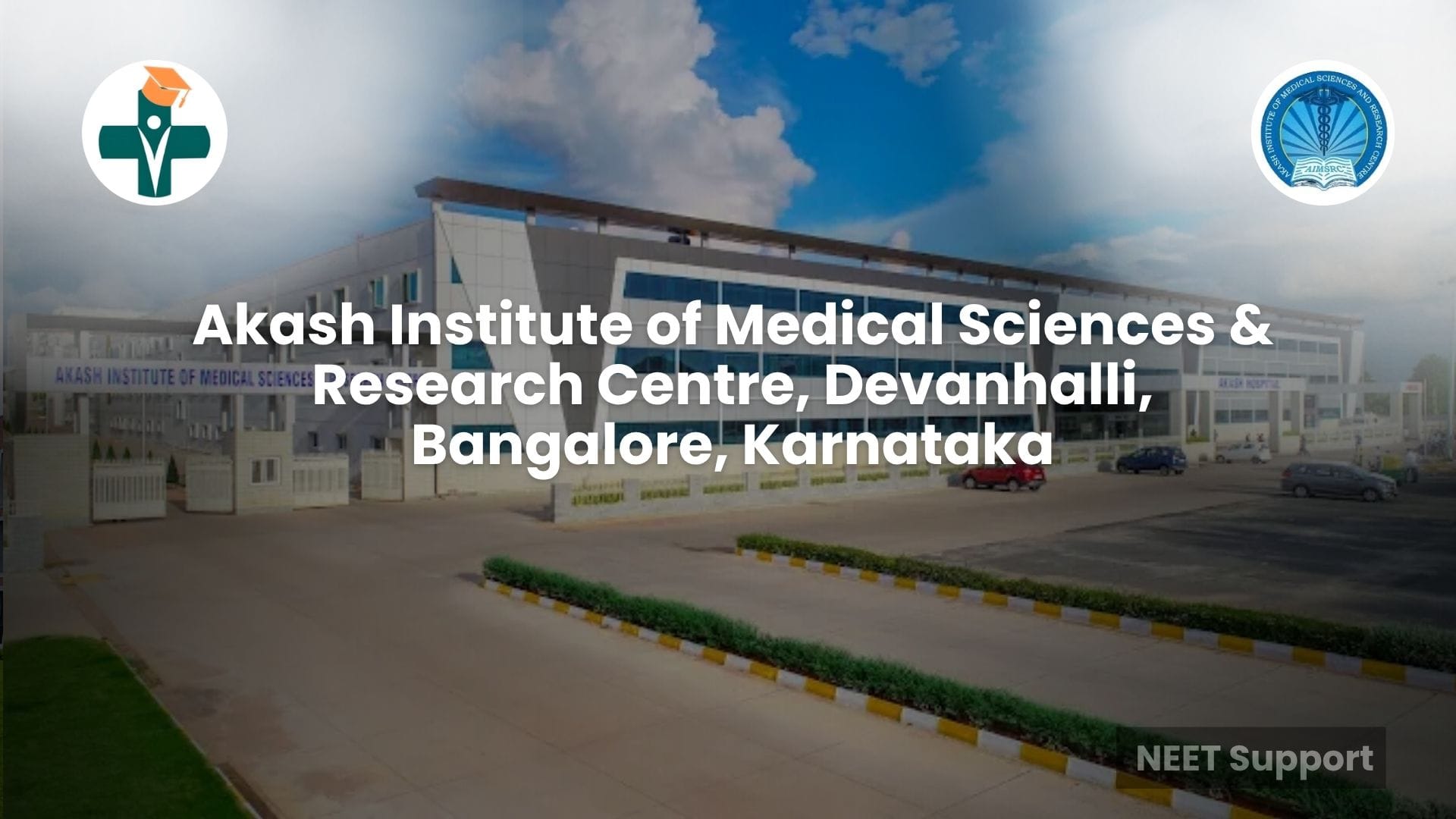
Choosing a medical college is a major decision for every NEET aspirant. Students generally compare colleges on several factors, including MBBS fees, NEET cutoff, seat intake, admission process, clinical exposure, hospital facilities, hostel, infrastructure, and location. Akash Institute of Medical Sciences & Research Centre (AIMSRC), located in Devanahalli, Bengaluru, Karnataka, is one of the private medical colleges that students can consider while exploring MBBS and postgraduate medical education in Karnataka.
The college is situated on Prasannahalli Road, Devanahalli, near Kempegowda International Airport, Bengaluru. It is affiliated with Rajiv Gandhi University of Health Sciences (RGUHS), Karnataka, and its MBBS programme follows the curriculum and clinical training framework prescribed by the National Medical Commission. The institution offers undergraduate MBBS education as well as postgraduate MD/MS programmes.
One notable point for students checking recent seat information is that the MBBS intake has increased over time. A seat matrix for the 2025–26 academic year lists 250 MBBS seats, compared with 150 seats in the preceding year.
Overview
Akash Institute of Medical Sciences & Research Centre is a medical education institution located in Devanahalli, Bengaluru Rural, Karnataka. Its location near Kempegowda International Airport makes it particularly accessible for students travelling from different parts of India.
The institution provides medical education at both undergraduate and postgraduate levels. The MBBS programme is affiliated with Rajiv Gandhi University of Health Sciences (RGUHS), Karnataka. The college's official course information states that the MBBS programme includes pre-clinical, para-clinical and clinical disciplines along with hospital-based clinical training.
The college is part of the broader Akash Group of Institutions, which offers programmes across medicine, nursing, physiotherapy, allied health sciences and other educational fields. For a medical aspirant, the biggest factors to evaluate are not only the college name but also the applicable seat category, current fee notification, NEET rank requirement, clinical exposure, hospital workload, and overall cost of education.
College Highlights
| Particular | Details |
|---|---|
| College Name | Akash Institute of Medical Sciences & Research Centre |
| Location | Devanahalli, Bengaluru, Karnataka |
| Address | Prasannahalli Road, Devanahalli, near International Airport, Bengaluru – 562110 |
| Type | Private Medical College |
| Affiliation | Rajiv Gandhi University of Health Sciences, Karnataka |
| Recognition | National Medical Commission framework/recognition |
| Undergraduate Course | MBBS |
| Postgraduate Courses | MD/MS |
| MBBS Entrance | NEET UG |
| PG Entrance | NEET-PG |
| MBBS Duration | 4.5 years + 1 year internship |
| Current Published MBBS Intake | 250 seats for AY 2025–26 |
| Counselling | Karnataka Examination Authority (KEA) for applicable seats |
| Location Advantage | Near Kempegowda International Airport |
The college's official MBBS page states an annual intake of 250 students, while the 2025–26 seat matrix also lists 250 MBBS seats.
Courses Offered
Akash Institute of Medical Sciences & Research Centre offers programmes in medical education at undergraduate and postgraduate levels.
The main medical programmes include:
- MBBS
- MD
- MS
The institution's wider academic group also offers nursing, physiotherapy and allied health science programmes.
For students interested specifically in medicine, MBBS is the primary undergraduate programme. After completing MBBS, eligible graduates can pursue postgraduate medical education through NEET-PG.
The college's postgraduate offerings include multiple clinical and non-clinical specialities. The institution's PG course information lists programmes such as MS Obstetrics & Gynaecology, MS Orthopaedics, MS Ophthalmology and MS ENT, while the NMC's postgraduate seat information also records disciplines including MD Emergency Medicine, MD Radio Diagnosis, MD Paediatrics, MD Anaesthesiology, MD Pharmacology, MD Pathology and MD Dermatology, among others.
MBBS Course and Seat Intake
The MBBS programme at AIMSRC is designed around the standard medical education structure prescribed for Indian medical graduates. It combines classroom teaching, laboratory-based practical education, and clinical training.
According to the college's current MBBS information, the course lasts 5.5 years in total, consisting of 4.5 years of academic education followed by one year of compulsory rotating internship. The college currently lists an intake of 250 MBBS students per year.
The 2025–26 MBBS seat matrix also shows a significant increase in approved intake, listing 250 seats for AIMSRC compared with 150 seats for 2024–25.
The MBBS curriculum covers three broad areas:
Pre-clinical subjects: These establish the foundation of medical science and include subjects such as anatomy, physiology and biochemistry.
Para-clinical subjects: Students progress into subjects that connect basic science with clinical medicine.
Clinical subjects: The later phase focuses more extensively on diagnosis, treatment, patient care, and clinical decision-making.
The compulsory internship provides practical exposure across different departments under supervision.
Eligibility Criteria
Candidates seeking MBBS admission must meet the eligibility conditions prescribed by the relevant authorities.
The college's published MBBS eligibility information states that candidates should have completed 10+2 with Physics, Chemistry, and Biology as compulsory subjects, with a minimum aggregate requirement mentioned by the institution, and must have a valid NEET score.
However, eligibility requirements can vary according to the applicable counselling rules, category, and admission year. Candidates should therefore verify the latest NMC and KEA requirements before applying.
Merely satisfying the basic academic eligibility criteria does not guarantee admission. Candidates also need to participate in the relevant counselling process and secure an allotment according to their NEET rank, category, preferences, and available seats.
Admission Process
Admission to the MBBS programme is based on NEET UG.
The broad admission process can be understood in the following steps.
Step 1: Appear for NEET UG
Candidates must appear for NEET UG and obtain a qualifying score/rank.
Step 2: Register for Counselling
Eligible candidates need to register with the appropriate counselling authority. For Karnataka counselling, the Karnataka Examination Authority (KEA) conducts the relevant admission process.
Step 3: Choice Filling
Candidates can select eligible colleges and seat categories during the choice-filling process according to the applicable counselling rules.
Step 4: Seat Allotment
Seat allotment depends on several factors, including NEET rank, category, seat availability, candidate preferences, and counselling rules.
Step 5: Document Verification and Admission
After receiving a seat allotment, the candidate must complete the required verification and admission formalities within the prescribed deadline.
The college's official MBBS information specifically states that its seats, including NRI/management quota seats, are allotted through online counselling conducted by KEA, with selection based on NEET rank.
NEET UG Counselling
Students planning to join AIMSRC should pay close attention to Karnataka counselling notifications.
The counselling process is particularly important because the same college can have different closing ranks and fee levels for different categories or seat types.
Candidates should therefore identify whether they are applying for a government quota seat, private quota seat, management category, or another applicable category before comparing fees and cutoff data. The college's published admission procedure confirms the role of KEA in online counselling.
Candidates should also remember that counselling schedules and rules can change from year to year. The latest KEA notification should always be treated as the final authority.
NEET Cutoff
There is no single permanent NEET cutoff for Akash Institute of Medical Sciences & Research Centre.
The closing rank can change according to:
- NEET UG performance in a particular year
- Number of applicants
- Counselling round
- Seat category
- Karnataka eligibility
- Candidate preferences
- Seat availability
- Government/private/other applicable quota
Historical counselling data can be useful for estimating admission chances, but it should never be interpreted as a guaranteed cutoff for the next admission cycle.
For example, a published 2025 counselling reference for AIMSRC records a 1G government-quota closing AIR of 88,636 in Round 2. This is a historical planning reference and should not be treated as the expected 2026 cutoff.
Previous Cutoff Trends
Looking at previous cutoff data can help NEET aspirants create a realistic college preference list.
However, candidates should be careful when comparing cutoff figures from different websites. A cutoff can refer to All India Rank, state rank, category rank, or a particular counselling route, and these are not interchangeable.
For Akash Medical College, historical data shows that closing ranks can differ substantially between categories. The 2025 reference data, for example, lists a 1G government-quota closing AIR of 88,636 in Round 2.
Akash Medical College MBBS Cutoff Reference
| Counselling/Category Reference | Closing Rank |
|---|---|
| 1G Government Quota – 2025 Round 2 | 88,636 |
| Other categories | Varies by category and round |
| Management/Other seat categories | Varies according to counselling and seat type |
Important: The above figure is a historical 2025 reference and is not the official 2026 cutoff. Candidates should check the latest KEA allotment lists for the actual closing rank applicable to their category.
A good strategy is to compare your NEET rank with multiple previous-round closing ranks, rather than relying on a single number.
Fees Structure
Fees are one of the most important factors when comparing private medical colleges in Karnataka.
The actual amount payable at AIMSRC depends on the seat category and applicable Karnataka fee notification. Students should not assume that one fee figure applies to every student.
Government quota seats in private colleges generally have a substantially different fee structure from private, management or NRI-related categories. Additional expenses may also apply for hostel, mess, university-related charges, examination fees, books, and other facilities.
A historical Karnataka counselling reference lists government-quota fees at approximately ₹1.54 lakh per year for the relevant category. This should be treated as a reference rather than a confirmed fee for the current admission cycle.
For PG admissions, a 2025 Karnataka PG allotment record shows an example of ₹13,87,994 as the course fee for an MD General Medicine allotment at AIMSRC under a particular category. This illustrates why PG fees must be checked course-by-course and category-by-category rather than using one figure for the entire institution.
Fee Reference
| Fee Component | Approximate Reference |
|---|---|
| MBBS Government Quota – Historical Reference | ₹1.54 lakh/year |
| MBBS Private/Other Categories | Depends on applicable KEA fee notification |
| Management/NRI Category | Category-specific |
| MD/MS | Varies by speciality and category |
| Hostel | Additional |
| Mess and Other Charges | Additional |
Note: These are planning references, not a confirmed 2026–27 fee schedule. Students should verify the latest KEA/college fee notification before making any payment.
Hostel and Accommodation
Hostel facilities are an important consideration for MBBS students because the course requires regular attendance in lectures, practical classes, clinical postings, and other academic activities.
AIMSRC is located in Devanahalli near Kempegowda International Airport, and the broader Akash campus provides an institutional environment for students from different healthcare programmes.
Students planning to stay on campus should confirm the latest hostel details directly with the college. Important points to check include:
- Room occupancy
- AC/non-AC options
- Hostel fee
- Mess charges
- Security deposit
- Electricity arrangements
- Internet facilities
- Laundry
- Hostel rules
- Transport availability
- Separate accommodation arrangements, where applicable
Because hostel charges and availability can change every academic year, students should obtain the current hostel fee schedule before admission.
Campus and Infrastructure
The college is located on the Akash campus in Devanahalli. Its location close to the international airport is one of the notable geographical advantages of the institution.
According to the college's MBBS information, the infrastructure includes modern classrooms and laboratories, while the institution also highlights practical and hands-on training.
The Akash Group describes its academic ecosystem as including medicine, nursing, physiotherapy, allied health sciences, and other programmes.
The college also states that its classrooms can accommodate different group sizes and that its library includes more than 6,000 books, 50+ national and international journals and access to more than 10,000 e-books.
For medical students, infrastructure should ideally be evaluated together with actual utilisation. Students and parents should check the condition of laboratories, library access, teaching facilities, clinical departments, and hospital services before taking a final admission decision.
Hospital and Clinical Exposure
Clinical exposure is arguably one of the most important parts of MBBS education.
A medical student needs regular interaction with patients to understand how theoretical concepts are applied in real clinical situations. Hospital postings help students develop skills in history-taking, examination, diagnosis, communication, and patient management under supervision. The college states that its MBBS programme provides clinical training at the hospital and includes hands-on medical training. The institution also highlights a specialised hospital with modern facilities and patient-care services as part of its postgraduate education environment.
Students considering admission should go beyond promotional information and, where possible, assess the hospital's current: OPD patient load, IPD occupancy, emergency services, operation theatre exposure, department-wise caseload, and availability of clinical teaching. These factors can have a meaningful impact on the quality of practical medical education.
Postgraduate MD/MS Courses
AIMSRC also provides postgraduate medical education.
The college's PG course page lists MS Obstetrics & Gynaecology, MS Orthopaedics, MS Ophthalmology and MS ENT among its postgraduate offerings.
The NMC postgraduate seat information also records multiple other programmes at the institution. These include:
- MD Emergency Medicine
- MD Radio Diagnosis
- MD Paediatrics
- MD Anaesthesiology
- MD Pharmacology
- MD Pathology
- MD Dermatology, Venereology & Leprosy
- MS General Surgery
- MS Obstetrics & Gynaecology
- MS Ophthalmology
- MS ENT
The exact sanctioned intake can vary by speciality and academic year, so candidates should verify the current NMC seat matrix before counselling. Admission to MD/MS programmes is through NEET-PG followed by the applicable counselling process.
Documents Required for Admission
Candidates should keep their original documents and photocopies ready before reporting to the college.
For MBBS admission, commonly required documents may include:
- NEET UG scorecard
- NEET UG admit card
- Class 10 certificate
- Class 12 marksheet/certificate
- Identity proof
- Category certificate, if applicable
- Domicile-related documents, where applicable
- KEA allotment letter
- Transfer certificate
- Migration certificate, where applicable
- Passport-size photographs
- Medical fitness certificate, if required
- Other documents specified by KEA
For PG admission, candidates generally need documents such as the MBBS degree, internship completion certificate, registration certificate, NEET-PG documents, and counselling allotment documents. The exact list can vary according to the admission year, so students should follow the latest KEA and college reporting instructions.
Academic Environment
Medical education requires sustained academic effort. Students have to balance lectures, practical classes, clinical postings, internal assessments and university examinations.
The MBBS programme at AIMSRC follows an integrated approach covering pre-clinical, para-clinical and clinical disciplines. The college states that its teaching includes lectures, tutorials and hospital-based training.
The college also highlights faculty experience, practical learning, continuing medical education and community outreach activities.
The broader campus environment includes students from different healthcare disciplines, which can provide opportunities for interaction with nursing, physiotherapy and allied health science students.
However, students should evaluate the academic environment personally by speaking with current students, visiting the campus, and understanding the actual teaching schedule and clinical workload.
Career Opportunities After MBBS
After completing MBBS and the compulsory internship, graduates have several potential career pathways.
One common route is to pursue postgraduate education through NEET-PG. Students can then specialise through MD, MS, or other recognised postgraduate programmes.
Other possible career paths include:
Hospital employment: Graduates can work as medical officers or junior doctors after obtaining the necessary registration.
Government medical services: Candidates can apply for relevant government healthcare positions when vacancies are announced.
Postgraduate specialisation: NEET-PG provides a pathway toward clinical and non-clinical specialities.
Research and academics: Students interested in medical research and teaching can pursue relevant postgraduate and academic pathways.
Public health: MBBS graduates can explore opportunities in public health programmes, healthcare organisations and related sectors.
The college's broader placement information and academic environment are designed to support students in developing healthcare-related professional skills, but actual career outcomes depend largely on the student's academic performance, skills, postgraduate qualifications, and experience.
Why Choose Akash Medical College?
Several factors may make AIMSRC worth considering for a NEET aspirant.
Bengaluru location: Devanahalli is part of the Bengaluru metropolitan region and is close to Kempegowda International Airport.
RGUHS affiliation: The MBBS programme is affiliated with Rajiv Gandhi University of Health Sciences, Karnataka.
NMC-regulated medical education: The institution operates within the NMC regulatory framework.
250 MBBS seats: The 2025–26 seat matrix lists 250 MBBS seats, providing a relatively larger intake compared with the college's earlier 150-seat capacity.
Postgraduate programmes: The institution offers multiple MD/MS specialities, providing postgraduate medical education within the same institution.
Clinical training: The college highlights hospital-based clinical education and hands-on training.
Multidisciplinary environment: The wider Akash campus offers programmes in multiple healthcare disciplines.
These advantages should still be compared with the student's rank, budget, preferred speciality, category, and other college options.
Important Things to Check Before Admission
Before accepting a seat at Akash Institute of Medical Sciences & Research Centre, students and parents should verify the latest official information rather than relying solely on older websites.
The first thing to confirm is the seat category. The difference between government quota, private quota, management, and NRI-related seats can significantly affect the total cost.
Next, check the current fee notification. Do not rely on a fee figure from an old counselling year.
Candidates should also verify the current MBBS seat intake because approved intake can change between academic years. The 2025–26 data shows 250 seats, whereas earlier records listed 150. Another important factor is clinical exposure. Students should enquire about hospital patient load, OPD attendance, emergency exposure, and department-wise clinical postings.
Finally, check the hostel, mess, transport and additional charges to calculate the actual cost of studying at the institution.
Frequently Asked Questions
Is Akash Institute of Medical Sciences & Research Centre a private medical college?
Yes. AIMSRC is a private medical college located in Devanahalli, Bengaluru, Karnataka.
Is Akash Medical College affiliated with RGUHS?
Yes. The college's official MBBS information states that the programme is affiliated with Rajiv Gandhi University of Health Sciences, Karnataka.
What is the MBBS admission exam at Akash Medical College?
MBBS admission is based on NEET UG, followed by the applicable counselling process. The college states that seats are allotted through online counselling conducted by KEA.
How many MBBS seats are available at Akash Medical College?
The college currently lists 250 MBBS seats, and the 2025–26 seat matrix also records an intake of 250.
What is the duration of MBBS at Akash Medical College?
The course is 5.5 years, comprising 4.5 years of academic study followed by one year of compulsory rotating internship.
Final Verdict
Akash Institute of Medical Sciences & Research Centre, Devanahalli, Bangalore is an option for NEET aspirants looking for a private medical college in Karnataka. Its RGUHS affiliation, NEET-based admission, 250-seat MBBS intake listed for 2025–26, hospital-based clinical training, Bengaluru location, and MD/MS programmes are important factors to consider.
At the same time, choosing a medical college should not be based on the college name alone. Candidates should compare NEET cutoff, seat category, current fees, clinical exposure, hostel expenses, hospital patient load, and alternative colleges before making a final decision.
Most importantly, cutoff and fee figures can change every admission year. Historical data can help with planning, but the latest KEA counselling notification, NMC seat matrix, and official college information should be considered the final sources for admission-related decisions.
Reviews
No reviews yet. Be the first to write one!