
Where NRI Rupees Actually Go Furthest: The Cheapest States for MBBS in India (2026)
Nishat
 WhatsApp
 Email
 Facebook
 Twitter/X
 LinkedIn
Table of Contents
Predict Your Rank Now
Enter your NEET score to get an estimated rank
Find the Best Colleges For You
Based on your NEET rank, Category & more

Get Your Dream Medical College
Secure your seat with expert counselling
Introduction
Every NRI family researching MBBS in India eventually asks the same question: where's it actually cheapest? The honest answer is more nuanced than any single "top 5 affordable states" list can capture, because the type of college you get into matters at least as much as which state it's in. A management quota seat at a mid-tier private college in Madhya Pradesh can cost less than half of what a top-tier deemed university charges in the very same price bracket elsewhere. This guide pulls together the real 2026 fee ranges across states and college types, so you can see where the genuine savings are — and where a "cheap" state turns out to have a much pricier NRI-specific fee once you look past the headline number.
Overview
| Parameter | Details |
|---|---|
| Total NRI Quota MBBS Seats in India (2026) | Roughly 6,320+ across government, private, and deemed institutions |
| Cheapest Overall Tier | Select government medical colleges with NRI seats — roughly ₹12.5–25 lakh/year |
| Cheapest Private-College States | Bihar, Madhya Pradesh, and Chhattisgarh — roughly ₹14–22 lakh/year |
| Mid-Range States | Telangana and Andhra Pradesh — roughly ₹18–29 lakh/year |
| Higher-Cost States | Tamil Nadu and Karnataka — roughly ₹22–50 lakh/year depending on the college |
| Most Expensive Tier | Top-tier deemed universities nationally — roughly ₹45–71 lakh/year (sometimes quoted in USD, up to $85,000/year at the very top) |
| Biggest Cost Driver | College type (government vs. private vs. deemed) generally matters more than which state you pick |
Key Highlights
- Government medical colleges with NRI seats are the genuine bargain tier, but they're rare — most Indian states don't offer an NRI quota in government colleges at all
- Among private-college states, Bihar, Madhya Pradesh, and Chhattisgarh consistently come up as the more affordable options for 2026
- Karnataka has both some of the cheapest and some of the most expensive NRI seats in the country — it depends entirely on which specific college you're looking at
- Deemed universities are almost always pricier than self-financing private colleges, sometimes by two to three times, because they charge nationally rather than under a state-regulated fee cap
- Total programme cost, not just the annual figure, is what actually matters — a cheaper annual fee over a longer effective payment period doesn't always add up to genuine savings
- Fee figures in this space are revised annually and vary meaningfully across sources, so treat every number here as a planning reference, not a locked-in quote
Why "Cheapest State" Is the Wrong Question to Start With?
Here's the thing most NRI-focused fee comparisons get backwards: they rank states as if every college within that state charges roughly the same. In reality, the type of college matters more than the state it sits in.
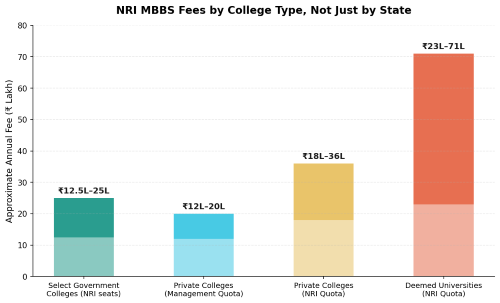
Select government medical colleges with NRI seats sit at the true bottom of the fee scale, roughly ₹12.5–25 lakh a year — but these seats are genuinely scarce, since most Indian states either have no NRI quota in government colleges at all, or reserve it for a narrow, specific category of NRI-sponsored candidates. Private colleges under management quota (not the NRI-specific fee tier) can be surprisingly affordable too, often ₹12–20 lakh a year, but management quota isn't the same thing as NRI quota, and eligibility rules differ. Once you move into a private college's actual NRI-quota fee tier, costs typically jump to ₹18–36 lakh a year. And deemed universities, which set their own fees independent of state regulation, routinely run ₹23–71 lakh a year, with the very top names touching $80,000+ annually.
The States Where NRI Fees Actually Run Lowest
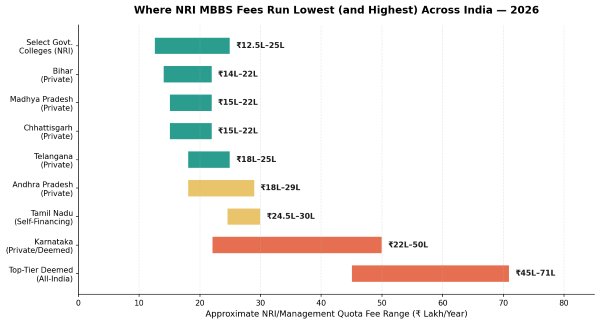
Bihar has genuinely emerged as one of the more budget-friendly options for NRI families in 2026, with several private and government-linked colleges offering NRI quota seats at comparatively reasonable rates, typically in the ₹14–22 lakh per year range.
Madhya Pradesh and Chhattisgarh both show up consistently as lower-cost private-college states, generally in the ₹15–22 lakh per year range for NRI seats — a meaningful saving compared to states like Tamil Nadu or Karnataka for a broadly similar quality of NMC-approved education.
Telangana and Andhra Pradesh sit a step up from the cheapest tier, typically ₹18–29 lakh per year, but still meaningfully below what Tamil Nadu's self-financing colleges or Karnataka's pricier private options charge.
Select government medical colleges — where an NRI quota genuinely exists — remain the cheapest option of all when you can find and qualify for one, generally landing in the ₹12.5–25 lakh per year range. The catch is real scarcity: most Indian states simply don't offer this route, and where it does exist, seat numbers are typically very small.
Where NRI Fees Run Highest?
Karnataka is the single most important state to understand precisely because it contains both ends of the spectrum. It has the largest number of NRI quota seats in the country, which means genuine bargains exist alongside genuinely expensive options — a mid-tier Karnataka private college might charge ₹14–20 lakh a year, while a top-tier deemed university in the same state can run $40,000–60,000 (₹33–50 lakh) or more. Tamil Nadu's self-financing private colleges cluster in a fairly narrow, higher band of ₹24.5–30 lakh a year, largely due to a state-wide fee revision that pushed most colleges into a similar range for the 2025-26 cycle.
At the very top of the market, elite deemed universities — the names most globally recognisable to NRI families — routinely charge ₹45–71 lakh a year, and in some cases considerably more once you add hostel, deposits, and other charges on top of tuition.
The Hidden Costs That Change the Real Comparison
A lower headline annual fee doesn't always mean lower total cost. A few things worth checking before you compare states purely on the sticker price:
- Course duration billed: Some deemed universities have historically charged NRI fees across more than 4.5 years of coursework, though a recent NMC order (April 2026) now restricts colleges to billing only the standard 4.5-year academic period, which should tighten this gap going forward.
- Lump-sum deposits: A number of deemed universities charge a one-time NRI deposit at admission — sometimes ₹5–25 lakh — on top of annual tuition, which a simple "per year" comparison can easily miss.
- Hostel, security deposit, and miscellaneous charges: These are almost always billed separately from tuition and can add several lakh rupees to the real first-year cost at any college, cheap or expensive.
- Currency and remittance timing: Fees quoted in USD can shift meaningfully in rupee terms depending on when you actually transfer funds, so build some cushion into your budget rather than planning against a fixed exchange rate.
Always ask any shortlisted college for the complete, all-inclusive cost of the full programme — not just the tuition figure advertised on their website.
Is a Government College NRI Seat Actually Worth Chasing?
If you can find and qualify for one, yes — the fee gap versus even the cheapest private options is substantial. But go in with realistic expectations about scarcity: NRI quota in government medical colleges is the exception rather than the rule in India's admission landscape, competition for the few seats that do exist tends to be intense, and eligibility rules (often requiring a specific, documented NRI-sponsor relationship) can be stricter than the more straightforward NRI-quota process at private and deemed institutions. Treat this as a genuine option to investigate, not a default assumption.
How Should You Actually Use This Comparison?
Start by deciding whether you're prioritising absolute lowest cost or a specific college's reputation and hospital infrastructure — these often pull in opposite directions. If cost is the primary driver, Bihar, Madhya Pradesh, and Chhattisgarh deserve a serious look, alongside actively checking whether any government college NRI seats are open in your target admission cycle. If reputation and infrastructure matter more, expect to pay considerably more, particularly at deemed universities, and budget accordingly rather than being surprised later. Either way, treat every fee figure in this piece — and everywhere else online — as a planning estimate, and get the current, complete cost breakdown in writing directly from your shortlisted colleges before committing.
FAQs
Which state has the cheapest NRI quota MBBS fees in 2026?
Among states with a meaningful number of private college options, Bihar, Madhya Pradesh, and Chhattisgarh consistently offer some of the more affordable NRI quota fees, typically in the ₹14–22 lakh per year range. Select government medical college NRI seats, where available, can be even cheaper.
Are government medical college NRI seats available in every state?
No. Most Indian states don't offer an NRI quota in government medical colleges at all. Where it exists, it's typically limited to a small number of seats and specific eligibility conditions.
Is Karnataka expensive or affordable for NRI quota MBBS?
Both, depending on the college. Karnataka has the largest number of NRI quota seats in India, spanning a wide range from relatively affordable mid-tier private colleges to some of the most expensive deemed universities in the country.
Why are deemed universities generally more expensive than private colleges?
Deemed universities set their own fees independently, since they aren't bound by state-level fee regulation committees the way self-financing private colleges typically are. This generally results in higher, less regulated tuition, especially at well-known institutions.
Does a lower annual fee always mean lower total cost?
Not necessarily. Course duration billed, lump-sum deposits, hostel charges, and other add-ons can significantly change the real total cost, so always ask for the complete programme cost rather than comparing annual tuition figures alone.
What's the difference between management quota and NRI quota fees?
Management quota seats are typically available to any eligible candidate (not necessarily NRI-linked) and tend to be somewhat cheaper, while NRI quota seats are specifically reserved for NRI, OCI, or NRI-sponsored candidates and usually carry a distinct, often higher, fee structure.
Which state has the most NRI quota seats overall?
Karnataka reportedly has the largest number of NRI quota MBBS seats in India, followed by states like Telangana, Tamil Nadu, and Andhra Pradesh.
Conclusion
The honest answer to "which state is cheapest for NRI quota MBBS" is that state alone doesn't tell you enough — college type does most of the heavy lifting. Government college NRI seats are the genuine bargain when you can find them; Bihar, Madhya Pradesh, and Chhattisgarh offer some of the more reasonable private-college options, and states like Karnataka span the entire spectrum from affordable to genuinely expensive within their own borders. Wherever you land, the real comparison isn't the headline annual fee — it's the complete, all-inclusive cost of the full programme, confirmed directly with the college rather than assumed from an aggregator list.
Reviews
No reviews yet. Be the first to write one!