
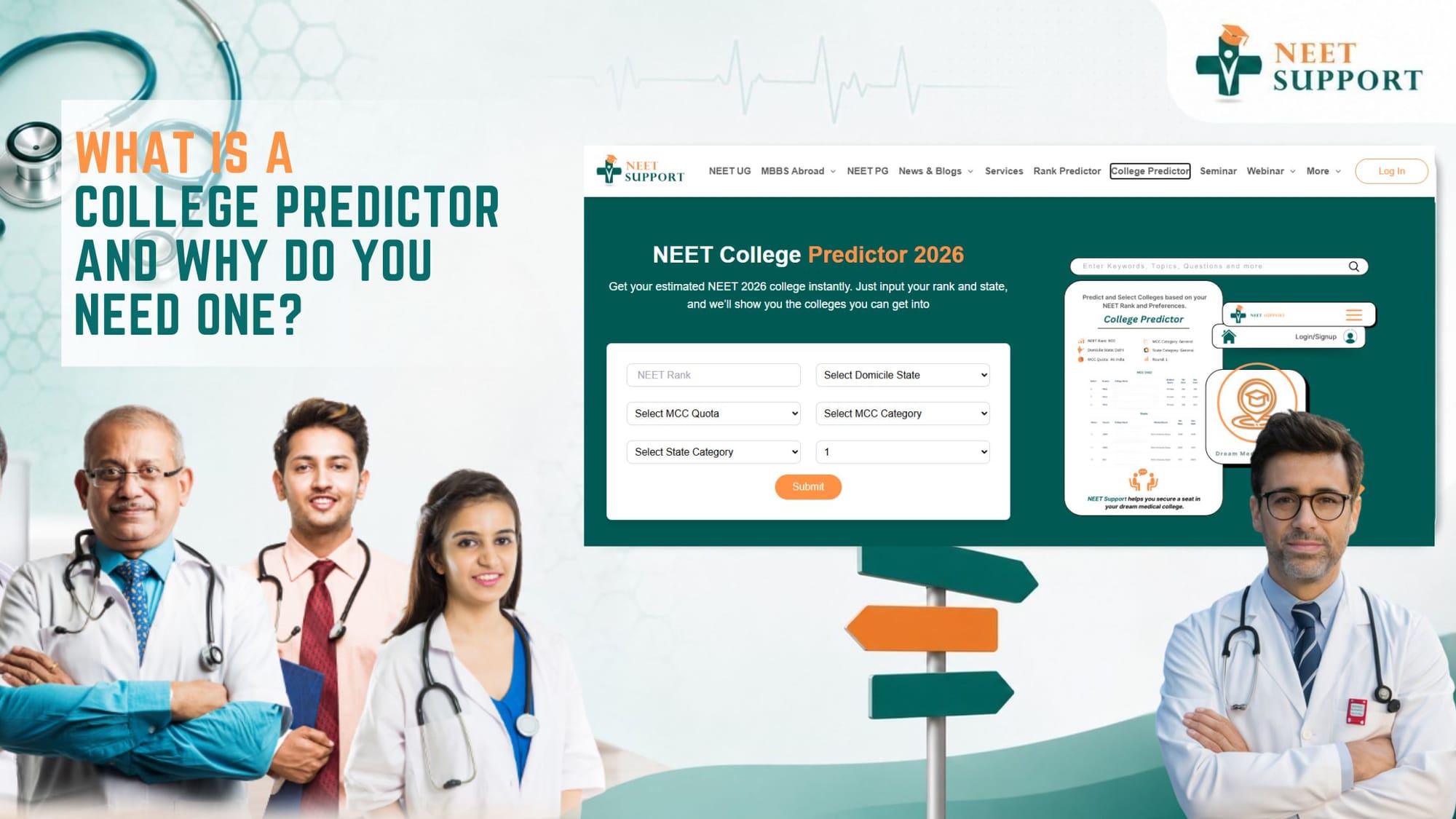
What Is a College Predictor and Why Do You Need One?
RISHIKESH KUMAR
 WhatsApp
 Email
Email Facebook
 Twitter/X
 LinkedIn
Table of Contents
Predict Your Rank Now
Enter your NEET score to get an estimated rank
Find the Best Colleges For You
Based on your NEET rank, Category & more

Get Your Dream Medical College
Secure your seat with expert counselling
Overview
The turn from secondary school to advanced education is extensively regarded as one of the most significant stages in a student’s academic journey. It’s frequently characterised by strong aspirations, disciplined study routines, and a determined effort to secure admission to a favoured institution. Scholars invest considerable time and energy in preparing for this important change, motivated by the desire to achieve their academic and professional ambitions.
At the same time, the admissions process can be complex and uncertain. With a large number of aspirants contending for a limited number of seats, along with changing cut-off scores and detailed eligibility conditions, scholars frequently witness stress and confusion. Determining whether one’s academic performance, standardised test results, or entrance examination rankings are sufficient for a dream college becomes a challenging task.
In this environment, technological tools have surfaced to simplify decision-making. One similar innovation is the college predictor, a data-based system designed to reduce queries in the admission process. It assists scholars in making informed choices.
What Is a College Predictor?
At its core, a College Predictor is a software application or digital engine that matches a student’s entrance exam performance (marks, percentile, or rank) against official past admission statistics from regulatory counseling bodies like JoSAA, the Medical Counselling Committee (MCC), or state-level DTE cells.
Instead of requiring students to analyse the data of previous years by themselves, the predictor instantly provides you with thousands of institutional records.
How Does a College Predictor Work?
Below is the step-wise algorithm given for how a college predictor works.
Data Aggregation
College predictor tools collect extensive past information from official counselling bodies and universities. This dataset includes round-wise opportunities and closing ranks, variations in seat distribution, and past cutoff patterns.
Algorithmic Matching
After the user inputs their academic scores, category, and preferred regions, the system filters unnecessary data. It also compares the user profile with past eligibility criteria of applicable institutions to identify suitable options.
Predictive Modeling
Rather than counting only on the past time’s data, the system studies long- term trends. However, if cutoffs for a course constantly rise by a small chance each time, the model incorporates this pattern to estimate more accurate and current admission chances.
Benefits of Using a College Predictor
Why are millions of students and career counselors going towards this tool every year? Here are the reasons:
Personalised Results: The tool doesn't give common advice. It evaluates your score, your category, and your state to provide you with the best colleges as per your profile.
Categorised Probability Zones: Most predictors divide your choices into clear zones, such as:
Dream/Reach Colleges: High-tier colleges where your scores are just on the line.
Target/Match Colleges: Institutions where your scores perfectly align with past cutoffs.
Safe Colleges: Colleges where your scores comfortably exceed past cutoffs, ensuring a guaranteed backup.
Real-Time Seat Matrix Insights: Many advanced tools update their databases to reflect current-year seat increases or the introduction of new academic branches, giving you a competitive edge during counseling rounds.
Saves Hundreds of Hours: Instead of manually checking the past year cutoff, admission criteria, and closing ranks, you get a clean, trustworthy list in seconds.
To know how to use a college predictor: Click here.
Top Reasons Why You Critically Need a College Predictor
If you are still on the fence about using a predictor, let’s look at the strategic advantages it brings to your admissions journey.
1. Eliminating Blind Spots
Various scholars apply to a large number of colleges without proper planning, hoping that at least one institution will offer admission. This approach frequently increases stress and financial burden because of multiple admission fees. At the same time, some scholars fail to apply to suitable colleges due to limited awareness of institutions that accept their score range. A college predictor helps break both problems by relating realistic openings and reducing unnecessary applications. It broadens scholars’ mindfulness while guiding them toward practical choices.
2. Casting a Foolproof Counseling Strategy
During counselling and preference selection, the sequence in which colleges are listed plays an important role. An incorrect order may reduce the chances of securing a desirable seat. A college predictor supports scholars by providing a structured strategy for arranging their preferences. It helps them prioritise dream options, balanced target colleges, and safer sides in a systematic manner.
3. Managing Stress and Anxiety
The period between examination results and admission procedures is frequently stressful for scholars. Query about future opportunities can produce anxiety and confusion. By offering data-supported predictions, a college predictor provides clarity and practical direction. This allows scholars to make informed opinions with less confidence.
4. Maximizing the Value of Your Score
Scholars devote significant trouble to achieving good academic results. A council predictor ensures that these achievements are used effectively by helping scholars identify institutions and courses that match their scores and eventually.
To get the best college predictor for you: Click here.
Who Should Use a College Predictor?
While high school students are the primary users, these tools add massive value to provide a good opportunity:
| User Category | How They Benefit |
|---|---|
| Applicants | Understand suitable college options and make informed admission decisions with greater confidence. |
| Guardians | Obtain a clearer view of admission possibilities, allowing better preparation for academic and financial planning. |
| Academic Advisors | Provide structured and data-based guidance to students in a more organized and efficient manner. |
| Educational Organizations | Evaluate student admission outcomes and improve counseling or training strategies based on performance trends. |
How to Choose the Right College Predictor Tool
Not all predictors are created equal. To ensure you are getting reliable advice, look for tools that meet the following criteria:
Data Integrity
Multi-Year Trend Analysis
Various Filters
Positive User Reviews
To know about how to choose the best college predictor: Click here.
Frequently Asked Questions (FAQs)
1. Are college predictors 100% accurate?
No tool can guarantee 100% accuracy because college admissions involve human variables that algorithms cannot predict perfectly. Factors like sudden changes in exam difficulty, shifts in student preferences (e.g., a sudden surge in demand for AI courses), or updates to reservation policies can alter cutoffs. View a predictor as a highly accurate compass, not a definitive map.
2. Is my personal data safe when using these platforms?
Reputable educational portals protect your data and use it strictly to generate your report. However, always check the privacy policy of the website. Avoid sketchy, unverified tools that demand sensitive personal information like your account passwords or government ID numbers just to show a result.
3. Can I use a college predictor before my official results are out?
Yes! Many advanced tools offer an integrated "Marks vs. Rank" feature. If you have calculated your estimated score using answer keys, you can input your predicted marks to get an early estimate of your potential college options.
4. Do these tools factor in category reservations and quotas?
The best ones absolutely do. Admission cutoffs vary wildly between general merit and reserved categories (like SC, ST, OBC, EWS, or defense/sports quotas). A reliable predictor will always ask for your specific category to ensure the results are accurate to your legal standing.
5. What is the difference between a "Reach" college and a "Safety" college?
A Reach (or Dream) college is an institution where your scores are slightly below or right on the line of historical cutoffs—admission is possible but tough. A Safety college is one where your scores are well above the historical cutoffs, making it highly probable that you will be accepted as a backup option.
6. Do college predictors cost money to use?
Many platforms offer basic versions completely free of charge, which give you a solid overview of your options. Premium tiers or highly detailed, downloadable counseling reports sometimes require a small fee or registration.
Conclusion
The practice of opting for colleges based only on hypotheticals, informal opinions, or outdated guidance is no longer effective in ultramodern education. In the present academic terrain, data-driven tools play an essential part in helping scholars make informed opinions. A college predictor doesn't replace the effort scholars invest in their studies; rather, it ensures that their academic achievements are secured in the most effective way possible.
By offering structured and dependable guidance, it converts the admission process from a confusing and stressful experience into a clear and systematized procedure. Scholars can identify suitable institutions, prepare realistic admission strategies, and explore openings with great accuracy.
As scholars begin their advanced education trip, using a council predictor can give clarity, confidence, and a more practical approach toward achieving their academic pretensions.
Reviews
No reviews yet. Be the first to write one!