
Top Private Medical Colleges for NRIs in Meghalaya
Nishat
 WhatsApp
 Email
 Facebook
 Twitter/X
 LinkedIn
Table of Contents
Predict Your Rank Now
Enter your NEET score to get an estimated rank
Find the Best Colleges For You
Based on your NEET rank, Category & more

Get Your Dream Medical College
Secure your seat with expert counselling
Introduction
Every other state in this series required narrowing a list down. Meghalaya requires the opposite explanation: until 2024, there was no list to narrow down at all. Here's the story of the one private medical college that changed that, and everything an NRI family needs to know about it.
Quick Numbers Before We Dive In:
- 1 private medical college in Meghalaya — and it only opened in 2024
- 150 MBBS seats a year at that college
- 23 seats reserved for the NRI quota
- $200,000 the full-course NRI fee, among the highest in Northeast India
If you searched "top private medical colleges Meghalaya," you've likely landed on a state that, until very recently, had exactly zero. Meghalaya's medical education story is almost entirely a government one — built around NEIGRIHMS Shillong, a central government "Institute of National Importance" with no private-college competition anywhere in the state. That changed in 2024, and the change is recent enough, and specific enough, that it deserves a proper deep dive rather than a padded list.
Meghalaya's First Private Medical College
PA Sangma International Medical College & Hospital (PIMC), at Khanapara, Baridua, in Meghalaya's Ri-Bhoi District, began its MBBS programme in 2024 — a joint initiative between the Government of Meghalaya and the University of Science and Technology, Meghalaya (USTM), a NAAC 'A'-grade university ranked within NIRF's top 200. It sits close to the Assam border, near Guwahati, which matters practically: for many NRI families, this is as much a Guwahati-adjacent option as a Meghalaya one.
Why this matters for your planning: PIMC isn't a padded-out addition to a long list — it's the entire private-college story in Meghalaya. There is no second option to compare it against within the state. Any research into "Meghalaya's top private colleges" is, honestly, research into this one institution.
Meet PA Sangma International Medical College
| MBBS seats | 150/year |
| Founded | 2024 (first MBBS batch) |
| Parent university | USTM (NAAC 'A'-grade, NIRF top-200) |
| Teaching hospital | 605 beds, with planned super-specialty expansion |
| State quota seats | 64 (annual fee ≈ ₹4.95 lakh; ≈ ₹24.75 lakh for the full course) |
| Management quota seats | 63 (annual fee ≈ ₹18 lakh) |
| NRI quota seats | 23 (full-course fee: USD $200,000) |
| Counselling route | NEET-UG, via Directorate of Health Services (DHS), Meghalaya |
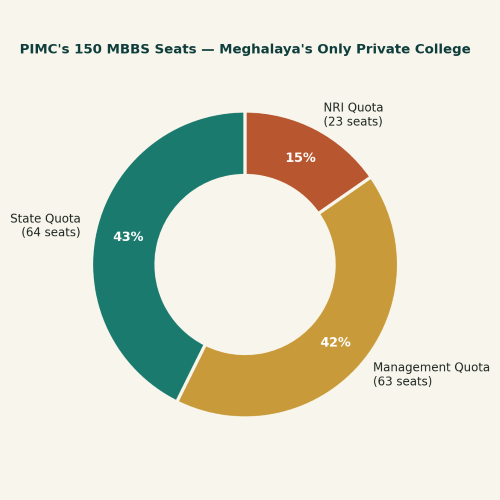
Based on PIMC's published 2024–25 seat allotment notification from the Government of Meghalaya. This is the entire private-sector MBBS capacity in the state.
What Each Quota Actually Costs?
Unlike the annual-fee structures common in southern states, PIMC's NRI quota is billed as a single lump sum for the entire course — $200,000, payable via DD, NEFT, or RTGS — rather than a per-year figure. That's worth understanding clearly before you compare it to anything else.
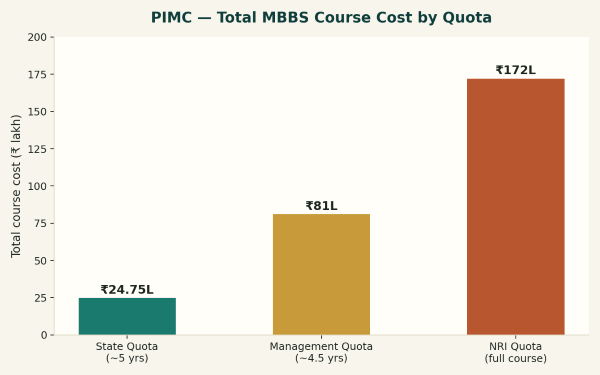
State-quota total based on the government-notified ₹4.95 lakh/year fee across the course. Management-quota total projected across 4.5 academic years at the published ₹18 lakh/year rate. NRI figure converted from PIMC's published $200,000 full-course fee at an indicative exchange rate. Confirm current figures directly with PIMC, since a newly launched college's fee structure can be revised as it establishes itself.
That's a genuinely steep jump — the NRI quota costs roughly seven times the state-quota total, and nearly double the management-quota total. For a brand-new college without an established track record, that's a premium worth thinking carefully about.
How Meghalaya Compares To The Rest Of This Series?
Here's the part that genuinely surprised us while researching this piece: despite being the newest, smallest-market private college in this entire series, PIMC's NRI-quota total cost lands right alongside — and above — several long-established deemed universities in the south.
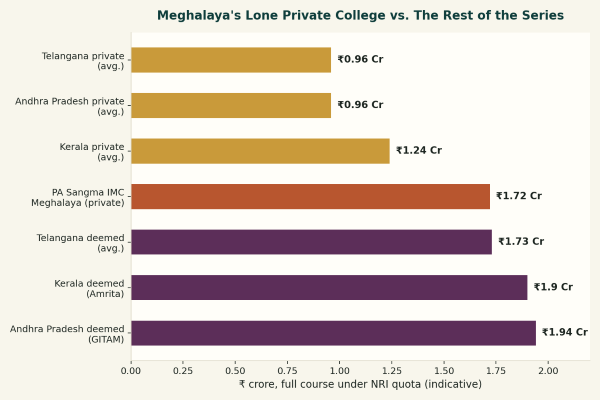
Figures drawn from PIMC's published fee notification and our companion state guides on Telangana, Andhra Pradesh, and Kerala's private and deemed medical college NRI-quota admissions.
In plain terms: a brand-new college in a state with almost no private medical education track record is charging NRI families nearly what Kerala's nationally ranked deemed university charges, and meaningfully more than the private-college averages in Telangana, Andhra Pradesh, or Kerala. That's not necessarily unreasonable — Northeast India's private medical seats are genuinely scarce, and scarcity drives price — but it's a number worth going in with eyes open about, rather than assuming a newer, smaller-state college will automatically be cheaper.
What You're Actually Getting For That Price?
To be fair to PIMC, the number isn't happening in a vacuum. The college is backed by USTM, an established, NAAC 'A'-grade university system with a genuine academic infrastructure behind it, not a standalone trust built purely around one hospital. Its 605-bed teaching hospital, with a stated 1,000-plus-bed expansion and super-specialty ambitions, is a serious infrastructure commitment for a first-generation medical college. And for NRI families with genuine ties to the Northeast — Assam, Meghalaya, or the wider region — it's the first time in the area's history that a private-college pathway has existed at all, which has real value regardless of price.
The honest caveat: it's two years old as of this writing. It doesn't yet have a graduating batch, an established residency placement record, or the kind of multi-decade clinical reputation that colleges like Kamineni or Jubilee Mission have built up. That's not a reason to avoid it, but it is a reason to do more first-hand due diligence than you might for a 20-year-old institution.
The Government Alternative, For Context
It's worth knowing what the non-private option in Meghalaya looks like, even though it has no NRI-specific pathway. NEIGRIHMS Shillong — the North Eastern Indira Gandhi Regional Institute of Health & Medical Sciences — is a central government Institute of National Importance offering roughly 50 MBBS seats a year, filled entirely through NEET-UG and All India Quota/state counselling via the Directorate of Health Services. Like most Institutes of National Importance, it does not carry a dedicated NRI quota; NRI/OCI candidates would need to compete through the general AIQ merit process like any other applicant nationally.
How NRI-Quota Admission Works At PIMC?
- Qualify NEET-UG. Compulsory for every category, including the NRI quota, with no exceptions.
- Establish NRI/OCI/PIO status or sponsorship, with the standard documentation — passport, visa/residency proof, and relationship proof for sponsored candidates.
- Register through the Directorate of Health Services (DHS), Meghalaya, which conducts the state's centralised NEET-UG counselling covering all three of PIMC's quota categories.
- Upload and verify documents, including NEET scorecard, academic transcripts (with AIU equivalence if schooled abroad), and NRI status proof.
- Fill and lock choices, and track the counselling calendar closely — as a newly launched college, PIMC's admission timelines have moved quickly in past cycles, with short windows between notification and seat confirmation.
- Accept the allotment and pay fees — noting that PIMC's NRI fee is billed as a lump sum for the full course rather than annual instalments, so plan the full payment rather than a year-by-year budget.
- Report physically to the college with original documents to complete admission formalities.
Documents To Keep Ready
- Valid passport and visa/residency proof for the candidate or sponsoring NRI relative
- NRI/OCI/PIO status certificate, or notarised sponsorship documentation
- NEET-UG admit card and scorecard
- 10th and 12th mark sheets, with AIU equivalence certification if schooled abroad
- Transfer certificate and migration certificate from the previous institution
- Passport-size photographs and any additional documents specified in the Meghalaya DHS counselling brochure
Is It Worth Considering, Realistically?
A few honest questions worth sitting with before treating PIMC as a serious option:
- Does genuine Northeast connection matter to your family more than an established institutional track record? If so, being first in the region counts for something a fee comparison alone won't capture.
- Are you comfortable with a college that doesn't yet have a graduating class, and therefore no verifiable residency-placement or licensing-exam track record yet?
- Have you compared the $200,000 lump sum against a full 5.5-year budget at an established southern private college or deemed university, rather than assuming "new, small-state college" automatically means "cheaper"? As the numbers above show, it often isn't.
- Is a 605-bed teaching hospital, with expansion plans still in progress, enough clinical exposure for your child's undergraduate years, compared to the 1,000-plus-bed hospitals attached to many longer-established colleges elsewhere in this series?
FAQs
How Many Private Medical Colleges Does Meghalaya Have?
Exactly one — PA Sangma International Medical College & Hospital (PIMC), Khanapara, Ri-Bhoi District — which began its first MBBS batch in 2024. Before that, Meghalaya had no private medical college at all.
Is PIMC A Deemed University?
No. PIMC is a private, self-financing medical college affiliated with the University of Science and Technology, Meghalaya (USTM), and admits through the state's own NEET-UG counselling conducted by the Directorate of Health Services (DHS), Meghalaya — not through the MCC's deemed-university pool.
How Many NRI-Quota Seats Does PIMC Offer?
23 seats a year, out of a total annual intake of 150 MBBS seats, alongside 64 state-quota and 63 management-quota seats.
Does Meghalaya Have Any Other Medical Colleges?
Yes, one government institution: NEIGRIHMS Shillong, a central government Institute of National Importance offering around 50 MBBS seats through NEET-UG and All India Quota/state counselling. It does not have a dedicated NRI quota.
Which Counselling Body Handles PIMC's Admissions?
The Directorate of Health Services (DHS), Government of Meghalaya, conducts the centralised NEET-UG counselling covering all of PIMC's quota categories, including the NRI quota.
Is PIMC's Hospital Big Enough For Solid Clinical Training?
Its 605-bed teaching hospital, with stated plans to expand toward 1,000-plus beds and add super-specialty departments, is a serious commitment for a first-generation medical college, though it's still smaller than several long-established hospitals covered elsewhere in this series. Ask directly about current OPD volume and how early clinical postings begin.
Is There A Service Bond After MBBS At PIMC?
Specific bond terms for PIMC were not confirmed in current public sources at the time of writing — confirm this directly with the college or the Meghalaya DHS counselling brochure, since bond and rural-service requirements vary by state and institution.
Should NRI Families Treat Meghalaya As A Primary Plan Or A Backup?
Given PIMC's newness and limited 23-seat NRI allocation, it's sensible to treat it as one option within a wider shortlist rather than a sole strategy — particularly if genuine Northeast ties aren't the deciding factor. Families focused purely on value and track record will likely find the more established markets in Andhra Pradesh, Telangana, or Kerala, covered elsewhere in this series, easier to plan around.
The Bottom Line
Meghalaya's medical education story just gained its first private chapter, and PA Sangma International Medical College is, for now, the entire chapter. It's a legitimate, NMC-approved, university-backed institution with real infrastructure investment behind it — but it's also new, priced at a genuine premium for its NRI quota, and without the track record that usually justifies that kind of pricing elsewhere in India. If a Northeast connection is central to your family's decision, it deserves serious consideration. If cost-per-value is the deciding factor, it's worth weighing carefully against the more established private and deemed college markets covered elsewhere in this series.
Reviews
No reviews yet. Be the first to write one!