
Top Medical Colleges for NRIs in Arunachal Pradesh: What You Need To Know
Nishat
 WhatsApp
 Email
 Facebook
 Twitter/X
 LinkedIn
Table of Contents
Predict Your Rank Now
Enter your NEET score to get an estimated rank
Find the Best Colleges For You
Based on your NEET rank, Category & more

Get Your Dream Medical College
Secure your seat with expert counselling
Introduction
Most states in this series have a shortlist to build. Arunachal Pradesh has one college- full stop — and even that one college's NRI policy isn't entirely settled. Here's the honest, carefully checked picture, not a padded list.
Quick Numbers Before We Dive In:
- 1 medical college in all of Arunachal Pradesh
- 100 total MBBS seats statewide
- 85% reserved exclusively for APST (Arunachal Pradesh Scheduled Tribe) domicile candidates
- Unclear whether a genuine, currently active NRI quota exists — more on that below
If you're an NRI parent who searched specifically for Arunachal Pradesh — maybe because of family roots there, or simply because you're comparing every state systematically — the first thing to know is that this is the smallest, most tightly domicile-protected medical education market in this entire series. There's no private college, no deemed university, and the one government college that does exist reserves the overwhelming majority of its seats for the state's own Scheduled Tribe residents.
The Only Medical College In The State
Tomo Riba Institute of Health & Medical Sciences (TRIHMS), Naharlagun, is Arunachal Pradesh's sole medical college — government-run, established in 2018, named after the state's second chief minister, and affiliated with Rajiv Gandhi University, Itanagar. It's backed by a roughly 500-bed teaching hospital and is NMC-approved.
| MBBS seats | 100/year (grown from an initial intake of 50) |
| Founded | 2018 |
| Ownership | Government of Arunachal Pradesh |
| Teaching hospital | ~500 beds |
| APST state domicile quota | 85 seats (85%) |
| All India Quota (AIQ), via MCC | 15 seats (15%) |
| Approx. annual fee | ~₹43,000 (interim, state-fixed) |
| Compulsory service bond | ₹10 lakh, or 1-year rural posting on completion |
That 85% APST reservation is unusually high compared to most Indian states' domicile quotas, and it reflects Arunachal Pradesh's specific constitutional protections for its tribal population. In practical terms, it means the vast majority of TRIHMS's seats were never open to outside applicants — NRI or otherwise — in the first place.
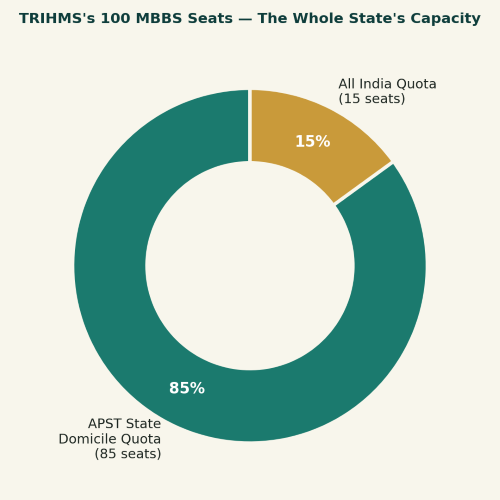
Based on TRIHMS's published 2025–26 seat matrix. This is the entire state's MBBS capacity — there is no second college to compare it against.
The Honest Answer On NRI Quota
Here's where this guide has to be more careful than most. Two genuinely conflicting pictures show up in the official record:
What TRIHMS's own admissions page says: The college's official eligibility documentation includes a specific "NRI/NRI-sponsored/PIO/OCI" admission category, with its own application fee (₹5,000, versus ₹750 for general categories) and detailed eligibility rules. Government records also show TRIHMS opened NRI registration for the 2021–22 academic session.
What the most recent official prospectus says: According to the 2025–26 TRIHMS prospectus (Government Order DMETR-16001/04/2021, dated 20 June 2025), the current seat matrix defines only two categories — APST state quota and All India Quota — with no NRI or management quota listed at all.
Our best read of this: TRIHMS has, at various points, run a small NRI/OCI/PIO admission provision, but it does not appear to be a guaranteed, standing feature of the current 100-seat matrix the way NRI quota is in states like Andhra Pradesh or Goa. One unusual detail from the college's own published eligibility rules adds weight to this: its NRI provision has historically been tied to a faculty-service condition — requiring at least seven years of remaining service from a sponsoring faculty member, with a discontinuation penalty of $100,000. That structure looks less like a general public NRI quota and more like a narrow, faculty-recruitment-linked benefit, which would explain why it doesn't appear in the state's standard published seat matrix.
The practical takeaway: if Arunachal Pradesh is genuinely on your shortlist, don't assume an NRI seat exists this admission cycle. Contact the Directorate of Medical Education, Training & Research (DMETR), Naharlagun, directly and ask whether an NRI/OCI/PIO category is being offered for the specific year you're applying, and under what terms.
What This Costs, In Context?
Whatever the NRI-quota picture turns out to be in a given year, one thing is consistent: TRIHMS is a government college with government-level pricing, which puts it in an entirely different cost bracket from the private-college markets we've covered elsewhere in this series.
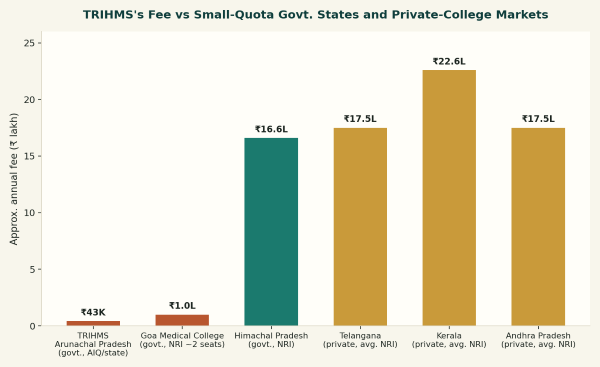
TRIHMS figure is the interim state-fixed fee for its standard AIQ/state-quota seats; a confirmed, separate NRI-specific fee schedule was not available in current public sources. Other states' figures are drawn from their respective government or private-college NRI-quota fee structures, including our companion guides on Telangana, Kerala, and Andhra Pradesh.
Even Goa's roughly ₹1-lakh NRI seat looks expensive next to TRIHMS's ₹43,000 general fee — which underlines just how different this market is from the private-college world most NRI-quota research is built around.
What Families Usually Do Instead?
Given the constraints — one college, an 85% domicile-only reservation, and a genuinely uncertain NRI pathway on the remaining seats — most NRI families with real ties to the Northeast tend to widen their search rather than anchor on Arunachal Pradesh specifically:
- The 15 All India Quota seats at TRIHMS are, in practice, the only reliable route for any non-APST candidate, NRI or otherwise, and they're allotted purely on NEET-UG rank through MCC — the same AIQ process used nationwide, not a distinct NRI channel.
- West Bengal, the nearest large medical education hub to the Northeast with an established private-college NRI-quota system, is a common next stop for families who want to stay reasonably close to the region.
- Karnataka, Maharashtra, Kerala, Telangana, and Andhra Pradesh remain India's largest, most predictable NRI-quota markets nationally, and are worth building a real shortlist around regardless of a family's regional starting point — as covered in our companion state guides.
How To Apply, If You Decide To Try?
- Qualify NEET-UG. Non-negotiable, as everywhere in India.
- Contact DMETR Naharlagun directly to confirm whether an NRI/OCI/PIO admission category is being offered for your specific application year, and under what conditions — don't rely on generic aggregator listings, given how much the picture has evidently shifted over recent prospectuses.
- If no NRI category is active, plan around the 15 AIQ seats instead, registering through MCC's standard All India Quota counselling like any other candidate nationally.
- Prepare standard documentation regardless: NEET-UG scorecard, passport and visa/residency proof, birth certificate, and (if applying under any NRI provision that is active) proof of NRI status of the student or sponsor.
- Build a genuine backup shortlist. With so much uncertainty around a dedicated NRI pathway, treat Arunachal Pradesh as, at best, one long-shot option within a wider plan.
FAQs
How Many Medical Colleges Does Arunachal Pradesh Have?
Exactly one — Tomo Riba Institute of Health & Medical Sciences (TRIHMS), Naharlagun, a government college established in 2018. There is no private or deemed medical college anywhere in the state.
Does TRIHMS Actually Have An NRI Quota?
It's genuinely unclear as of the most recent published information. TRIHMS's own admissions page describes an NRI/NRI-sponsored/PIO/OCI eligibility category with a distinct application fee, and the college registered NRI applicants for at least the 2021–22 academic session. However, the most recent official 2025–26 prospectus defines only APST state quota and All India Quota categories, with no NRI or management quota listed. Contact DMETR Naharlagun directly to confirm the current year's position before applying.
How Many Total MBBS Seats Does Arunachal Pradesh Offer?
100 seats a year at TRIHMS — 85 reserved for APST (Arunachal Pradesh Scheduled Tribe) domicile candidates and 15 allotted through the All India Quota (AIQ) via MCC counselling.
Can A Non-APST Or Non-Domicile Candidate Get In At All?
Yes, but only through the 15 All India Quota seats, allotted purely by NEET-UG rank through MCC's standard national counselling process — the same route available to candidates from anywhere in India, not a state-specific NRI channel.
What Is The Unusual "Faculty Bond" Mentioned In TRIHMS's NRI Eligibility Rules?
TRIHMS's published eligibility documentation ties its historical NRI provision to a sponsoring faculty member committing to at least seven years of remaining service, with a stated $100,000 penalty for discontinuation. This structure suggests the provision may have been designed as a faculty-recruitment benefit rather than a general public NRI quota, which would explain why it isn't listed in the state's standard seat matrix.
Does Arunachal Pradesh Have Any Private Or Deemed Medical Colleges?
No. TRIHMS is the state's only medical college, and it is entirely government-run. There is no private, self-financing, or deemed-university medical college anywhere in Arunachal Pradesh.
Why Is The APST Reservation At TRIHMS So High?
Arunachal Pradesh Scheduled Tribe (APST) status carries strong constitutional protections reflecting the state's demographic composition, and the state has set its domicile reservation at 85% of TRIHMS's seats — considerably higher than the domicile quotas typical in most other Indian states.
Are There Nearby States With A More Dependable NRI-Quota Option For Northeast-Linked Families?
West Bengal is the nearest large private-college NRI-quota market to the Northeast. Beyond that, Karnataka, Maharashtra, Andhra Pradesh, Telangana, and Kerala remain India's largest and most predictable NRI-quota markets nationally, regardless of a family's specific regional ties.
The Bottom Line
Arunachal Pradesh is an honest outlier in this series: a single government medical college, an unusually high domicile reservation, and an NRI-quota picture that even official state documents don't describe consistently. If your family has a genuine, specific reason to pursue TRIHMS, the right move is a direct call to DMETR Naharlagun before you build any plan around it — not a generic "NRI quota" listing found online. For most NRI families, though, the far more dependable routes remain the private and deemed college markets of states like Andhra Pradesh, Telangana, Kerala, and Karnataka, where the rules are settled, and the seat counts are large enough to actually plan around.
Reviews
No reviews yet. Be the first to write one!