
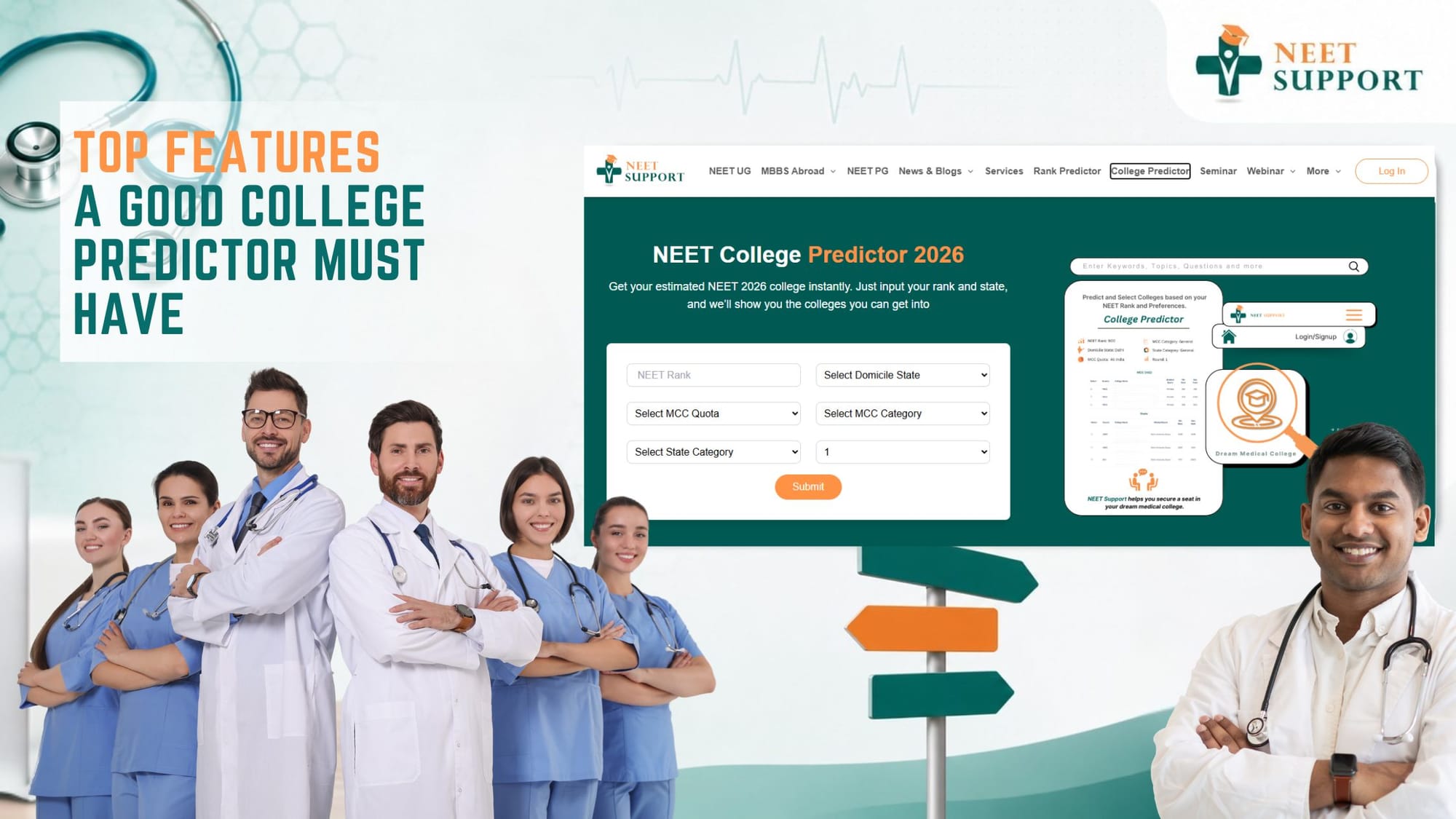
Top Features A Good College Predictor Must Have
Nishat
 WhatsApp
 Email
Email Facebook
 Twitter/X
 LinkedIn
Table of Contents
Predict Your Rank Now
Enter your NEET score to get an estimated rank
Find the Best Colleges For You
Based on your NEET rank, Category & more

Get Your Dream Medical College
Secure your seat with expert counselling
Choosing the right college is one of the biggest decisions in a student’s life. After exams and rank results, most students feel confused about which colleges they can realistically get. This is where a college predictor becomes very useful. A good college predictor saves time, reduces stress, and gives students a clearer idea of their chances.
But not every college predictor is equally helpful. Some tools give random results, some use outdated data, and some are too complicated to understand. A truly good college predictor should be accurate, easy to use, and built around the student’s real situation. Here are the top features it must have.
1. Accurate Results
The most important feature of any college predictor is accuracy. Students rely on it to make serious admission decisions, so the results must be based on reliable data. If the prediction is wrong, students may miss better opportunities or choose unrealistic options.
A good predictor should use previous year cutoffs, admission trends, and seat availability to show a fair estimate. Accuracy builds trust, and without trust, the tool is not useful.
2. Updated Database
A college predictor should always use the latest information. Colleges, cutoffs, seat intake, and admission rules can change every year. If the database is old, the prediction will not match current reality.
An updated database makes the tool more dependable. It should include recent counselling rounds, current admission patterns, and new colleges if they are added to the list. Students should feel confident that the tool reflects the present admission scenario.
3. Easy-to-Use Interface
A good tool should be simple and student-friendly. Many users are school students or parents who may not be familiar with complicated websites. If the predictor is confusing, people may stop using it.
The design should be clean, with clear fields for entering rank, marks, category, state, and course. The result should appear quickly and in an easy format. A simple interface makes the experience smooth and stress-free.
4. Personalised Predictions
Every student is different. A predictor should not give the same answer to everyone. It should consider important details such as exam rank, category, home state, quota, and preferred branch.
Personalised predictions are much more useful because they match the student’s actual profile. This helps students see colleges that are genuinely relevant to them. A one-size-fits-all result is never enough.
5. College Filtering Options
A strong predictor should allow students to filter colleges according to their needs. For example, students may want to search by location, fees, branch, ownership, or college type. These filters make the search more focused.
Without filters, students may waste time looking at colleges that are not suitable. Filtering helps them shortlist the best options faster. It also makes decision-making much easier during counselling.
6. Category and Quota Support
In many entrance exams, category and quota play a major role. A student’s chances can change depending on whether they belong to General, OBC, SC, ST, EWS, or another category. Similarly, home state quota and the all-India quota can affect seat chances.
A good college predictor must handle these factors correctly. If it ignores them, the prediction will not be realistic. This feature is especially important for exams like NEET, JEE, and other state-level entrance tests.
7. Realistic Admission Chances
A useful predictor should not only list colleges, but also show the chances of admission clearly. For example, it may mark colleges as high chance, moderate chance, or low chance. This helps students understand where they stand.
Realistic chances are better than giving false hope. Students can then create a balanced list that includes dream colleges, target colleges, and safe colleges. This makes counselling planning much smarter.
8. Wide College Coverage
A good predictor should include many colleges, not just the famous ones. Students need a broad database that covers government colleges, private colleges, deemed universities, and state colleges. The more complete the coverage, the more useful the tool becomes.
Wide coverage helps students discover colleges they may not have considered before. It also increases the chances of finding better alternatives. A limited list can seriously reduce the value of the tool.
9. Comparison Feature
Students often compare colleges before making a final choice. A good predictor should make this easy. It should help users compare fees, hostel availability, course quality, location, and previous cutoffs.
A comparison feature saves time and brings clarity. Instead of checking different websites separately, students can view important details in one place. This is a big advantage during the admission process.
10. Counselling Guidance
A college predictor becomes much more helpful when it also guides students through the counselling process. Many students know their rank but are not sure how to fill out their choices or what order to prefer colleges in.
The tool should give simple suggestions about choice filling, backup options, and expected rounds. It can also explain how cutoff trends work. This kind of guidance makes the tool more than just a predictor; it becomes a decision-support tool.
11. Mobile-Friendly Design
Most students use their phones to check admission-related information. So the predictor should work well on mobile devices. Pages should load quickly, buttons should be easy to tap, and results should fit properly on a small screen.
A mobile-friendly tool is more convenient and accessible. If students can use it anywhere, they are more likely to depend on it during busy counselling days.
12. Simple Language and Clear Explanations
A college predictor should speak in a language students understand. Admission tools sometimes use technical terms that confuse users. A good predictor should explain results in simple words.
Clear language helps students and parents understand what the prediction means. It reduces mistakes and makes the tool more friendly. A well-written explanation can make a big difference in the user experience.
For Details about NEET College Predictor - Read
Why These Features Matter
A college predictor is not just a website or app. It is a guide that helps students make one of the most important choices in their academic life. When the tool is accurate, updated, and easy to use, it gives students confidence during a stressful time.
These features also save effort. Instead of searching through many websites and admission pages, students can get useful information in one place. That makes the college selection process faster, smoother, and more practical.
FAQs
What is a college predictor?
A college predictor is an online tool that helps students estimate which colleges they can get based on their rank or marks. It uses previous year cutoffs and admission trends. This makes the college shortlisting process easier and faster.
How accurate are college predictors?
College predictors are usually accurate if they use updated cutoff data and proper counselling trends. However, results are still estimates, not guarantees. Final admission depends on actual cutoffs, seat availability, and counselling rounds.
What details are needed to use a college predictor?
Most college predictors require rank or marks, category, state, and quota details. Some also ask for preferred branch or course. Entering correct details ensures more realistic predictions.
Is category important in college prediction?
Yes, category plays a major role because cutoffs differ for General, OBC, SC, ST, and EWS candidates. A good predictor considers category-based cutoffs. Without this, the prediction can be misleading.
Are private colleges included in college predictors?
Yes, many good college predictors include private colleges, deemed universities, and government colleges. This helps students explore more options. Wide coverage is important for better shortlisting.
Final Thoughts
A good college predictor should do one main thing very well: help students make better admission decisions. It should be accurate, clear, personalised, and updated. It should not confuse users or give unrealistic results.
In simple words, the best college predictor is the one that combines data, ease of use, and honest guidance. When these features come together, students get a tool they can truly trust during counselling and admission season.
Reviews
No reviews yet. Be the first to write one!