
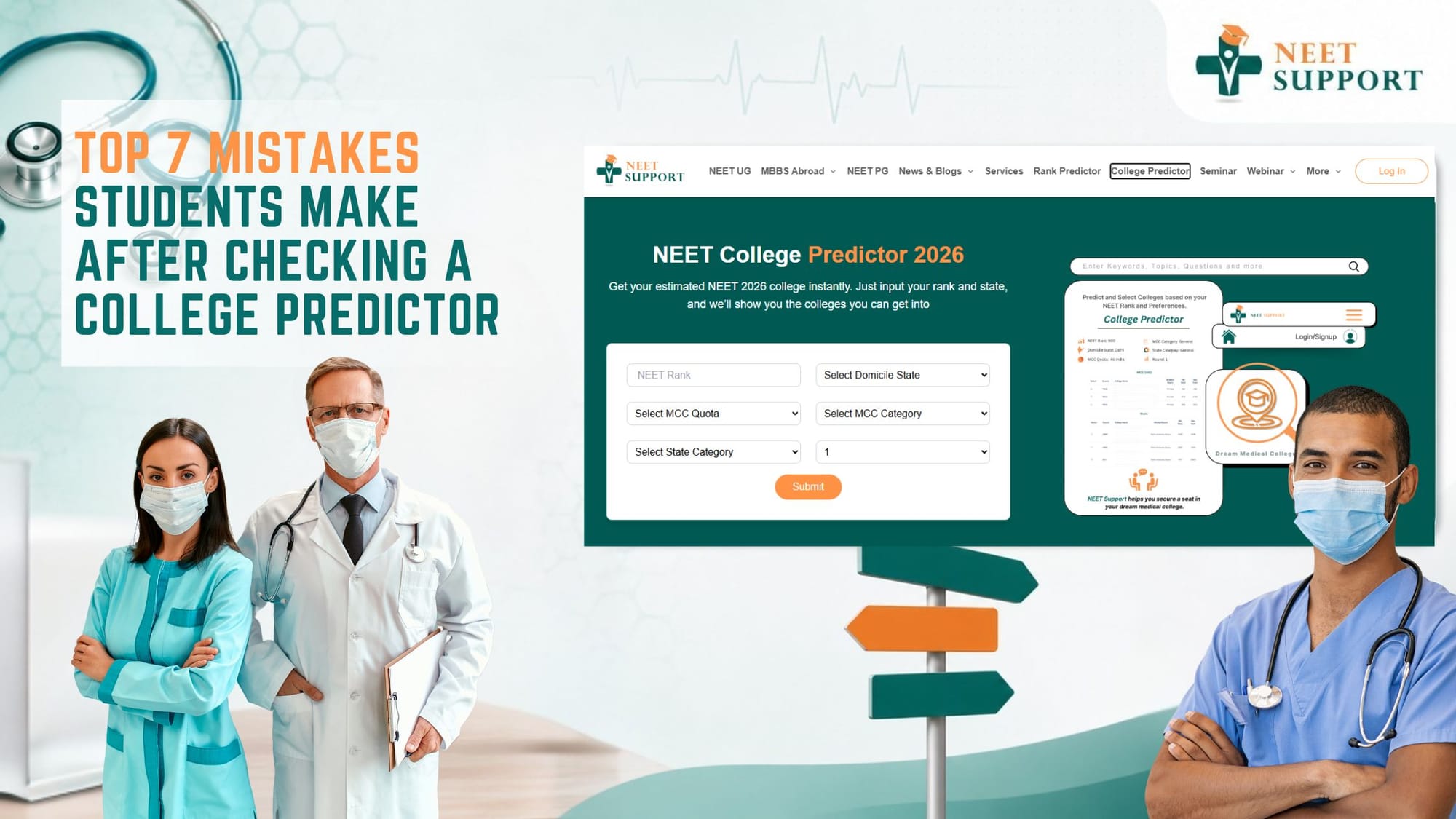
Top 7 Mistakes Students Make After Checking A College Predictor
Nishat
 WhatsApp
 Email
Email Facebook
 Twitter/X
 LinkedIn
Table of Contents
Predict Your Rank Now
Enter your NEET score to get an estimated rank
Find the Best Colleges For You
Based on your NEET rank, Category & more

Get Your Dream Medical College
Secure your seat with expert counselling
After months of exam preparation, stress, and endless rank calculations, checking a college predictor feels like the first real moment of clarity. You finally type in your rank, category, state, and course preferences—and within seconds, the tool gives you a list of colleges you might get into.
For many students, this list becomes an emotional trigger. If the result looks good, they feel confident and relaxed. If it looks disappointing, they panic and assume their future is ruined. But here’s the truth: a college predictor is only as useful as the decisions you make after using it. Many students unknowingly make mistakes that reduce their chances during counselling, even if their rank is decent.
To make sure you don’t fall into the same trap, let’s look at the top 7 mistakes students make after checking a college predictor, and how you can avoid them with smart planning.
1. Treating the Predictor Result as a Final Guarantee
One of the most common mistakes students make is assuming the predictor’s output is fixed and accurate, like an official counselling allotment. If a predictor shows a certain college, students start believing that admission is confirmed. On the other hand, if a college does not appear, they immediately think it is impossible.
But predictors work on previous-year trends, expected cutoff movement, and estimated participation data. Real counselling depends on factors like seat availability, number of candidates registering, reservation distribution, and round-wise vacancy. Even small changes in trends can shift cutoffs dramatically.
What students do wrong:
- Believe the shown colleges are guaranteed
- Lose hope if a desired college doesn’t appear
Better approach: Treat the predictor as a guidance tool, not a final verdict. It tells you what is possible, not what is confirmed.
2. Ignoring Counselling Rounds and Cutoff Drops
Another big mistake is thinking counselling happens only once. Students check their predicted options, see limited colleges, and assume they have no chance at better institutions. In reality, most counselling processes occur in multiple rounds, and many seats open later due to upgrades, withdrawals, or vacant seat conversion.
Often, a college that seems out of reach in Round 1 becomes achievable by Round 2 or Mop-Up. Students who understand this stay patient and keep their options open. Students who don’t often make rushed decisions early often regret them later.
Common mistake:
- Giving up too early after the Round 1 prediction
What you should do instead:
- Track the previous year's Round 1, Round 2, and Mop-Up cutoffs
- Keep realistic colleges in your preference list, even if they seem slightly higher
3. Making a Poor Preference List (Too Optimistic or Too Safe)
Many students misunderstand how preference filling works. After checking a college predictor, they either become overly confident or overly fearful. Overconfident students fill only the top colleges, assuming they’ll get one. Fearful students fill only low colleges, thinking it’s safer.
Both approaches can harm your final allotment. Counselling is not about what you can get—it is about the order in which you choose options. A well-structured preference list is a mix of ambition and practicality.
Typical wrong patterns:
- Only top colleges (high risk)
- Only low colleges (missed opportunity)
Better strategy: Create a balanced preference list with:
- Dream colleges (high cutoff, low probability)
- Realistic colleges (near your rank range)
- Safe options (backup colleges)
This way, you stay competitive without risking everything.
4. Not Researching the Colleges Beyond the Name
A predictor gives you a list, but it doesn’t tell you whether that college is actually suitable for you. Many students choose colleges purely based on reputation, social media hype, or the excitement of seeing a government institute in the results.
Later, they realise they ignored important details such as fee structure, hostel conditions, location issues, bond rules, or even whether the college has proper infrastructure. In medical admissions, even hospital patient flow and internship quality matter a lot. In engineering, placement support and industry exposure can make a major difference.
Common mistake:
- Choosing colleges without researching details
What you should do instead: Before finalising preferences, check:
- Official approval (NMC/AICTE/UGC as applicable)
- Fees and hostel charges
- Bond/service rules (especially in medical colleges)
- Placement record and internship facilities
- Campus location and living conditions
A college predictor tells you what you might get, but research tells you what you should choose.
5. Panicking and Taking Immediate Emotional Decisions
Students often underestimate how emotional the post-result phase can be. A disappointing predictor list can cause panic, stress, and even impulsive decisions like deciding to drop out or selecting random private colleges. Meanwhile, a very good predictor list can make students careless, causing them to skip backup planning.
The biggest problem is making decisions in the first few hours of seeing the result. Counselling is a strategic process, not an emotional one. If you rush, you might lock yourself into choices that don’t match your long-term goals.
What students do wrong:
- Panic and lose confidence
- Make instant decisions without analysis
What you should do instead: Take a pause. Give yourself at least 24–48 hours. Discuss with parents, teachers, or mentors and review multiple college options calmly.
6. Confusing State Quota and All India Quota Predictions
This mistake can completely destroy your counselling plan. Many students check a predictor without understanding quota differences. A college that seems easy to get under the state quota may be very hard under the All India quota, and vice versa.
Some predictors show general cutoffs without separating counselling types properly. This creates confusion and false expectations. Students then waste time filling out colleges they are not even eligible for.
Major confusion areas:
- State counselling vs AIQ counselling
- Category cutoffs vs general cutoffs
- Private vs government seat distribution
Correct approach: Always check:
- Which counselling are you applying for
- Which colleges come under that counselling authority
- Separate cutoff trends for AIQ and state quota
Without quota clarity, even a good predictor becomes misleading.
7. Not Preparing Documents and Backup Plans Early
This is the most dangerous mistake because it hits suddenly. Students spend weeks discussing colleges, but forget to prepare documents until counselling registration starts. At that stage, even one missing certificate can block the process.
Problems like wrong category certificate format, expired domicile, incorrect scanned file size, or missing affidavit are extremely common. Students who delay preparation end up stressed, confused, and sometimes miss deadlines.
Along with documents, many students also fail to plan financially. They don’t discuss the budget for private colleges, hostel costs, or emergency options. When they finally face reality, the decision becomes chaotic.
Common errors:
- Document scanning and verification delayed
- No financial planning for private colleges
- No backup plan if the seat isn’t allotted
What to do instead: Start preparing immediately:
- Keep scanned copies of all certificates ready
- Check the counselling brochure requirements
- Discuss budget limits with family early
- Keep alternative options ready (course change, private seat, drop year plan)
For details about NEET College Predictor - Read
FAQs
What details are required to use a college predictor?
Most predictors ask for your rank/score, category, state, gender, and preferred course. Some also require quota type (AIQ or state quota). Entering correct details is important for accurate predictions.
Is it better to use rank or score in a predictor?
Rank-based prediction is generally more accurate because counselling cutoffs are usually rank-based. Score-based predictors work best when the expected rank is also calculated correctly. If rank is available, always prefer using rank.
What is the difference between a college predictor and a rank predictor?
A rank predictor estimates your expected rank based on marks and exam difficulty. A college predictor uses your rank to estimate possible colleges. The rank predictor comes first, college predictor comes after.
Why do different predictors show different results?
Different platforms use different databases, cutoff years, and prediction algorithms. Some update their data frequently while others don’t. That’s why results may vary, so checking 2–3 predictors is a smart idea.
Should I rely on college predictor results for preference filling?
You can use it to shortlist colleges, but preference filling should be done carefully. Always include dream, realistic, and backup colleges. Final decisions should be based on official counselling rules and college research.
What should I do after using a college predictor?
After checking results, research the shortlisted colleges, compare fees and facilities, and prepare your preference list. Also keep your documents ready for counselling registration. Most importantly, track counselling schedules and round-wise cutoff trends.
Conclusion
A college predictor can reduce confusion and give direction, but it cannot replace smart planning. The students who succeed in counselling are not always the ones with the best ranks—they are the ones who use their rank wisely.
Avoiding these seven mistakes can protect you from regret and improve your chances of getting the best possible seat. Use the predictor as your starting point, then strengthen your decision with research, patience, and strategy.
In the end, counselling is not about luck. It’s about choosing intelligently when everyone else is rushing blindly.
Reviews
No reviews yet. Be the first to write one!