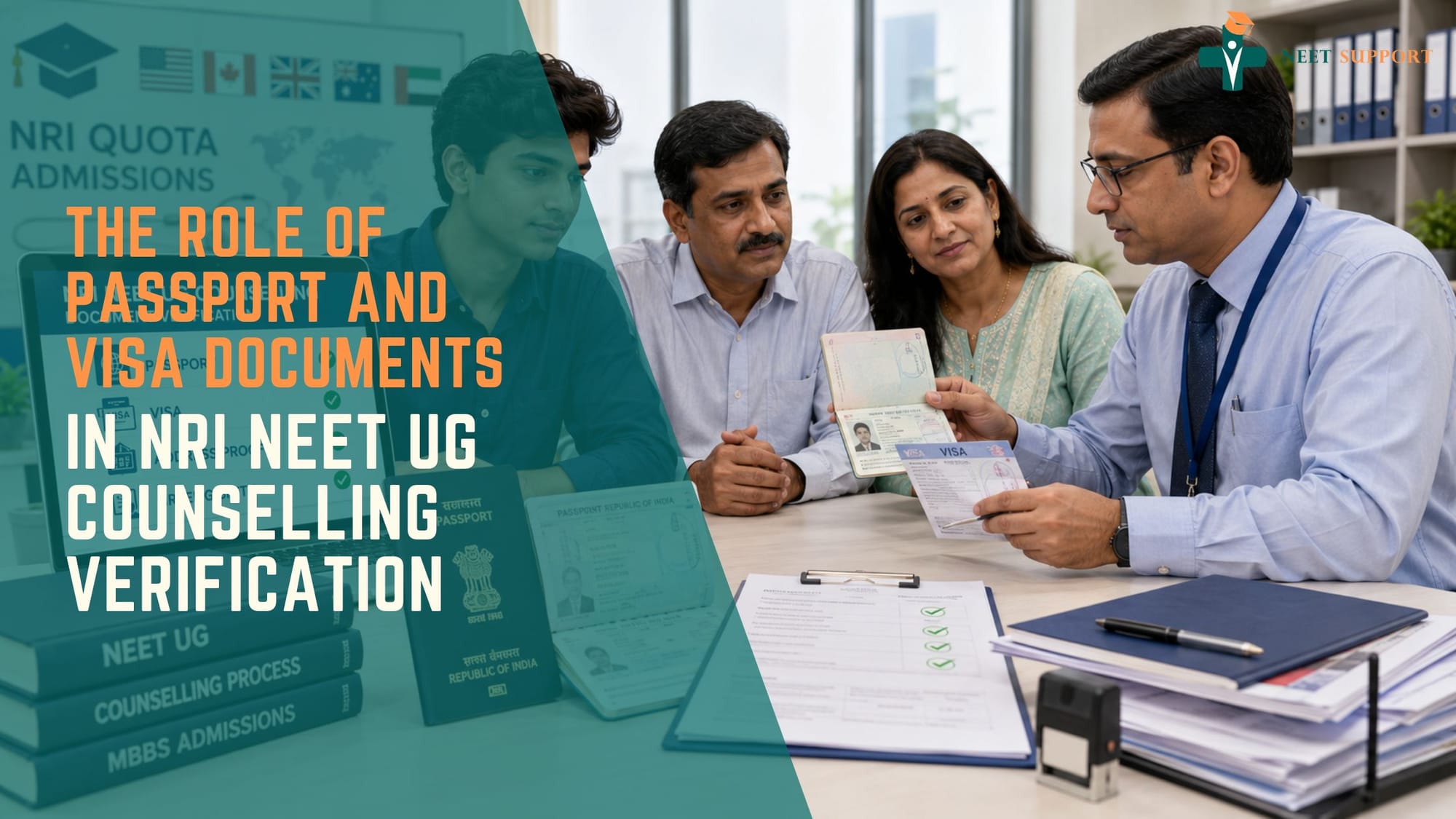
The Role Of Passport And Visa Documents In NRI NEET UG Counselling Verification
Nishat
 WhatsApp
 Email
Email Facebook
 Twitter/X
 LinkedIn
Table of Contents
Predict Your Rank Now
Enter your NEET score to get an estimated rank
Find the Best Colleges For You
Based on your NEET rank, Category & more

Get Your Dream Medical College
Secure your seat with expert counselling
Introduction
Of all the documents families gather for NRI quota admissions, the passport is probably the one nobody thinks twice about. It's just... there, sitting in a drawer somewhere, the thing you grab before a flight. So it genuinely catches people off guard when a verification officer flips through it and says, "this visa page expired four months ago" — and suddenly a document that felt like the easiest item on the checklist becomes the reason a seat is hanging in the balance.
Let's actually sit with this one properly, because passports and visas quietly do a lot more work in NRI quota verification than most families expect going in. How they function as proof, what "valid" really means here, and where things tend to go wrong without anyone meaning for them to.
Why A Passport Isn't Just Identification Here?
In everyday life, your passport is mostly just proof of who you are. Show it at the airport, get your boarding pass, done. But in NRI NEET UG Counselling, it's doing something a bit more specific — it's core evidence of where you actually live and what your citizenship or residency status is, which happens to be the entire foundation the NRI quota is built on. A verification officer isn't just checking that your name matches your NEET application. They're checking whether the passport itself genuinely supports the claim being made — that you, or your sponsor, hold real NRI, OCI, or PIO status, not just a passport that's collected a lot of stamps over the years.
That's why the type of passport matters so much. If a student is applying on their own NRI status, or a sponsor is establishing theirs, the expectation is usually a foreign-issued passport — not an Indian passport with some loose overseas connection hanging off it. An Indian citizen who travels abroad often enough doesn't become an NRI just because their passport looks well-traveled. The passport needs to actually reflect the status being claimed, not just gesture toward it.
What Counts, And What Honestly Doesn't?
Here's where the rules get specific, and a little unforgiving if you get them wrong. If the candidate or sponsor holds foreign citizenship, that foreign-issued passport is your primary proof — full stop, nothing else really substitutes for it. And Indian passport holders on their own generally aren't eligible for the NRI quota unless they separately hold an OCI or PIO card too. The Indian passport by itself just doesn't establish the kind of connection this quota was built around.
If your family's situation runs through an OCI or PIO card instead of foreign citizenship, that card works almost like a companion to the passport — it needs to be valid, submitted alongside the application, and handily, it also functions as a long-term, multiple-entry visa for India. That's one less separate document to chase down, at least.
And if it's a sponsor establishing NRI status on the candidate's behalf — a parent working abroad, say — it's the sponsor's foreign passport doing the heavy lifting here, submitted together with proof of the relationship between the two of them. The candidate's own passport, if they even have one, generally supports the picture but doesn't replace the sponsor's documentation.
Now Let's Talk About Visas, Because This Is Where People Actually Trip Up?
A passport tells you who someone is. A visa tells you what they're legally allowed to be doing, and where — and that distinction matters more than families usually expect. If a sponsor holds a valid work visa in the US, that visa is part of what proves their residency is genuine and current, not just something that used to be true a few years back.
Here's the bit that catches so many families off guard: passport and visa validity doesn't just get checked once, at the moment you apply. It has to hold up all the way through the admission process. A visa that was perfectly fine when you registered for counselling can quietly expire by the time you're standing at physical document verification — and that becomes a real problem, not because anyone's NRI status actually changed, but because the piece of paper sitting on the table no longer proves what it needs to prove. If a visa is anywhere close to expiry during your counselling window, don't wait for someone to point it out. Renew it first.
And for candidates who don't have an OCI card and are coming to India purely to study — foreign citizens without that built-in visa cover — a proper student or entry visa becomes its own separate thing to manage. For anyone staying long-term through the course, that visa needs to be renewed periodically too. It's not a box you tick once at admission and forget about; it follows you through the years of the degree.
The Name-Matching Problem Nobody Really Warns You About
There’s a minor incident that confounds many families more often than not: names may not precisely correspond across a passport, a visa, an NRI certificate, and university records. This is particularly the case for families that have lived in different parts of the world, altered spellings for convenience, or simply have names that do not fit into the standard Western format. A middle name that surfaces in one paper is missing in the other. A last name that is spelled one way in one document is spelled differently elsewhere. A hyphen that appears at one point may be absent in the same name in another document. Although these points look trivial, they are precisely the points that trigger the verification agent into action, despite the fact that everyone in the room is already aware it is one and the same person.
The fix isn't complicated, just a bit tedious: sit down with your passport, visa, NRI certificate, and every academic document side by side, and check that the name reads identically everywhere. If it doesn't, and you can't easily fix the underlying document, at least walk in with an explanation ready — a legal name-change record, if that applies — rather than discovering the mismatch for the first time at the verification desk, with a queue behind you and a deadline ticking.
What Actually Happens If These Documents Don't Hold Up?
Worth being direct about this, because it's not a minor administrative hiccup. If passport or visa documents turn out invalid, expired, mismatched, or — in the more serious cases — forged or manipulated in any way, the consequences go well beyond a delay. Applications and admissions can be cancelled outright, and MCC has been explicit that fabricated documentation can get a candidate blocked from future counselling rounds entirely, with legal consequences possible depending on how serious it is. None of this is meant to scare genuine families — it's meant to explain why "close enough" really isn't good enough when it comes to passport and visa paperwork specifically.
A Practical Checklist For This Piece Of The Puzzle
Before you're anywhere near a verification desk, a few things are worth running through. Make sure the passport you're submitting actually matches the status being claimed — a foreign passport for foreign citizenship, or an Indian passport paired with a valid OCI/PIO card if that's how your family's situation works. Check that the visa isn't just valid today, but will still be valid through the realistic stretch of your counselling and admission timeline — not just the day you happen to be registering. If a visa's due to expire anywhere near that window, renew it now, not after someone flags it for you. Line up names across every single document — passport, visa, NRI certificate, academic records — and sort out any mismatches ahead of time instead of trying to explain them on the spot. And if a sponsor is involved rather than personal NRI status, make sure it's genuinely their passport and visa doing the proving, backed by clear relationship documentation, rather than the candidate's own passport quietly trying to do a job it can't actually do.
FAQs
Why does a passport matter so much in NRI quota verification?
Because it's core evidence of citizenship or residency status, which is the entire foundation the NRI quota eligibility rests on, not just a general identity document.
Can an Indian passport holder qualify for the NRI quota on its own?
Generally no, unless they also hold a valid OCI or PIO card alongside it, since an Indian passport alone doesn't establish the overseas connection the quota requires.
Whose passport matters if I'm applying as a sponsored candidate?
The sponsor's foreign passport is the key document in that case, submitted along with clear proof of the relationship between sponsor and candidate.
Does an OCI or PIO card replace the need for a visa?
Largely yes, since it functions as a long-term, multiple-entry visa for India, simplifying that requirement for cardholders compared to foreign citizens without one.
Do foreign citizens without an OCI card need a separate visa to study in India?
Yes, they need a valid student or entry visa, and for long-term stays during the course, that visa typically needs periodic renewal.
What happens if my passport or visa documents are found invalid or forged?
Consequences can include cancellation of the application or admission, being blocked from future counselling rounds, and potential legal action in serious cases.
Should I renew a visa that's close to expiring before counselling begins?
Yes, it's strongly advisable to renew proactively rather than risk it expiring during the counselling or verification window.
Final Thoughts
Passports and visas feel almost too ordinary to worry about — they're the paperwork of everyday travel, not the kind of thing families usually treat as high-stakes. But within NRI NEET UG Counselling specifically, they're doing quiet, foundational work, establishing the exact legal status the entire NRI quota rests on. They deserve the same care you'd give your Embassy Certificate or sponsorship affidavit, not a spot at the bottom of a travel folder somewhere.
Check the dates. Check the names. Make sure the right passport is actually proving the right thing for your specific situation. Do that, and you'll walk into verification with one less thing to worry about — which, given everything else already on an NRI family's plate during counselling season, is honestly worth quite a lot.
Disclaimer: Passport, visa, and documentation requirements can vary by state, college, and academic year, and are subject to updates by MCC, NMC, or individual counselling authorities. Always verify the latest official requirements on mcc.nic.in or your target state's counselling portal before applying.
Reviews
No reviews yet. Be the first to write one!