
The One That Nalanda Never Built: Why Bihar Has No Deemed Medical College For NRI Families
Nishat
 WhatsApp
 Email
 Facebook
 Twitter/X
 LinkedIn
Table of Contents
Predict Your Rank Now
Enter your NEET score to get an estimated rank
Find the Best Colleges For You
Based on your NEET rank, Category & more

Get Your Dream Medical College
Secure your seat with expert counselling
Introduction
A thousand years before "deemed university" was a phrase anyone used, Bihar's Nalanda was quite possibly the closest thing the ancient world had to an internationally accredited university — students travelled from Korea, China, and Central Asia to study there. It seems almost ironic, then, that modern Bihar is one of the few Indian states with genuinely no deemed medical university at all. Here's the honest, fully confirmed answer, not a padded list.
Quick Numbers Before We Dive In:
- 0 deemed medical universities anywhere in Bihar
- 12 private, state-counselled medical colleges instead — covered in our companion guide
- 57–59 deemed medical colleges exist nationally, concentrated overwhelmingly in a handful of other states
- Uttar Pradesh, Jharkhand — Bihar's immediate neighbours — each have at least one
A Confirmed Absence, Not A Research Gap
This isn't a case of conflicting sources or murky institutional status, the kind of ambiguity we've run into elsewhere in this series. Multiple independent, state-wise breakdowns of India's deemed medical college landscape are consistent on this point: Bihar simply isn't on the list. One widely cited national tally puts the count at "Andhra Pradesh, Delhi, Gujarat, Jharkhand, Kerala, Uttarakhand and Uttar Pradesh states have one deemed medical college each, Odisha, Telangana and Haryana have two... Karnataka has 12... Maharashtra has 14" — and Bihar appears nowhere in that accounting. Every medical college in the state, private or government, runs through the Bihar Combined Entrance Competitive Examination Board's own UGMAC counselling, not MCC's separate deemed-university pool.
Bihar Stands Out, Even Among Its Own Neighbours
What makes this genuinely notable isn't just that Bihar lacks a deemed university — it's that literally every state bordering it has at least one.
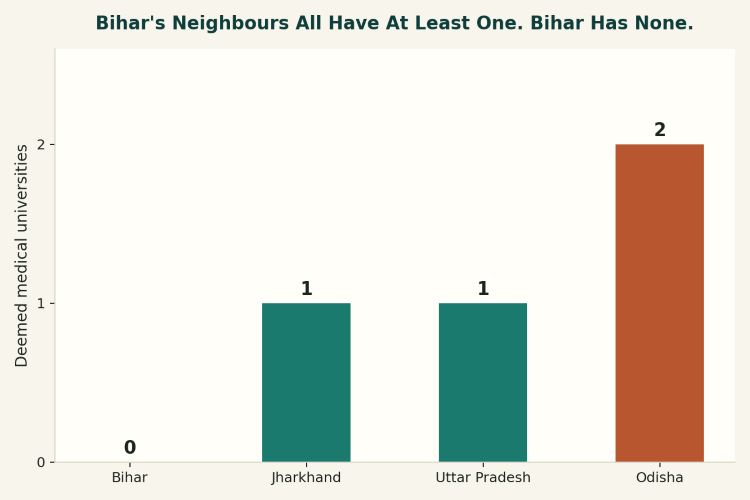
Based on published state-wise deemed medical college counts. Bihar is the outlier in its own immediate region — every neighbouring state we've been able to confirm has at least one deemed institution.
That's a genuinely unusual position for a state of Bihar's size and population. It's not that Eastern India lacks deemed medical education entirely — Odisha alone has three campuses across two universities, as our companion guide covers — it's that Bihar specifically hasn't developed one.
Where India's Deemed Colleges Actually Live?
Zooming out further, the national picture makes Bihar's position even clearer. Deemed medical education in India isn't evenly spread — it's heavily concentrated in a small handful of states, and Bihar sits at the empty end of that distribution alongside a few others.
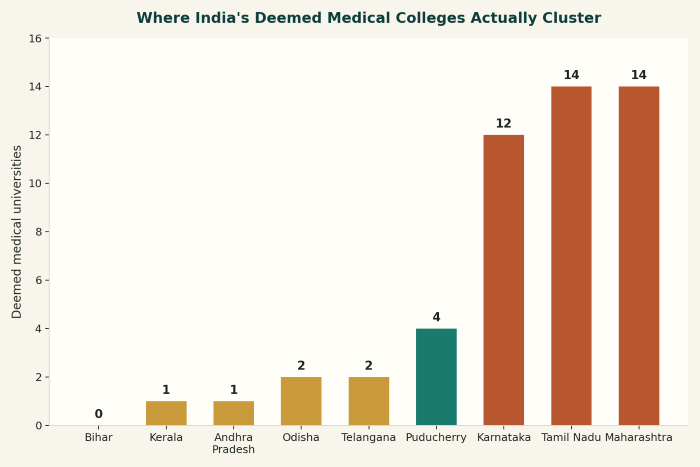
Based on a national state-wise tally of NMC-recognised deemed medical colleges as of 2025. Karnataka, Maharashtra, and Tamil Nadu alone account for roughly 40 of India's approximately 57–59 deemed medical colleges — well over two-thirds of the national total.
Three states — Karnataka, Maharashtra, and Tamil Nadu — host the overwhelming majority of India's deemed medical colleges between them. Everywhere else, including large, populous states like Bihar, Uttar Pradesh, and West Bengal, has little to none. This isn't really a Bihar-specific story so much as a reflection of where India's private higher-education trusts have historically chosen to build large multi-disciplinary university systems.
Why This Gap Probably Exists?
Nothing in public sources explains this directly, but the pattern fits a broader trend: deemed-university status tends to emerge from large, well-capitalised, multi-disciplinary private trusts — the same kind that built KIIT and SOA in Odisha, or Manipal and JSS in Karnataka — expanding into medicine after establishing themselves in engineering, management, or the sciences. Bihar's private higher-education sector has grown significantly in the medical space specifically, with 12 private colleges now operating, but none of those trusts appear to have pursued the separate UGC deemed-university track, whether by choice, scale, or timing.
What This Means If You're Planning Around Bihar?
- Don't go looking for an MCC deemed-counselling route inside Bihar. It doesn't exist yet, and no announced plans for one were found in current public sources.
- Bihar's real NRI-quota opportunity is its private-college sector, which we've covered in detail separately — a genuinely well-documented, comparatively affordable market with confirmed, college-specific NRI fees ranging roughly $21,000 to $35,000 a year.
- If the deemed-university route specifically matters to your family — MCC's single national counselling window, typically larger hospital infrastructure, sometimes stronger national rankings — neighbouring Uttar Pradesh and Jharkhand each have at least one option, and Odisha, a bit further east, has three campuses across two universities worth a proper look.
- This picture could shift. Deemed-university status is a live, evolving space nationally — Telangana had zero deemed medical colleges until 2024, and Meghalaya got its first private medical college only that same year. Bihar's absence today doesn't rule out a change within this decade.
FAQs
Does Bihar Have Any Deemed Medical Universities?
No. Multiple independent, state-wise national counts confirm Bihar has zero medical colleges holding UGC deemed-university status. Every medical college in the state, private or government, is counselled through Bihar's own BCECEB/UGMAC process.
Is This Likely To Change Soon?
There's no confirmed plan either way in current public sources, but the broader national picture shows this kind of status can shift quickly — Telangana had no deemed medical college until 2024, and Meghalaya's entire private medical college sector is only a couple of years old. Bihar's current absence isn't necessarily permanent.
Where Should NRI Families Interested In Bihar Look Instead?
Bihar's own well-documented private-college sector, covered in our companion guide, is the realistic option within the state — 12 colleges with confirmed, college-specific NRI fees roughly between $21,000 and $35,000 a year.
Which Neighbouring States Have A Deemed Medical College, If The Route Matters To Us?
Uttar Pradesh and Jharkhand, both bordering Bihar, each have one confirmed deemed medical college. Odisha, a bit further east, has three campuses across two deemed universities (KIIT and Siksha 'O' Anusandhan), covered in our companion Odisha guide.
Why Are Deemed Medical Colleges So Concentrated In A Few States?
The pattern seems to follow where large, well-capitalised, multi-disciplinary private education trusts have historically built out their institutions — Karnataka, Maharashtra, and Tamil Nadu together account for well over two-thirds of India's roughly 57–59 deemed medical colleges, largely through groups that expanded from engineering or general higher education into medicine.
Does The Absence Of A Deemed College Reflect Badly On Bihar's Medical Education Overall?
Not necessarily. Deemed-university status is a specific institutional and administrative designation, not a direct measure of medical education quality — Bihar's government colleges (including AIIMS Patna) and its 12 private colleges continue to train doctors through the state's own well-established counselling system.
How Many Deemed Medical Colleges Exist In India Overall?
Approximately 57–59, as of the most recent counts, concentrated overwhelmingly in Karnataka, Maharashtra, and Tamil Nadu, with smaller numbers spread across states like Odisha, Telangana, Kerala, Andhra Pradesh, Gujarat, and a handful of others.
What's The Difference Between A Deemed University And A Private College For NRI Purposes?
A deemed university fills every seat through the MCC's national Deemed University counselling, with its own independently set fee structure. A private, state-counselled college — like all 12 of Bihar's — fills its seats through the state's own counselling body, with fees regulated at the state level.
Does Bihar's Private-College Market Make Up For The Lack Of A Deemed Option?
For many families, yes, especially those prioritising cost — Bihar's private colleges land among the more affordable NRI-quota options found across this entire series, even without a deemed-university alternative to compare against.
Is There A Central Institution In Bihar Similar To A Deemed University?
AIIMS Patna is a central government Institute of National Importance, administratively distinct from both deemed universities and state-counselled private colleges, and — consistent with the pattern at most AIIMS campuses outside Delhi — does not carry a dedicated NRI quota.
Wrapping Up
Bihar's deemed medical education gap is real, confirmed, and consistent with what we'd expect from where India's large private-university trusts have historically concentrated their investment — not a reflection on Bihar's medical education quality generally, which its well-regarded private and government colleges continue to demonstrate. For now, the honest advice for an NRI family focused on Bihar is straightforward: skip the deemed-university search entirely, and put that research energy into the state's private-college market instead, where the real options — and the real numbers — already exist.
Reviews
No reviews yet. Be the first to write one!