
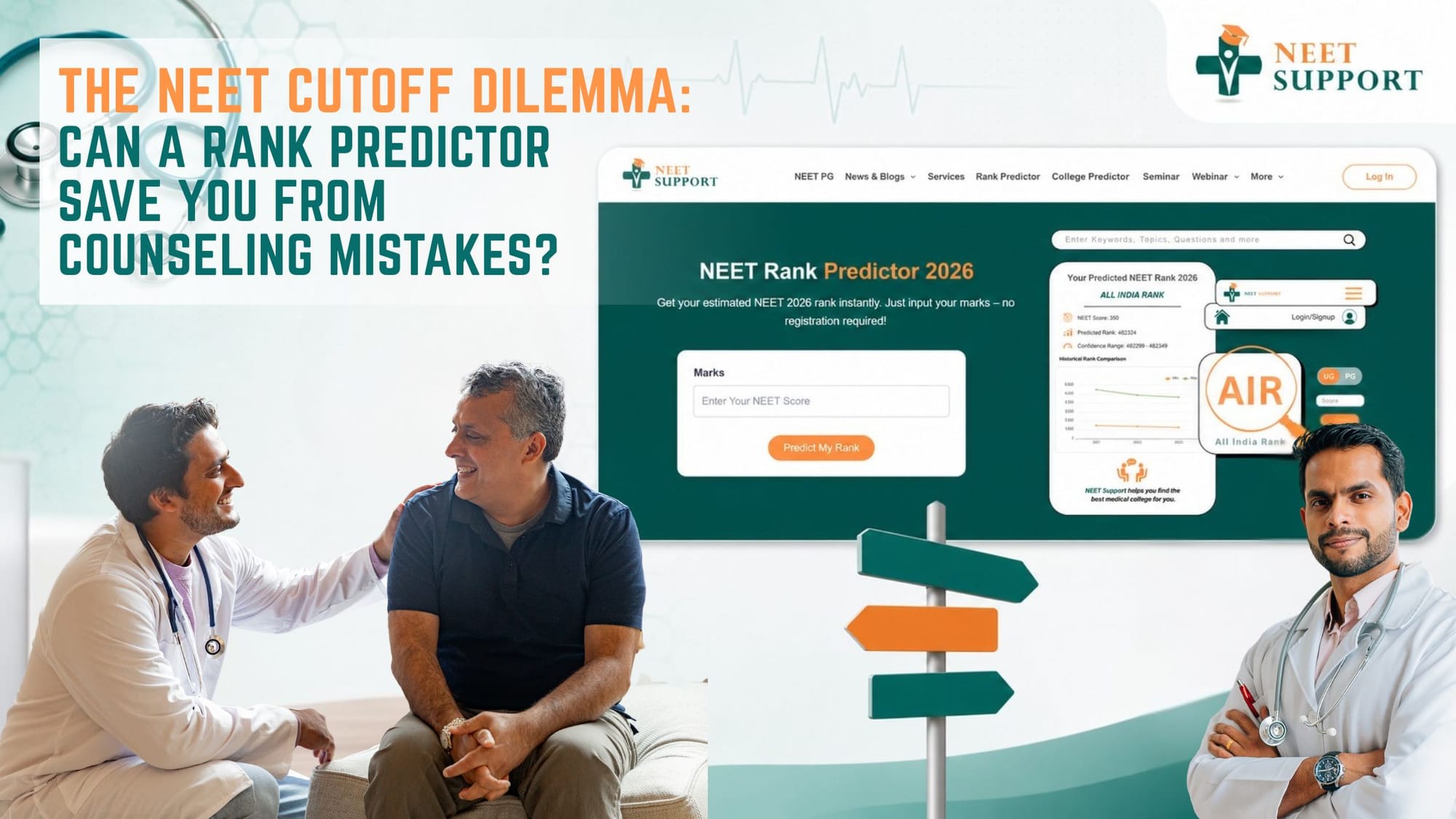
The NEET Cutoff Dilemma: Can a Rank Predictor Save You from Counseling Mistakes?
RISHIKESH KUMAR
 WhatsApp
 Email
Email Facebook
 Twitter/X
 LinkedIn
Table of Contents
Predict Your Rank Now
Enter your NEET score to get an estimated rank
Find the Best Colleges For You
Based on your NEET rank, Category & more

Get Your Dream Medical College
Secure your seat with expert counselling
Overview
For millions of medical students in India, the National Eligibility cum Entrance Test (NEET) represents far more than just a competitive examination. It reflects years of dedication, nonstop preparation, and emotional pressure. Yet, qualifying for the examination is the only way to start the journey. The time between the announcement of NEET results and the final counselling process is frequently stressful for both scholars and parents.
Every year, more than two million candidates contend for a limited number of MBBS and BDS seats across the country. This violent competition creates what various describe as the “NEET cut-off Dilemma.” Cutoff scores change annually because of factors such as test difficulty, students’ performance, seat vacancy, and reservation programs. As a result, indeed a small mistake during counselling may affect a student’s opportunity to secure an asked medical college.
To manage this query, various scholars rely on digital tools called NEET Rank Predictors. These platforms attempt to estimate ranks and admission possibilities based on marks attained. But, an important question remains: Do these tools authentically help scholars make the right opinions, or can they sometimes create misleading expectations during the counselling process?
Understanding the Cutoff Dilemma
The main challenge in the NEET admission process is that a student's score out of 720 alone cannot directly determine the chances of getting a medical seat. Due to changing competition situations every time, a score that formerly guaranteed admission to a top government medical council may not be sufficient at this time. This query substantially arises because of variations in rank and counselling patterns.
1. NEET Marks vs. NEET Rank
Medical admissions are based on All India Rank (AIR) rather than only marks attained. When the examination is easier, numerous scholars achieve high scores, which leads to high competition and significant changes in ranking positions.
2. The Counselling Matrix
The counseling process is conducted in several stages by the Medical Counselling Committee (MCC) and state authorities. These rounds include Round 1, Round 2, Mop- Up Round, and Stray Vacancy Round. Each round follows different opening and closing ranks for category similar as General, OBC, SC, ST, and EWS.
To know more about the counseling process: Click here.
Because college choice filling is both strategic and final, scholars frequently face confusion.
What is a NEET Rank Predictor and How Does It Work?
A NEET Rank Predictor is an AI-driven or data-backed digital tool designed to estimate a candidate's All India Rank before the official results are announced, or to predict college allotments based on a specific rank.
It works on several algorithms.
To know detailed information on the NEET rank predictor: Click here.
Can a Rank Predictor Save You from Counseling Mistakes?
The short answer is yes, but only if you use it wisely and strategically. Here is how a rank predictor protects you from making big errors during the counseling process:
Preventing "Over-Confidence Blunders"
Various scholars with good scores incorrectly believe that admission to a nearby government medical college is guaranteed. As a result, they frequently select only the top choices during MCC counselling. But if the cutoff rises suddenly, they may fail to secure any seat in the first round. Rank predictor tools help scholars understand the query in cutoffs and encourage them to include safer backup options.
Eliminating the "Blind Choice Filling" Trap
Choice filling requires careful planning and prioritisation. However, the system will automatically assign the lower option if the student fills in the lower college above the top college. Rank predictors help scholars in arranging colleges in a proper order based on their quality and once admission trends, reducing the threat of poor selection.
Navigating the Mop-Up and Stray Vacancy Rounds
In later counselling stages, similar to Mop-Up and Stray Vacancy rounds, seats frequently become available when scholars upgrade to more institutions. Advanced predictor tools examine the past vacancy patterns and help scholars decide whether it's safer to keep their current seat or stay for a better occasion in the final rounds.
Limitations You Must Keep in Mind
While these tools are incredibly beneficial, relying blindly on them can backfire due to various limitations:
The "Anomaly" Factor: No algorithm can predict unprecedented shifts. For instance, sudden changes in seat matrix (e.g., the government adding 10,000 new MBBS seats or a state changing its reservation policy) can become an obstacle in the already fed data.
Data Accuracy: Free or unverified rank predictors often use outdated databases or simple mathematical models that fail to capture category-wise sub-allocations accurately.
Integrating Predictors into Your Counseling
To maximise your chances of securing the best possible medical seat, use a rank predictor as part of this comprehensive, three-step strategy:
1. Gather the results: Use two or three reputable rank predictors to establish an average expected rank range and a preliminary list of potential colleges.
2. Cross-Verify with Official Data: Cross-reference the predictor’s suggestions with the official closing rank PDFs published on the MCC website and respective state counseling portal archives from the past two years.
3. Build a Tiered Choice List: Design your final choice-filling form using the "Dream-Realistic-Safe" framework. Ensure you include enough safe options to guarantee admission, while keeping your dream choices at the very top.
Frequently Asked Questions (FAQs)
1. How accurate are NEET rank predictors?
The accuracy of a rank predictor depends heavily on its underlying data and algorithm. Premium tools that utilize multi-year historical trends and adjust for current-year variables (like paper difficulty) offer highly realistic estimates, usually within a narrow margin of error. However, they should always be treated as directional guides rather than absolute guarantees.
2. Is All India Quota (AIQ) counseling different from State Quota counseling?
Yes. AIQ counseling is conducted by the Medical Counselling Committee (MCC) for 15% of seats in all government medical colleges across India, alongside 100% of seats in Deemed Universities, Central Universities, AIIMS, and JIPMER. State Quota counseling is conducted by respective state education boards for the remaining 85% of seats within that specific state for local domiciled students.
3. What happens if I make a mistake in my choice-filling order?
If you arrange your choices incorrectly, the automated counseling software will allot you the highest college on your list for which your rank qualifies. If you accidentally placed a less desirable college above your dream college, you will be stuck with the lesser option, missing out on a superior institution you earned the rank for.
4. Can a rank predictor help me choose between MBBS and BDS?
Yes. Most advanced rank predictors allow you to filter by course type. If your rank is borderline for a government MBBS seat, the predictor can show you alternative pathways, such as top-tier government BDS seats or private/deemed university MBBS seats within your budget.
5. Why do NEET cutoffs change so drastically every year?
NEET cutoffs fluctuate due to three primary variables: the difficulty level of the question paper, the total number of students appearing for the exam, and changes in the total seat matrix (such as the opening of new government medical colleges or updates to state reservation quotas).
6. Should I participate in Round 2 if I am allotted a seat in Round 1?
If you are satisfied with your Round 1 college but still want to try for a higher-preference college, you can opt for the "Upgradation" option and participate in Round 2. If you do not get upgraded, you retain your Round 1 seat. However, ensure you thoroughly understand the current year's security deposit forfeiture rules before entering subsequent rounds.
Conclusion
The NEET cutoff dilemma is a hectic situation that arises due to high competition and a complex, multi-level seat allocation system. Although a NEET Rank Predictor cannot change a student’s score or ensure admission, it acts as a helpful logical tool. It reduces anxiety by furnishing data- driven results, replaces queries with structured planning, and helps minimise miscalculations during the choice- filling process. Scholars should view rank predictors as positive and predictive remarks rather than absolute authorities. Their suggestions should be cross-checked with official counselling information, enabling scholars to make informed opinions and approach the seat allotment process with less clarity, confidence, and a more balanced strategy.
Reviews
No reviews yet. Be the first to write one!