NEET Category Conversion Rule: How Unfilled Reserved Seats Change to the General Pool
RISHIKESH KUMAR
 WhatsApp
 Email
Email Facebook
 Twitter/X
 LinkedIn
Table of Contents
Predict Your Rank Now
Enter your NEET score to get an estimated rank
Find the Best Colleges For You
Based on your NEET rank, Category & more

Get Your Dream Medical College
Secure your seat with expert counselling
Going through the NEET UG counselling process can feel confusing and stressful. After spending years studying Physics, Chemistry, and Biology, many students find themselves dealing with complex rules, seat matrices, and official guidelines that are not always easy to understand.
One common question many medical aspirants have is: what happens to reserved seats like SC, ST, OBC, EWS, or PwD if no eligible candidates take them? Do these seats remain empty or get wasted?
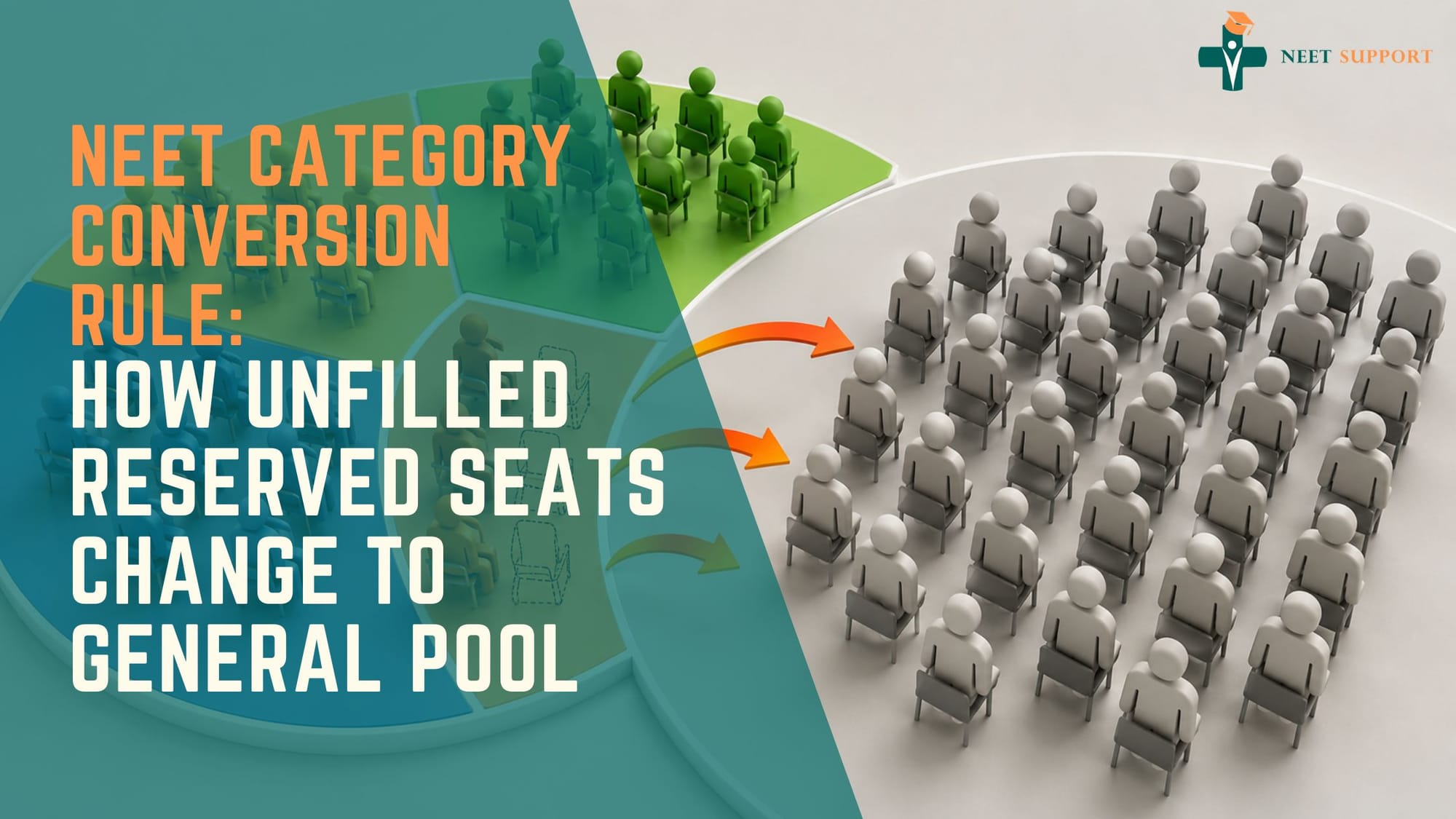
The simple answer is no. These seats do not go to waste. The Medical Counselling Committee (MCC) and state authorities follow a clear system known as the NEET Category Conversion Rule. This rule is applied in the later rounds of counselling, where any unfilled reserved seats are converted into the General (Unreserved) category, making them available to more candidates.
Overview: Understanding Reservation vs. Seat Vacancy
To understand how category conversion works, it helps to first understand how seats are distributed.
Under the 15% All India Quota (AIQ), central educational institutions (such as AIIMS, JIPMER, BHU, and AMU), and 85% State Quota seats, standard vertical reservation policies apply:
OBC (Non-Creamy Layer): 27%
Scheduled Caste (SC): 15%
Gen-EWS (Economically Weaker Section): 10%
Scheduled Tribe (ST): 7.5%
PwD (Persons with Benchmark Disabilities): 5% (applied horizontally across all categories)
| Category | Reservation Percentage |
|---|---|
| OBC-NCL | 27% |
| SC | 15% |
| Gen-EWS | 10% |
| ST | 7.5% |
| Unreserved / General Pool | ~40.5% |
| PwD | 5% (Horizontal across all) |
In the first two rounds of counselling (Round 1 and Round 2), reserved seats are strictly kept for candidates of those specific categories who have valid and up-to-date certificates.
However, by Round 3 (also called the Mop-Up Round) and the Stray Vacancy Round, many seats may still remain empty. This usually happens because some candidates do not report, their documents get rejected, or there are not enough eligible applicants in certain categories.
Instead of leaving these valuable medical seats vacant, the counselling system activates the Category Conversion rule, which helps reassign these unfilled reserved seats to other categories so that maximum seats are filled.
Key Highlights of the Category Conversion Process
Here are the essential rules you need to know about how and when category conversion takes place:
Timing Matters: Category conversion does not happen in Round 1 or Round 2. It is only applied in Round 3 and the Stray Vacancy Round, after all eligible candidates from each reserved category have been considered.
Merit-Based Allocation: Once seats are converted, they are added to the General (Unreserved) pool. This means any candidate with a valid NEET rank can get these seats based purely on their All-India Rank (AIR), regardless of their original category.
Step-by-Step Conversion Process: The conversion is not done all at once. It follows a proper order or sequence. For example, ST seats may first convert to SC, and only after that move to the General category if still unfilled.
PwD Seats Cleared First: PwD (Persons with Disabilities) seats are handled first within their respective categories before any category conversion starts, ensuring fair allocation within each group.
The Conversion Ladder: Step-by-Step Breakdown
The MCC follows a specific conversion ladder to reallocate unfilled seats. Understanding this order helps explain how seats shift across categories during Round 3 and Stray Vacancy rounds.
1. Horizontal Conversion (PwD Seats)
Before vertical categories shift, Person with Disability (PwD) seats that remain unfilled are merged back into their parent vertical category.
ST-PwD to ST
SC-PwD to SC
OBC-PwD to OBC
EWS-PwD to EWS
UR-PwD to UR
2. Vertical Category Conversion (Round 3 onwards)
Once horizontal vacancies are absorbed, the central algorithm processes vertical category vacancies in the following strict order:
| Original Seat Category | Conversion Rule | Final Allocation Pool |
|---|---|---|
| ST Seats | Convert to | SC Pool |
| SC Seats | Convert to | UR / General Pool |
| EWS Seats | Convert to | UR / General Pool |
| OBC Seats | Convert to | UR / General Pool |
| NRI Seats | Convert to | UR / General Pool |
Step A: ST to SC Conversion
In many cases, Scheduled Tribe (ST) seats have fewer applicants, especially in certain regions or colleges. So, if these seats remain vacant, they are first offered to Scheduled Caste (SC) candidates to ensure they are filled.
Step B: SC to Unreserved (UR) Conversion
If the seats moved from ST to SC are still not filled, or if original SC seats remain empty, they are officially converted into Unreserved (UR) seats. This means they are now open to all candidates.
Step C: EWS & OBC to Unreserved (UR) Conversion
If there are no eligible candidates left in the EWS or OBC categories, these unfilled seats are directly transferred to the Unreserved (UR) pool without going through other steps.
Step D: NRI / Management Quota to UR
In Deemed Universities and some special seats, if NRI quota seats remain vacant, they are converted into General or Management quota seats so they can be filled in the final counselling rounds.
Strategic Comparison: How Conversion Rules Vary Across Quotas?
It is important to understand that the Medical Counselling Committee (MCC) handles the central All India Quota (AIQ) seats, while each state has its own authority to manage the 85% State Quota seats. For example, different states have their own counselling bodies that follow their own procedures. Because of this, the rules for seat conversion at the state level may be slightly different from the rules followed under the central AIQ system.
| Feature | MCC All India Quota (AIQ 15%) | State Quota (85%) |
|---|---|---|
| Authority | Medical Counselling Committee (MCC) | State Medical Counselling Bodies |
| Applicable Rounds | Round 3 & Stray Vacancy Round | Last Online Round / Spot Round |
| ST Seat Shift | Shifts to SC first, then to UR | Varies (Some states shift ST to SC, others directly to open pool) |
| OBC/EWS Shift | Shifts directly to UR pool | Depends on state reservation laws |
| Document Disqualification | Converted to UR for subsequent rounds if category document fails | Varies by state authority |
Why Category Conversion Matters for General Pool Candidates?
If you are a General/Unreserved category student, the initial seat matrices might look intimidating. Around 59.5% of seats are tagged under various vertical reservations.
However, the Category Conversion rule is a major reason why cutoff ranks often shift significantly in Round 3 and the Stray Vacancy Round.
During the initial counselling phases—Rounds 1 and 2—reserved seats are strictly locked for their respective category candidates and cannot be accessed by others. However, after the reporting deadlines pass, some of these seats may remain unfilled due to non-joining or withdrawal. At this stage, in Round 3 or the Stray Vacancy Round, a category conversion process is triggered. Through this mechanism, the unoccupied reserved seats are transferred into the Unreserved or General Pool. As a result, the overall number of seats available to open-merit candidates increases. This expansion of the General Pool often causes the closing ranks to shift downward, allowing candidates with comparatively lower ranks to secure admission unexpectedly.
Key Takeaway for Aspirants: Do not abandon your counselling strategy after Round 2! Tens of seats that start as reserved in Round 1 end up as General pool seats by the Stray Vacancy round, making choice filling in later rounds critical.
Frequently Asked Questions (FAQs)
1. Does category conversion happen in Round 1 or Round 2 of NEET counselling?
No. Category conversion never happens in Round 1 or Round 2. During the first two rounds, reserved seats remain strictly reserved to give every eligible candidate in those categories a fair chance to claim them. Conversion only begins in Round 3 (Mop-Up) and subsequent Stray Vacancy rounds.
2. What happens if my category certificate is rejected during document verification?
If your category certificate (e.g., OBC-NCL or EWS) is found invalid or expired during physical/online document verification, you will not be disqualified from counselling entirely. Instead, your category status for subsequent rounds will be automatically changed to General/Unreserved (UR), provided you meet the minimum qualifying percentile for the UR category.
3. Can an ST seat directly convert into a General (UR) seat?
In MCC All India Quota (AIQ) counselling, an ST seat does not convert directly to UR. It first converts to the SC category. Only if there are no eligible SC candidates available to claim that converted seat does it shift into the Unreserved (UR) general pool.
4. Do candidates getting a converted General seat need to pay extra fees?
No. The fee structure for an MBBS or BDS seat depends on the college type (Government, Private, or Deemed University), not on whether the seat was converted from a reserved category. If an SC or ST seat in a Government Medical College converts to UR, the candidate who receives it pays the standard government tuition fee for that college.
5. Can reserved category candidates apply for General pool converted seats?
Yes. "General" or "Unreserved" means open to all candidates based purely on merit. If an OBC, SC, ST, or EWS candidate has a higher NEET rank than a General candidate, they are fully eligible to claim an Unreserved seat.
6. Is the category conversion rule the same for AIQ and State Quotas?
While the overall principle—filling vacant seats rather than wasting them—is universal, the exact mechanics vary. MCC follows a uniform rule for 15% AIQ and Central Universities. State counselling authorities follow their respective state government reservation acts, which might have different rules for inter-category shifts. Always read your specific state's counselling prospectus.
Conclusion
The NEET Category Conversion Rule plays an important role in medical admissions in India. It serves two main purposes. First, it makes sure that students from reserved categories get a fair chance to take their allotted seats. Second, it prevents medical seats from going empty, so that no resources are wasted.
If you are going through NEET UG counselling, it is important to carefully check the seat matrix released before Round 3 and the Stray Vacancy Round. This is where you can see how many seats may be converted. Understanding how these seats move into the General pool can help you plan your choices more wisely and improve your chances of getting a seat in a good medical college.
Reviews
No reviews yet. Be the first to write one!