
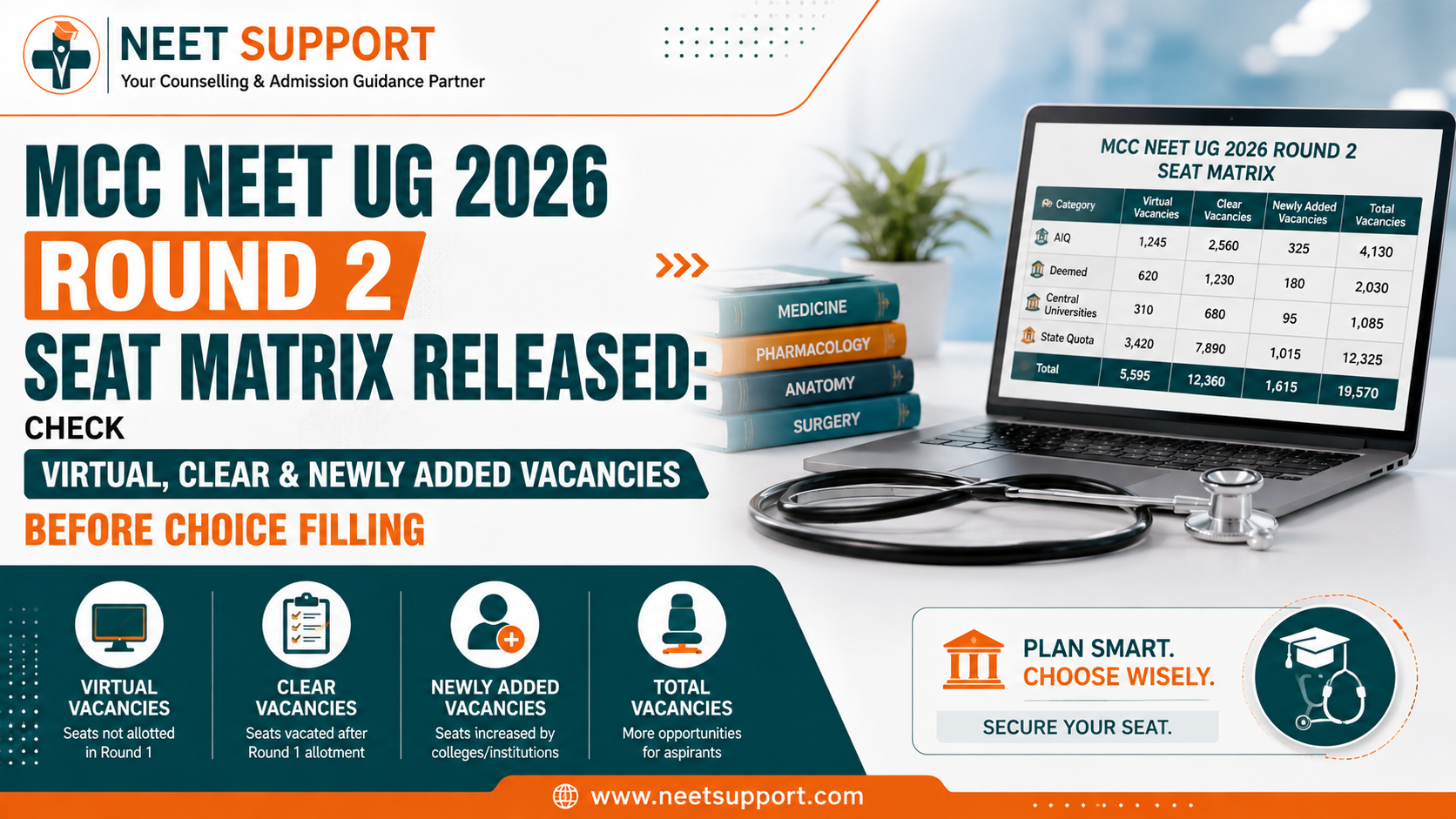
MCC NEET UG 2026 Round 2 Seat Matrix Is Out: Check Virtual, Clear & Newly Added Vacancies Before Choice Filling
Khushi Kant
 WhatsApp
 Email
Email Facebook
 Twitter/X
 LinkedIn
Table of Contents
Predict Your Rank Now
Enter your NEET score to get an estimated rank
Find the Best Colleges For You
Based on your NEET rank, Category & more

Get Your Dream Medical College
Secure your seat with expert counselling
Introduction
The Medical Counselling Committee (MCC) has released the Round 2 seat matrix for All India UG Medical & Dental Counselling 2026, covering MBBS, BDS, and B.Sc Nursing seats. This isn't just one list; it's actually three separate documents, and understanding the difference between them matters a lot before you sit down to fill your Round 2 choices.
If you're taking part in Round 2, whether as a Float candidate hoping to upgrade or a fresh entrant, this seat matrix is exactly what you should be studying right now, before choice filling closes.
Three Lists, Three Different Meanings
This is the most important thing to understand before anything else:
Virtual Vacancy — This means a seat may become available, but only if the candidate currently holding it gets upgraded to something else. In other words, it's a possibility, not a guarantee. The seat is technically occupied right now by someone who has chosen Float and might move on to a different seat, freeing this one up.
Clear Vacancy — This means the seat is already genuinely vacant, right now, with nobody holding it. These are your safest bets in terms of actual availability, since there's no dependency on another candidate's decision.
Newly Added Seats — These are additional seats that have been included specifically for Round 2 — seats that weren't part of Round 1's matrix at all, perhaps due to fresh approvals or corrections in the seat count at certain institutes.
Treating all three lists as equally "available" would be a mistake. A seat on the Virtual Vacancy list might not actually open up for you, depending on what the current seat-holder decides to do. Clear Vacancy and Newly Added seats are more dependable in that sense.
What The Seat Matrix Actually Shows?
Each entry in these documents includes:
- State Name — where the institute is located
- Institute Type — for example, "All India except Central University," "Central University," "AIIMS," "Deemed University," or "Employees State Insurance Scheme"
- Institute Name and Address — the specific medical or dental college
- Quota — such as All India, Open Seat Quota, IP University Quota, Delhi University Quota, Muslim Minority Quota, Jain Minority Quota, Self-Financed Merit Seat, and several others depending on the institute
- Branch/Course — MBBS, BDS, or B.Sc Nursing
- Category — BC, EW (EWS), OP (Open/General), SC, ST, and PH variants (PwD) within each category
- Total Seats — the number of seats available under that specific combination
This is genuinely detailed; the same institute can appear multiple times in the list, once for each quota and category combination it offers. For example, a single central university college might show separate rows for its regular All India quota seats, its Delhi University quota seats, and its IP University quota seats, each with different seat counts by category.
Why This Level of Detail Matters For Your Choice List?
Because seats are broken down by quota, category, and course separately, it's worth checking carefully that you're looking at the right combination for your own eligibility. A seat shown under "Delhi University Quota" or "IP University Quota," for instance, isn't open to just any candidate; these quotas typically have specific eligibility conditions attached. Similarly, "Jain Minority Quota" or "Muslim Minority Quota" seats at certain deemed universities are restricted to candidates meeting those specific minority criteria.
Before adding a seat to your choice list based on what you see in this matrix, make sure:
- The quota type genuinely applies to you
- The category shown matches your own declared category
- You're looking at the right course (MBBS vs BDS vs B.Sc Nursing)
How To Use This Seat Matrix Effectively?
Start with Clear Vacancies. Since these seats are already vacant with certainty, treat this list as your primary reference when building your choice order.
Layer in Newly Added Seats. These are fresh additions for Round 2, so they're worth reviewing carefully; they might include options you didn't have in Round 1 at all.
Treat Virtual Vacancy as a bonus possibility, not a plan. You can still add these to your choice list, since if the upgrade does happen, the seat becomes available to you. But don't build your entire strategy around a Virtual Vacancy seat as if it's guaranteed; it depends on another candidate's Round 2 outcome, which is outside your control.
Don't rely only on what you remember from Round 1. As this counselling season has emphasized, Round 2's seat matrix can look meaningfully different from Round 1; some seats fill up, some open up, and new ones get added. Build your Round 2 list fresh, based on this updated matrix, not on assumptions carried over from your Round 1 research.
How Should You Prepare Your Round 2 Choices?
A practical approach is to divide your choices into different preference levels.
Step 1: Check All Three Seat Lists
Open:
Virtual Vacancy → Clear Vacancy → Newly Added Seats
and identify colleges/courses relevant to you.
Step 2: Shortlist Your Options
Don't add a college simply because a seat appears in the matrix.
Consider whether you would genuinely be willing to join that college and course.
Step 3: Arrange According to Preference
Your choice list should reflect your actual preference.
A higher preference should mean:
"If I get this seat, I would prefer it over the choices below it."
Step 4: Consider Your Rank and Category
Your NEET rank, category, and applicable quota can affect the practical chances of getting a particular seat.
Step 5: Review the Complete List
Before submission, go through the entire choice order again.
Step 6: Follow MCC's Choice Filling and Locking Instructions
Make sure you complete the choice filling/locking process within the official timeline applicable to Round 2.
Documents You Should Have Ready
While reviewing the seat matrix itself doesn't require documents, it's worth having these ready as you move into actual choice filling and later reporting:
- NEET UG 2026 admit card and scorecard
- Category certificate, if applicable
- Any quota-specific eligibility documents (minority status, domicile for university-specific quotas, ESI eligibility, etc.)
- A valid government photo ID
FAQs
What's the difference between Virtual Vacancy and Clear Vacancy?
Virtual Vacancy seats are currently occupied but might become available if that candidate gets upgraded, it's a possibility, not a certainty. Clear Vacancy seats are already genuinely empty and available right now.
Should I prioritize Clear Vacancy seats over Virtual Vacancy seats in my choice list?
Generally, yes, if you want more certainty. Clear Vacancy and Newly Added seats are more dependable, since they don't rely on another candidate's decision. You can still include Virtual Vacancy seats, but understand they may or may not actually open up.
Are Newly Added Seats seats I missed seeing in Round 1?
Not exactly, these are seats specifically included for Round 2, which weren't part of Round 1's matrix. They could be the result of fresh approvals or corrections at particular institutes.
Can I select any seat I see in this matrix?
Only if you're actually eligible for that specific quota and category combination. Some quotas, like Delhi University Quota, IP University Quota, or minority quotas at certain deemed universities, have specific eligibility conditions that not every candidate meets.
Should I rely on my Round 1 research for Round 2 choice filling?
No. The seat matrix can look meaningfully different in Round 2, so it's worth reviewing this fresh data properly rather than assuming Round 1 availability still applies.
Final Thoughts
This three-part seat matrix release gives you a genuinely detailed picture of what's available in Round 2 — but only if you take the time to distinguish between what's guaranteed (Clear Vacancy and Newly Added Seats) and what's conditional (Virtual Vacancy). Build your choice list with that distinction in mind, cross-check every quota against your own eligibility, and don't rush through hundreds of pages of data in the final hours before choice filling closes.
If you're unsure how to interpret a specific quota, need help figuring out which seats you're genuinely eligible for, or want guidance on ordering your Round 2 choice list, reaching out to a trusted NEET counselling expert can help you make sense of this data with a lot more confidence.
📞 Need help with MCC Round 2 seat matrix, quota eligibility, or choice filling strategy? Connect with NEET Support.
Reviews
No reviews yet. Be the first to write one!