
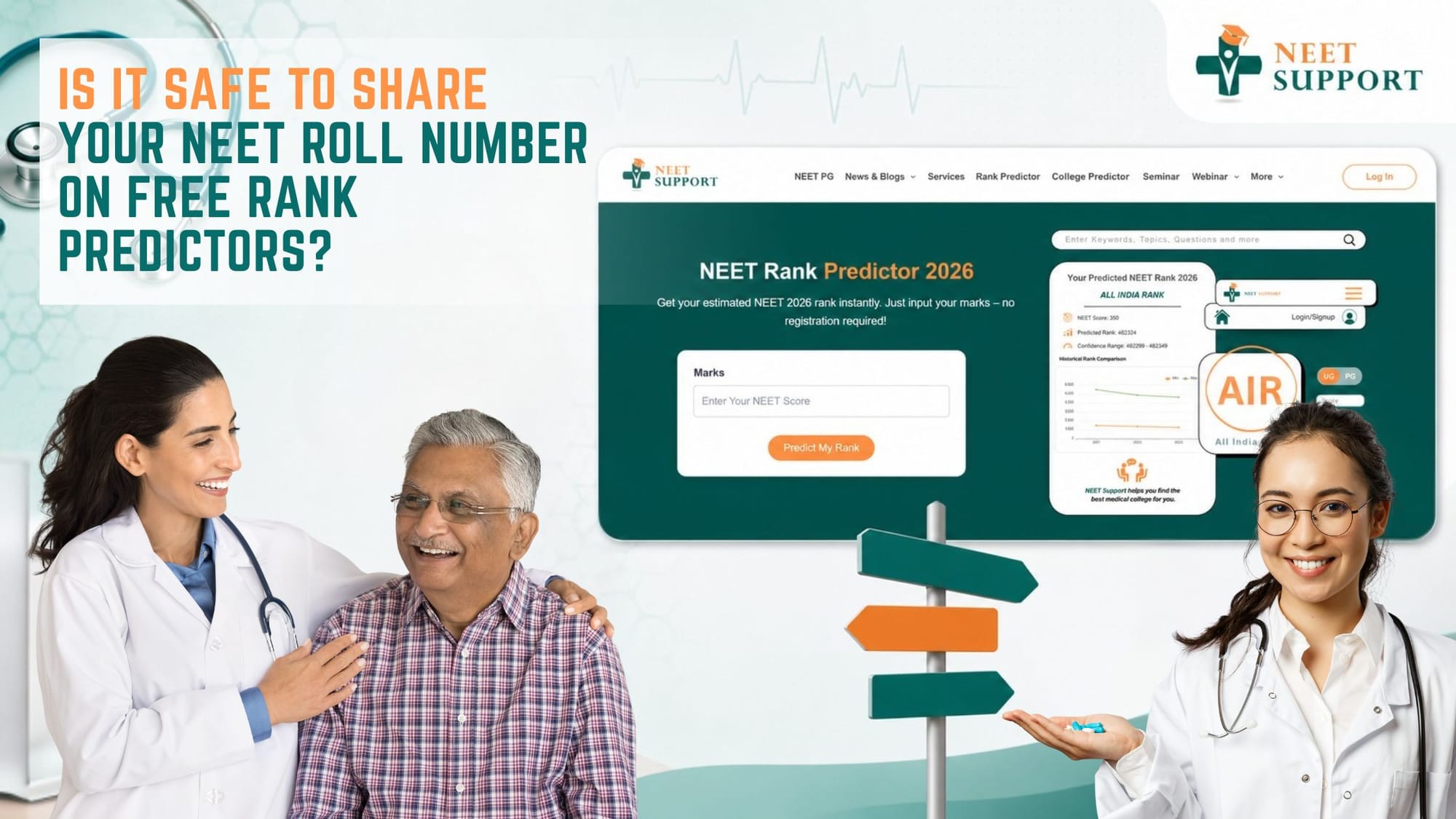
Is It Safe to Share Your NEET Roll Number on Free Rank Predictors?
RISHIKESH KUMAR
 WhatsApp
 Email
Email Facebook
 Twitter/X
 LinkedIn
Table of Contents
Predict Your Rank Now
Enter your NEET score to get an estimated rank
Find the Best Colleges For You
Based on your NEET rank, Category & more

Get Your Dream Medical College
Secure your seat with expert counselling
Overview
The time immediately after the NEET examination is particularly sensitive and stressful for medical applicants. Scholars frequently witness anxiety and expectation as they await their results and try to estimate their future prospects. During this phase, many turn to free online rank predictor tools that claim to give quick estimates of All India Rank (AIR) and possible college allotments by simply entering basic examination details.
Although these tools may feel helpful and accessible, an important concern has lately gained attention among scholars and teachers. The primary issue is whether it's safe to submit sensitive information, such as NEET roll numbers or application IDs, on unverified websites. The appeal of immediate prediction can be strong, but sharing information with third-party apps can have serious consequences, such as data misuse and theft. Thus, it becomes essential to critically evaluate the trust and security of similar platforms.
Why Do Predictors Want Your Roll Number?
To understand the risks, it is essential to ask a fundamental question: Why does a free rank predictor require your official NEET roll number or application number to estimate a rank based on your marks?
Technically, a rank predictor only needs three raw data points to calculate your rank:
Your expected or actual raw score (out of 720)
Your reservation category (General, OBC, SC, ST, EWS)
Your home state (for 85% state quota calculations)
An algorithm does not require your specific roll number to compare your scores from previous data cutoffs. When free platforms insist on collecting your roll number, application number, or date of birth before displaying your results, it is rarely for technical accuracy. Instead, it is only a data gathering mechanism and uses your roll number on their official websites.
Key Features
Not every rank predictor tool is created with false intentions; still, a significant number of free platforms are developed by various associations primarily to collect and monetise students’ data. Being suitable to know the characteristics of similar data- collection websites is important for guarding particular information and avoiding its misuse.
1. Mandatory Credential Walls
A major warning sign is when a website restricts access to predicted results unless you give sensitive details such as NEET roll number, application IDs, or upload a photo of admit cards.
2. Aggressive Cross-Platform Tracking
Some platforms force users to verify identity through mobile OTPs or Google sign-in. This process connects academic information with particular identifiers like phone numbers and e-mail accounts across platforms.
3. Masked Marketable Power
Various similar websites lack transparency regarding privacy policies, frequently missing essential sections like “About Us” or a proper policy. These are constantly temporary runners created by consultancy enterprises or marketing tricks to generate student leads.
4. Excessive Data Fields
Another index is the demand for unconnected particular details, including family income, domestic address, or budget for private medical education. Similar information is not relevant for rank prediction and is primarily used for marketable targeting.
Risks of Sharing Your NEET Roll Number
Sharing your official exam credentials on unverified, free platforms exposes you to a series of risks that can compromise both your personal peace of mind and your actual medical counselling process.
1. The Threat of Mock Counselling Fraud
The most dangerous risk involves the manipulation of the official Medical Counselling Committee (MCC) or state counselling portals. If a third party obtains your NEET roll number, application number, and guesses or acquires your date of birth, they may attempt to log into official portals during active counselling. And deliberately alter a student's choice-filling list, prioritising high-fee private colleges where they receive commissions, completely ruining the student's chances of a government seat.
2. Aggressive Marketing Spam and Tele-Harassment
Your data is highly valuable. Free rank predictors frequently sell their compiled databases to low-tier private medical colleges, overseas medical agents (promoting MBBS abroad), and coaching institutes. Within days of submitting your roll number, your phone and inbox will likely be flooded with spam marketing calls, admission offers, and high-pressure sales tactics targeting your parents.
3. Public Topper Poaching and Identity Theft
If you score exceptionally well, commercial institutes routinely scan free rank predictor databases to locate high scorers. They may use your leaked roll number to pull your official scorecard from the NTA portal once results are live. Some unethical coaching centres have used these stolen details to print a student's face and roll number in national newspapers, falsely claiming them as their own students.
How to Verify if a Predictor is Safe to Use
You do not have to avoid rank predictors entirely, but you must be highly selective about which platforms you trust with your data. A genuinely safe rank predictor will provide the following characteristics:
| Feature | Secure Platform | Risky Data-Collection Platform |
|---|---|---|
| Personal Information Requirement | Minimal details are requested. | Sensitive details are compulsory. |
| Verification Process | No unnecessary verification needed. | OTP or account login is required. |
| Result Accessibility | Results are shown immediately after entering marks. | Access is restricted until data is submitted. |
| Website Transparency | Clear company details and privacy policies are available. | Ownership and privacy information are unclear. |
| Data Usage | Information is used only for rank estimation. | User data may be collected for marketing purposes. |
| User Safety | Focuses on privacy and data protection. | May expose users to security and fraud risks. |
Using Predictors Without Risking Your Data
You can easily get the analytical insights of a rank predictor while keeping your personal information entirely secure by following this data-protection strategy:
1. Use Placeholder Information
Still, users can enter any number rather than real details if a rank predictor asks for a roll number without official verification. In various cases, the system only requires the field to be filled in order to calculate the estimated rank based on marks entered by the student.
2. Abandon High- Barrier spots sites
Students should immediately avoid websites that demand OTP verification, mobile number downloads, or admit card uploads before showing results.
3. Stick to Established Media and Educational Doors
It's safer to use rank predictors provided by trusted educational platforms or well- known academic news sources. These associations generally have a proper privacy policy and maintain advanced norms of data protection for scholars.
To know your rank from a verified and trusted user’s platform: Click here.
Frequently Asked Questions (FAQs)
1. Can someone change my official NEET counseling choices using just my roll number?
No, a roll number alone is not enough to log into the official MCC portal. However, if a malicious entity has your roll number along with your application number and date of birth (which are often collected together on free predictors), they can potentially gain access or reset your password if you have not secured your profile with a strong, unique password and two-factor authentication.
2. Is it safe to enter my actual marks and category on these websites?
Yes, sharing your raw marks, category, and state is completely safe. This data is anonymous and cannot be traced back to your actual identity or official NTA account without your roll number, name, or phone number.
3. Why do some coaching institutes ask for our admit cards before the results?
Coaching institutes collect admit cards primarily to track your performance and claim your rank in their marketing campaigns if you achieve a top score. While reputable institutes do this transparently for their enrolled students, you should never upload your admit card to anonymous online platforms.
4. What should I do if I have already shared my roll number on an unverified site?
Do not panic. Ensure that you use a completely unique, strong password when creating your profile on the official MCC and state counseling portals. Monitor your registered email and mobile phone for any unauthorized password reset requests, and avoid responding to unsolicited admission calls or messages.
5. Are there any official government rank predictors for NEET?
No, the National Testing Agency (NTA) and the Medical Counselling Committee (MCC) do not provide rank predictors. They only publish the official results and the historical opening and closing rank data (seat allotment lists) from previous counseling rounds on their official websites.
6. How can I safely predict my rank manually without online tools?
You can predict your rank manually by downloading the official opening and closing rank PDFs from the previous year's counseling rounds directly from the MCC or your state portal website. By comparing your calculated marks against the historical ranks associated with those scores, you can establish a highly accurate and entirely secure baseline.
Conclusion
A NEET roll number is more than just a set of figures; it represents a student’s academic identity and future medical career. Although free rank predictors can help to reduce stress and give an idea about possible ranks, scholars should use them precisely and wisely. Particular test credentials should only be shared on official and secure government counselling websites. While marks and scores belong to scholars, sensitive details like roll numbers and application IDs must be defended from unknown platforms. Scholars should value their data security as seriously as they value their test medication and avoid risking their privacy for quick online predictions.
Reviews
No reviews yet. Be the first to write one!