
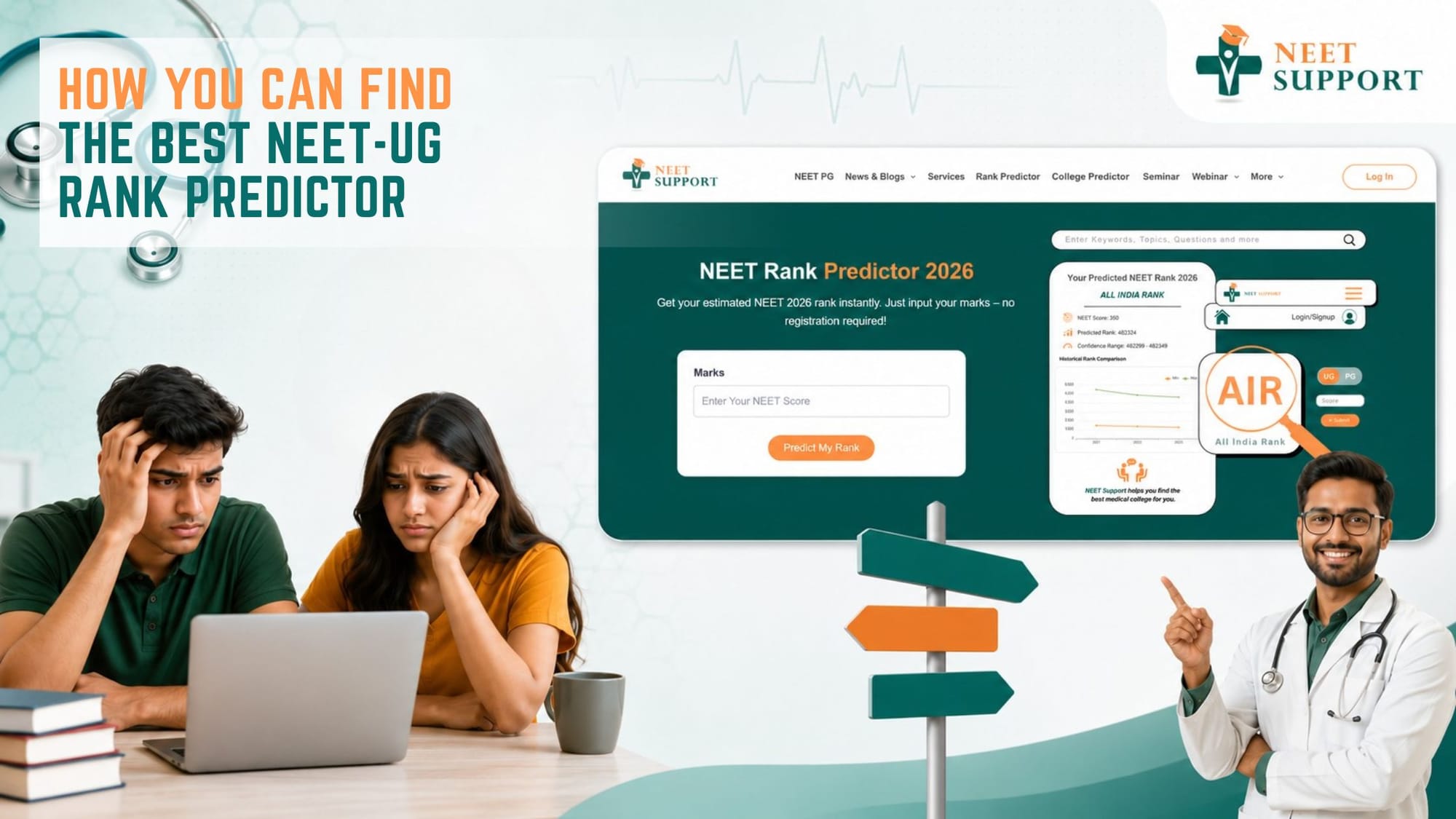
How You Can Find the Best NEET-UG Rank Predictor
Nishat
 WhatsApp
 Email
Email Facebook
 Twitter/X
 LinkedIn
Table of Contents
Predict Your Rank Now
Enter your NEET score to get an estimated rank
Find the Best Colleges For You
Based on your NEET rank, Category & more

Get Your Dream Medical College
Secure your seat with expert counselling
Introduction
Finding the best NEET UG rank predictor is important because it helps you plan your college options more realistically, but not all tools are equally reliable. A good NEET rank predictor should be transparent, data‑driven, and aligned with recent National Testing Agency (NTA) trends rather than vague guesswork.
Below is a clean version of the blog content with all external links removed, so you can paste it directly into your CMS or editing tool.
What is a NEET UG Rank Predictor?
A NEET UG rank predictor is an online tool that estimates your All India Rank (AIR) and category rank based on your expected or actual NEET score (out of 720). These tools use past‑year marks‑versus‑rank data from NTA to project where your score usually falls in terms of rank range and possible college options.
Most predictors also show:
- Your estimated percentile
- Whether you are likely to clear the NEET
- A rough idea of which colleges you may get through NEET counselling or private/management quota.
Why Choosing the Best Predictor Matters?
Different rank‑predictor tools can give you widely varying ranks for the same score, which can confuse you about your college options. The best predictors reduce this uncertainty by being:
- Based on official NTA data (marks‑rank lists from previous years)
- Frequently updated for the latest NEET cycle (for example, using the latest available NEET data)
- Transparent about how they calculate the rank range.
Using a weak or outdated predictor can lead to over‑optimism or unnecessary stress, so selecting the right one is crucial for realistic counselling planning.
7 Ways to Identify the Best NEET UG Rank Predictor
1. Check the Data Source and Freshness
Look for tools that clearly mention they use NTA‑published official marks‑rank data from recent NEET UG cycles. Avoid predictors that do not state which year’s data they use or that rely only on generic formulas or “expert opinions.”
A strong clue is when the description explains that ranks are derived from historical rank ranges for each mark score.
2. Prefer Tools That Show A Rank Range, Not A Single Rank
The best predictors display an estimated rank range (for example, “AIR 5,000–7,500”) rather than a single exact rank. This reflects natural variation in cut‑offs and competition year‑to‑year and gives you a more realistic picture.
If a tool shows only one fixed rank without any range or disclaimer, treat it as less reliable.
3. Verify If It Asks for the Category and State
Since NEET counselling uses category (General, OBC, SC, ST, EWS, etc.) and state quotas, the best predictors let you select:
- Your category
- Your home state
This helps you see both your All India Rank and your state‑wise or category‑wise rank possibilities. If the tool does not ask for a category or state, it cannot give you a complete counselling‑oriented estimate.
4. Look for Percentile, Qualification Status, and College Hints
High‑quality NEET rank predictors usually bundle extra insights such as:
- Your predicted percentile
- Whether you are likely to qualify for NEET UG
- A rough list of possible MBBS/BDS colleges or admission chances (including private and abroad options)
This turns the predictor into a planning tool, not just a number‑cruncher.
5. Compare with Multiple Trusted Predictors
To spot inconsistencies, cross‑check your score on two or three reputed predictors from well‑known coaching institutes or education portals.
If several trustworthy tools give you roughly similar rank ranges, your estimate is more likely to be realistic. Large differences may indicate that one tool is outdated or uses weak assumptions.
6. Check for Transparency and Explanation
The best predictors explain how they work in simple language. For example:
- They mention that ranks are derived from previous years’ marks‑rank data
- They clarify that the result is only an estimate, not the official NTA rank
- They may show a brief example or screenshot of how to use the tool
Avoid tools that hide their methodology behind vague “AI” or “algorithm” labels without any clear explanation.
7. Prefer Well‑Known Education Portals and Coaching Brands
Many leading coaching institutes and education portals run NEET rank‑predictor tools that are updated regularly and linked to their broader counselling content. These platforms usually invest in:
- Updated data tables
- User‑friendly interfaces
- Follow‑up features like college prediction, cutoff insights, and counselling guidance
How to use a NEET UG Rank Predictor Step by Step?
- Calculate Your Expected NEET Marks
Use your NEET answer‑key analysis or self‑calculation to get a total score out of 720. - Open 2–3 Reputable Rank Predictors
Visit well‑known education or coaching sites that publish NEET‑specific rank predictors. - Enter Your Details
- Input your total marks (and sometimes subject‑wise marks)
- Select your category and state
- Choose the correct exam year (for example, NEET 2026)
- Read the Result Carefully
- Note your estimated rank range and percentile
- Check if the tool indicates qualification status and college chances
- Repeat the same inputs on another trusted predictor and compare the rank ranges
- Use Ranks As A Planning Guideline, Not A Guarantee
Remember that the predictor cannot control future competition, reservation changes, or NTA discretion. Use the rank to shortlist colleges, think about backup options, and prepare mentally for counselling rather than treating it as your final rank.
Common Mistakes to Avoid When Using Rank Predictors
- Relying on a single tool without cross‑checking – one faulty predictor can mislead your expectations.
- Ignoring category and state filters – this gives you only an incomplete, All‑India‑only view that may not match your actual counselling scenario.
- Treating the predicted rank as official – only NTA‑published ranks are final; predictors are for planning only.
To know What is NEET Rank Predictor - Read
FAQs
How accurate are NEET rank predictors?
NEET rank predictors are usually reasonably accurate when they use the latest NTA data and provide rank ranges. But they cannot guarantee an exact rank because competition changes every year. Factors like number of candidates, paper difficulty, and cut-offs affect the final AIR. So, they should be used as guidance, not as official results.
Can a rank predictor tell me whether I will qualify NEET or not?
Many rank predictors show a qualification status based on expected percentile. If your score falls above the expected cut-off range, it may show “Qualified.” But final qualification depends on NTA’s official cut-off announcement. So, the tool gives only a probability-based result, not a confirmed decision.
Is it safe to trust rank predictors for counselling planning?
Yes, rank predictors are useful for early planning and shortlisting colleges. They help you estimate whether you are closer to government, private, or semi-government options. But you should always cross-check results with multiple tools. Final counselling decisions must be based on official NEET rank and counselling cut-offs.
What are the biggest mistakes students make while using NEET rank predictors?
The most common mistake is relying on only one predictor and treating it as final. Many students also ignore category and state filters, which leads to misleading results. Another major mistake is expecting an exact rank instead of understanding rank ranges. Predictors are meant for planning, not for final conclusions.
Can NEET rank predictors help in college prediction too?
Yes, many advanced predictors provide a list of possible MBBS/BDS colleges based on your expected rank. Some also show private, management quota, and abroad options. This feature helps students shortlist realistic choices early. Still, final allotment depends on official counselling cut-offs and seat availability.
How should I use a NEET rank predictor correctly?
First, calculate your expected marks using answer keys or self-evaluation. Then enter the marks, category, and state in a reliable rank predictor tool. Check the rank range and percentile carefully instead of focusing on a single number. Finally, repeat the process on 2–3 predictors and compare the results.
Why is category important in a rank predictor?
Category matters because NEET counselling happens through reservation-based seat distribution. General, OBC, SC, ST, and EWS candidates have different cut-offs and rank eligibility. A good predictor gives you category rank along with AIR. Without category input, the prediction becomes incomplete and less useful for counselling.
Conclusion
The best NEET UG rank predictor is not the flashiest or most heavily advertised tool, but the one that is transparent, data‑driven, and updated for the latest NEET cycle. By checking the data source, comparing multiple trusted predictors, and using the estimated rank range as a planning guide rather than a final result, NEET aspirants can align their expectations with realistic college and counselling options. A smartly chosen rank predictor becomes a powerful planning aid—helping you shortlist institutes, evaluate backup choices, and stay emotionally prepared for whatever AIR you finally receive.
Also Read - How To Handle Inaccuracies in NEET-UG Rank Predictors
Reviews
No reviews yet. Be the first to write one!