
 WhatsApp
 Email
Email Facebook
 Twitter/X
 LinkedIn
Table of Contents
Predict Your Rank Now
Enter your NEET score to get an estimated rank
Find the Best Colleges For You
Based on your NEET rank, Category & more

Get Your Dream Medical College
Secure your seat with expert counselling
Overview
Preparing for competitive entrance examinations similar as common Entrance Examination, National Eligibility cum Entrance Test (NEET), and MHT- CET is only the first stage of the admission process. After the declaration of results, scholars must fill out the form for counselling and choice filling, which frequently becomes a stressful and confusing experience. Based on their rank or percentile, candidates need to decide which college or institution they're likely to secure during admissions.
The process becomes hectic because scholars are needed to examine a large amount of cut-off data from previous years. Manually reviewing opening and closing ranks for different colleges, categories, and proportions can consume considerable time and may lead to confusion or incorrect opinions. Various scholars struggle to identify realistic options that match their academic performance and preferences.
In similar situations, a College Predictor Tool serves as an effective result. These tools use previous admission data and algorithmic analysis to give scholars a list of possible colleges and courses. When used wisely, they help candidates compare options, understand admission possibilities, and prepare a balanced and well- planned choice- filling strategy for the counselling process.
What is a College Predictor?
At its core, a College Predictor is a software application or digital engine that matches a student’s entrance exam performance (marks, percentile, or rank) against official past admission statistics from regulatory counselling bodies like JoSAA, the Medical Counselling Committee (MCC), or state-level DTE cells.
Instead of requiring students to analyse the data of previous years by themselves, the predictor instantly provides you with thousands of institutional records.
The Input-Output Dynamic
To get the most out of a college predictor, you have to feed it the right data. A standard advanced system relies on a clear dynamic:
[ Your Profile Input] ───► [ Algorithmic Matching] ───► [ Strategic Output]
• Percentile / Rank • Scans Past Cutoffs • Reach Campuses
• Category & Gender • Applies Home State Quota • Safe-Bet Campuses
• Domicile State • Factors Seat Capacity • Safe Fallbacks
Key Highlights of Using a Predictor Tool Properly
When you approach a college predictor strategically, it provides several distinct advantages over manual searching:
Eliminates Guesswork: A College Predictor Tool helps scholars make informed admission opinions using previous year results and cutoff information. Instead of depending on rumours, online conversations, or outdated sources, scholars admit recommendations grounded on official institutional records and Right to Information (RTI) data. This makes the admission process more accurate and secure.
Save time: The tool also reduces the time and trouble needed to examine admission trends. Before, scholars had to manually compare cutoff lists and prepare spreadsheets from multiple sources. With automated analysis, the same process can now be completed quickly and in an organised manner.
Hidden quotas: In addition, the predictor identifies reservation programs and share systems that scholars may overlook, including female reserved seats and state- based categories.
Prevents choice-filling mistakes: By dividing colleges into top, moderate, and safe options, it helps scholars avoid miscalculations during choice filling and improves their chances of securing admission successfully.
How to Use a College Predictor Like a Pro
1. Collect Academic Credentials
To begin with, scholars should gather all essential academic information before using a College Predictor Tool. This includes category-wise rank, Common Rank List (CRL) or All India Rank, Domicile of the particular state, and reservation category similar to OBC-NCL, EWS, ST, PwD, or defence quota. Accurate data is necessary for near-accurate predictions.
2. Prepare Accurate Profile Information
After collecting details, scholars must ensure that their profile information is correct and complete. Even small errors in rank, category, or state can affect the final prediction and lead to false results.
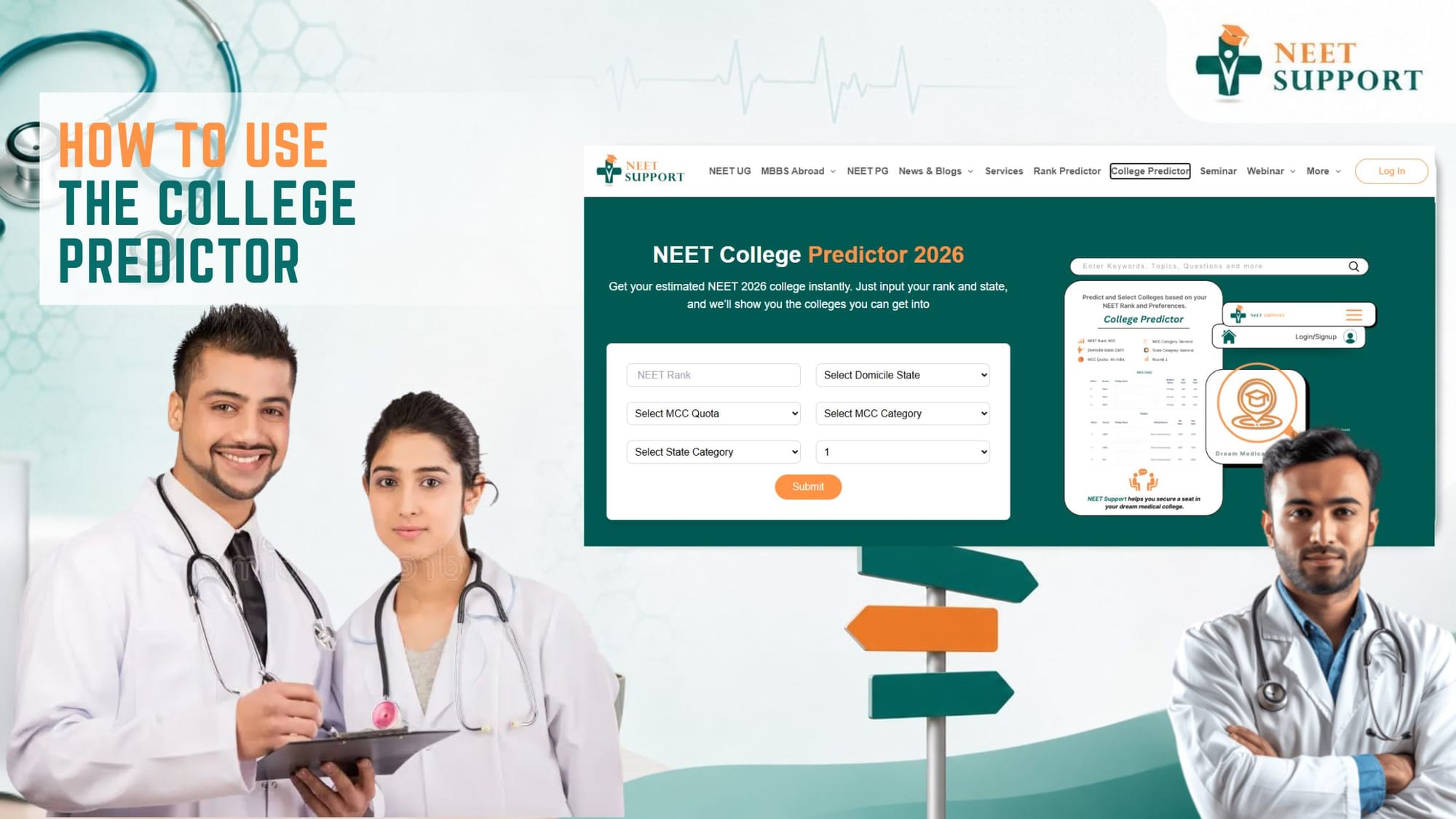
3. Enter Data into the Predictor
Next, scholars should access a trusted predictor platform and input their academic details precisely. This step forms the base of the analysis, as the tool processes all inputs to generate college predictions.
For trusted prediction from a renowned predictor: Click here
4. Consider Home- State Advantage
While entering details, opting for the correct domicile state is important. Various institutions allocate a significant portion of seats to home- state candidates, which can positively impact cutoff ranges and admission chances.
5. Interpret Prediction Categories
After processing, the tool classifies colleges into different probability groups, such as top colleges, moderate colleges, and safe options. These orders help scholars understand where they have low, medium, or high chances of admission.
6. Finalise Choice Filling Strategy
Eventually, scholars should upgrade the list using filters similar to preferred branches, cities, or institution types like central-governed or state-governed colleges. The final result should guide choice filling on official counselling portals, similar as common Seat Allocation Authority and Medical Counselling Committee to give a well- structured admission preference list.
The Perfect Choice-Filling Guide
When organising your preferences online, use a top-down structural pyramid based on your predictor's feedback.
| Tier Placement | Predictor Category Type | Strategic Goal |
|---|---|---|
| Top Tier (Options 1–10) | Reach / Dream Colleges | Prestigious college, highly preferred choices. If cutoffs drop unexpectedly due to a tough paper or seat expansion, you stand to benefit. |
| Middle Tier (Options 11–30) | Moderate / Safe-Bets | Your primary realistic targets. This forms the solid core of your strategy where you are highly competitive. |
| Bottom Tier (Options 31+) | Safe / Fallbacks | Insurance options. These guarantee you secure a respectable seat in the initial rounds, preventing you from ending up empty-handed. |
Frequently Asked Questions (FAQs)
Q1: What is the difference between a Rank Predictor and a College Predictor?
A Rank Predictor takes your raw exam marks or immediate exam percentile and guesses your final All India Position based on past normalization formulas. A College Predictor takes that final rank and cross-references it with specific college seat matrices to reveal which campuses will accept that rank.
Q2: Why is my Home State choice showing a different cutoff than the All India tier?
Many national and state-funded institutes have distinct regional policies. For example, NITs split their seat allocation 50-50 between local state residents (Home State quota) and out-of-state applicants. The closing ranks for local residents are typically much more relaxed, allowing you to get better branches at a lower rank.
Q3: Can a college predictor guarantee my final admission?
Absolutely not. No digital tool can guarantee an admission spot because they cannot predict real-time student psychology. If a particular branch suddenly becomes a massive trend this season, or if a large cluster of top-ranking students choose a single campus, live cutoffs will fluctuate away from historical data. Treat predictors as a highly accurate compass, not a final guarantee.
Q4: Should I trust a predictor that doesn't ask for my category details?
No. In competitive admissions frameworks, a category status (General, OBC-NCL, SC, ST, EWS) completely dictates your cutoff tier. A general rank of 10,000 maps to vastly different choices than an OBC or SC rank of 10,000. Any tool that fails to capture your category details is providing a broad, generic calculation that could mislead you.
Q5: How often are these predictor tools updated?
Premium tools update their underlying data models annually. They ingest the finalized official closing rank datasets right after the conclusion of the previous year's spot rounds and adjust their mathematical weights if an institute introduces fresh seat capacities or launches entirely new academic branches.
Q6: Is it worth paying for a premium college predictor account?
Basic predictions (viewing basic historical matches) should always be accessible for free on reputable portals. However, paying for a premium tier can be highly beneficial if it grants you live access to interactive counseling webinars, side-by-side branch placement data comparisons, or personalized human mentor support during complex choice-filling rounds.
Conclusion
A College Predictor Tool helps scholars resolve the query after examinations through a more systematised, data- grounded approach for admission planning. By entering accurate academic details and aligning results with career goals, scholars can fill their choices using a methodical “top, moderate, and safe” format. This reduces emotional decision- making errors and supports a more logical preference list during counselling. The use of previous admission data further improves clarity and helps scholars make informed selections grounded in realistic possibilities. Overall, it enables better planning and confidence while sharing in official counselling processes.
Reviews
No reviews yet. Be the first to write one!