
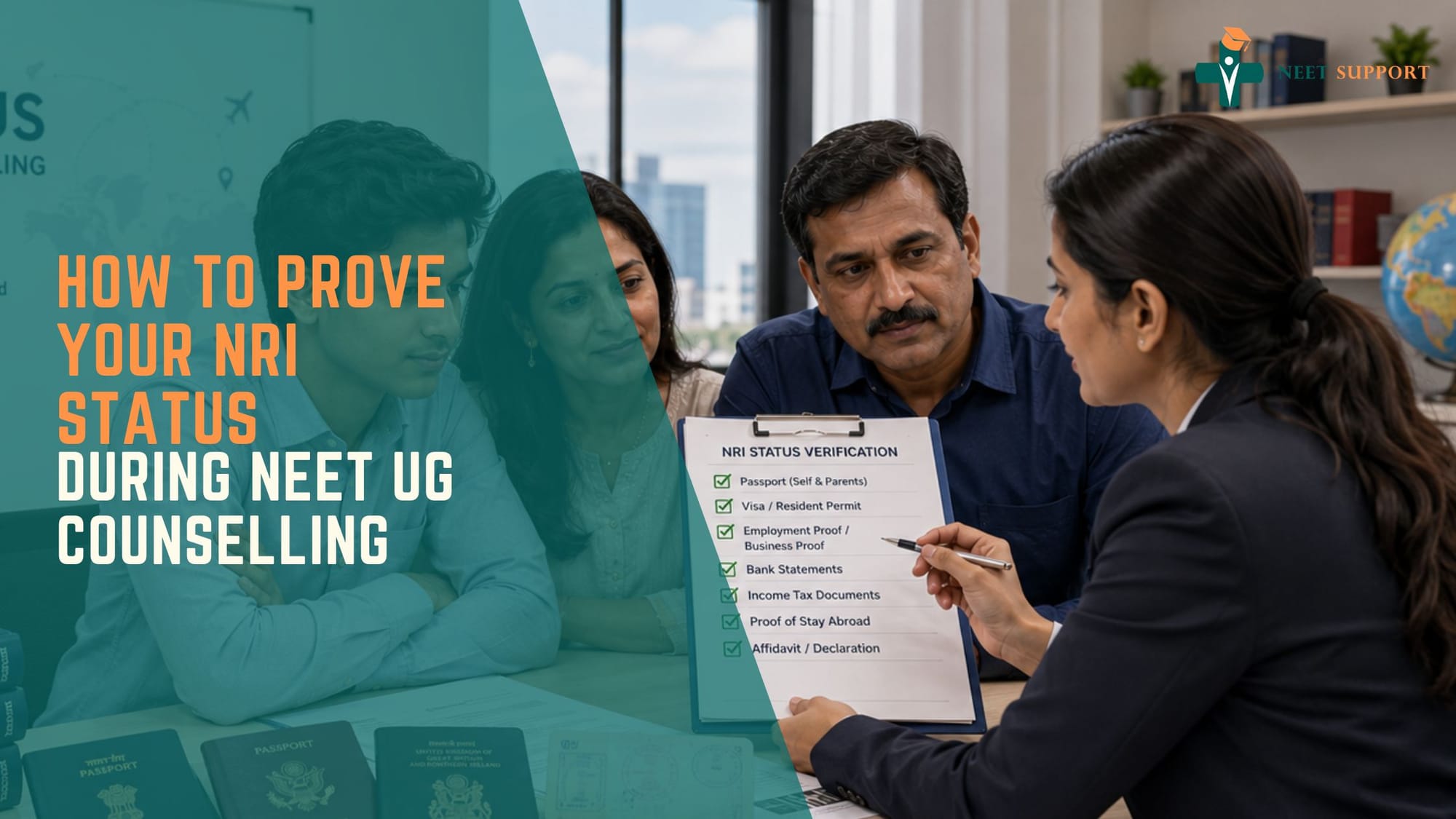
How To Prove Your NRI Status During NRI NEET UG Counselling
Nishat
 WhatsApp
 Email
Email Facebook
 Twitter/X
 LinkedIn
Table of Contents
Predict Your Rank Now
Enter your NEET score to get an estimated rank
Find the Best Colleges For You
Based on your NEET rank, Category & more

Get Your Dream Medical College
Secure your seat with expert counselling
Introduction
You know that feeling when someone asks you to "just prove it," and suddenly the thing you've known to be true your whole life feels weirdly hard to actually demonstrate on paper? That's pretty much what a lot of NRI families go through the first time they sit down to figure out how to prove their NRI status for counselling. You know you're an NRI family. You've lived it. But an admissions office doesn't run on lived experience — it runs on stamped, attested, government-issued paper. And that gap between "obviously true" and "officially provable" is exactly where this article lives.
So let's talk it through, honestly and simply — not as a dry checklist, but as an actual walk-through of what "proving" your NRI status really means, why it's stricter than it used to be, and how to get it right the first time instead of finding out the hard way during document verification.
Why This Even Needs Proving In The First Place
Here's the honest context: the NRI quota is a genuinely good thing for families who qualify, but it's also been quietly misused over the years by candidates who stretched or invented an overseas connection just to dodge the tougher general merit cutoff. Because of that, the people running counselling — MCC, the state authorities — have gotten a lot more careful about what actually counts as proof. It's not personal, and it's not about doubting your family specifically. It's the system protecting itself from the small number of people who've made it necessary.
Which means the burden really is on you to show, cleanly and officially, that your NRI connection is real. Let's get into how.
The One Document That Matters More Than Any Other
If you remember only one thing from this whole article, let it be this: the NRI Certificate — sometimes called the Embassy Certificate — is your single most important piece of proof, full stop. It has to come from the Indian Embassy or Consulate in the country where the NRI, whether that's you or your sponsoring parent, actually lives. Not a notary. Not a local lawyer. Not a chartered accountant back in India who's happy to stamp something for you. MCC has been explicit about this — certificates that don't come directly from an embassy or consulate get rejected at the very first stage of verification, no exceptions made for how convincing the alternative document looks.
Why does it carry so much weight? Because it's the one piece of paper that comes from an actual government authority confirming, in writing, that yes — this person genuinely lives and works abroad, genuinely holds the status they're claiming. Everything else in your document folder supports this certificate; nothing really replaces it.
What Actually Goes Into Getting One
Getting this certificate isn't complicated, but it does take real time, so let's walk through it honestly. You (or your sponsoring parent) apply at the nearest Indian Embassy or Consulate, submitting a passport copy, proof of your visa or residence status abroad, some form of employment or business documentation, and a filled-in declaration form specific to that mission's process. Once issued, this certificate is generally treated as valid for around a year, which matters — if your family went through this process eighteen months ago for a previous attempt, it's probably time to renew it, not reuse it.
Here's the part that trips people up: consulate appointment slots and processing times vary hugely depending on where you live. Some cities turn this around in a couple of weeks. Others have genuine backlogs stretching well past a month. You don't control that timeline, which is exactly why this should be the very first thing you tackle, not something squeezed in after NEET results are out and counselling is already ticking.
If You're Applying As A Sponsored Candidate, The Rules Have Tightened
This bit is genuinely important, and it's changed more recently than a lot of older blog posts online will tell you. It used to be fairly common for a distant or even informal relative to write a "sponsorship letter" — basically a note saying "I'll support this child's education" — and have that count as proof enough. That's no longer good enough. MCC's own guidelines now make clear that self-written sponsorship letters aren't accepted on their own; what's needed is a candidate's own self-attested declaration confirming they're an NRI, OCI, PIO, or the child of NRI parents, backed directly by the NRI Embassy Certificate of the parent or candidate.
And if the person supporting the application isn't a parent — say, a grandparent, an uncle, or an aunt — there's an even more specific bar to clear. According to MCC's own published guidance, simply showing that a relative has "looked after" the student in some informal way isn't enough to establish them as a qualifying guardian. An actual affidavit to that effect has to be produced before the Indian Mission itself — not just notarized locally, but formally presented and accepted at the embassy or consulate level. That's a meaningfully higher bar than a quick notarized letter, and it's exactly the kind of detail families miss if they're working off older advice or outdated blog posts.
The Supporting Cast: Other Documents That Back Up Your Claim
Once your NRI Certificate is in hand, a few other pieces round out your proof:
Your (or your sponsor's) valid passport, with a visa page that's actually current — not expired, not about to expire mid-counselling. If you or your sponsor holds an OCI card instead of active NRI status, that comes with its own consulate-issued certificate confirming the OCI status and quoting the card number, following a broadly similar process to the standard NRI certificate.
A notarized affidavit — properly worded, properly attested — establishing the relationship between candidate and sponsor if they're not the same person, and confirming financial responsibility for the candidate's education. And if it applies to your situation, whatever legal guardianship documentation is needed for a non-parent sponsor, which, as covered above, now needs that embassy-level affidavit specifically.
Depending on your state or college, you might also be asked for proof the sponsor can actually afford what they're committing to — bank statements, an employment letter, something showing real financial capability behind the promise.
A Few Honest Things People Get Wrong
Let's be real about where this usually goes sideways, because knowing the failure points is half the battle.
People wait too long. This has to be said again because it's genuinely the number one cause of last-minute panic — the embassy certificate takes real time, and starting it "closer to counselling season" instead of the moment you decide to go this route is the single most avoidable mistake on this whole list.
People assume any relative counts. They don't, not automatically, and definitely not without the right paperwork behind them now that the rules have tightened around non-parent sponsors.
People submit a locally notarized document and think that's the same as an embassy certificate. It isn't, and MCC has been clear that these get bounced at the first check.
People let their certificate go stale. If it's from a previous, unsuccessful counselling attempt and it's been sitting around for over a year, it's probably not going to pass muster this time around — refresh it rather than reuse it.
A Simple Way To Think About This
Honestly, the whole process gets a lot less intimidating if you think of it less like "proving" something and more like "documenting" something you already know to be true. You're not trying to convince anyone of a stretch — you're just building the paper trail that makes an already-true fact officially recognizable. Start with the embassy certificate, because everything else genuinely hangs off it. Get your relationship and guardianship paperwork sorted early if it applies to you, especially if your sponsor isn't a parent. Keep everything current, not just accurate. And when in doubt about a specific document's format or requirement, check directly with the embassy or your target counselling authority rather than trusting a random forum thread — rules here have shifted meaningfully in the last couple of years, and not every source online has caught up.
FAQs
What is the single most important document to prove NRI status?
The NRI Certificate, also called the Embassy Certificate, issued directly by the Indian Embassy or Consulate in the country where the NRI resides. It's the foundation everything else builds on.
Can a local notary or lawyer abroad issue an NRI certificate instead?
No, MCC only accepts certificates issued directly by the Indian Embassy or Consulate. Documents from local notaries, lawyers, or accountants are rejected at the first verification stage.
How long is an NRI certificate valid for?
Generally around one year, so a certificate from a previous, unsuccessful counselling attempt usually needs to be renewed rather than reused.
Are informal sponsorship letters still accepted?
No, according to current MCC guidelines, self-written sponsorship letters alone are no longer sufficient. Candidates need a self-attested declaration backed by an actual Embassy Certificate.
What's required if my sponsor isn't a parent?
Beyond standard relationship proof, an affidavit specifically establishing legal guardianship needs to be produced before the Indian Mission itself, not just notarized locally.
How do OCI cardholders prove their status instead of an NRI certificate?
They submit their valid OCI card along with a certificate from the Indian Consulate confirming that status and quoting the OCI card number, through a process similar to the standard NRI certificate.
Do I need my sponsor's financial documents as well?
Depending on the state or college, yes, some counselling authorities ask for bank statements or employment proof confirming the sponsor's financial capability to support the candidate's education.
What happens if my documents don't meet the required format?
Non-embassy or improperly attested documents are typically rejected during verification, which can delay or jeopardize an otherwise valid NRI quota application.
Final Thoughts
Proving your NRI status isn't really about jumping through hoops for the sake of it — it's the one part of NRI NEET UG Counselling that exists specifically to protect the seats for families like yours, the ones with a genuine connection behind their application. It takes patience, it takes starting early, and honestly, it takes reading the fine print a little more carefully than most people bother to. But none of it is genuinely hard once you know exactly what's being asked for and why.
Get the embassy certificate moving first, build everything else around it, and keep it all current rather than assuming last year's paperwork still holds. Do that, and you'll walk into document verification with a folder that doesn't just look complete — it actually is.
Disclaimer: Documentation requirements for proving NRI status can vary by state, college, and academic year, and are subject to updates by MCC, NMC, or individual counselling authorities. Always verify the latest official requirements on mcc.nic.in or your target state's counselling portal before applying.
Reviews
No reviews yet. Be the first to write one!