
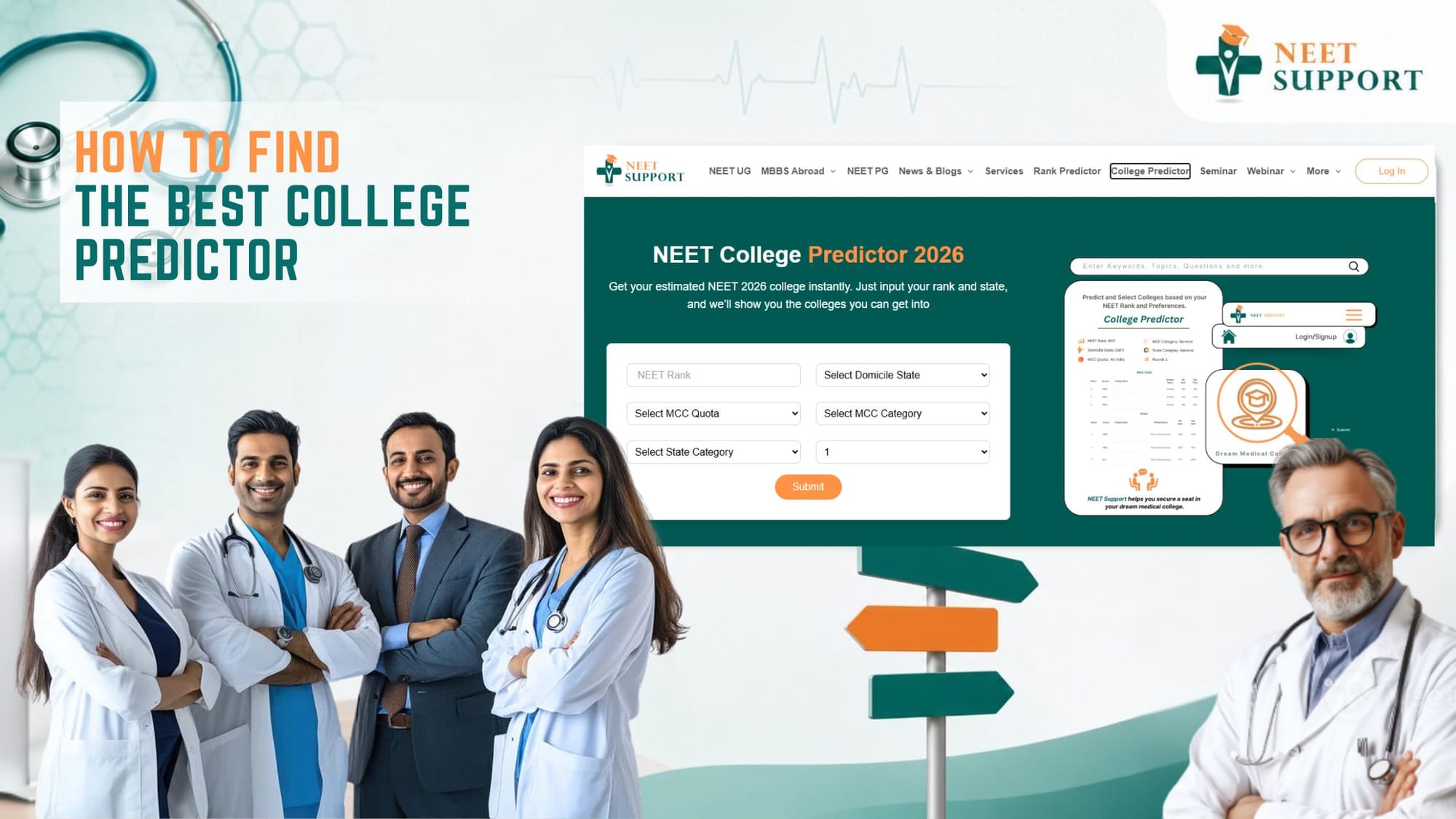
How to Find the Best College Predictor
RISHIKESH KUMAR
 WhatsApp
 Email
Email Facebook
 Twitter/X
 LinkedIn
Table of Contents
Predict Your Rank Now
Enter your NEET score to get an estimated rank
Find the Best Colleges For You
Based on your NEET rank, Category & more

Get Your Dream Medical College
Secure your seat with expert counselling
Overview
Each time, a vast number of scholars appear for competitive entrance examinations similar to JEE, NEET, CAT, and CUET. Once the examination process ends, candidates frequently enter a stressful phase of query and begin wondering which institutions they may really get into with their scores. Earlier, this process needed scholars to manually search through past times cutoff lists, admission reports, and ranks, which was both time-consuming and confusing. In recent times, technological advancements in education have simplified this task through the College predictor tools.
These digital platforms estimate the colleges and courses a student may be admitted to based on examination scores, ranks, categories, and admission trends. Nonetheless, the growing number of predictor websites has made it difficult to determine which platforms give reliable and accurate guidance. An unreliable predictor may create unnecessary overconfidence or discourage students from applying to institutions where they may actually have a strong chance of admission.
Thus, understanding how to assess and effectively use secure college predictor tools is essential for making informed and confident opinions during the admission and counselling process.
What is a College Predictor?
At its core, a College Predictor is a software application or digital engine that matches a student’s entrance exam performance (marks, percentile, or rank) against official past admission statistics from regulatory counseling bodies like JoSAA, the Medical Counselling Committee (MCC), or state-level DTE cells.
Instead of requiring students to analyse the data of previous years by themselves, the predictor instantly provides you with thousands of institutional records.
Rank Predictor vs. College Predictor: The Vital Difference
Many students confuse these two tools, but they serve entirely distinct purposes in your planning phase:
Rank Predictor: This is the tool students use to predict their All-India Rank (AIR).
College Predictor: This is the tool you use next. With the help of your marks and rank, it will estimate the chances of getting admission in college, which will directly help you in the counselling period.
To know more about this: Click here.
Key Highlights of a Top-Tier College Predictor
While opting for a reliable platform, scholars should avoid depending on simple databases that only give limited information. Advanced college predictor tools are designed with advanced technologies that improve accuracy and give better admission guidance. The following features should be precisely estimated before choosing a tool.
Machine Learning Integration
Advanced predictor tools use technologies similar to XGBoost and neural network models to study past admission data and identify complex patterns. This helps in generating more accurate estimates for scholars from different categories and reservation groups.
Detailed Seat Analysis
A good predictor should give information about seat vacancy in reputed institutions, including IITs, NITs, AIIMS, state universities, and private colleges. It must easily display the admission possibilities across different colleges and courses.
Quota-based Prediction
The platform should directly distinguish between various admission procedures, such as Home State and Other State proportions or All India and State share seats, to improve trust in the predicted result.
Regional Preference Support
Some advanced tools also consider factors like the distance between a student’s domicile and the institution to recommend practical and accessible college options.
How Advanced Predictors Work Behind the Scenes
To get the most out of a college predictor, you have to feed it the right data. A standard advanced system relies on a clear dynamic:
[ Your Profile Input] ───► [ Algorithmic Matching] ───► [ Strategic Output]
• Percentile / Rank • Scans Past Cutoffs • Reach Campuses
• Category & Gender • Applies Home State Quota • Safe-Bet Campuses
• Domicile State • Factors Seat Capacity • Safe Fallbacks
How to Spot an Unreliable Predictor
Not every college predictor platform offers dependable or accurate guidance. Scholars should precisely examine a tool before depending on its predictions for admission guidance.
1. Immediate Payment Requests or Mandatory Registration
A genuine educational platform generally allows users to access basic prediction services without forcing them to pay or create an account immediately. Tools that hide important information behind mandatory payment systems or inordinate promotional forms should be handled with care.
2. Ignoring State and Quota Details
Admission cutoffs frequently differ significantly based on proportions and domicile rules. For example, scholars applying under the Home State quota may admit a lower ending rank compared to candidates from other countries. Thus, a predictor that only asks for rank and category without collecting state-related information cannot give reliable results.
3. Use of Old Admission Data
Admission trends change every time due to variations in seat vacancy, new institutions, and arising courses similar as Artificial Intelligence and Data Science. A predictor based on outdated records may give wrong/false recommendations and reduce the chances of prediction.
4. Simplified Percentile-to-Rank Conversion
Numerous scholars get similar percentile scores in national-level examinations, making factual rank a more accurate factor for predictions. Platforms using fixed percentile charts without detailed rank analysis may generate incorrect admission possibilities.
5. Unrealistic Accuracy Claims
No college predictor can guarantee complete admission certainty. Platforms promising “100 accurate” or guaranteed allotments may mislead scholars, as admission issues depend on changing competition situations and comforting trends.
Step-by-Step Guide to Evaluating and Choosing the Best Platform
To find the absolute best tool for your target exam, implement this systematic evaluation strategy:
Step 1: Verify the Data Sources
Check the tool’s documentation or "About" section. A dependable tool explicitly states that its predictions are built directly from official counseling authorities, such as JoSAA, the Medical Counselling Committee (MCC), or respective state bodies.
Step 2: Test with Reference Data
Before relying on a tool for your own future, perform a calibration check. Input a known rank from a sibling or friend from a prior year. Cross-verify if the tool's generated "Safe" and "Possible" outputs align accurately with the actual college that the individual secured.
Step 3: Assess the Filter Depth
A premium platform allows you to slice and dice your data. You should be able to actively filter results by specific course branches, annual tuition fee brackets, campus locations, and institutional rankings (such as NIRF status).
Step 4: Prioritize Clean, Ad-Free Interfaces
When organizing your future, the last thing you need is a barrage of pop-ups obscuring your data view. The best tools offer fast, mobile-responsive interfaces with options to export your customized college list as a clean PDF for easy review during final choice filling.
Frequently Asked Questions (FAQs)
Q1: Are college predictor tools completely accurate?
No tool can claim absolute precision. College predictors generate smart mathematical estimates based on historical patterns, past cutoffs, and established seat matrices. While they are highly accurate for general planning, the final allocation depends entirely on live choices made by your peers during official counseling.
Q2: Why do different predictor tools show different college options for the same rank?
This variance occurs because different platforms utilize distinct algorithmic models. Basic tools simply show a mirror image of the previous year's cutoffs. Advanced tools weigh historical data across multiple consecutive years, adjust for new seats, and apply predictive algorithms to anticipate shifting student preferences.
Q3: Should I trust a predictor tool that only asks for my marks instead of my rank?
You can use a marks-based predictor for a rough early estimate right after your exam. However, because exam difficulty changes every year, the correlation between marks and ranks shifts significantly. For definitive counseling strategy, always prioritize tools that utilize your projected or official All India Rank.
Q4: Do these tools factor in state quotas and gender-specific reservations?
The top-tier, industry-standard predictors absolutely do. They include comprehensive filters for Home State quotas, regional categories, and female-only seat pools. If a tool lacks these specific options, treat its output as a generic, broad estimate rather than a personalized plan.
Q5: Is it safe to share my entrance exam registration details on these websites?
You should exercise caution. Reputable, high-quality predictor tools generally allow you to input your rank, category, and state anonymously without forcing you to upload official admit cards or sensitive roll numbers. Avoid sharing confidential credentials on unverified, ad-heavy platforms.
Q6: When is the ideal time to start using a college predictor tool?
The ideal window opens immediately after your unofficial answer keys are released. You can use a rank predictor to estimate your position, then transition to a college predictor to draft a preliminary shortlist of 20 to 30 target institutions. This gives you a massive head start before live choice filling begins.
Conclusion
A college predictor tool plays an important role in simplifying the complex admission process by converting large amounts of counseling data into clear and organized guidance. By selecting reliable platforms that use authentic counseling records, quota-based analysis, and previous admission trends, students can reduce confusion and save considerable time and effort. However, these tools should be considered supportive resources rather than absolute guarantees of admission. Students should use the predicted college lists to create balanced and practical choice-filling strategies while also monitoring current counseling updates and cutoff changes. With proper use, college predictor tools can help students make informed academic decisions and approach the admission process with greater confidence and clarity.
Reviews
No reviews yet. Be the first to write one!