How Open States Differ From Closed States in Private College Admissions: A Complete UG Counselling Guide
Nishat
 WhatsApp
 Email
 Facebook
 Twitter/X
 LinkedIn
Table of Contents
Predict Your Rank Now
Enter your NEET score to get an estimated rank
Find the Best Colleges For You
Based on your NEET rank, Category & more

Get Your Dream Medical College
Secure your seat with expert counselling
Introduction
One of the most underused strategies in UG counselling is also one of the least understood: applying to a private medical college seat in a state you've never lived in. Most students assume MBBS admission is strictly tied to "your own state" — but for private colleges specifically, that's only true in some states. In others, any NEET-qualified candidate from anywhere in India can walk in and compete, no domicile certificate required. Understanding this distinction — between "Open States" and "Closed States" — can genuinely open up seats you didn't know you were eligible for.
First, Separate Three Completely Different Things
Before getting into the open/closed classification, it's important to understand that Indian MBBS admission actually runs on three distinct layers, and the open/closed question only applies to one of them:
- 15% All India Quota (AIQ) seats: open to every NEET-qualified candidate in the country, filled centrally by MCC, regardless of domicile — this is always open, in every state, with no exceptions.
- 85% State Quota (government college) seats: reserved strictly for candidates holding a valid domicile of that specific state, filled through the state's own counselling authority — this is always closed to outsiders, in every state, with essentially no exceptions.
- Private and management-quota seats: here's where things vary. Since private colleges aren't run by the state government, each state independently decides its own policy on whether out-of-state candidates can even apply for private-college seats within its own state counselling process. This decision — and only this decision — is what splits India into "Open States" and "Closed States."
So when people ask "is Karnataka an open state?", they specifically mean: can a candidate without Karnataka domicile compete for Karnataka's private college seats? The answer has nothing to do with AIQ (always yes) or government seats (always no) — it's purely about that state's private-quota policy.
What Makes A State "Open"?
An Open State is one where private (and in some cases institutional-quota) medical colleges allow candidates from any state in India to register, participate in choice-filling, and get allotted seats through that state's own counselling process — without needing a domicile certificate for that state. In practice, this means a student who has lived their entire life in, say, Bihar could register directly for private MBBS counselling in an open state, compete purely on NEET score, and get allotted a seat there.
What Makes A State "Closed"?
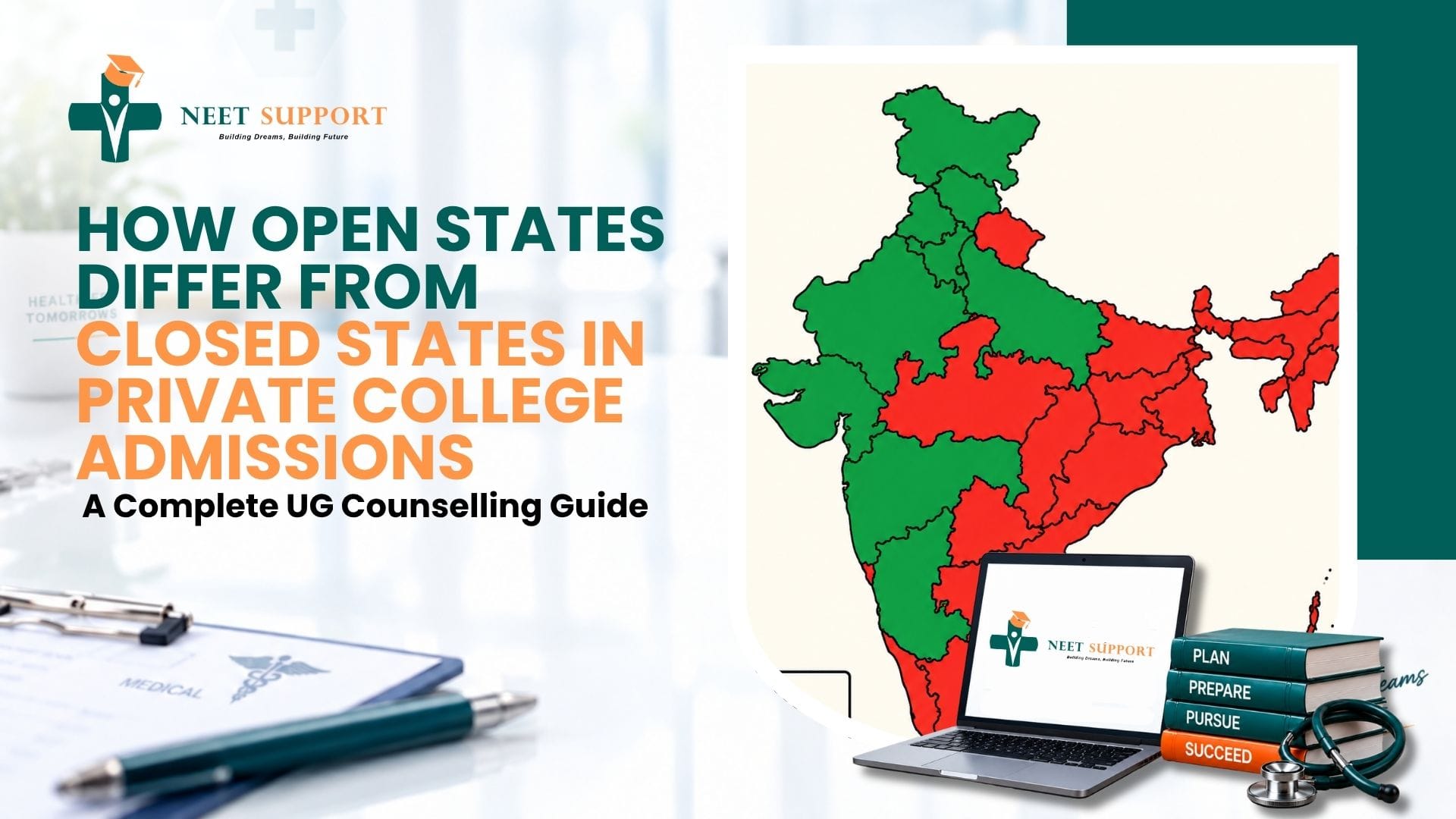
A Closed State restricts its private-college seats to candidates who hold that specific state's domicile — an outsider generally cannot apply for private quota seats there at all, no matter how strong their NEET score is. The classic, consistently-cited examples across recent cycles are Gujarat, Odisha, Punjab, and Jammu & Kashmir — these states restrict private and deemed-adjacent college seats to their own domicile candidates, and this classification has held fairly steadily year over year.
The Currently Reported Open States For 2026
Based on recent 2026 counselling reporting, a genuinely large number of states — one source counts seventeen states — allow candidates from any state to register for private (and often deemed) medical college seats in that state's own counselling process. States commonly and consistently cited as open across multiple 2026 sources include:
- Karnataka
- Kerala
- Uttar Pradesh
- West Bengal
- Telangana
- Bihar
- Chhattisgarh
- Himachal Pradesh
- Uttarakhand
- Haryana
The States Where Classification Gets Genuinely Murky
This is important to flag honestly, because different sources disagree on a few states, and this is exactly the kind of thing that trips candidates up if they rely on a single blog's list:
- Tamil Nadu appears as "open" in some 2026 sources (specifically noted for offering open institutional quota seats) and as effectively "closed" in others (restricting private quota to domicile candidates). This inconsistency likely reflects the distinction between Tamil Nadu's general private quota and its separate institutional/NRI categories — but it means you should not rely on any single list for Tamil Nadu specifically; check the current-year Tamil Nadu counselling bulletin directly.
- Maharashtra is more clearly defined but still nuanced: it allows non-domicile candidates specifically for institutional quota seats in private colleges, but not for the state's general private quota — so whether Maharashtra counts as "open" for you depends entirely on which specific seat category you're targeting there.
- Madhya Pradesh operates on a delayed-opening model: it opens outside-state applications starting from Round 2, with domicile candidates given first preference before non-domicile candidates are considered.
- Rajasthan follows a similar delayed pattern, opening to outside-state candidates from Round 3, again with domicile candidates prioritised first.
The pattern in Madhya Pradesh and Rajasthan is worth understanding on its own: these states aren't purely "open" or "closed" — they're conditionally open, meaning your realistic chance as an outsider only appears once local demand has been satisfied in earlier rounds. If you're an out-of-state candidate targeting these states, Round 1 is essentially not available to you at all; your window opens later.
States Where The Question Doesn't Even Apply
A handful of states and union territories — Assam, Goa, Delhi, Meghalaya, and Mizoram — simply have no private medical colleges at all, so the open/closed classification doesn't apply to them in the first place. If you're researching these regions specifically hoping for a private-seat opportunity, that search will come up empty regardless of domicile rules, because there's no private seat pool to be open or closed about.
Deemed Universities: A Completely Separate, Always-Open Category
It's worth being precise here because deemed universities often get lumped into this discussion incorrectly. Deemed universities are always open to all-India candidates, with no domicile requirement whatsoever, in every state — this is because they're counselled centrally through MCC's own separate deemed-university counselling process, not through individual state counselling authorities. So even if a college happens to be physically located in a "closed" state like Gujarat or Punjab, if it's a deemed university, its seats remain nationally open regardless of that state's private-quota policy for its regular private colleges.
Eligibility Criteria For Out-of-State Candidates In Open States
If you're planning to apply as an outsider in an open state, here's what generally applies:
- A valid, qualifying NEET UG score — exactly as required for any candidate, with no relaxation or special provision for being from out of state.
- Direct registration on that specific state's own counselling portal — this is a separate registration from your home state's counselling and from MCC's AIQ registration; you'll need to register independently with each state you're targeting.
- Payment of that state's specific registration fee and security deposit, following that state's own fee structure and refund rules, which may differ from your home state's.
- Category treatment as General, in most open states, regardless of your home-state reservation category. This is a genuinely important detail: reservation benefits like SC/ST/OBC status generally do not carry over across state lines for private-quota seats in an open state — an OBC candidate from their home state is typically treated as a General category applicant when competing for private seats in another state's open counselling. This means you should compare your NEET score against that open state's general category cutoff, not your usual reserved-category cutoff, when assessing realistic chances.
Why This Actually Matters For Your Strategy?
Restricting your search to only your home state can mean missing seats you're genuinely eligible for. Here's why this matters practically:
- Some open states have private colleges with better infrastructure or comparatively less competition than similarly-priced private colleges in a candidate's home state, simply because fewer local candidates are aware of or actively pursuing this route.
- If your home state happens to be a closed state or has very limited private capacity, an open state might be your only realistic route into a private MBBS seat at all, beyond AIQ and deemed universities.
- Fee structures, NRI quota availability, and management quota volume vary significantly by state — Haryana, Uttar Pradesh, Rajasthan, and Karnataka, for instance, are commonly cited as leading destinations specifically for NRI quota admissions, which is a separate but related consideration if that category applies to your family.
A Word Of Caution On Relying On Any Single List
Given how much these lists genuinely disagree with each other — even between reputable-seeming counselling advisory sites — you should treat every "open states list" you find online, including the summary in this article, as a starting point for research, not a final answer. Classifications can shift year to year based on state government policy changes, and even within a single year, different sources have been shown to classify the same state (Tamil Nadu being the clearest example here) differently. Before you spend time and application fees registering for an out-of-state counselling process, verify the current year's exact policy directly from that state's official counselling authority bulletin — look specifically for language around "domicile requirement," "outside-state candidates," or "all-India candidates" in the eligibility section of that state's private/management quota rules.
A Practical Checklist Before Applying As An Out-of-State Candidate
- Confirm your target state's current-year classification directly from its official counselling bulletin, not just from a blog's summary list.
- Check whether the state is fully open, conditionally open (like Madhya Pradesh or Rajasthan, opening only from a later round), or open only for a specific quota category (like Maharashtra's institutional quota) — these three scenarios require very different strategies and timing.
- Compare your NEET score against that state's general category cutoff, since reservation benefits typically won't transfer for an out-of-state private-quota application.
- Budget for a separate registration fee and security deposit for each additional state you register in, since these are independent processes from your home state's counselling.
- Don't ignore deemed universities as a parallel, always-open option regardless of which state they're physically located in — they offer a genuinely domicile-free route nationally.
- Factor in realistic fee levels for management or NRI quota seats in your target state, since private-college costs can vary substantially by state and category, separate from the open/closed question itself.
FAQs
What's the basic difference between an Open State and a Closed State?
An Open State allows candidates from any part of India to compete for its private-college seats without a domicile certificate, while a Closed State restricts those same seats strictly to candidates holding that state's own domicile.
Does the open/closed classification apply to government medical college seats?
No, government college state-quota seats (the 85% pool) are always restricted to domicile holders in every state — the open/closed distinction applies only to private-college seats.
Is AIQ affected by whether a state is "open" or "closed"?
No, the 15% All India Quota is always open to every NEET-qualified candidate nationally, completely independent of any state's private-quota policy.
Which states are most consistently classified as "closed"?
Gujarat, Odisha, Punjab, and Jammu & Kashmir are the states most consistently cited as closed across recent counselling cycles.
Are deemed universities affected by a state's open/closed classification?
No, deemed universities are always open to all-India candidates regardless of which state they're located in, since they're counselled centrally through MCC, not through state authorities.
Can I use my home state's reservation category (SC/ST/OBC) when applying to an open state's private quota?
Generally no — most open states treat out-of-state candidates as General category for private-quota seats, regardless of their home-state reservation status.
Do all states have private medical colleges to classify as open or closed?
No, states like Assam, Goa, Delhi, Meghalaya, and Mizoram have no private medical colleges, so the open/closed question doesn't apply there at all.
How do I register for an open state's counselling if I'm from a different state?
You register directly on that specific state's own counselling portal, separately from your home state's counselling and from MCC's AIQ registration, paying that state's own fees and deposit.
Is it worth applying to an open state outside my home state?
It can be, especially if your home state is closed or has limited private capacity, or if the open state offers better infrastructure or comparatively less competition for a similar fee bracket.
Do NRI quota seats follow the same open/closed rules as regular private quota?
Not necessarily — NRI quota eligibility is based on sponsor relationships rather than domicile, and states like Haryana, Uttar Pradesh, Rajasthan, and Karnataka are commonly cited as leading destinations specifically for NRI quota admissions.
The Bottom Line
The open-versus-closed state distinction is really about one narrow but consequential question: does this state's private-college counselling let outsiders in, and if so, under what conditions? A genuinely large number of states currently do, some fully and some only from a later round or within a specific quota, while a smaller, fairly consistent group — Gujarat, Odisha, Punjab, and Jammu & Kashmir — keep their private seats reserved strictly for their own domicile holders. Given how inconsistently this classification gets reported even across recent, seemingly reliable sources, the smartest move isn't memorising a list — it's checking your specific target state's current official bulletin before you register, so you know exactly which door is actually open to you this year.
Reviews
No reviews yet. Be the first to write one!