
Home Away From Home: The Best Private Medical Colleges In Tamil Nadu For NRI Students
Nishat
 WhatsApp
 Email
 Facebook
 Twitter/X
 LinkedIn
Table of Contents
Predict Your Rank Now
Enter your NEET score to get an estimated rank
Find the Best Colleges For You
Based on your NEET rank, Category & more

Get Your Dream Medical College
Secure your seat with expert counselling
Introduction
If you're an NRI parent or student trying to figure out where to pursue your MBBS in India, you'll hear about Tamil Nadu as a name many times - and for very good reasons. The state has one of the oldest and most reliable private medical education systems in the country, a great many medical colleges that are recognised by the NMC, and a well-defined NRI quota, which has been around long enough to have sorted out all rules and fees related to it. This is more important than one thinks - many NRIs end up being duped by vague "management quota" promises in less controlled states.
This guide walks through the colleges that actually show up on serious shortlists for NRI admission, what the NRI quota really costs, how the process differs from regular NEET counselling, and what to weigh before picking one over another.
Overview
| Parameter | Details |
|---|---|
| State | Tamil Nadu |
| NRI Quota Availability | Only in private self-financing colleges and deemed universities — government medical colleges in Tamil Nadu do not offer NRI seats |
| Typical NRI Reservation | 10–15% of total seats, per NMC guidelines |
| Two Main Pathways | Self-financing private colleges (TN state counselling for govt quota + separate NRI counselling) and Deemed universities (100% MCC All-India counselling) |
| Approximate NRI Fee Range (Self-Financing Colleges) | ₹24.5–30 lakh per year |
| Approximate NRI Fee Range (Deemed Universities) | ₹23 lakh to over $50,000/year, depending on the institution |
| Eligibility | NRI, OCI, PIO status, or NRI-sponsored Indian candidates, with valid NEET-UG qualification |
| Colleges Ranked in India's Top 50 (NIRF) | Tamil Nadu has 8 medical colleges in this bracket |
Key Highlights
- Tamil Nadu runs one of India's most established and predictable NRI quota systems for MBBS admission
- NRI seats exist only in private and deemed institutions — government colleges don't offer this route at all
- Self-financing colleges like PSG Institute of Medical Sciences charge government-quota fees as low as ₹4.5 lakh/year, but NRI fees climb to ₹27 lakh/year at the same institution
- Deemed universities such as SRM and Sri Ramachandra run entirely through MCC's All-India counselling, with no Tamil Nadu domicile requirement at all
- Hospital scale varies hugely — from 650-bed attached hospitals at some private colleges to genuinely massive 1,500–1,800-bed teaching hospitals at the bigger deemed universities
- NRI-quota fees across most colleges rose meaningfully for the 2025-26 admission cycle, so older fee figures floating around online are likely outdated
- Eligibility for NRI seats requires proper documentation — simply being willing to pay the NRI fee doesn't automatically qualify a candidate
Why Do NRI Students Choose Tamil Nadu for MBBS?
The reason Tamil Nadu consistently finds itself in the top NRI picks is that maturity and scale are in its favor as a state. The state has plenty of medical colleges, with a combination of historical private trusts and a recent influx of deemed universities. Over the years, this has helped build a unique ecosystem of healthcare and hospitals in the cities of Chennai, Coimbatore, and Madurai, among others. This has translated into more options and an easier fee structure for NRI families, as well as colleges that understand the NRI process and have already cleared the kinks in the paperwork involved.
It also helps that Tamil Nadu takes its fee regulation seriously. The state's Fee Regulatory Committee sets and revises tuition brackets for government, management, and NRI quota seats every cycle, which — while it does mean fees have been rising — also means the numbers are publicly tracked rather than negotiated privately behind closed doors the way they sometimes are elsewhere.
Deemed Universities vs Self-Financing Private Colleges — What's The Real Difference?
This is the single most important thing to understand before you start shortlisting colleges, because it changes the entire admission process.
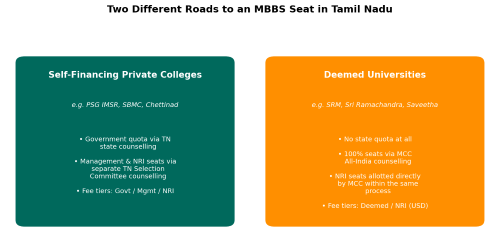
Self-financing private colleges — think PSG Institute of Medical Sciences, Sree Balaji Medical College, or Chettinad — participate in Tamil Nadu's state counselling for their government-quota seats, but run Management and NRI quota admissions through a separate process handled by the state's Selection Committee. Deemed universities like SRM, Sri Ramachandra, and Saveetha work completely differently — they don't have a state quota at all, and every single seat, including NRI seats, is allotted through MCC's centralised, all-India counselling process. If you're an NRI applicant, this distinction determines which portal you register on, which counselling calendar you follow, and how your NEET score gets converted into an actual seat offer.
Top Private Medical Colleges In Tamil Nadu NRI Students Actually Consider
Sri Ramachandra Medical College and Research Institute (SRIHER), Chennai – A medical university regarded as one of the oldest and best in India that started in the year 1985. The deemed status was conferred on it in 1994, and the school runs a huge 1,800-bedded hospital as a teaching hospital, with around 15% of 250 MBBS seats belonging to the NRI quota, offered through the MCC academic counselling for deemed universities like SRIHER. NRI fees for the full course of study may extend accordingly between 250,000 and 260,000 dollars, usually paid in installments.
SRM Medical College Hospital & Research Centre, Chennai — Another major deemed university option, known for a genuinely large 1,500-bed hospital with advanced facilities including robotic surgery and a dedicated cancer centre. NRI fees here are typically quoted around $50,000 per year, and like SRIHER, admission runs entirely through MCC with no domicile restriction.
PSG Institute of Medical Sciences and Research, Coimbatore — Established in 1985 by the well-known PSG group, this is one of the more affordable entry points into Tamil Nadu's private medical education scene at the government-quota level (around ₹4.5 lakh/year), though NRI quota fees rise to roughly ₹27 lakh/year. It's a self-financing college, so it follows the state-counselling-plus-separate-NRI-process model.
Chettinad Hospital and Research Institute, Kelambakkam — It is a well-established private medical institution found near Chennai, which has a slightly higher NRI quota fee than many similar institutions, and in recent years it has reportedly crossed ₹30 lakh annually.
Sree Balaji Medical College and Hospital (SBMC), Chrompet, Chennai — Among the many self-financed colleges in Chennai with an NRI quota is SBMC. It adopts the normal Tamil Nadu Selection Committee method.
Saveetha Medical College, Kanchipuram — It is a deemed university located outside Chennai and offers another MCC counseling method for NRI candidates looking for a peaceful environment.
Velammal Medical College Hospital and Research Institute, Madurai — It is worth considering for those families who would like a private institution away from the Chennai-Coimbatore area of southern Tamil Nadu.
Between them, these colleges cover the full range of what NRI applicants typically compare — hospital scale, city versus semi-urban settings, and the deemed-versus-self-financing decision that shapes the entire admission experience.
What Do NRI Quota Fees Actually Look Like?
This is usually the first question every NRI family asks, and the honest answer is: it varies more than you'd expect, and it's been rising.
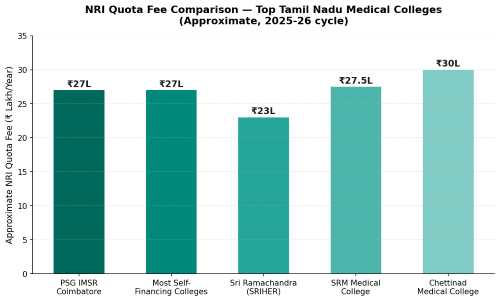
For most self-financing private colleges, NRI fees for the 2025-26 cycle sit around ₹27 lakh per year, up from roughly ₹24.5 lakh the previous year — a jump reflecting a state-wide fee revision rather than something specific to one college. Deemed universities price things differently, sometimes in rupees and sometimes in US dollars — Sri Ramachandra's total NRI course cost runs into the $250,000+ range over the full programme, while SRM quotes its NRI fee at roughly $50,000 per year. Chettinad tends to sit toward the higher end even among self-financing colleges, with figures approaching or exceeding ₹30 lakh annually in recent reporting.
Remember that tuition is only one part of the real cost. Hostel fees, caution deposits, university/registration charges, and annual exam fees all add up on top of the headline tuition number — so when comparing colleges, always ask for the full first-year cost, not just the advertised annual fee.
How Big Are The Attached Hospitals?
Since clinical training quality depends heavily on patient volume and hospital infrastructure, this is genuinely worth comparing across your shortlist.
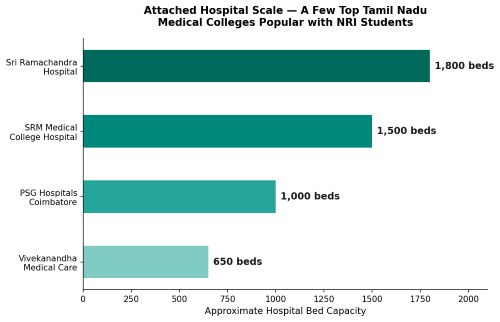
The bigger deemed universities tend to run genuinely enormous teaching hospitals — Sri Ramachandra's attached hospital runs at around 1,800 beds, and SRM's isn't far behind at roughly 1,500, both offering the kind of high-volume, high-complexity case exposure (robotic surgery, transplant programmes, dedicated cancer centres) that smaller colleges simply can't match. Self-financing colleges run somewhat smaller, though still substantial, hospitals — PSG's Coimbatore network runs at around 1,000 beds, for instance. Neither is objectively "better" — a bigger hospital means more volume and complexity, but can also mean less individual attention during clinical postings, so it's a genuine trade-off worth thinking through based on what kind of learner your child is.
What's The Admission Process For NRI Quota In Tamil Nadu?
- Qualify NEET-UG with a valid score — this is non-negotiable regardless of NRI status
- Determine whether your target college is a self-financing private college or a deemed university, since this decides your counselling route
- For self-financing colleges, register separately for the Tamil Nadu Selection Committee's Management/NRI quota counselling
- For deemed universities, register through MCC's centralised counselling for the deemed university NRI stream
- Submit valid NRI, OCI, or PIO documentation alongside your NEET scorecard and academic records
- Participate in choice filling and wait for seat allotment based on your NEET score within the NRI category
- Report to the college with original documents, sponsorship proof, and the first instalment of fees to confirm your seat
- Complete document verification, medical fitness checks, and the anti-ragging undertaking before starting classes
What Documents Do NRI Applicants Typically Need?
- Valid NEET-UG admit card and scorecard
- Passport copy showing NRI/OCI/PIO status, or valid sponsorship documentation for NRI-sponsored Indian candidates
- Class 10 and 12 mark sheets and certificates
- Transfer/school leaving certificate
- Proof of NRI relationship (for sponsored candidates — typically a specified relative's NRI status)
- Embassy or consulate attestation of documents, where required by the specific college
- Passport-size photographs
- Medical fitness certificate
Exact document requirements vary by college and by whether you're applying as a genuine NRI/OCI candidate versus an NRI-sponsored Indian candidate, so it's worth confirming the specific list with your target college well before counselling begins.
Which College Should You Actually Choose?
Honestly, this comes down to three things: budget, how much you value a deemed university's "no domicile, pure merit" simplicity versus a self-financing college's often lower entry-level costs, and how much hospital scale matters to you. If your family wants the biggest, most internationally recognisable name and can absorb a higher, dollar-denominated fee, SRM or Sri Ramachandra are the obvious starting points. If you'd rather work within Tamil Nadu's state-regulated fee bands and are comfortable navigating the separate NRI counselling process, PSG, Chettinad, or SBMC are all reasonable, well-established options. Either way, don't skip the step of directly contacting each college's admissions office — fee figures shift every cycle, and a five-minute call can save you from planning around numbers that are already a year out of date.
FAQs
Do government medical colleges in Tamil Nadu offer NRI seats?
No. NRI quota seats are only available in private self-financing colleges and deemed universities. Government colleges in Tamil Nadu don't reserve any seats for NRI candidates.
How much of a college's total seats are reserved for NRI quota?
Typically 10–15% of total seats, in line with NMC guidelines, though the exact number varies by institution and can change slightly year to year.
What's the real difference between a deemed university and a self-financing private college for NRI admission?
Self-financing colleges split their seats between Tamil Nadu state counselling (for government quota) and a separate NRI/management counselling process. Deemed universities have no state quota at all — every seat, NRI included, goes through MCC's all-India counselling.
Why have NRI quota fees gone up recently?
Tamil Nadu's Fee Regulatory Committee revised the fee structure for the 2025-26 cycle, raising management quota fees by roughly ₹1.5 lakh and NRI quota fees by roughly ₹2.5 lakh annually across most self-financing colleges — a state-wide adjustment rather than something specific to individual institutions.
Do NRI students need to travel to India for counselling, or can it be done remotely?
This varies by college and round — some processes allow document submission through an authorised representative, while final admission confirmation typically requires the candidate or representative to be physically present. Confirm the specific requirement with each college.
Can NRI candidates apply to multiple colleges at the same time?
Generally yes, particularly across the MCC deemed university stream, where candidates can list multiple institutional preferences during choice filling, similar to regular NEET counselling.
Is there a service bond attached to NRI quota MBBS seats?
This varies by institution — some deemed universities explicitly state no service bond applies to their degree, while certain self-financing colleges may have different terms. Always check the specific bond and stipend policy for your target college before signing anything.
What happens if an NRI candidate's NEET score doesn't meet the cutoff for their target college?
Since NRI quota still requires a qualifying NEET-UG score, even if the bar is comparatively more accessible than general or management categories, candidates who fall short would need to consider other colleges or wait for later counselling rounds, where cutoffs sometimes ease further.
Conclusion
While Tamil Nadu's NRI quota system for MBBS is indeed one of the most developed and comprehensive in India, it is not without its complexities. The distinction between deemed and self-financing institutions changes the whole admission process, and most importantly, the fee structure is dynamic; fees will increase, making last year's fee figures less than useful for familiarization with yearly costs. No matter whether you are opting for a deemed university like SRM or Sri Ramachandra, or a self-financed institution like PSG or Chettinad, make sure you check the latest fees and availability of seats directly with the college and find out which counseling process applies to your case before making a commitment.
Reviews
No reviews yet. Be the first to write one!