Gangtok's Best-Kept Secret: Sikkim's Only Private Medical College For NRI Families
Nishat
 WhatsApp
 Email
 Facebook
 Twitter/X
 LinkedIn
Table of Contents
Predict Your Rank Now
Enter your NEET score to get an estimated rank
Find the Best Colleges For You
Based on your NEET rank, Category & more

Get Your Dream Medical College
Secure your seat with expert counselling
Introduction
Sikkim rarely comes up in NRI medical education conversations, and that's a little unfair — it's actually home to one of the Northeast's older, more established private colleges, running quietly in the hills above Gangtok since before most of the colleges covered elsewhere in this series existed. It also happens to be one of the more confusing ones to research, and we're not going to pretend otherwise.
Quick Numbers Before We Dive In:
- 1 private medical college in Sikkim — and no government alternative in the state
- ~2000 the year it opened, making it one of the Northeast's oldest private medical colleges
- 150 MBBS seats a year, spread across six different quota categories
- Genuinely unclear whether a currently active NRI quota exists — sources disagree, and we'll walk through why
A Hill-Station College With A Two-Decade Head Start
Sikkim Manipal Institute of Medical Sciences (SMIMS), Gangtok, is Sikkim's only medical college — and unlike most of the Northeast states we've covered, there isn't even a government alternative to fall back on. Founded around 2000 as part of the Manipal Education Group's expansion into the Northeast, it predates Meghalaya's and Manipur's first private colleges by roughly two decades. That head start shows: SMIMS runs a 550-bed teaching hospital, NAAC A accreditation, and a genuinely large, well-established campus at Tadong, 5th Mile.
Whose College Is It, Exactly?
Here's where the research gets genuinely tangled, and it's worth walking through rather than glossing over. Some sources describe SMIMS as a straightforward constituent college of Sikkim Manipal University (SMU), admitting through its own direct process plus Sikkim's state counselling. Others describe it as a constituent college of the Manipal Academy of Higher Education (MAHE) — a deemed university headquartered in Manipal, Karnataka — with admissions partly routed through MCC's deemed counselling. A few sources blend both, describing "MCC Deemed + SMU Direct Admissions" in the same breath.
What this likely means in practice: SMIMS probably sits in a genuine institutional grey zone — historically built as SMU's own medical college, with some administrative overlap with the wider Manipal/MAHE network given the shared parent group. For an applicant, the practical takeaway is this: some seats may route through MCC's national counselling, while state quota, management, and NRI seats are typically handled through Sikkim's own Human Resource Development Department (HRDD) and SMU directly. Confirm which route applies to your specific category before assuming either process automatically covers you.
What A Seat Actually Costs, By Category?
SMIMS runs one of the more granular fee structures in this series — six distinct categories, each priced differently, which makes "the SMIMS fee" a genuinely meaningless phrase without specifying which one you mean.
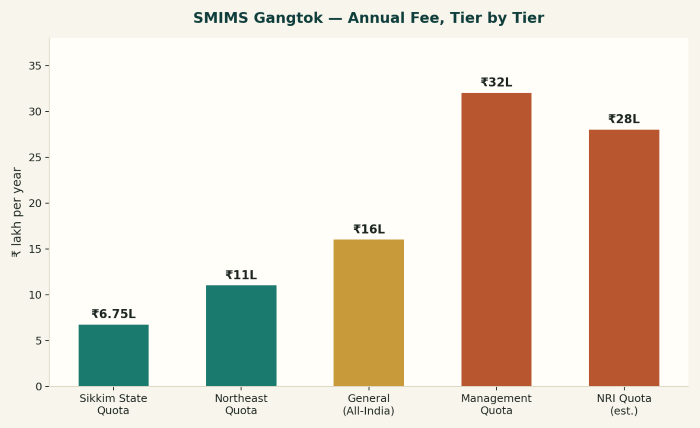
Sikkim state quota, Northeast quota, General, and Management figures from Collegedunia's published fee breakdown. NRI figure is an estimate based on typical premiums over management-quota pricing at comparable private colleges nationally — a confirmed, current NRI-specific figure for SMIMS was not available in public sources at the time of writing. Confirm directly with SMU before budgeting.
There's also a remarkable detail buried in that six-category structure: SMIMS reserves 50 seats a year as a 100% fee-concession "Freeship" Sikkim quota — genuinely free MBBS education for eligible Sikkim-domicile candidates selected by the state government. That's an unusually generous inclusion feature for a private college, and it's worth knowing about even if it doesn't apply to an NRI applicant directly.
Slicing Up 150 Seats Six Ways
Between the freeship allocation, the paying-Sikkim quota, general seats, and the smaller specialised categories, SMIMS's intake is genuinely more fragmented than most colleges in this series.
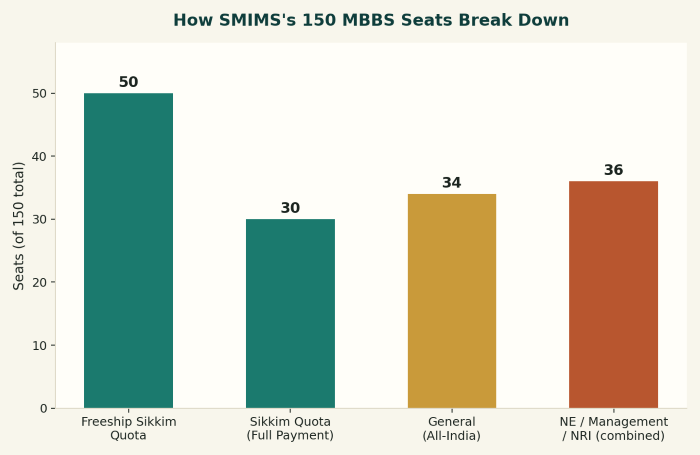
Freeship, full-payment, and general figures are drawn from SMIMS's own published fee-structure document and Formity's rank-range analysis. The final category combines Northeast, Management, and NRI seats, whose individual counts weren't separately confirmed in current public sources.
The NRI Question, Honestly Unresolved
This is the part of the research that genuinely didn't resolve cleanly, and it deserves to be said plainly rather than papered over. One detailed, recently updated source states flatly: "No NRI quota at SMIMS." Several other equally recent sources describe the opposite — an active NRI category, open to "NRI, OCI, PIO and Foreign Nationals from any country," complete with a specific document checklist (sponsor's passport, visa, sponsorship affidavit, proof of relationship) that reads like genuine institutional detail rather than generic filler.
Our best read: it's plausible that NRI seats at SMIMS are filled inconsistently year to year, or that they exist as a genuine but small, less-publicised category that some trackers miss entirely. Either way, the responsible move is the same one we've made throughout this Northeast leg of the series — don't assume, and get a direct, current answer from SMU (03592-270534) before building any plan around an NRI seat here.
Setting Sikkim's Numbers Against The Rest Of The Series
Even working from an estimated NRI figure, it's worth seeing where SMIMS would land relative to the other colleges we've profiled across this project.
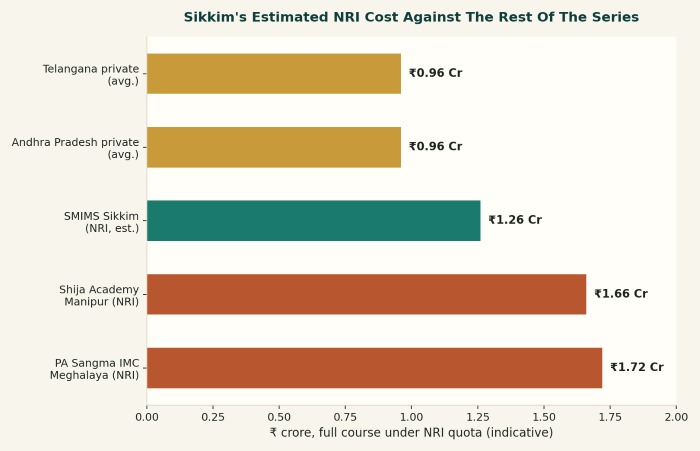
Sikkim figure is an estimate based on the management-quota fee pattern described above, projected across a 4.5-year course. Other figures are drawn from published data and our companion guides on Telangana, Andhra Pradesh, Manipur, and Meghalaya.
If the estimate holds, Sikkim would land meaningfully below its Northeast neighbours and roughly in line with the private-college averages we found in Telangana and Andhra Pradesh — a genuinely different cost position than Manipur or Meghalaya's newer, pricier private colleges.
Getting Through The Admissions Maze
- Clear NEET-UG. Compulsory for every category at SMIMS, with no exceptions.
- Call SMU directly before assuming anything about NRI eligibility. Given the conflicting information above, this single phone call will save more time than any amount of further online research.
- Register through the correct channel for your target category — MCC for any AIQ-linked seats, and Sikkim's HRDD or SMU's own process for state, management, and (if currently offered) NRI seats.
- Prepare NRI documentation regardless, in case the category is open in your application cycle: sponsor's passport and visa, sponsorship affidavit, and proof of relationship.
- Watch SMIMS's own fraud warning closely. The college has explicitly stated it uses no agents or middlemen and charges no donation or capitation fee — treat any third party claiming otherwise as a red flag, not a shortcut.
- Complete document verification and fee payment once a seat is confirmed through whichever process applies.
- Report physically to the Tadong campus with original documents to finish enrolment.
Documents Worth Having Ready Either Way
- Valid passport and visa/residency proof for the candidate or sponsoring relative
- Sponsorship affidavit and proof of relationship, if applying under an NRI-sponsored category
- NEET-UG admit card and scorecard
- 10th and 12th mark sheets, with equivalence certification if schooled abroad
- Transfer certificate and migration certificate from the previous institution
- Caution deposit and registration fee (₹10,000 each, per SMIMS's published fee structure)
A Few Things Worth Weighing
- The institutional ambiguity isn't necessarily a red flag — it likely just reflects SMIMS's position within a large, established group (Manipal/MAHE) with genuinely overlapping administrative structures. But it does mean extra diligence is warranted before assuming any specific counselling route applies to you.
- The Freeship quota is a genuinely distinctive feature worth knowing about if your family has any Sikkim connection, even tangentially, since it's a rare fully-subsidised route at a private institution.
- Gangtok is remote but well-connected by Northeast standards, with regular flights via Pakyong Airport and road access from Siliguri — less isolated than some of the other Northeast locations covered in this series.
- If the NRI category turns out to be unavailable in your application year, the general category (~₹16 lakh/year) remains open to any NEET-qualified Indian citizen, NRI candidates included, without a domicile restriction.
FAQs
Is SMIMS Really Sikkim's Only Medical College?
Yes. Sikkim Manipal Institute of Medical Sciences, Gangtok, is the only medical college in the state, and there's no government medical college in Sikkim to serve as an alternative.
Does SMIMS Actually Offer An NRI Quota?
It's genuinely unclear from current public sources. Some detailed sources state plainly that no NRI quota exists, while several others describe an active NRI category with specific document requirements. Call Sikkim Manipal University directly to confirm the current position before applying.
Is SMIMS A Private College Or A Deemed University?
Both descriptions appear across different sources, and the honest answer is that it sits in a genuine grey zone — built as Sikkim Manipal University's own medical college, with some administrative links to the Manipal Academy of Higher Education (MAHE), a deemed university. Confirm which counselling route applies to your specific target category directly with SMU.
How Many MBBS Seats Does SMIMS Offer?
150 a year, split across six categories: a 50-seat fully-subsidised Freeship Sikkim quota, a 30-seat Sikkim quota at full payment, 34 general seats, and a combined roughly 36 seats across Northeast, Management, and NRI categories.
What's The "Freeship" Quota, And Can An NRI Candidate Apply For It?
It's a 100% tuition-fee-concession category reserved for Sikkim-domicile candidates selected by the state government — not applicable to NRI candidates, but worth knowing about as a distinctive feature of SMIMS's fee structure.
Which Counselling Body Handles Admission To SMIMS?
It varies by category. General and state-linked seats generally route through Sikkim's Human Resource Development Department (HRDD) and SMU's own process, while a portion of seats may be routed through MCC's national counselling given the institution's Manipal/MAHE connections. Confirm the exact route for your category directly with SMU.
How Big Is SMIMS's Teaching Hospital?
Its attached hospital in Tadong has around 550 beds, offering multi-specialty clinical training — solid infrastructure reflecting the college's two-decade-plus history, longer than most other Northeast private colleges covered in this series.
Where This Leaves You?
Sikkim offers something genuinely different from its Northeast neighbours in this series: an older, more established private college with real infrastructure behind it, at a price point that — if our estimate holds — looks more like the Southern private-college markets than the newer, pricier options in Manipur or Meghalaya. The catch is a research trail that doesn't fully resolve the NRI question, which makes a direct call to SMU the single most valuable step before building any plan around SMIMS.
Reviews
No reviews yet. Be the first to write one!