From Nalanda To NEET: Bihar's Private Medical Colleges For NRI Families
Nishat
 WhatsApp
 Email
 Facebook
 Twitter/X
 LinkedIn
Table of Contents
Predict Your Rank Now
Enter your NEET score to get an estimated rank
Find the Best Colleges For You
Based on your NEET rank, Category & more

Get Your Dream Medical College
Secure your seat with expert counselling
Introduction
Bihar hosted one of the world's first truly international universities — Nalanda drew students from Korea, China, and Central Asia over a thousand years before anyone coined the term "NRI quota." That legacy doesn't show up in current medical college rankings, but it's a nice bit of context for a state that, today, runs a genuinely clean, well-documented, and refreshingly affordable private-college system for NRI families.
Quick Numbers Before We Dive In:
- 9–12 private medical colleges in Bihar, depending on the year — new NMC approvals keep adding to the count
- ~1,900 total MBBS seats across Bihar's private sector
- ~285 of those, roughly, reserved for the NRI quota
- $21,000–$35,000/year is the confirmed NRI-quota fee range — genuinely modest by national standards, and unusually well-documented, college by college
A State That Actually Publishes Its Numbers
One thing that sets Bihar apart from several states covered in this series: its private-college fee structure is unusually well-documented, right down to college-specific NRI figures in US dollars. There's no deemed-university layer muddying the picture here either — Bihar's medical education runs on a straightforward two-tier system, government and private, both counselled through the same state body, the Bihar Combined Entrance Competitive Examination Board (BCECEB), via its UGMAC portal.
Bihar's private sector has grown steadily — from 9 colleges a couple of years ago to 12 as of the latest NMC records, with Mahabodhi Medical College & Hospital in Nalanda receiving approval as recently as 2026. Of the 12, ten are private non-minority institutions, and two carry minority status (Katihar Medical College and Madhubani Medical College, both Muslim-minority; Mata Gujri Memorial Medical College, Sikh-minority).
What A Seat At Each College Actually Costs?
This is where Bihar genuinely stands out in this series: rather than a single averaged "NRI fee" for the whole state, individual colleges publish clear, specific, dollar-denominated NRI rates — and they vary meaningfully.
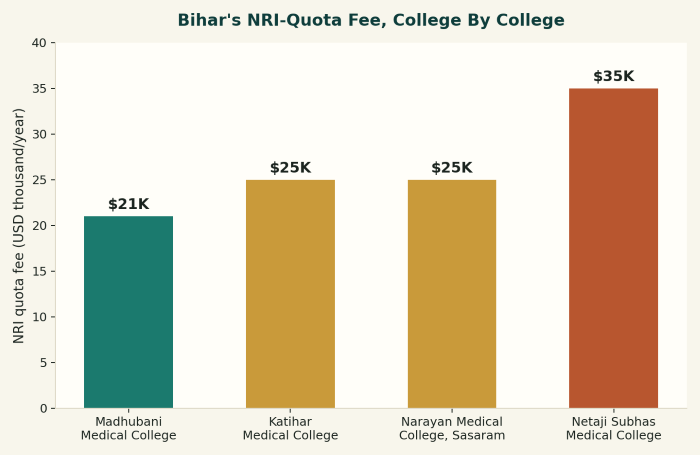
Figures are drawn from published college-wise fee tables covering tuition, development, and NRI charges for the 2025–26 admission cycle. Confirm current figures directly with BCECEB or the individual college, since fees are reviewed periodically.
Netaji Subhas Medical College, in Bihta near Patna, sits at the top of that range — its general tuition alone runs considerably higher than its peers, and its NRI premium follows suit. Madhubani Medical College, by contrast, is the most affordable of the four we found clear figures for, at $21,000 a year. That's a genuine, worthwhile spread to weigh before assuming "Bihar private college" means one uniform price tag.
The Big Four, By Seats
Bihar's private colleges vary considerably in scale too — from newer, smaller institutions to a couple of genuinely large 250-seat campuses.
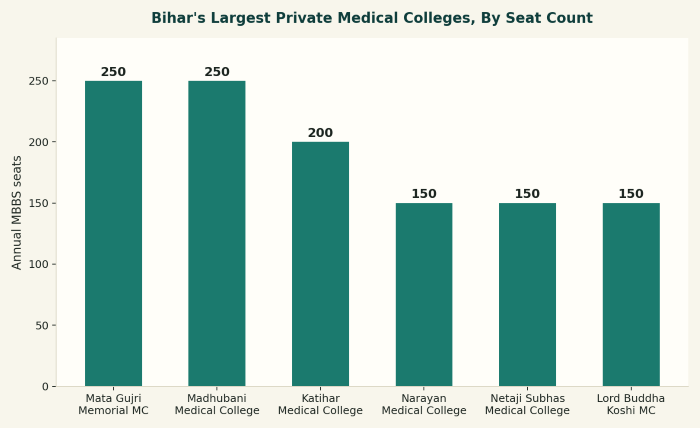
Based on published NMC seat-matrix data. Bihar's remaining private colleges — Shree Narayan Institute of Medical Sciences, Himalaya Medical College, RDJM Medical College, and others — round out the roughly 1,900-seat private sector, mostly at the 150-seat tier.
Narayan Medical College & Hospital, Sasaram, deserves a specific mention: built around a 1,150-bed hospital on a 25-acre campus, it's frequently cited as one of the state's stronger clinical training environments, and it began as a charitable hospital — Narayana Chikitsalay — before growing into a full medical college, a slightly different origin story than the trust-and-campus model common elsewhere.
Reading Bihar's Fine Print
Bihar's private colleges run a genuinely useful eligibility clause worth knowing about: if NRI or self-financed seats go unfilled by Round 3 of counselling, they're reallocated in a defined order, rather than simply lapsing or converting straight to general management pricing the way some other states handle it. The exact reallocation sequence is spelled out in each college's own admission rules — worth reading directly rather than assuming a default.
It's also worth noting the minority-quota structure at a few of these colleges: 50% of seats at both Katihar Medical College and Madhubani Medical College are reserved for Muslim-minority candidates, and 30% at Mata Gujri Memorial Medical College are reserved for Sikh-minority candidates. These reservations sit alongside, not instead of, the standard management and NRI quotas, but they do shape how many genuinely open seats are available in a given counselling round.
Setting Bihar Against The Rest Of This Series
Even with the spread between its cheapest and priciest colleges, Bihar's overall position in this series is a comfortable one — squarely in the affordable half, ahead of most Southern and Northeastern private-college markets we've covered.
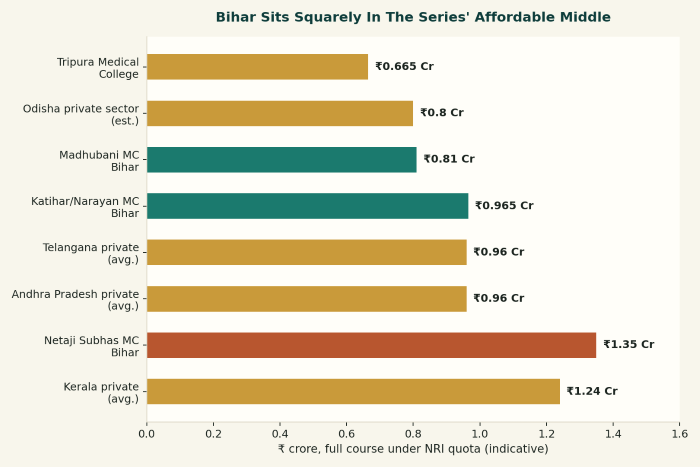
Bihar figures are based on each college's confirmed NRI fee, projected across 4.5 academic years. Other figures drawn from published data and our companion guides across this series.
Only Tripura and Odisha's private sector undercut Bihar's cheaper colleges, and even Netaji Subhas — Bihar's priciest option — still lands below the private-college averages in Telangana, Andhra Pradesh, and Kerala. For a family prioritising cost without sacrificing NMC recognition, Bihar's private-college market deserves a genuinely serious look.
Making Your Way Through UGMAC
- Clear NEET-UG. Compulsory for every seat category, no exceptions.
- Register on the UGMAC portal, run by BCECEB, for Bihar's centralised state counselling covering government, management, and NRI-quota seats alike.
- Establish NRI or NRI-sponsored status, with the documentation BCECEB's UGMAC prospectus specifies.
- Rank your college choices carefully during counselling. Choices generally lock after Round 1, with only reshuffling allowed in Round 2, so front-load your research rather than treating early rounds as a trial run.
- Track the reallocation order for unfilled seats if you're applying late in the cycle, since Bihar's specific rules on how vacant NRI/self-financed seats get redistributed vary from a simple conversion-to-management approach.
- Complete verification and fee payment once an allotment is confirmed.
- Report physically to the allotted college with original documents to finish enrolment.
Documents Worth Having Ready
- Valid passport and visa/residency proof for the candidate or sponsoring NRI relative
- NRI or NRI-sponsored status documentation, per BCECEB's UGMAC prospectus requirements
- NEET-UG admit card and scorecard
- 10th and 12th mark sheets, with equivalence certification if schooled abroad
- Transfer certificate and migration certificate from the previous institution
- Minority-status documentation, if applying to a minority-quota seat at Katihar, Madhubani, or Mata Gujri
A Few Things Worth Weighing
- Fee transparency is a genuine strength here. Bihar's college-wise, dollar-specific NRI figures are more precisely documented than in several states covered in this series — use that clarity to compare colleges directly rather than relying on a single statewide average.
- The gap between Bihar's cheapest and priciest private colleges is real — a $14,000-a-year difference between Madhubani and Netaji Subhas adds up to well over ₹25 lakh across the full course.
- Minority-quota reservations affect how many genuinely open seats exist at three of Bihar's most prominent private colleges — factor this into realistic expectations if you're not applying under one of those categories.
- Bihar's broader NEET cut-off environment is demanding — government colleges here require some of the higher marks nationally, which pushes many genuinely strong candidates toward the private sector regardless of NRI status.
FAQs
How Many Private Medical Colleges Does Bihar Have?
Between 9 and 12, depending on the year — the count has grown as new colleges receive NMC approval, most recently Mahabodhi Medical College & Hospital in Nalanda in 2026. As of the latest NMC records, there are 12: ten private non-minority and two private minority institutions.
Does Bihar Have Any Deemed Medical Universities?
No. Unlike several states covered in this series, Bihar's medical education system is a straightforward two-tier structure — government and private — with no deemed-university layer to sort out separately.
Which Counselling Body Handles Bihar's Medical Admissions?
The Bihar Combined Entrance Competitive Examination Board (BCECEB), through its UGMAC portal, runs the centralised counselling covering government, management, and NRI-quota seats across all of Bihar's medical colleges.
Do Bihar's Government Medical Colleges Offer An NRI Quota?
No. Bihar's NRI-quota seats exist only within the private sector; government colleges fill seats through state quota and the All India Quota, following the pattern common across most Indian states.
How Many Total NRI-Quota Seats Are Available In Bihar?
Roughly 285, based on the standard 15% NRI allocation applied across Bihar's private-college sector's approximately 1,900 total MBBS seats.
What's The Largest Private Medical College In Bihar?
Mata Gujri Memorial Medical College, Kishanganj, and Madhubani Medical College are Bihar's largest private institutions, each with 250 MBBS seats annually.
Are Any Of Bihar's Private Colleges Minority Institutions?
Yes — Katihar Medical College and Madhubani Medical College are Muslim-minority institutions, each reserving 50% of seats for that community, while Mata Gujri Memorial Medical College is a Sikh-minority institution reserving 30% of seats. These reservations apply alongside, not instead of, the standard management and NRI quotas.
How Competitive Is Bihar's Government-College NEET Cut-Off?
Demanding — government medical colleges in Bihar generally require scores in the 610–680 range for general-category candidates, among the higher thresholds nationally, which is one reason many strong candidates end up considering the private sector regardless of NRI status.
Is There A Compulsory Service Bond After MBBS At Bihar's Private Colleges?
Specific bond terms vary by college and weren't uniformly confirmed across the sources reviewed for this piece — confirm directly with your target college or BCECEB, since service-bond requirements are common at private medical colleges nationally.
Wrapping Up
Bihar won't headline anyone's list of glamorous NRI medical education destinations, but its private-college sector does something genuinely useful: it publishes clear numbers, offers real price variation to choose from, and lands consistently in the more affordable half of every comparison we've run across this series. For a family doing careful, budget-conscious research rather than chasing brand names, it's worth a proper look.
Reviews
No reviews yet. Be the first to write one!