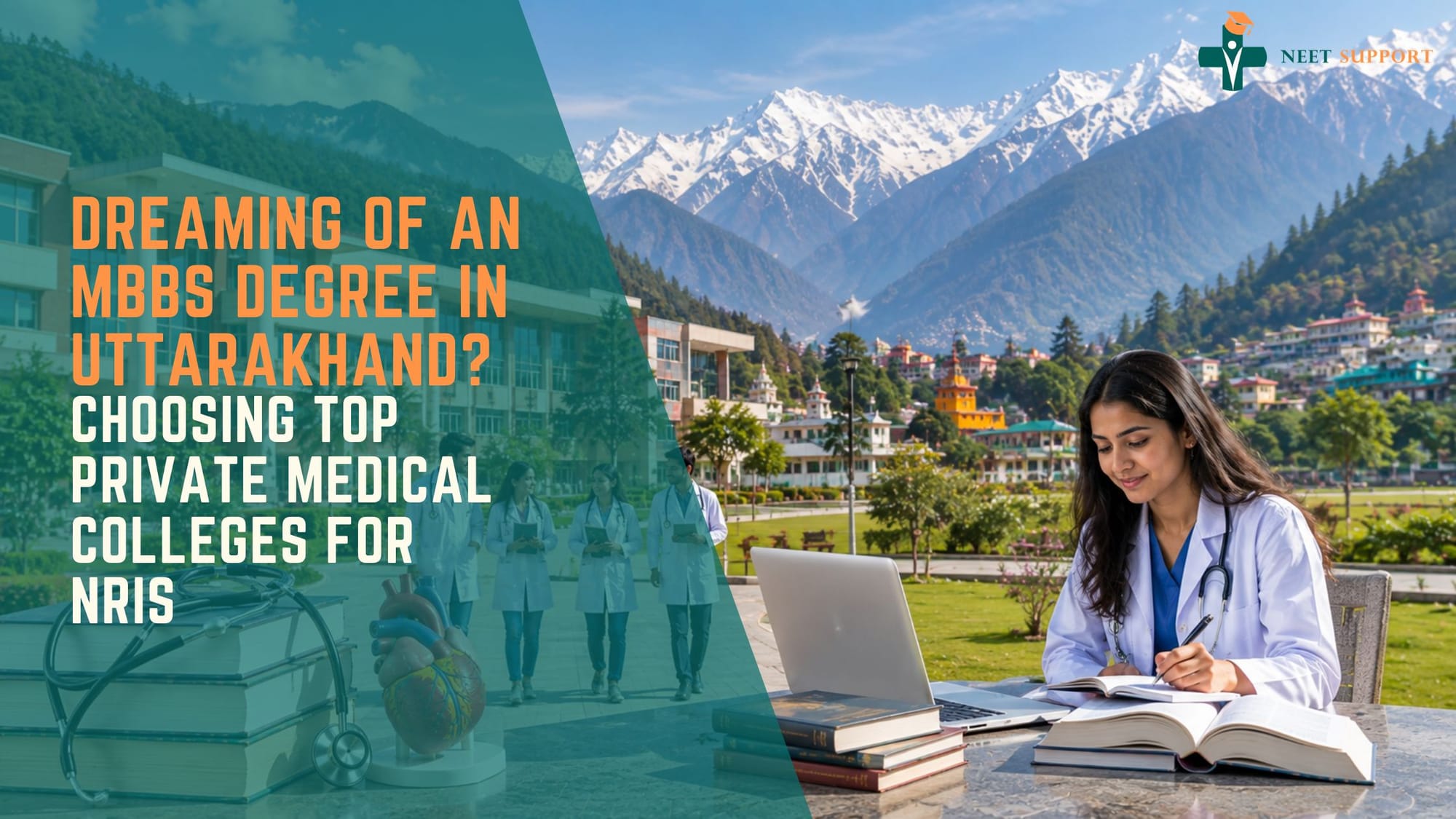
Dreaming Of An MBBS Degree In Uttarakhand? Choosing Top Private Medical Colleges For NRIs
Nishat
 WhatsApp
 Email
Email Facebook
 Twitter/X
 LinkedIn
Table of Contents
Predict Your Rank Now
Enter your NEET score to get an estimated rank
Find the Best Colleges For You
Based on your NEET rank, Category & more

Get Your Dream Medical College
Secure your seat with expert counselling
Introduction
It's almost always the same scene. Somewhere abroad, at some odd hour because the time zones never quite line up, a parent is sitting with a laptop open, fifteen browser tabs running, half-empty cup of tea going cold beside them, trying to make sense of NEET cutoffs, NRI quota rules, and fee structures that seem to change every time they refresh the page. If that's you right now, first — take a breath. You're not doing anything wrong. This process is genuinely confusing for everyone, no matter how many times they've been through it before.
Here's something that might make the search a little easier, though. Over the last few years, more and more NRI families have quietly started pointing their search toward Uttarakhand. Not the obvious first choice, maybe, but once you actually look into it, you understand why. It's a small state with only a handful of private medical colleges, tucked into the Himalayan foothills, with cleaner air, calmer campuses, and a state counselling system that, honestly, is a lot less chaotic to deal with than some of the bigger education hubs.
So let's actually sit with this topic for a while — not the rushed, bullet-point version, but the kind of conversation you'd have with a friend who's already been down this road. What are the real options in Uttarakhand? How does the NRI quota actually work? What should you expect to pay? And what are the small, easy-to-miss details that trip people up later? Let's get into it.
Why Does Uttarakhand Keep Coming Up In These Conversations?
I'll be honest — the first time someone mentioned Uttarakhand for MBBS admission, my instinct was to picture apple orchards, not medical colleges. But there's real substance behind why it's earned this reputation.
For starters, there just aren't that many private medical colleges here. That might sound like a downside, but flip it around for a second — fewer colleges usually means each one has to actually maintain a reputation to survive, and NRI seats aren't being fought over by thirty different institutions the way they might be in states with dozens of colleges chasing the same pool of applicants.
Then there's the locality itself. Dehradun, where a majority of the aforementioned educational institutions are found, is not a huge and intimidating city. It is green, it is calm, and for a parent who is located thousands of miles away and spends sleepless nights worrying about his child’s safety, it matters more than any rank or statistic.
And practically speaking, the admissions process runs through one central body — Hemwati Nandan Bahuguna Uttarakhand Medical Education University, or HNBUMU, based in Dehradun. When you're trying to coordinate paperwork and counselling from another country, having a single, recognised authority to deal with instead of a scattered mess of processes is, frankly, a relief.
Let's Clear Up What The NRI Quota Actually Means
Before we go any further, there's one thing I want to say clearly, because I've seen families get this wrong before — the NRI quota is not a shortcut around NEET. Every single candidate, NRI or otherwise, has to sit for and qualify NEET-UG. No exceptions, no workarounds. What the NRI quota changes isn't the exam; it's the fee bracket and, in most cases, the pool of competition your child is up against.
In Uttarakhand's private colleges, seats are generally divided into three buckets — State Quota for those with Uttarakhand domicile, Management Quota which is open to candidates from any state in India, and NRI Quota, set aside specifically for NRI, OCI, and PIO applicants or students sponsored by an NRI relative. Roughly half the seats in most of these colleges tend to fall under Management Quota, with a smaller, defined slice carved out just for NRI admissions.
If there's one piece of advice I'd underline twice here, it's this — start your documentation early. Proving NRI status isn't just a formality. Depending on whether your child is applying directly as an NRI or through a sponsor, you'll likely need passport copies, relationship certificates, and embassy attestations, and gathering all of that under pressure during counselling season is a stress nobody needs.
The Colleges Worth Actually Knowing About
Himalayan Institute Of Medical Sciences, Dehradun
This name keeps coming up whenever people start inquiring about medical institutions. The name is Himalayan Institute of Medical Sciences, popularly known as HIMS. This Institute began its journey in the year 1995 and is regarded as the first private medical college in the state. It was established under the aegis of the Himalayan Institute Hospital Trust and is a constituent of the Swami Rama Himalayan University.
What actually sets it apart, though, isn't its age. It's the hospital attached to it. Himalayan Hospital is NABH-accredited with over 1,200 beds, which means students aren't just reading about patient care in textbooks — they're standing in wards, watching it happen, fairly early into their training. For a field like medicine, where confidence really does come from repetition and real exposure, that's not a small thing.
HIMS takes in around 150 MBBS students each year. Under the NRI quota, tuition tends to sit somewhere between USD 30,000 and 35,000 annually, though — and I say this with real emphasis — please treat that as a starting point for your research, not a final number. These figures shift, sometimes more than once a year, so always confirm directly with the college before you plan around them. The campus itself is in Jolly Grant, close to Dehradun's airport, with the kind of quiet, green surroundings that make settling into a new country a little gentler.
Shri Guru Ram Rai Institute Of Medical And Health Sciences, Dehradun
Ask a local education consultant in Dehradun which colleges they trust, and SGRR will almost always be in that first breath alongside HIMS. It's built a steady, dependable reputation over the years — strong faculty, a well-run teaching hospital, and the kind of consistency that families quietly value even if it doesn't make headlines.
SGRR does welcome non-domicile and NRI candidates through its Management and NRI quota seats, so it's absolutely a real option for families applying from outside India. Like the others, admission runs through NEET-UG and the state counselling process, with fees varying depending on which quota your child is admitted under.
If HIMS feels like the well-known name everyone mentions first, SGRR is often the one people quietly say they'd trust just as much — sometimes more, depending on who you ask.
Graphic Era Institute Of Medical Sciences, Dehradun
This one's newer, and it shows in a different way — less legacy, more momentum. Graphic Era Institute of Medical Sciences is backed by the larger Graphic Era group, which already runs a sizeable university network, and that backing shows up in how quickly its infrastructure has been expanding.
One thing worth flagging, because it genuinely surprises people — Graphic Era doesn't follow the standard Uttarakhand state government reservation rules that the other private colleges do. That changes how its seat matrix is structured, and it's exactly the sort of detail that's easy to gloss over until it affects your child's actual seat allotment. Worth a direct conversation with the college or a counselling expert before you lock this in as an option.
If you're the kind of family drawn to institutions that are actively investing and growing rather than resting on decades of history, this is the one to look at a little closer.
Gautam Buddha Chikitsa Mahavidyalaya, Dehradun
Also known as Gautam Buddha Medical College, this rounds out the list of the four major private medical colleges in the state. It follows the same admission route — NEET-UG, HNBUMU counselling, seats spread across State, Management, and NRI quotas.
It doesn't carry quite the same decades-long story as HIMS, and that's fine to say plainly. But it's NMC-approved, it's a genuine option, and for families who didn't quite land a seat in the first round at the more established colleges but still want to stay within Uttarakhand, it often ends up being exactly the right second door to knock on.
Now, Let's Talk Money — Honestly
I know this is the part everyone's really been waiting for, so let's not dance around it.
State-run medical colleges can be incredibly cheap, with the entire course cost being roughly ₹6.85 lakhs. However, since there are very few NRI seats, the admission process is competitive, and families opt for private institutions instead. In the case of HIMS, for example, the annual tuition fee for NRIs can range from USD 30,000 to 35,000. Other colleges follow a similar pattern but with costs varying from year to year.
Here's my honest, slightly blunt advice — don't build your financial plan around any number you read in a blog, including this one. Fee structures get revised almost every year, sometimes with very little warning. The only numbers worth trusting are the ones on the official college website or in the HNBUMU counselling brochure released closer to admission time. Everything else, treat as a rough sketch, not a blueprint.
A Few Things I'd Want You To Remember
Start your paperwork early — earlier than feels necessary. NRI documentation takes time, and Indian counselling timelines move fast once they kick off, sometimes faster than families expect.
Don't just chase the biggest name. Spend real time looking into the hospital attached to each college, because that's often where the actual learning happens, far more than any brochure or ranking suggests.
Keep some financial breathing room beyond the tuition figure. Hostel, mess, security deposits, one-time admission charges — these add up quietly and are almost always listed separately from the headline fee.
And where you can, go straight to the college's own admission office rather than relying entirely on third-party consultants. It's a small habit that saves a lot of confusion later.
FAQs
Is NEET-UG Compulsory For NRI Quota Admission In Uttarakhand?
Yes, without exception. Every candidate, whether NRI, OCI, or PIO, has to qualify NEET-UG. The NRI quota changes the fee bracket and seat category — it doesn't remove the entrance exam requirement.
Which Authority Conducts Counselling For Private Medical Colleges In Uttarakhand?
Counselling for State, Management, and NRI Quota seats runs through Hemwati Nandan Bahuguna Uttarakhand Medical Education University (HNBUMU), Dehradun, via its official portal.
How Many Private Medical Colleges In Uttarakhand Offer NRI Quota Seats?
There are four major ones — Himalayan Institute of Medical Sciences, Shri Guru Ram Rai Institute of Medical and Health Sciences, Graphic Era Institute of Medical Sciences, and Gautam Buddha Chikitsa Mahavidyalaya.
What Documents Are Usually Needed To Prove NRI Status?
Generally, you'll need the candidate's or sponsor's NRI status proof, passport copies, relationship certificates where applicable, and embassy or consulate attestation — though exact requirements can shift slightly year to year, so it's worth double-checking closer to the time.
Is The NRI Quota Fee The Same As The Management Quota Fee?
No, they're usually separate fee slabs. NRI quota fees tend to run higher than state quota fees, and often differ from standard management quota fees too, so it's worth asking each college for its specific breakdown.
Can NRI Candidates Also Apply For Government College Seats In Uttarakhand?
They can, yes, but the seats are limited and the competition is intense, which is why most NRI families end up applying to private colleges alongside government options rather than instead of them.
Which Private College In Uttarakhand Has The Strongest Reputation For MBBS?
Himalayan Institute of Medical Sciences (HIMS), established in 1995, is widely seen as the most established, largely thanks to its scale and the large teaching hospital attached to it.
One Last Thought Before You Go
Sending your child to study medicine in another country, from where you're sitting, thousands of kilometres away, is never just a logistics problem. It's an emotional one too — there's the distance, the currency conversions, the unfamiliar systems, and underneath all of it, a very real, very human worry about whether they'll be okay.
What Uttarakhand offers, in its own quiet way, is something a little rare in Indian medical education right now — a small, manageable set of colleges you can actually get to know properly, instead of getting lost in an overwhelming list of thirty options that all start to blur together. Whether it's the legacy and hospital strength of HIMS, the steady trust people place in SGRR, the fast growth at Graphic Era, or the dependable presence of Gautam Buddha Medical College — there's likely a genuine fit here for your family, as long as you give the paperwork, timelines, and finances the care they deserve.
Take your time. Double-check every number directly with the colleges. And trust that a good doctor's journey, more often than not, really does begin with exactly this kind of careful, unhurried first step.
Disclaimer: Fees, seat numbers, and admission details shared here are indicative, based on recent publicly available information, and can change with each academic session. Please verify the latest figures directly with the respective colleges or the official HNBUMU counselling authority before making any decisions.
Reviews
No reviews yet. Be the first to write one!