
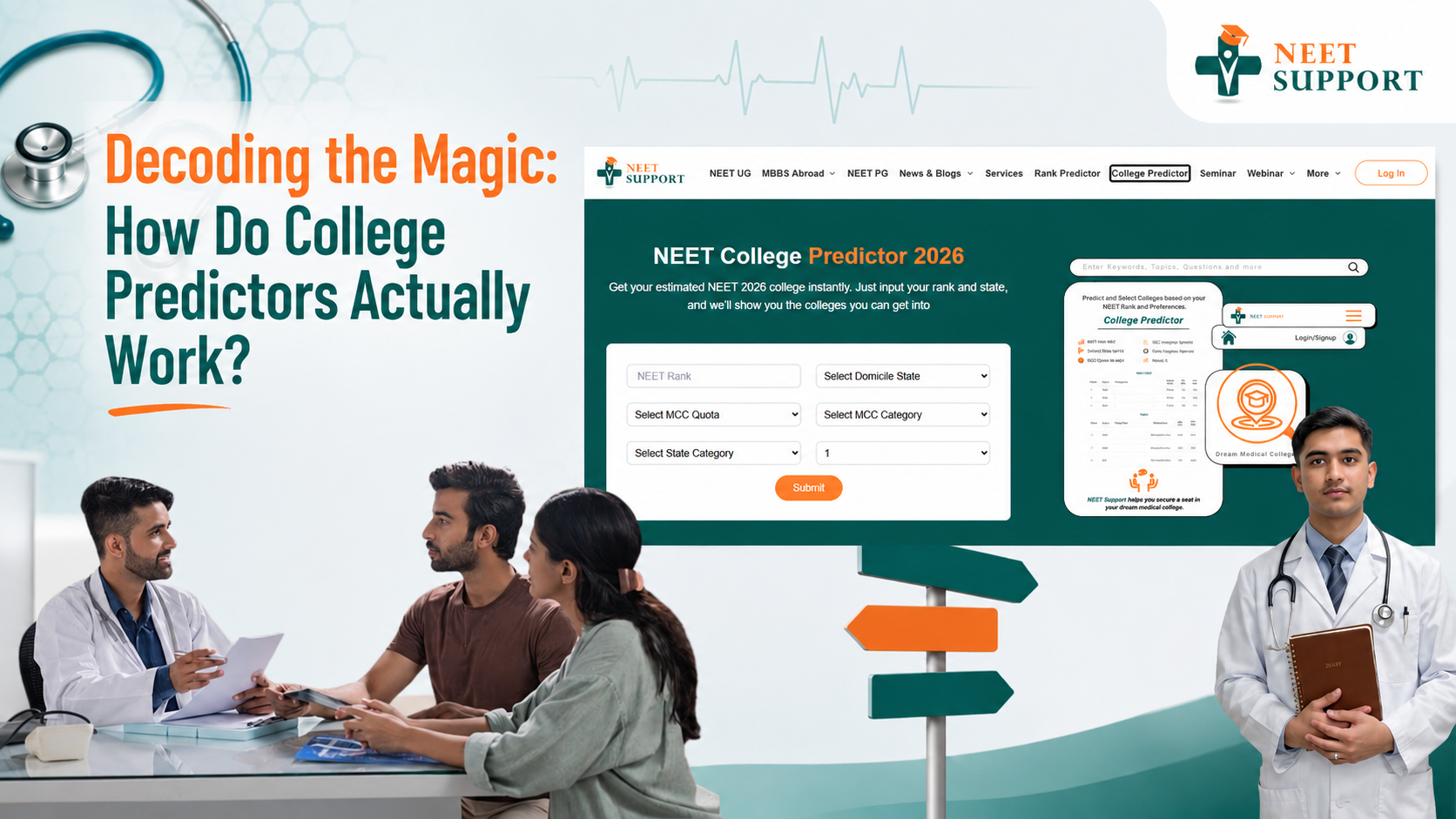
Decoding The Magic: How Do College Predictors Actually Work?
Nishat
 WhatsApp
 Email
Email Facebook
 Twitter/X
 LinkedIn
Table of Contents
Predict Your Rank Now
Enter your NEET score to get an estimated rank
Find the Best Colleges For You
Based on your NEET rank, Category & more

Get Your Dream Medical College
Secure your seat with expert counselling
Every year, lakhs of NEET aspirants find themselves in the exact same pressure cooker. The exam is over, the answer keys are matched, and you’re staring at your expected score or All India Rank (AIR). Now comes the trillion-dollar question: Which medical college will I get into?
Enter the NEET College Predictor—the ultimate digital savior for anxious future doctors and parents.
To know about a good college predictor, read- What is NEET College Predictor
You plug in your rank, select your category, hit "Predict," and boom! A curated list of government and private medical colleges appears on your screen. It feels like magic, but behind that smooth interface is a powerhouse of data science, MCC counseling rules, and historical logic.
If you’ve ever wondered how these tools actually estimate your chances of wearing that white coat, you’re in the right place. Let’s look at the three pillars that drive every accurate medical college predictor: Cutoffs, Seat Matrices, and Counseling Trends.
1. What Are Cutoffs?
The absolute foundation of any NEET predictor is cutoff data. In medical admissions, cutoffs are entirely driven by student choices and a simple concept: Opening and Closing Ranks.
- Opening Rank: The rank of the very first student who grabbed a seat in an MBBS/BDS course at a specific college (like AIIMS New Delhi or MAMC) during counseling.
- Closing Rank: The rank of the very last student who got the final available seat before the door shut for that college.
How Predictors Use This:
A good predictor ingests the closing ranks of hundreds of medical colleges from previous years. When you input your AIR, the tool instantly maps your rank against these historical ranges.
The Simple Rule: If your rank falls comfortably below the previous year’s closing rank for a specific government medical college (GMC), the predictor flags it as a "High Probability" or "Safe" option for you.
2. What Is the Seat Matrix?
A predictor that only looks at general cutoffs is doing half the job. NEET counseling is famously complex, and to give you a realistic prediction, the tool must factor in the official Seat Matrix.
The seat matrix is the blueprint released by counseling authorities detailing exactly how many MBBS seats are available. A predictor must instantly split your chances into two major pathways:
- 15% All India Quota (AIQ): Managed by the MCC, where students from any state can compete for seats in any government college across India, including central universities like AIIMS, AMU, and BHU.
- 85% State Quota: Managed by respective state counseling authorities (like DME Maharashtra, UPDGME, etc.). This is where your domicile matters massively, as cutoffs vary wildly from state to state.
The Category Breakdown:
Inside those quotas, the predictor filters seats based on your specific reservation:
- Category Quotas: General, OBC, SC, ST, EWS.
- Sub-categories: Persons with Disabilities (PwD) or Defense quotas.
When you select your category and home state, the algorithm deletes all irrelevant data, isolates the exact slice of the seat matrix meant for you, and calculates your chances based on category-specific closing ranks.
3. What Are Counseling Trends?
If a predictor only looked at last year's data, it would give you wrong results. Why? Because the medical admission landscape shifts every single year based on three major variables:
A. Rank Inflation (Score vs. Rank)
This is the biggest headache for NEET aspirants. In some years, a score of 610 might get you an AIR of 15,000. In a year with an easier paper, that exact same score of 610 might push your rank down to 30,000.
Advanced predictors know that colleges allocate seats based on Rank, not Marks. Therefore, the algorithm relies heavily on AIR trends rather than just looking at the score.
B. New Medical Colleges
Every year, the National Medical Commission (NMC) approves new government and private medical colleges, adding thousands of new MBBS seats. A smart predictor updates its database to reflect these new seats, knowing that more seats mean the closing ranks will likely slide down, giving you a better chance at older colleges.
C. Counseling Rounds
NEET admissions happen in waves.
- Round 1: Cutoffs are incredibly high because everyone is testing the waters.
- Round 2 & Mop-Up/Round 3: Cutoffs drop as top rankers leave state seats for AIQ seats (or vice versa).
- Stray Vacancy Round: High-risk, high-reward round where cutoffs can unexpectedly drop for remaining vacant seats.
A smart predictor doesn't just give you a flat "Yes." It tells you which round you are most likely to clear the cutoff.
How the Algorithm Works Step-by-Step
Here is the step-by-step journey your data takes the moment you click "Predict":
Tips for Using a College Predictor
While college predictors are incredibly smart, they predict probability, not certainty. To use a predictor like a seasoned counselor, follow these rules:
- Always Rely on AIR over Marks: Never use a predictor that asks only for your marks. Ranks are the only currency that matters in NEET counseling.
- Be Honest with Your Domicile: State cutoffs vary drastically. A rank that gets you a top GMC in one state might not even get you a semi-government seat in a high-cutoff state like Rajasthan or Uttar Pradesh. Input your legal domicile state carefully.
- Build Your Choice-Filling List: The best way to use a predictor is as a filtering tool. Use its output to construct your official counseling preference entry form. Place your "Dream" colleges at the very top, "Reach" in the middle, and "Safe" backups at the bottom.
FAQs
How accurate are NEET college predictors?
NEET college predictors are generally quite accurate when they use updated MCC and state counseling data along with previous years’ closing ranks. However, they predict probabilities, not guaranteed admissions, because counseling trends change every year.
What details do I need to use a NEET predictor?
Most predictors require your NEET score, AIR (All India Rank), category, domicile state, and quota preference. Accurate inputs help the algorithm provide more realistic college predictions.
Why is AIR more important than marks in NEET counseling?
Medical admissions are based primarily on rank rather than marks. The same marks can produce very different AIRs depending on exam difficulty and competition levels each year.
Why do NEET cutoffs change every year?
Cutoffs fluctuate because of exam difficulty, number of applicants, seat additions, reservation policies, and changes in student preferences toward specific colleges.
Do NEET predictors include private medical colleges?
Yes. Most advanced predictors include government, semi-government, deemed universities, and private medical colleges to give students a wider range of possible options.
How should I use a NEET college predictor smartly?
Use it to categorize colleges into dream, reach, and safe options while preparing your choice-filling strategy. It should guide your decisions, not replace official counseling information.
Summary
A NEET college predictor takes the chaos of lakhs of data points, category reservations, and dual-quota complexities, and condenses it into a clear, actionable roadmap. By blending cutoff boundaries, seat matrix constraints, and counseling round trends, these tools save you weeks of manual research and prevent costly mistakes during choice-filling.
So, calculate your rank, analyze the trends, and take your first step toward your medical career with confidence!
Also Read - Top 7 Mistakes Students Make After Checking A College Predictor
Reviews
No reviews yet. Be the first to write one!