
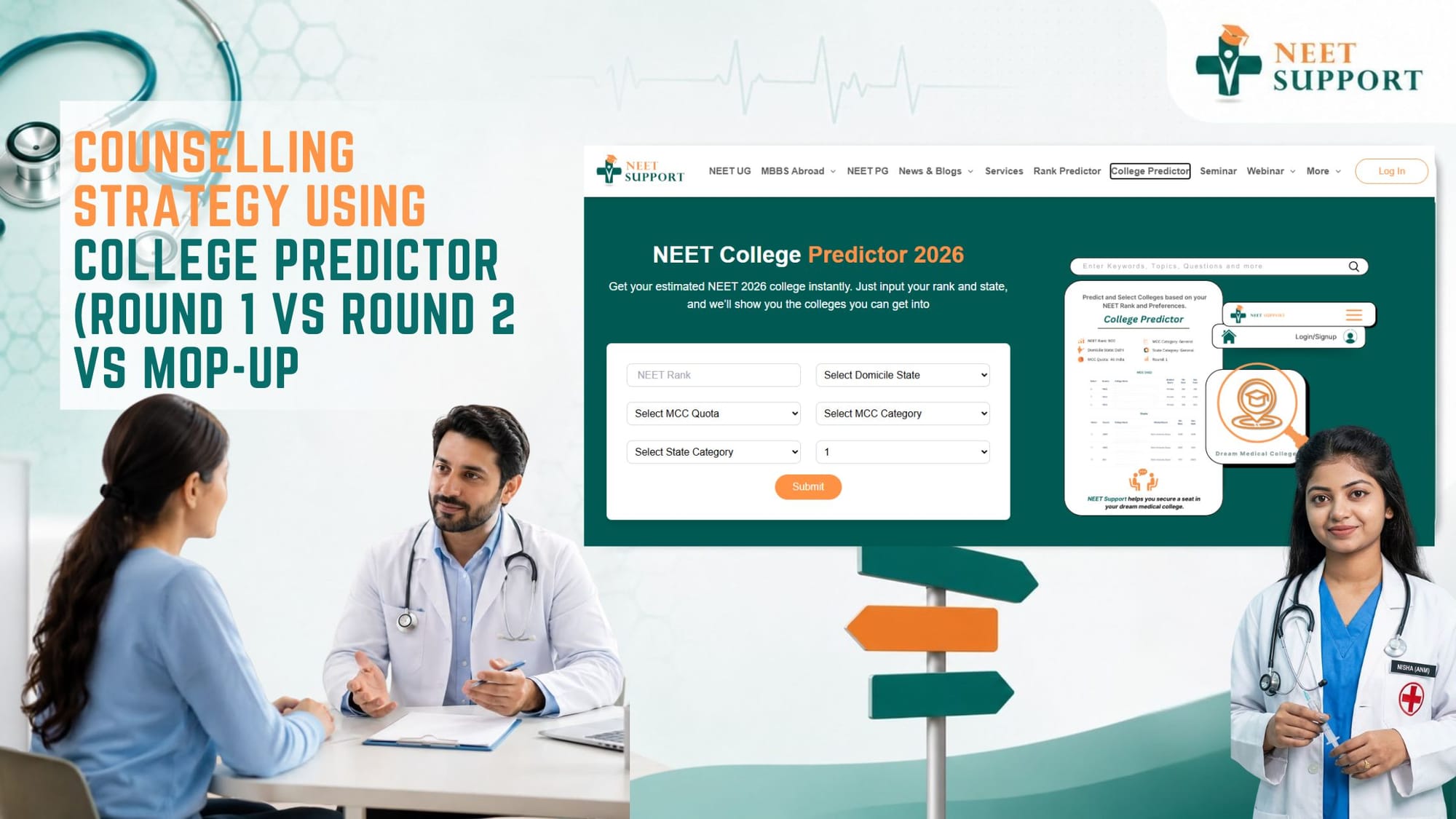
Counselling Strategy Using College Predictor (Round 1 vs. Round 2 vs. Mop-Up)
Nishat
 WhatsApp
 Email
Email Facebook
 Twitter/X
 LinkedIn
Table of Contents
Predict Your Rank Now
Enter your NEET score to get an estimated rank
Find the Best Colleges For You
Based on your NEET rank, Category & more

Get Your Dream Medical College
Secure your seat with expert counselling
The grueling hours of study, the endless mock tests, and the stress of the exam day are finally behind you. You have your NEET UG scorecard in hand, and a wave of relief washes over you. But just as you are about to celebrate, reality hits: the real game has just begun, and it's called the counselling process.
Securing a seat in a government or premium private medical college isn't just about your NEET score; it’s about masterfully navigating the All India Quota (AIQ) and State Quota counselling rounds (Nadella et al., 2025). Missing out on your dream MBBS or BDS seat because of a poor choice-filling strategy is a heartbreak you want to avoid.
By combining a calculated approach with a modern NEET College Predictor tool, you can turn the odds completely in your favor across Round 1, Round 2, and the Mop-Up (Round 3) stages (Nadella et al., 2025). Here is your ultimate, step-by-step game plan to ace the medical admissions process.
The Secret Weapon: What is a NEET College Predictor?
Before jumping into the rounds, let’s talk about your digital guide. A NEET College Predictor is an algorithmic tool that analyzes massive amounts of historical data—specifically the opening and closing ranks from previous Medical Counselling Committee and state rounds—alongside current seat matrices and category-wise distributions (UR, OBC, SC, ST, EWS).
Instead of manually scrolling through thousands of pages of confusing PDF cutoff lists from previous years, you enter your NEET All India Rank (AIR), category, and home state. The tool instantly categorizes your choices into:
- Dream Colleges: Highly ambitious options (e.g., top-tier AIIMS or premier state GMCs) where past cutoffs are slightly higher than your rank.
- Target Colleges: Highly realistic medical colleges where your rank matches previous cutoffs comfortably.
- Safety Colleges: Safe bets where cutoffs are traditionally lower, ensuring you won't walk away empty-handed.
Equipped with this tool, let's break down how your strategy must shift as you progress through the rounds.
For details, read- What is NEET College Predictor?
Round 1: The "Test Drive" and Dream Phase
Think of Round 1 as your baseline entry. Because almost every qualified NEET candidate registers for this round, the competition feels fierce, and cutoffs are generally at their highest. However, it is also the safest round because of the "Free Exit" rule.
The Strategy
- Aim High: Your choice-filling list should be heavily weighted toward your "Dream" and "Target" colleges. If you want a top-tier government medical college, put it down, even if your rank is slightly lower.
- Do Not Under-Fill: A common mistake made by NEET aspirants is filling out only 5 or 10 elite colleges. If you don't get allotted a seat, you gain no leverage. Fill out a comprehensive list that flows logically from top-tier down to your safety options.
Predictor Action Plan
Filter the college predictor for the Round 1 closing ranks of the previous 2–3 years. Lock in your top choices based on these results. If you get a seat, congratulations! You can report to the college, secure it, and opt for "Upgrade" to see if you can snag a better medical college in the next round without losing your current one.
Round 2: The Calculated Risk and Stabilization Phase
Round 2 is where the real chess game begins. Many seats allotted in Round 1 are vacated because students choose not to join, opt for their State Quota seats instead of the All India Quota (AIQ), or fail to complete documentation. Consequently, the seat matrix changes drastically.
The Strategy
- Beware the Exit Penalty: Unlike Round 1, Round 2 does not have a free exit. If you are allotted a seat in Round 2 and you forfeit it, your security deposit (which can be substantial, especially for Deemed Universities) will be forfeited.
- The Upgrade Climb: If you opted for an upgrade from Round 1, your previous seat remains secure unless you get a better choice from your new preference list in Round 2. Once upgraded, you cannot claim your Round 1 seat back.
- Re-order Wisely: Put medical colleges that are slightly above your rank but within striking distance at the very top.
Predictor Action Plan
Switch your college predictor settings to Round 2 historic cutoffs. Look specifically for colleges that showed a significant "drop" or variation in closing ranks between Round 1 and Round 2 in previous years. This reveals which institutions typically have a high vacancy rate after the first round.
The Mop-Up Round (Round 3): High-Risk, High-Reward
The Mop-Up Round (increasingly designated as Round 3 in modern unified systems) is the final major frontier for leftover, unjoined, or newly added seats in government and private institutions (Nadella et al., 2025). The dynamics here are entirely erratic. Sometimes, an elite GMC seat opens up because a student dropped out at the last second to join a different program or because of sudden seat additions by the NMC.
The Strategy
- The Ultimate Gamble: This round is perfect for two types of students: those who haven’t secured an MBBS/BDS seat yet, and those willing to risk a decent lower-tier seat for a shot at a vacant premium seat.
- Extreme Caution Required: Slots are incredibly limited. If you are too greedy and only fill ultra-elite colleges, you might end up with nothing, pushing you into the highly unpredictable Stray Vacancy round, where rules are incredibly strict.
- Pragmatism is King: Ensure your choice-filling includes a couple of rock-solid safety colleges that the predictor guarantees you will get, just to ensure you lock down an MBBS seat for the year.
Predictor Action Plan
Analyze the Mop-Up / Round 3 trends. Pay close attention to category shifts and look for hidden gems—GMCs in slightly remote locations or newly established state medical colleges that traditionally see cutoffs drop significantly in the final hours.
Comparative Cheat Sheet: Your NEET Choice-Filling Blueprint
Pro-Tips for NEET Aspirants
- Keep an Eye on the Live Seat Matrix: Before every single round, the MCC and state authorities release a fresh seat matrix showing exactly how many seats are vacant in each category. Cross-reference this live document with your college predictor data.
- Never Mix Up Course Preferences: If you only want MBBS, do not fill BDS or BAMS choices just to fill up the list. If you are allotted a seat you don't want in later rounds, exiting can be costly and legally complicated.
- Master the AIQ vs. State Quota Balance: Track how your 85% State Quota rounds align with the 15% All India Quota (AIQ) rounds (Nadella et al., 2025). Often, securing a top-tier college in your home state during State Round 2 is a much safer and better bet than chasing a wild card in the central Mop-Up.
FAQs
Are NEET College Predictors completely accurate?
No predictor can guarantee exact allotments because counselling changes every year depending on competition, seat availability, reservation policies, and student preferences. However, a good predictor provides a strong estimate and helps build a smart strategy.
Should I participate in Round 1 even if my rank is low?
Yes. Many students skip Round 1 assuming they won’t get a seat, but even participating gives you experience with the counselling system and keeps you eligible for later rounds in many counselling processes.
Is Round 2 easier than Round 1?
Round 2 can sometimes offer slightly lower cutoffs because some students leave seats vacant after Round 1. However, competition still remains high, especially for top government medical colleges.
What happens if I do not join the allotted college in Round 2?
In most counselling systems, leaving a seat in Round 2 can lead to forfeiture of the security deposit and other penalties. Students should carefully read counselling rules before making decisions.
Can I upgrade my seat after getting one in Round 1?
Yes. Most counselling authorities allow students to choose an “upgrade” option. This means your current seat remains safe while you become eligible for a better preference in the next round.
Conclusion
NEET counselling is not just a bureaucratic formality; it is a strategic extension of your competitive exam. By understanding the distinct behavioral shifts from Round 1 to Round 2, and finally to the Mop-Up round, you transition from a passive applicant to an active strategist.
Trust your hard work, leverage technology like data-driven NEET college predictors, stay patient, and play your cards right. Your white coat and stethoscope are well within reach!
Also Read - How You Can Find the Best NEET-UG Rank Predictor
Reviews
No reviews yet. Be the first to write one!