
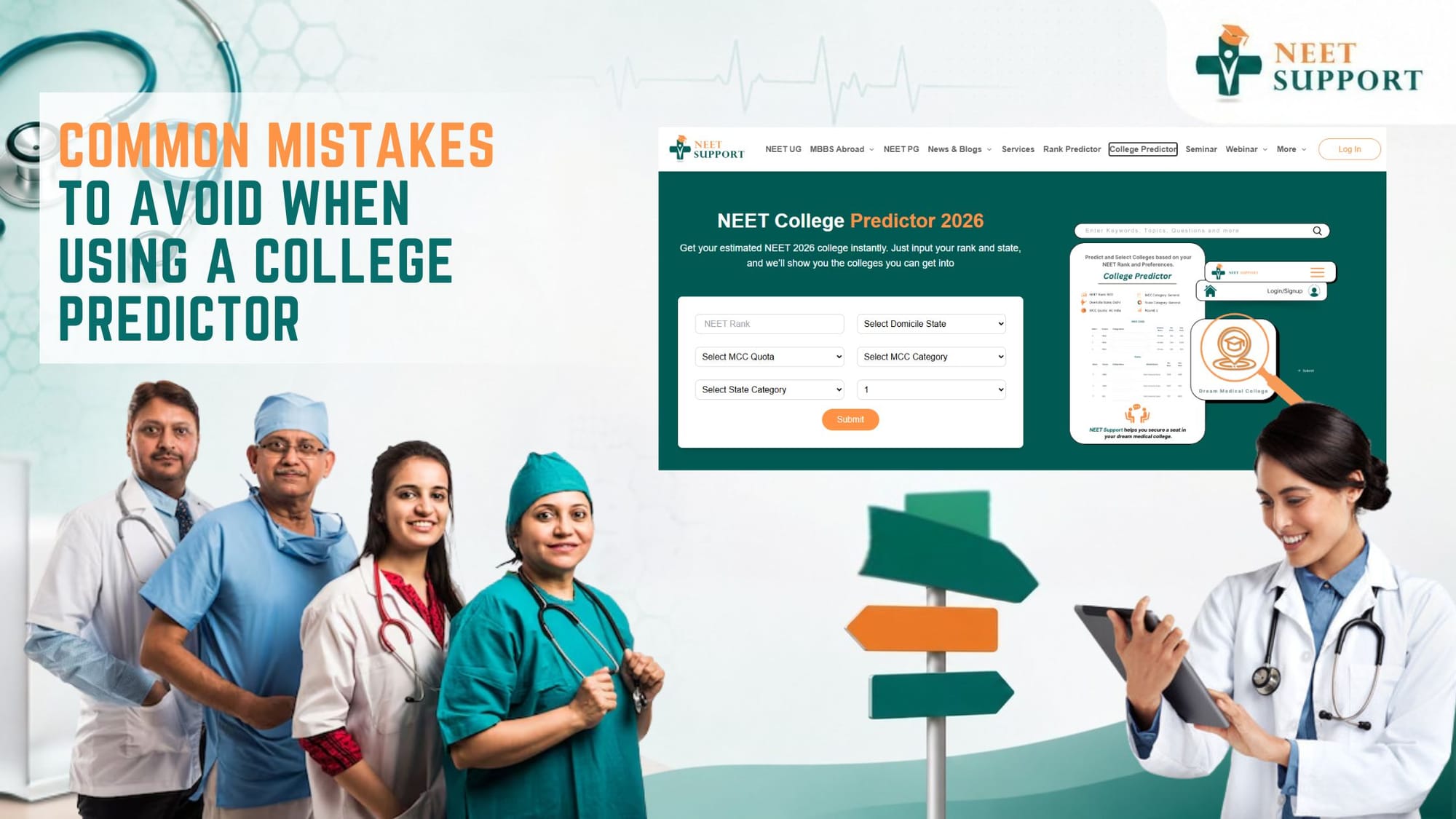
Common Mistakes to Avoid When Using a College Predictor
RISHIKESH KUMAR
 WhatsApp
 Email
Email Facebook
 Twitter/X
 LinkedIn
Table of Contents
Predict Your Rank Now
Enter your NEET score to get an estimated rank
Find the Best Colleges For You
Based on your NEET rank, Category & more

Get Your Dream Medical College
Secure your seat with expert counselling
Overview
The time period after the examinations is emotionally demanding for scholars and their families. After months of preparation, school exams, or competitive entrance examinations, scholars eventually complete the most delicate stage of their academic journey. Still, rather than immediate relief, a situation of anxiety and stress is felt by students while waiting for admission results. During this phase, a large number of scholars and parents depend on admission predictors or college prediction platforms to estimate future academic openings and possible career paths.
When used wisely, these tools can be largely useful and beneficial for students. They study past admission records, opportunities, and closing ranks, seat allocation patterns, and counselling trends to give scholars a practical understanding of suitable college options. Similar platforms can support better decision-making and help candidates to prepare for counselling sessions in a more systematic and confident manner.
Despite these advantages, the effectiveness of a college predictor largely depends on the correctness of the information entered and the prospects users attach to the results. Misinterpreting probabilities, ignoring category-based details, or believing that a predicted result guarantees admission can lead to confusion and poor planning during the counselling process.
Before understanding the specialized limitations of these platforms, scholars must first recognize their factual purpose. A college predictor substantially works on past data and statistical analysis. It examines patterns from earlier admission cycles and estimates the possibility of securing admission under the same circumstances.
Still, no algorithm can completely predict the changing conditions of a new admission cycle. Differences in examination difficulty, unforeseen changes in students’ preferences, policy variations, or sudden social and economic factors may impact final admission. Thus, scholars should use these tools as academic guides rather than fully reliable sources for making final admission opinions and future educational plans.
Key Highlights
If you are currently plugging your numbers into online portals, keep these high-level warning signs in mind:
Garbage In, Garbage Out
Entering estimated or wrong scores rather than official marks or predicted rank can provide false admission predictions. Accurate information is essential for obtaining reliable results from any predictor tool.
The Quota Oversight
Scholars frequently ignore the major differences between open-category and reserved-category admission criteria. This mistake may lead to unrealistic expectations or missed opportunities at dream institutions.
Treating “Possible” as “Guaranteed”
A high probability score shouldn't be considered a verified admission offer. Scholars should always include other backup colleges during the counselling and choice-filling process.
Ignoring the Structural Timeline
Using outdated predictor platforms without checking the latest admission programs, seat matrix, or input changes can result in inaccurate guidance and poor decision-making.
Core Mistakes to be Avoided
1. Entering Unrealistic or wrongly calculated Marks
One of the most common miscalculations scholars make is entering inaccurate scores into college predictor tools. After competitive examinations, various scholars calculate their marks using unofficial answer keys and frequently overrate their performance. Some ignore negative marking rules, while others award themselves marks for uncertain answers.
This can result in serious problems because, indeed, a small difference in marks may significantly affect the final rank, especially in competitive fields such as engineering and medical lines.
2. Confusing “Rank Predictors” with “College Predictors.”
Numerous scholars fail to understand the difference between a rank predictor and a council predictor. A rank predictor estimates a pupil’s anticipated rank or percentile based on examination marks, whereas a council predictor compares that rank with former admission cutoffs to suggest suitable institutions.
Using raw marks directly in a council predictor without first estimating a realistic rank frequently leads to inaccurate results. Scholars should first calculate their probable rank using dependable platforms before exploring council options.
To get detailed information about “Rank-Predictor” and “College-Predictor”: Click here.
3. Reservation basis
University admissions are divided into several categories and proportions. Ignoring reservation criteria, state proportions, or Category-specific criteria may result in incorrect college prediction and poor counselling guides.
[Your Input Score]
│
├──► Wrong Category Chosen ──► Useless, Inaccurate Predictor Output
│
└──► True Verified Profile ──► Actionable Target & Safety College List
Scholars belonging to reserved or specialized categories should precisely review category-based admission data rather than counting only on open-merit statistics. Ignoring reservation benefits may cause scholars to underrate their admission openings. On the other hand, opting for a reserved category in a predictor tool without enjoying a valid and officially approved instrument can result in unrealistic marks and inaccurate admission possibilities.
4. Blindly Copying the Predictor output Into Choice-Filling Forms
Various scholars make the mistake of directly copying the list generated by predictor platforms into official counselling portals. During counselling processes similar to JoSAA, MCC, or state-based admissions, the order of preferences plays a largely important part. Predictor tools substantially arrange colleges according to statistical chances rather than particular factors such as economic condition, position preference, campus terrain, or many other attributes.
To know about the college's cutoff, admission process, and seat matrix: Click here.
Moving from Guesswork to Precision
To combat these common algorithmic biases, use this structural checklist to frame your college selection methodology:
| Step | Action Item | Why It Matters |
|---|---|---|
| 1 | Use multiple independent tools | Comparing results across different platforms helps reduce errors caused by relying on a single prediction source. |
| 2 | Enter a conservative score estimate | Using a worst-case or lower-bound score ensures that “safety” colleges remain realistically achievable. |
| 3 | Verify the top 5 predictions manually | Checking recommendations against official university cutoff records improves accuracy and reduces misinformation. |
| 4 | Apply personal decision filters | Considering financial limits, preferred branch, and placement records ensures choices align with real personal priorities. |
Frequently Asked Questions (FAQs)
1. Why did the College predictor tool? I could get into a college, but I was rejected in the first round?
Predictors evaluate the absolute final closing ranks, usually matching the late spot-admission or mop-up rounds of previous years. The early rounds of live counseling always feature significantly higher cutoffs because top-tier students hold onto multiple seats before dropping them later in the cycle.
2. Should I trust free predictor tools or pay for premium ones?
Free tools are excellent for broad structural overviews (e.g., understanding if your rank places you in Tier 1, Tier 2, or Tier 3 institutions). Premium tools typically provide value if you need highly hyper-localized data, such as tracking complex minority quotas, internal branch sliding trends, or real-time seat matrix updates.
3. Can a change in the exam's difficulty pattern break a predictor's accuracy?
Absolutely. If an entrance exam is significantly easier than the previous year, the average scores will skyrocket. This means a score of 90% might net a much lower relative rank than it did a year prior, rendering tools that rely purely on static "marks-to-college" metrics inaccurate. Always prioritize "rank-to-college" metrics.
4. How do predictors handle brand-new college branches or campus locations?
They struggle with them. Because algorithms rely on historical datasets, they cannot accurately evaluate a newly launched branch (e.g., Artificial Intelligence or Data Science tracks at a classic university) or a freshly constructed satellite campus. For those, you must analyze the core university's general reputation manually.
5. What does it mean if a tool says a college is a "Reach"?
A "Reach" (or Dream) category indicates that your rank or score sits slightly below or directly on the historical cutoffs of that institution. Admission is statistically possible if seat surrender rates are high, but it should never be relied upon as a guaranteed option.
6. Can I use an out-of-state predictor for state-quota engineering or medical seats?
Only if the tool explicitly features a localized state-quota toggle. State counseling systems operate on completely independent merit lists and regional reservation laws. Using a generic national tool to calculate local state-quota behavior is a major recipe for error.
Conclusion
College predictors serve as precious tools that simplify complex and unstructured admission data into clear ranges. This helps scholars and families save considerable time that would otherwise be spent manually examining information and documents. Still, these tools are designed to support human judgment rather than replace it entirely.
Scholars should avoid counting on them as fully accurate or guaranteed sources of admission issues. A more balanced approach includes using conservative score estimates, verifying categories and regional quota details, and maintaining a well- prepared list of dependable backup institutions. By integrating data-driven perceptivity with particular research and practical considerations, scholars can make further informed and confident opinions throughout the admission process.
Reviews
No reviews yet. Be the first to write one!