
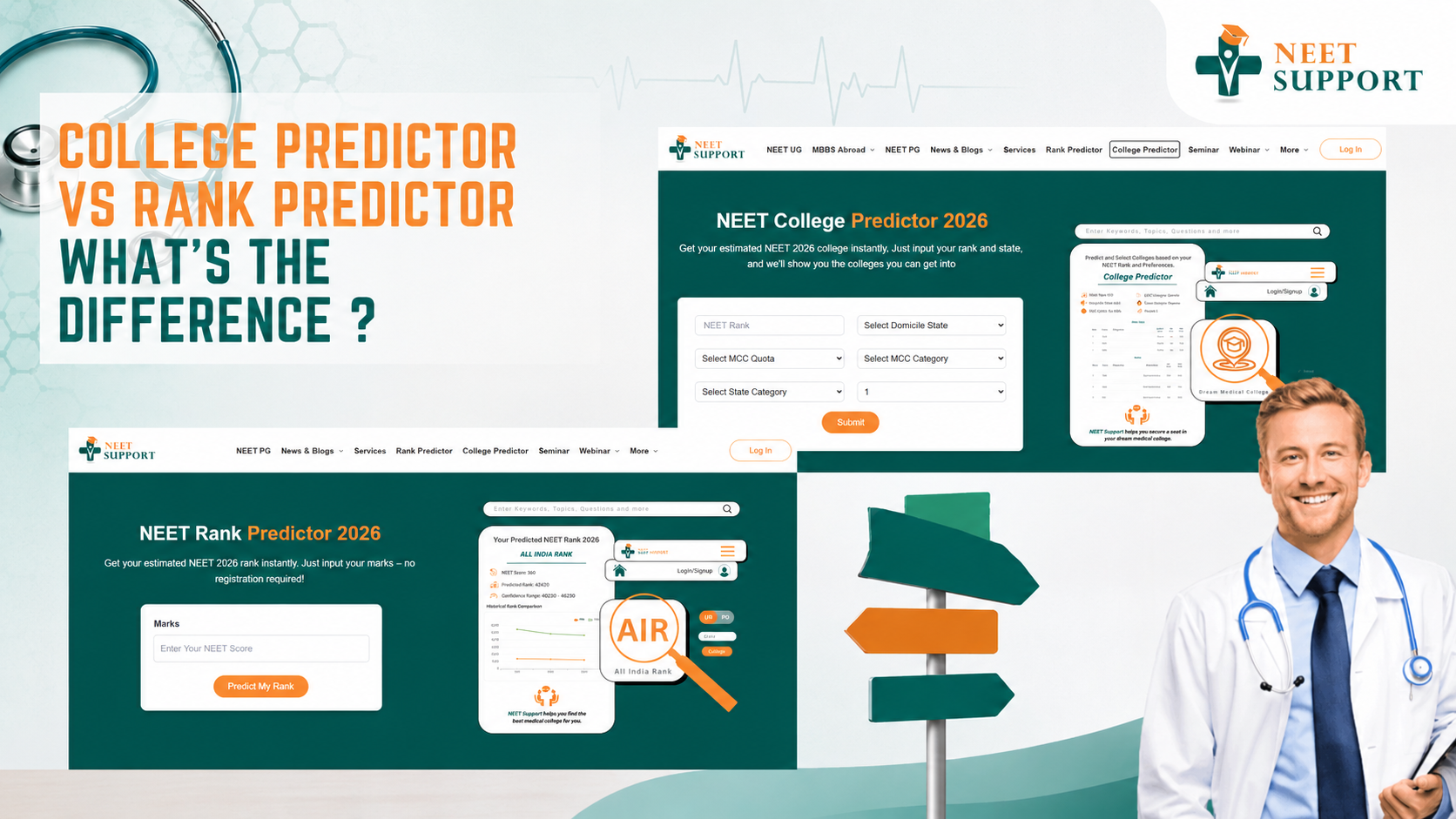
College Predictor vs. Rank Predictor: What’s the Difference?
Nishat
 WhatsApp
 Email
Email Facebook
 Twitter/X
 LinkedIn
Table of Contents
Predict Your Rank Now
Enter your NEET score to get an estimated rank
Find the Best Colleges For You
Based on your NEET rank, Category & more

Get Your Dream Medical College
Secure your seat with expert counselling
The exam season is finally over. You’ve spent months—maybe even years—huddled over textbooks, drinking questionable amounts of coffee, and memorizing formulas. You’ve finally walked out of the exam hall, taken a massive sigh of relief, and... realized the anxiety isn't actually gone. It has just evolved.
Now begins the waiting game. What will my score be? What will my rank be? And most importantly, which college am I actually getting into?
In the middle of this stressful limbo, you will inevitably run into two popular online tools designed to save your sanity: Rank Predictors and College Predictors.
At first glance, they sound like they do the exact same thing. But using them interchangeably is a bit like confusing a GPS with a weather app—both are useful for a road trip, but they tell you completely different things. Let’s break down exactly what these tools are, how they differ, and how you should use them to land your dream campus.
1. What is a Rank Predictor?
Before a university can offer you a seat, they need to know where you stand in the crowd. That is where a Rank Predictor comes in.
How it Works
A Rank Predictor takes your estimated exam scores (which you calculate using official or unofficial answer keys) and estimates what your final rank will be across the country or state.
It does this by analyzing:
- Historical Data: How many marks were required to get a specific rank in previous years?
- Exam Difficulty: If the paper was brutally hard, a lower score might still yield a high rank. If it were easy, everyone’s scores would shoot up.
- Number of Test-Takers: More competition generally shifts the rank brackets.
The Core Purpose: A Rank Predictor answers the question: "Based on how I think I performed, where do I stand compared to everyone else?"
2. What is a College Predictor?
Once you have a rough idea of your rank (or your actual rank once results are officially declared), you move on to the College Predictor.
How it Works
A College Predictor skips the guesswork about your performance and focuses entirely on the admissions ecosystem. You input your expected or actual rank, your category (General, OBC, SC, ST, EWS), your gender, and your home state.
The tool then cross-references your profile with the cutoff trends of hundreds of colleges from the last 3 to 5 years.
The Core Purpose: A College Predictor answers the question: "With the rank I have, which campuses and engineering branches/medical seats am I realistically going to get?"
The Key Differences
To help you visualize how these two tools operate, let’s look at them side-by-side:
For details, read- What is NEET College Predictor
Why You Can’t Rely on Just One
Think of the admission process as a two-step journey.
If you only use a Rank Predictor, you'll get a number—say, Rank 4,500. That’s great for bragging rights or calming your nerves, but it doesn’t tell you if Rank 4,500 is enough to get into your favorite computer science program or a top-tier medical college.
On the flip side, a College Predictor is practically useless without a rank. If you feed it random numbers, it will feed you random colleges.
The Best Way to Use Them:
- Step 1: The exam finishes. You check the answer key and get your estimated marks.
- Step 2: You plug those marks into a Rank Predictor to get an estimated rank range (e.g., 8,000–9,500).
- Step 3: You take that estimated rank and plug it into a College Predictor to see what your future might look like.
- Step 4: Once the official results are declared, you throw away the Rank Predictor, take your actual rank, and run it through the College Predictor one last time to finalize your counseling strategy.
The Reality Check: Are These Tools 100% Accurate?
It is incredibly important to take these predictors with a grain of salt. They are driven by algorithms and historical data, not magic. They cannot predict human behavior or sudden structural changes.
Here is why their predictions can sometimes go sideways:
- The Changing Trends: If a particular branch (like Artificial Intelligence) suddenly becomes massively popular in a given year, its cutoff will skyrocket, rendering last year's data less accurate.
- Seat Matrix Updates: If top colleges suddenly add 500 new seats, the cutoffs will drop, opening doors that a predictor might have labeled "closed."
- Human Error in Inputs: Rank predictors rely on students accurately reporting their marks. If thousands of students miscalculate their scores on the tool, the predicted rank curve will be skewed.
How to Smartly Use These Predictors for Choice Filling
When the time comes for counseling (choice filling), your College Predictor results should serve as your foundation. A smart strategy is to divide your predicted colleges into three distinct buckets:
1. The "Dream" Bucket (Top Choices)
These are colleges where the previous year's cutoffs were slightly higher than your rank. There is a low-to-medium chance you will get in, but you should absolutely list them at the top of your choice form just in case cutoffs drop.
2. The "Realistic" Bucket (Match Colleges)
These are the colleges that the tool predicts you have a 70% to 90% chance of clearing. Your rank aligns beautifully with their historical cutoffs. This forms the meat of your application list.
3. The "Safe" Bucket (Backup Choices)
These are colleges where your rank is comfortably higher than their usual cutoffs. You are almost guaranteed a seat here. Always include a few of these at the bottom of your list so you don’t end up empty-handed if the year proves to be highly competitive.
FAQs
Which tool should I use first, the Rank Predictor or the College Predictor?
You should use the Rank Predictor first. It helps you estimate your rank right after your exam using your calculated marks. Once you have that estimated rank, you can plug it into a College Predictor to see your campus options.
Can I use a College Predictor before my official exam results are declared?
Yes, but you will need to use your estimated rank from a Rank Predictor first. Keep in mind that your results will only be as accurate as the estimated rank you provide.
Why do different websites show different predicted ranks for the same marks?
Each website uses its own unique formula and historical data pool. Some might factor in a higher difficulty level for the exam, while others might have a larger sample size of student data, leading to slight variations in their predictions.
How accurate are Rank Predictors?
They are generally reliable for getting a rough estimate, but they are rarely 100% accurate. They cannot perfectly predict the exact performance of every single student across the country or sudden changes in the marking trends.
What does "Opening Rank" and "Closing Rank" mean in a College Predictor?
Opening Rank: The highest rank (best score) accepted by a college for a specific course in a previous year.
Closing Rank (Cutoff): The lowest rank accepted for that course, meaning the seat matrix was filled after this rank.
Should I rely on these tools for my final counseling choice filling?
Use them as a reference guide, but do not rely on them blindly. Treat the output as a starting point to build your list, and always verify current seat counts, fees, and college approvals on the official counseling website.
If my exam was very difficult, will my predicted rank be lower or higher?
If the exam paper was exceptionally tough for everyone, the overall cutoffs will drop. This means you can achieve a higher (better) rank even with a lower numerical score compared to previous years.
Final Thoughts
The period between writing an exam and sitting in a college classroom is filled with speculation, rumors, and unsolicited advice from relatives.
Instead of stressing out, use Rank Predictors and College Predictors as data-driven compasses. A Rank Predictor tells you how well you fought the battle; a College Predictor helps you map out the territory you’ve won. Use them together, plan your choices wisely, and take your next big step with confidence. Good luck!
Reviews
No reviews yet. Be the first to write one!