

Charminar to Convocation: An NRI's Guide to Telangana's Top Private Medical Colleges
Nishat
 WhatsApp
 Email
 Facebook
 Twitter/X
 LinkedIn
Table of Contents
Predict Your Rank Now
Enter your NEET score to get an estimated rank
Find the Best Colleges For You
Based on your NEET rank, Category & more

Get Your Dream Medical College
Secure your seat with expert counselling
Introduction
Hyderabad shows up on every NRI shortlist sooner or later — biryani jokes aside, it's genuinely become one of India's biggest private medical education markets. Here's what the fee brochures don't spell out clearly enough.
Quick numbers before we dive in:
- 28+ private medical colleges in Telangana offer NRI seats
- ~700 NRI-quota MBBS seats statewide
- 0 deemed medical universities in Telangana
- 15% of every private college's seats are reserved for NRI/OCI candidates
If you're reading this from Chicago, Muscat, or Sydney, chances are someone in the family already floated Hyderabad as an option — maybe a cousin studying at Kamineni, maybe just the city's reputation as India's newer tech-and-healthcare boomtown. Telangana's private medical college scene is large, well-established, and genuinely built around NRI admissions in a way few states are this explicit about. But it also works a little differently from neighbouring Andhra Pradesh, and knowing that difference upfront will save you a confused phone call with an admissions office in the middle of counselling season.
The One Thing To Get Straight Before Anything Else
Telangana currently has no deemed-to-be-university medical college. Every single medical college in the state — private or government — is affiliated to Kaloji Narayana Rao University of Health Sciences (KNRUHS), Warangal, and admissions run through KNRUHS's own centralised counselling rather than the MCC's separate deemed-university pool. That's a genuinely useful simplification for NRI families: there's only one counselling calendar to track, one fee-regulating body (the Telangana Admission and Fee Regulatory Committee, or TAFRC) setting the ceilings, and one rulebook governing every private college's NRI quota.
Why this matters for your planning: Because there's no deemed-university premium to weigh against private-college pricing here, Telangana's NRI-quota fee band is far tighter and more predictable than Andhra Pradesh's. You're mostly comparing private colleges against each other — on hospital strength, city location, and brand — rather than choosing between two structurally different systems.
How Are the Seats Actually Sliced?
Every private medical college in Telangana splits its MBBS intake into three fixed categories, and this three-tier structure is the single most important thing to understand before you start comparing colleges:
- Category A (Convenor / State Quota) — 50% of seats. Filled through KNRUHS's merit-based state counselling at a heavily subsidised fee, roughly ₹60,000 a year. Open mainly to domicile candidates competing on NEET rank.
- Category B (Management Quota) — 35% of seats. Filled by the college's own management, open to a wider pool of NEET-qualified candidates, at ₹11.5–14 lakh a year.
- Category C (NRI Quota) — 15% of seats. Reserved specifically for NRI, OCI, and PIO candidates (or NRI-sponsored Indian candidates), typically priced at ₹23–26 lakh a year at most colleges, rising higher at the most in-demand Hyderabad institutions.
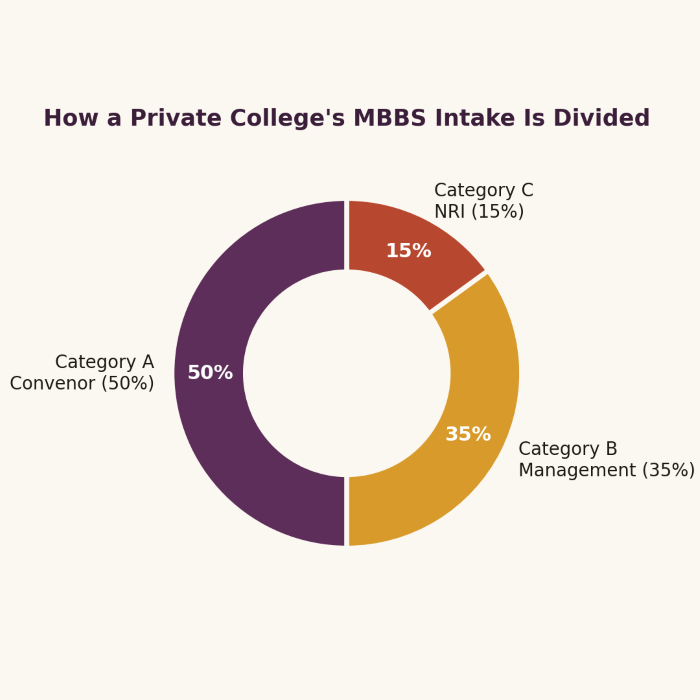
Based on the published Category A / B / C seat-matrix rules applied across Telangana's private medical colleges.
Government medical colleges, worth noting, don't participate in this at all — Telangana's state-run colleges have no NRI quota whatsoever. Every NRI seat in the state sits inside a private college.
What NRI Quota Actually Costs, Category By Category?
The jump between categories is steep, and it's worth seeing side by side rather than as three separate numbers you half-remember from different websites.
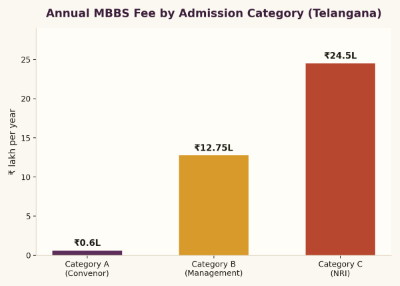
Category A and B figures from TAFRC's 2026–27 notified fee structure; Category C (NRI) shown as the statewide ₹23–26 lakh band's midpoint. Individual colleges vary — see the college comparison below.
That's the statewide average. In practice, Telangana's NRI-quota fees fan out more than the ₹23–26 lakh headline number suggests — the most sought-after Hyderabad-adjacent colleges push meaningfully higher, while smaller regional colleges often sit lower to stay competitive for seats that are otherwise hard to fill.
The Colleges NRI Families Actually Shortlist
Telangana's private medical college field is large — more than 28 institutions currently offer NRI seats — so most families narrow it down fast using three filters: hospital bed strength, how established the college is, and where it sits relative to Hyderabad. Here's how some of the most frequently shortlisted names stack up.
| College | Location | Established | Teaching hospital | Indicative NRI-quota fee (annual) |
|---|---|---|---|---|
| Kamineni Institute of Medical Sciences | Narketpally, Nalgonda | 1997 | 1,000+ beds | ₹30–35 lakh |
| Apollo Institute of Medical Sciences & Research | Hyderabad | 2012 | Apollo Hospitals network | ₹28–32 lakh |
| Malla Reddy Institute of Medical Sciences | Hyderabad | 2006 | 800+ beds | ₹22–26 lakh |
| Deccan College of Medical Sciences | Hyderabad | 1985 | 750+ beds | ₹23–26 lakh |
| MediCiti Institute of Medical Sciences | Ghanpur, Medchal | 2001 | 600+ beds | ₹23–25 lakh |
| Chalmeda Anand Rao Institute of Medical Sciences | Karimnagar | 2002 | 700+ beds | ₹20–24 lakh |
| Mamata Medical College | Khammam | 1995 | 1,000+ beds | ₹12–20 lakh |
| SVS Medical College | Mahbubnagar | 2002 | 500+ beds | ₹20–24 lakh |
Fee figures are indicative ranges drawn from published counselling and admissions sources and shift every academic year — always confirm the exact, current figure with the college's admissions office or KNRUHS's official fee notification before committing funds. Hyderabad-based colleges with larger, more established hospitals tend to sit at the higher end of the NRI-fee band; regional colleges outside the city are usually more moderately priced.
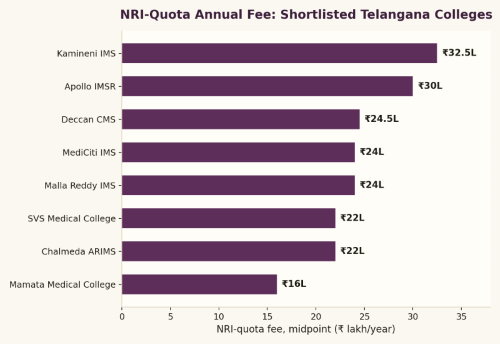
Midpoints calculated from the indicative ranges in the table above.
Hyderabad Versus The Rest Of The State
One more pattern worth knowing before you pick a shortlist: where a college sits geographically shapes both its price and its patient volume. Hyderabad and its immediate suburbs host the largest concentration of high-fee, high-infrastructure private colleges, while regional hubs like Karimnagar, Khammam, and Mahbubnagar offer solid, NMC-approved alternatives at a noticeably gentler price point.
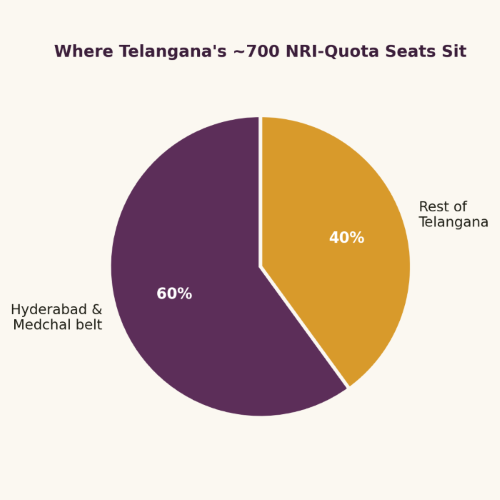
Approximate distribution based on the concentration of private medical colleges in Hyderabad/Medchal versus other Telangana districts.
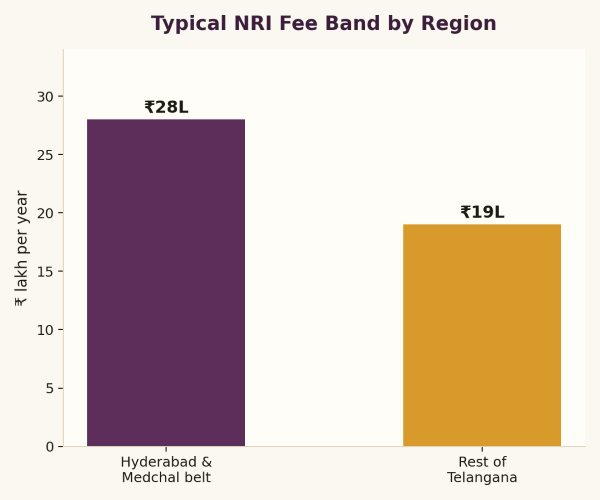
Illustrative comparison based on the college fee ranges shown earlier.
Neither option is automatically the right call. A Hyderabad college puts your child closer to the international airport, a larger NRI-student community, and (often) a bigger, busier hospital. A regional college can mean a smaller, closer-knit campus and meaningfully lower fees — sometimes ₹10 lakh a year or more in savings, which compounds fast across 4.5 years.
How NRI-Quota Admission Works In Telangana?
- Qualify NEET-UG. Compulsory for every seat and every category — Convenor, Management, or NRI — with no exceptions.
- Confirm your NRI/OCI/PIO status or sponsorship. NRI-sponsored candidates need notarised proof of their relationship to a first-degree NRI relative, along with that relative's own status documentation.
- Register for KNRUHS counselling. Unlike states with a separate deemed-university track, every Telangana private college — including Category C NRI seats — is filled through the single KNRUHS state counselling portal.
- Upload documents for verification. NEET scorecard, passport and visa/residency proof, academic transcripts (with AIU equivalence certificates if schooled abroad), and NRI sponsorship paperwork.
- Fill and lock your choices. KNRUHS counselling typically runs across multiple rounds, including a Mop-Up round — watch the portal closely, as notification windows are often short.
- Accept your allotment and pay fees within the deadline stated in your allotment order; late payment can forfeit the seat.
- Report physically to the college with original documents to complete admission formalities.
The Documents To Keep Ready
- Valid passport and visa/residency proof for the candidate, or for the sponsoring NRI relative
- NRI/OCI/PIO status certificate, or notarised sponsorship affidavit establishing the family relationship
- NEET-UG admit card, rank letter, and scorecard issued by NTA
- 10th and 12th mark sheets, with AIU equivalence certification if the candidate studied abroad
- Transfer/migration certificate and conduct certificate from the previous institution
- Passport-size photographs and any category certificates as specified by KNRUHS
How To Actually Pick One?
With this many private colleges competing for the same NRI-quota applicant pool, a shortlist built on hospital strength and honest budget math tends to serve families far better than chasing name recognition alone:
- Match the fee to a full 4.5-year budget, not just one year. A ₹10 lakh-a-year difference between two colleges becomes a ₹45 lakh difference by graduation — before hostel, mess, and living costs.
- Ask about bed count and daily patient footfall, not just total hospital size. A 1,000-bed hospital with low occupancy teaches less than a busier 600-bed one.
- Check how many rounds of KNRUHS counselling the college typically fills in, since colleges that regularly go to Mop-Up round can sometimes be negotiated with more flexibly on documentation timing.
- Factor in the city. Hyderabad colleges offer better connectivity and a larger expatriate-student community; regional colleges often offer quieter campuses and real cost savings.
- Confirm there's no confusion between Category B and Category C pricing when a consultant quotes you a number — the two are frequently blurred in marketing material, and the gap between them is substantial.
FAQs
Does Telangana have any deemed medical university?
No. As of now, Telangana has no medical college holding UGC "Deemed to be University" status. Every medical college in the state, government or private, is affiliated to Kaloji Narayana Rao University of Health Sciences (KNRUHS) and admits through the state's own centralised counselling rather than the MCC's separate deemed-university pool.
Do Telangana's government medical colleges have an NRI quota?
No. NRI quota seats in Telangana exist exclusively in private medical colleges, where they make up 15% of the total MBBS intake (Category C). Government colleges fill their seats entirely through Convenor/state-quota and All India Quota routes, with no NRI reservation.
What are Category A, B, and C in Telangana's admission system?
They're the three fixed seat categories every private medical college in Telangana must follow. Category A (Convenor/State Quota) is 50% of seats at a subsidised fee around ₹60,000 a year. Category B (Management Quota) is 35% of seats, priced ₹11.5–14 lakh a year. Category C (NRI Quota) is 15% of seats, reserved for NRI/OCI/PIO candidates, priced roughly ₹23–26 lakh a year on average, though top-tier colleges charge more.
Who regulates the fees private colleges can charge?
The Telangana Admission and Fee Regulatory Committee (TAFRC) sets and notifies the fee ceilings for Category A, B, and C seats each academic year, and KNRUHS enforces these figures through its centralised counselling process. Colleges cannot charge above the notified band for a given category.
Who is eligible for the NRI quota — does the student have to live abroad themselves?
Not necessarily. Candidates who are themselves NRI, OCI, or PIO status holders are directly eligible. Alternatively, an Indian-resident candidate can be admitted under "NRI-sponsored" status if a first-degree relative — typically a parent or sibling — holds valid NRI status and formally sponsors the admission with notarised documentation.
Which counselling authority handles admissions — is it MCC or a state body?
Kaloji Narayana Rao University of Health Sciences (KNRUHS), Warangal, handles all Telangana medical college counselling, including Category C (NRI) seats in private colleges. There's no separate MCC deemed-university counselling to navigate here, since Telangana has no deemed medical university.
The Bottom Line
Telangana's private medical college system is unusually transparent, as these things go: one counselling body, one regulator setting fee ceilings, and a clearly defined 15% NRI quota at every participating college. There's no deemed-university wildcard to weigh, which makes comparison-shopping genuinely easier than in most states. The real decision is simpler than it looks — pick your city, be honest about your 4.5-year budget, and shortlist three or four colleges with hospitals strong enough to actually teach your child medicine, not just award them a degree.
Reviews
No reviews yet. Be the first to write one!