

Backwaters and Bedsides: An NRI's Guide to Kerala's Top Private Medical Colleges
Nishat
 WhatsApp
 Email
 Facebook
 Twitter/X
 LinkedIn
Table of Contents
Predict Your Rank Now
Enter your NEET score to get an estimated rank
Find the Best Colleges For You
Based on your NEET rank, Category & more

Get Your Dream Medical College
Secure your seat with expert counselling
Introduction
Ask any NRI education consultant which state has the most predictable private MBBS market in India, and Kerala usually comes up fast. Not the cheapest, not the flashiest — but the one where you can actually know the fee before you call anyone. Here's why that matters, and where to look.
Quick numbers before we dive in:
- ~20 self-financing (private) medical colleges in Kerala offer MBBS
- 15% of seats at each reserved for NRI/OCI/PIO candidates
- 300+ NRI-quota seats statewide, and counted separately from CEE's regular counselling
- 0 NRI quota seats in Kerala's government medical colleges
If you've already read about Andhra Pradesh or Telangana's NRI-quota landscape, Kerala is going to feel refreshingly calm by comparison. There's no wide fee band to negotiate, no dramatic gap between a "budget" private college and a "premium" one, and — unusually for India — the government itself publishes the exact rupee figure every private college is allowed to charge. That doesn't make the decision effortless, but it does make it a lot less stressful to plan around.
Why Kerala's Private-College Market Behaves So Differently?
Most states leave NRI-quota pricing largely to the college, within a loosely regulated ceiling. Kerala does the opposite: the state's Fee Regulatory Committee (FRC), acting through the Commissioner for Entrance Examinations (CEE Kerala), issues an annual Government Order that fixes the exact management-quota and NRI-quota fee for every self-financing medical college by name. The result is a market where nearly every well-known private college charges almost the same NRI fee — typically somewhere in a tight ₹21.6–22.7 lakh-a-year band — regardless of whether it's in Thrissur, Kollam, or Kozhikode.
The one big structural difference to know upfront: Kerala's NRI-quota seats aren't filled through the same counselling round as management-quota or state-merit seats. They're allotted separately by the LBS Centre for Science and Technology, a Government of Kerala body, working from NEET-UG rank once general counselling rounds are underway — NRI quota seats typically only open up from Round 2 onward. Missing this distinction is one of the most common planning mistakes NRI families make with Kerala admissions.
The Three Tiers, And The Gap Between Them
Kerala's MBBS pricing sits in three very distinct bands, and the jump from one to the next is dramatic — especially the leap from government to private.
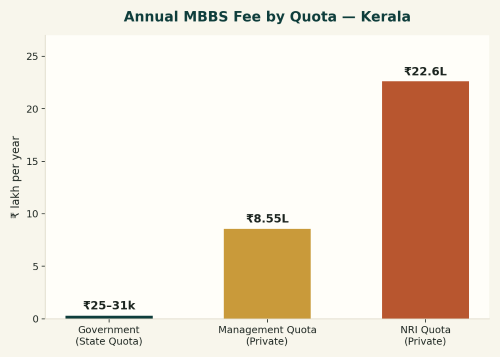
Government fee based on CEE Kerala's notified state-quota fee (₹25,000–31,570/year). Management and NRI figures are averages drawn from CEE's published 2026 fee order across Kerala's self-financing medical colleges.
Government medical colleges in Kerala remain genuinely inexpensive — a legacy of the state's strong public health investment — but they carry no NRI quota at all. Every NRI seat in the state, without exception, sits inside a private, self-financing college.
The Strikingly Uniform NRI Fee Across Top Colleges
This is the chart that surprises most people researching Kerala for the first time. Unlike Andhra Pradesh or Telangana, where NRI fees can swing by ₹15–20 lakh a year between colleges, Kerala's better-known private colleges cluster within about a lakh of each other.
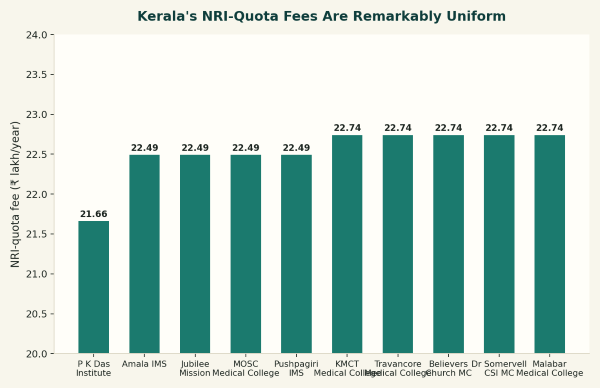
Figures are from CEE Kerala's official fee notification (GO-based fee order) for the 2025–26/2026–27 admission cycle. A handful of colleges — including some newer or provisionally listed ones — may carry different, unconfirmed figures; always check the latest CEE notification directly.
Because the fee gap between colleges is this narrow, the real decision for most NRI families in Kerala isn't "which college is cheapest" — it's "which college has the hospital, location, and community fit that suits my child." That's a genuinely different, and arguably healthier, way to shop for a medical college.
Meet The Names That Come Up Again And Again
Kerala's private medical college scene has a strong thread of community and minority institutions — many were founded by Christian denominational trusts, and several hold minority-community seat protections alongside their open NRI and management quotas. A handful come up on almost every shortlist:
| College | Location | Established | NRI-quota fee (annual) | Notes |
|---|---|---|---|---|
| Jubilee Mission Medical College & Research Institute | Thrissur | 2002 | ₹22.49 lakh | Large attached hospital; strong reputation, Christian-minority trust |
| Amala Institute of Medical Sciences | Thrissur | 2002 | ₹22.49 lakh | Known for disciplined campus culture and research exposure |
| Pushpagiri Institute of Medical Sciences | Thiruvalla | 2002 | ₹22.49 lakh | Community-managed, well-regarded clinical training |
| Malankara Orthodox Syrian Church (MOSC) Medical College | Kolenchery | 1997 | ₹22.49 lakh | Established Orthodox Church-run institution near Kochi |
| Believers Church Medical College Hospital | Thiruvalla | 2015 | ₹22.74 lakh | Newer, large hospital campus |
| Travancore Medical College | Kollam | 2007 | ₹22.74 lakh | Popular with south Kerala and Gulf NRI families |
| KMCT Medical College | Kozhikode | 2016 | ₹22.74 lakh | North Kerala option, growing hospital infrastructure |
| Malabar Medical College | Kozhikode | 2004 | ₹22.74 lakh | Established north Kerala presence |
| Dr. Somervell Memorial CSI Medical College | Karakonam, Thiruvananthapuram | 2002 | ₹22.74 lakh | CSI Church-run, south Kerala |
Fees are the officially notified figures from CEE Kerala's fee order; management-quota fees at these same colleges sit around ₹8.5–8.6 lakh a year. These numbers are reviewed and can change each admission cycle — always cross-check against the current year's CEE notification before committing funds.
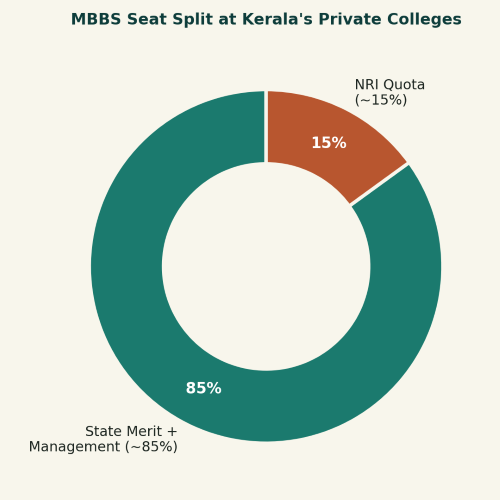
Standard reservation pattern applied across Kerala's self-financing medical colleges — 15% of total MBBS seats reserved for NRI/OCI/PIO candidates and NRI-sponsored applicants.
What The Extra Costs Actually Look Like?
The headline NRI tuition figure isn't the whole bill. On top of roughly ₹21.65–22.74 lakh in annual tuition, Kerala's private colleges typically add:
- College/development fee: around ₹53,000/year
- Hostel: ₹90,000–₹1.2 lakh/year
- Mess: ₹30,000–₹60,000/year
- Caution deposit: ₹10,000–₹25,000 (often partly refundable)
- Counselling/registration fee: around ₹5,000, paid once at the LBS Centre stage
Budget an extra ₹1.5–2 lakh a year above the headline tuition figure, and you'll be close to the real number.
How Kerala Compares To The States You May Already Be Researching?
If you've been comparing NRI-quota options across South India, it helps to see Kerala's total course cost sitting alongside what similar research turns up for Andhra Pradesh and Telangana.
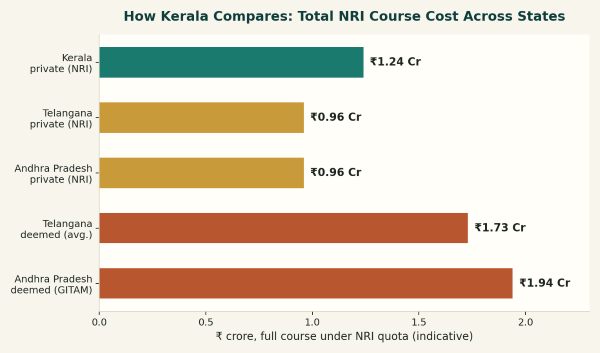
Kerala figure based on the ₹22.6 lakh/year average NRI fee projected across the full 5.5-year MBBS-plus-internship programme. Andhra Pradesh and Telangana figures drawn from our companion state guides on private and deemed medical college NRI-quota admissions.
Kerala lands in the middle: noticeably more expensive than the typical Telangana or Andhra Pradesh private college, but a good ₹40–70 lakh cheaper than either state's deemed-university route. What you're buying at that price point is a tightly regulated fee (so no unpleasant surprises), Kerala's strong general healthcare ecosystem, and — for many NRI families, especially Gulf-based Malayali households — genuine cultural and linguistic familiarity that other states can't offer.
A quick note for completeness: Kerala does also have one genuine deemed medical university, Amrita School of Medicine in Kochi, which runs its admissions through the separate MCC deemed-university pool rather than CEE/LBS state counselling. It sits outside the scope of this private-college guide, but it's worth knowing it exists if the deemed route interests you specifically.
How NRI-Quota Admission Actually Works In Kerala?
- Qualify NEET-UG. As everywhere else in India, this is compulsory for every quota, with zero exceptions.
- Establish NRI, OCI, or PIO status — or a valid NRI sponsor. Kerala's eligibility hierarchy specifically prioritises direct NRI/OCI/PIO status and their children first; NRI-sponsored candidates (sponsored by a relative or, in some cases, a non-relative) are considered only after that pool is exhausted.
- Register separately with the LBS Centre for Science and Technology for NRI-quota counselling — this is distinct from CEE Kerala's regular state counselling that handles merit and management seats.
- Upload and verify documents, including proof of the sponsor's foreign residency, income documentation, and the standard NEET and academic paperwork.
- Participate from Round 2 onward, since NRI-quota seat allotment in Kerala typically doesn't begin until the second round of counselling.
- Accept your allotment and pay fees within the stated deadline — including the tuition, college fee, and deposit components.
- Report physically to the college with originals and multiple photocopies of every required document.
The Documents To Keep Ready
- Valid passport and visa/residency proof for the NRI parent or sponsor
- NRI/OCI/PIO status certificate, or notarised sponsorship documentation if applying under the sponsored category
- Proof of the sponsor's annual income, sufficient to support the full course fee
- NEET-UG admit card and scorecard
- 10th and 12th mark sheets, with equivalence certification if schooled abroad
- Transfer certificate, migration certificate, and conduct certificate from the previous institution
How To Actually Choose, Given The Fees Barely Differ?
Since Kerala's tight fee regulation removes most of the price-shopping element, families tend to do better focusing on:
- Hospital size and specialty mix. Some of these colleges run 1,000-plus-bed multi-specialty hospitals; others are smaller but excellent in specific departments. Ask directly about bed count and daily OPD volume.
- Location relative to family and travel. Thrissur and Kochi-area colleges sit closer to Kochi's international airport; Kollam and Thiruvananthapuram colleges suit south Kerala families better; Kozhikode serves the north.
- Community and campus culture. Several of these colleges have a denominational or community character (Christian-minority trusts, CSI, Orthodox Church) that shapes campus life — worth understanding if that matters to your family.
- How established the college is. Older colleges like Jubilee Mission (2002) and MOSC (1997) have a longer clinical and academic track record than some of the newer entrants like Believers Church (2015) or KMCT (2016).
FAQs
Do Kerala's government medical colleges have an NRI quota?
No. NRI quota seats in Kerala exist exclusively within private, self-financing medical colleges. Government medical colleges fill their seats entirely through state-merit and All India Quota routes, with no NRI reservation whatsoever.
Why are Kerala's NRI fees so similar across colleges?
Because Kerala's Fee Regulatory Committee, through CEE Kerala, issues an annual government order that fixes the exact NRI-quota and management-quota fee each self-financing college is permitted to charge, by name. Unlike states where colleges set their own fee within a loose ceiling, Kerala's figures are close to identical because they're centrally notified rather than independently set.
Who handles NRI-quota counselling in Kerala — is it the same as regular counselling?
No. Kerala's NRI-quota seats are allotted separately by the LBS Centre for Science and Technology, a distinct Government of Kerala body, rather than through CEE Kerala's regular merit and management counselling. NRI-quota seat allotment typically only begins from Round 2 of the overall counselling calendar.
Who is eligible for Kerala's NRI quota?
Direct NRI, OCI, or PIO status holders and their children get first priority. NRI-sponsored candidates — where a relative, or in some cases a non-relative, with valid NRI status sponsors the candidate's admission and fees — are considered only after the directly-eligible pool is exhausted, and often require proof of the sponsor's sufficient annual income.
Does Kerala have any deemed medical university?
Yes, one: Amrita School of Medicine, part of Amrita Vishwa Vidyapeetham in Kochi. It admits through the separate MCC deemed-university counselling pool rather than CEE/LBS state counselling, so it sits outside the private-college system covered in this guide.
How many NRI-quota seats are available across Kerala?
Estimates vary by source and year, but a commonly cited figure is upwards of 300 NRI-quota seats spread across roughly 20 self-financing medical colleges, with individual colleges typically offering 15–25 NRI seats depending on total intake.
Which Kerala colleges have the biggest teaching hospitals?
Several of the well-established names — Jubilee Mission, Believers Church Medical College, and MOSC among them — run large, high-volume multi-specialty hospitals. Exact bed counts and daily patient volumes vary and are worth confirming directly with each college, since hospital scale is one of the few genuinely differentiating factors once fees are this uniform.
The Bottom Line
Kerala offers NRI families something genuinely rare in Indian private medical education: predictability. The fee is published, regulated, and nearly identical across every well-known private college, which means the real work of choosing isn't a spreadsheet exercise in fee comparison — it's a more human one, about hospital quality, location, and the kind of campus your child will actually thrive in. Budget around ₹1.2–1.3 crore for the full course, including extras; start your LBS Centre registration the moment NEET results are out, and you're working with one of the most transparent systems in the country.
Reviews
No reviews yet. Be the first to write one!