
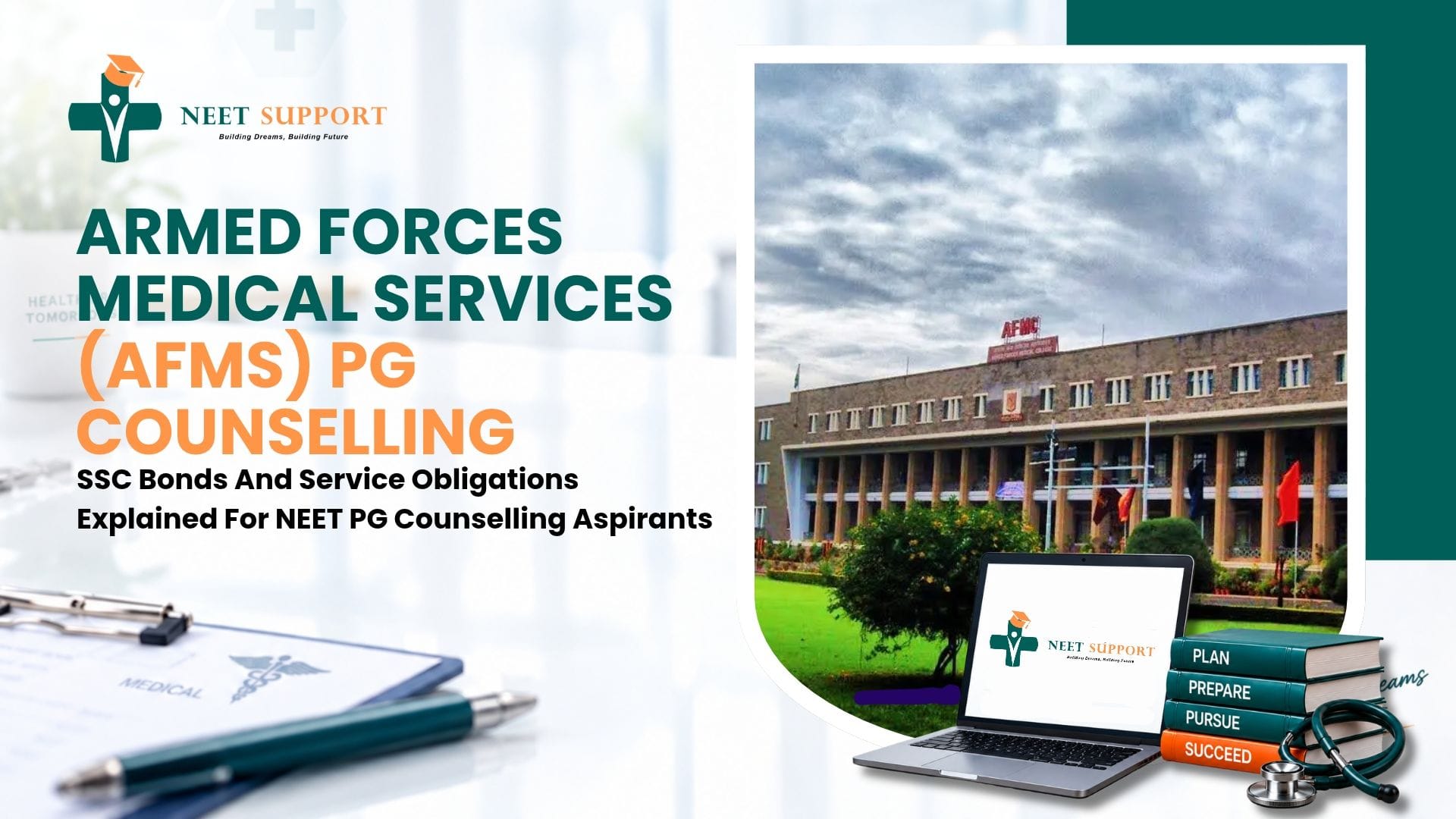
Armed Forces Medical Services (AFMS) PG Counselling: SSC Bonds And Service Obligations Explained For NEET PG Counselling Aspirants
Nishat
 WhatsApp
 Email
 Facebook
 Twitter/X
 LinkedIn
Table of Contents
Predict Your Rank Now
Enter your NEET score to get an estimated rank
Find the Best Colleges For You
Based on your NEET rank, Category & more

Get Your Dream Medical College
Secure your seat with expert counselling
Introduction
Picture two doctors sitting in a hostel room after the NEET PG result. One says, "I want the best branch I can get, and I want a career with purpose, structure, and respect." The other says, "I want freedom to choose my city, my hospital, and my future." Both are right. Both are aiming for the same PG degree. But their paths can look very different.
For some doctors, the Armed Forces Medical Services (AFMS) is a path worth serious thought. It offers uniformed service, a disciplined career, strong clinical exposure, and the pride of serving the nation's soldiers and their families. But it also comes with something every aspirant must understand clearly before signing up: service obligations and bonds.
This blog explains AFMS PG admission, the Short Service Commission (SSC) route, and the commitments attached to it, in simple language, the way a senior who has seen it all would explain it over chai. Let's begin.
A friendly note: eligibility rules, seat numbers, bond terms, service periods, and penalty amounts can change from year to year. Everything here is general guidance. Always confirm exact details in the official notification issued by the Directorate General of Armed Forces Medical Services (DGAFMS), the official recruitment portals, and mcc.nic.in before making any decision.
First, What Is AFMS And Why Do Doctors Choose It?
The Armed Forces Medical Services is the medical wing that looks after the health of the Army, Navy, and Air Force personnel and their families. Doctors in AFMS work in military hospitals, field areas, training institutions, and sometimes in remote or challenging locations.
Many doctors find the idea appealing for good reasons:
- A structured career. You enter with a rank, a pay structure, and a clear progression system.
- Strong clinical exposure. Military hospitals handle a wide variety of cases, which can build confidence and experience.
- A sense of purpose. Serving those who serve the country is a source of pride for many.
- Stability and benefits. Housing, medical care, and other service benefits are part of the package, as per the rules in force.
- Leadership and discipline. The training builds qualities that stay with you for life.
But there is another side. Military service means postings you may not choose, transfers, field duty, and a life that follows rules and orders. It is a calling, not just a job. That is why understanding the bond and service obligations matters so much.
How AFMS PG Admission Connects To NEET PG Counselling?
This is where many aspirants feel confused, so let's keep it simple.
Your NEET PG score is the key that opens most PG doors in India. Regular NEET PG Counselling, conducted by the Medical Counselling Committee (MCC), covers 50% All India Quota seats in government colleges and several central, deemed, and other institutions. State counselling covers the rest.
AFMS PG admission is a separate and specialised pathway. Seats in armed forces institutions and hospitals are linked to the service, and they are generally meant for eligible candidates who are serving officers or who join the service through the prescribed route. The process, eligibility, selection steps, and seat details are announced by the competent authority each year, and your NEET PG performance usually plays a central role.
The important point is this: AFMS PG seats are not just academic seats. They are tied to a career in uniform. When you take one, you are not only choosing a branch. You are choosing a service commitment too.
What Is A Short Service Commission (SSC)?
A Short Service Commission is a type of commission in the armed forces where an officer serves for a fixed period instead of a full career, with options as per the rules in force. For doctors, it is a way to join AFMS and serve for a defined number of years, after which there may be options such as extension, a permanent commission (subject to criteria and vacancies), or release from service.
Think of it as a long-term contract with the service. In return for the training, the pay, the position and, in some cases, the PG opportunity, you agree to serve for a period set by the rules.
Key things to remember:
- The length of the commission, extension rules, and exit options are set by the official notification.
- Permanent commission is not automatic. It depends on eligibility, performance, medical standards, and vacancies, as per the policy in force.
- Rules can be revised, so always read the current version, not an old blog or a senior's memory from three years ago.
Understanding Bonds And Service Obligations
This is the heart of the matter, so let's slow down.
A bond or service obligation is a commitment that you will serve for a certain period after receiving certain benefits. In the AFMS context, this can be connected to joining through a commission, undergoing PG training, or both. If you do not complete the committed period, there may be consequences, which can include financial penalties or other conditions as the rules describe.
Here is why it exists. Training a specialist costs the service a lot of money and time. The obligation ensures that the investment returns as years of service to the armed forces.
Questions Every Aspirant Should Ask Before Joining
Do not rely on guesswork. Find the official answers to these questions:
- How long is the initial commission or service period?
- Is there a separate service obligation after completing the PG course? If yes, for how long?
- Does the obligation run alongside the commission, or does it add to it? This is a common confusion, so read the exact wording.
- What happens if I want to leave early? Is there a penalty, a repayment condition, or a notice requirement?
- Are there limited exit options during the PG course? Rules for resigning while in training can be stricter than those after it.
- What are the options after the commission ends? Extension, permanent commission, or release?
- How are postings decided after PG? Can I express preferences, and how much do they matter?
- Are there any medical or physical standards I must keep meeting?
Write these questions in a notebook. When you read the official notification, tick off each one with the exact page or clause number. This habit will protect you from costly surprises later.
The Real-Life Side Of Service Life
Rules on paper are one thing. Daily life is another. A doctor who has chosen AFMS often shares experiences like these:
- You may be posted far from home. Military postings can include remote or high-altitude areas, and family may not always be able to move with you.
- Postings change. Transfers are a normal part of service life, which affects children's schooling, a spouse's career, and your own routine.
- You work within a hierarchy. Decisions, duty hours and responsibilities follow a chain of command.
- You may be called for non-clinical duties. Administrative and training responsibilities can come along with clinical work.
- You build a close community. Many officers describe a strong sense of camaraderie, support and shared purpose.
None of this is meant to scare you. It is simply meant to help you decide with open eyes. Some doctors find this life deeply rewarding. Others realise it does not match their personal goals. Both outcomes are fine, as long as the decision is made before the bond is signed, not after.
Weighing Pros And Cons Honestly
Let's look at both sides, plainly.
What You May Gain?
- A secure position with a clear career ladder
- Respected PG training in a structured environment, where seats are available through the service
- Rich case exposure in military and referral hospitals
- A pay and benefit structure as per service rules
- Pride, discipline and a sense of belonging to something larger
What You May Need To Accept?
- A fixed service commitment and the possibility of financial or other consequences for leaving early
- Limited choice in postings, at least initially
- Frequent moves and time away from family in some phases
- A work culture that is different from civilian hospitals
- Less freedom to switch careers quickly
If the first list excites you and the second list feels acceptable, AFMS may suit you well. If the second list makes you uncomfortable, it is wiser to know that now.
How To Compare AFMS With Regular NEET PG Counselling Options?
A smart decision means comparing, not guessing. Here is a simple way to look at it.
Freedom Of Choice. In regular NEET PG Counselling, you choose among a wide range of colleges and branches, subject to your rank. In AFMS, the pathway is more structured, and your choices follow service needs and rules.
Career Path. Civilian PG gives you flexibility to practise, teach, research, or move abroad. AFMS gives you a defined path within the service, with its own advantages.
Bond And Obligations. Many states and institutions have their own bond or seat-leaving rules in regular counselling. AFMS obligations are linked to a commission, and understanding them clearly is essential. Compare the total commitment in each case, not just the headline number.
Financial Picture. Look at fees, stipend or pay, benefits, and any penalties for leaving. Do not compare a salary figure with a stipend figure without understanding the whole package.
Lifestyle. Think about location, family, comfort with discipline, and your personal long-term plans.
There is no single right answer. The best choice is the one that fits your goals, values, and circumstances.
Smart Steps Before You Commit
Here is a practical roadmap you can follow.
Step 1: Read The Official Notification Fully. Not a summary, not a video, the actual document. Pay special attention to eligibility, selection process, bond clauses, and penalty rules.
Step 2: Talk To Serving Or Retired Officers. Ask about postings, work-life balance, PG training, and the real experience of the bond. People who have lived it can give insights that no document does.
Step 3: Discuss With Your Family. A service commitment affects your spouse, parents, and future children too. Include them in the conversation early.
Step 4: Check Your Medical And Physical Standards. Service has its own standards. Know what they are and whether you meet them before you invest hope in this route.
Step 5: Compare Your Alternatives. Look at what you could get through MCC and state counselling at your rank, including seat-leaving and bond rules in those systems.
Step 6: Keep Your Documents Ready. Armed forces processes are known for strict verification. Keep your MBBS degree, internship certificate, registration certificate, identity proof, photographs, and category documents scanned and organised.
Step 7: Decide Calmly, Not In A Panic. Take your time and decide before the deadline, not in the last hour.
Common Mistakes To Avoid
Even clever aspirants fall into these traps:
- Joining because friends did, without understanding the bond
- Reading only a senior's summary instead of the official document
- Confusing the commission period with the post-PG service obligation
- Assuming old rules still apply this year
- Ignoring the impact on family and personal plans
- Skipping the medical standards check until the last minute
- Missing deadlines for forms, verification, or reporting
- Treating the bond like a formality instead of a serious commitment
- Believing rumours in social media groups over official notices
Every one of these is avoidable. A little patience now can save years of regret.
Managing The Emotional Side
Choosing a path that includes a bond can feel heavy. You may worry about locking yourself into a long commitment, or about missing out on the freedom your friends will have. These feelings are normal.
A few gentle reminders:
- It is okay to take time to think. A big decision deserves a calm mind.
- It is okay to say no. Not every path is meant for every doctor.
- It is okay to say yes. If the service calls you, take pride in that choice.
- Your worth is not defined by your rank or by the seat you take.
- Talk to someone you trust, whether a senior, a mentor, or a counsellor, if the decision feels overwhelming.
A Simple Checklist Before You Decide
Keep this handy:
- Read the latest official AFMS notification fully.
- Note the length of the commission and any post-PG obligation.
- Understand exit options and penalties clearly.
- Check eligibility and medical standards.
- Talk to officers who have lived this life.
- Discuss the decision with your family.
- Compare with your MCC and state counselling options.
- Organise all documents and note every deadline.
- Save copies of every form, receipt and communication.
- Decide calmly, not under pressure.
FAQs
Is AFMS PG Admission Part Of Regular NEET PG Counselling?
AFMS PG admission follows its own pathway, set by the competent authority. Your NEET PG score generally matters, but the process, eligibility and seats differ from regular MCC NEET PG Counselling. Always check the latest official notification.
What Is A Short Service Commission In AFMS?
It is a commission in which a doctor serves in the armed forces for a defined period, with options after that as per the rules, such as extension, permanent commission or release. The exact terms are in the official notification.
What Is A Service Bond Or Service Obligation?
It is a commitment to serve for a set period after receiving certain benefits, such as a commission or PG training. If you leave early, financial or other consequences may apply as per the rules.
Is There A Separate Service Obligation After Completing PG?
This depends on the current rules and the route through which you joined. Read the official notice carefully and confirm whether any obligation runs alongside your commission or in addition to it.
Can I Leave During My PG Course?
Rules for leaving during training can be stricter than those after it, and penalties may apply. Check the exact exit conditions before you accept any seat.
Is Permanent Commission Guaranteed After SSC?
No. Permanent commission depends on eligibility criteria, performance, medical standards and vacancies, as per the policy in force. Do not assume it is automatic.
How Are Postings Decided After PG?
Postings are decided by service requirements and rules. Some preferences may be considered, but you should not expect full control over your location. Ask serving officers for realistic insights.
Do Medical And Physical Standards Apply?
Yes, armed forces service has its own medical and physical standards. Check them in the official notification and consider getting yourself assessed early, so that there are no surprises at a later stage.
How Is AFMS Different From Seats In MCC And State Counselling?
Regular counselling offers broader choice of colleges and cities, with bonds and seat-leaving rules that vary. AFMS offers a structured service career with its own commitments. Compare the total package, including freedom, obligations and lifestyle.
Can I Take Part In Both AFMS And NEET PG Counselling?
Many aspirants keep both options open, but joining one may affect what you can do in the other. Read the rules of each process carefully, especially about joining, resigning and penalties.
What Is The Most Important Thing To Do Before Joining AFMS Through SSC?
Read the official notification fully, understand the bond and service obligations, talk to people who have lived the experience and make your decision calmly, with your family and your long-term goals in mind.
Final Thoughts
AFMS can be a proud and rewarding path for doctors who are ready for it. It offers structure, purpose and strong clinical training. But it comes with commitments that deserve respect and careful thought.
The golden rule is simple: know the bond before you sign the bond. Read the official rules, ask honest questions, compare your options within NEET PG Counselling and beyond, and speak to people who have walked the road. When your decision comes from understanding, not from pressure, you are far more likely to be happy with it.
Whichever path you choose, military or civilian, your journey as a doctor is about care, skill and service. Trust your preparation, stay informed through official sources, and choose the road that feels right for you.
Wishing you clarity, courage, and a career you’ll be proud of.
Reviews
No reviews yet. Be the first to write one!