
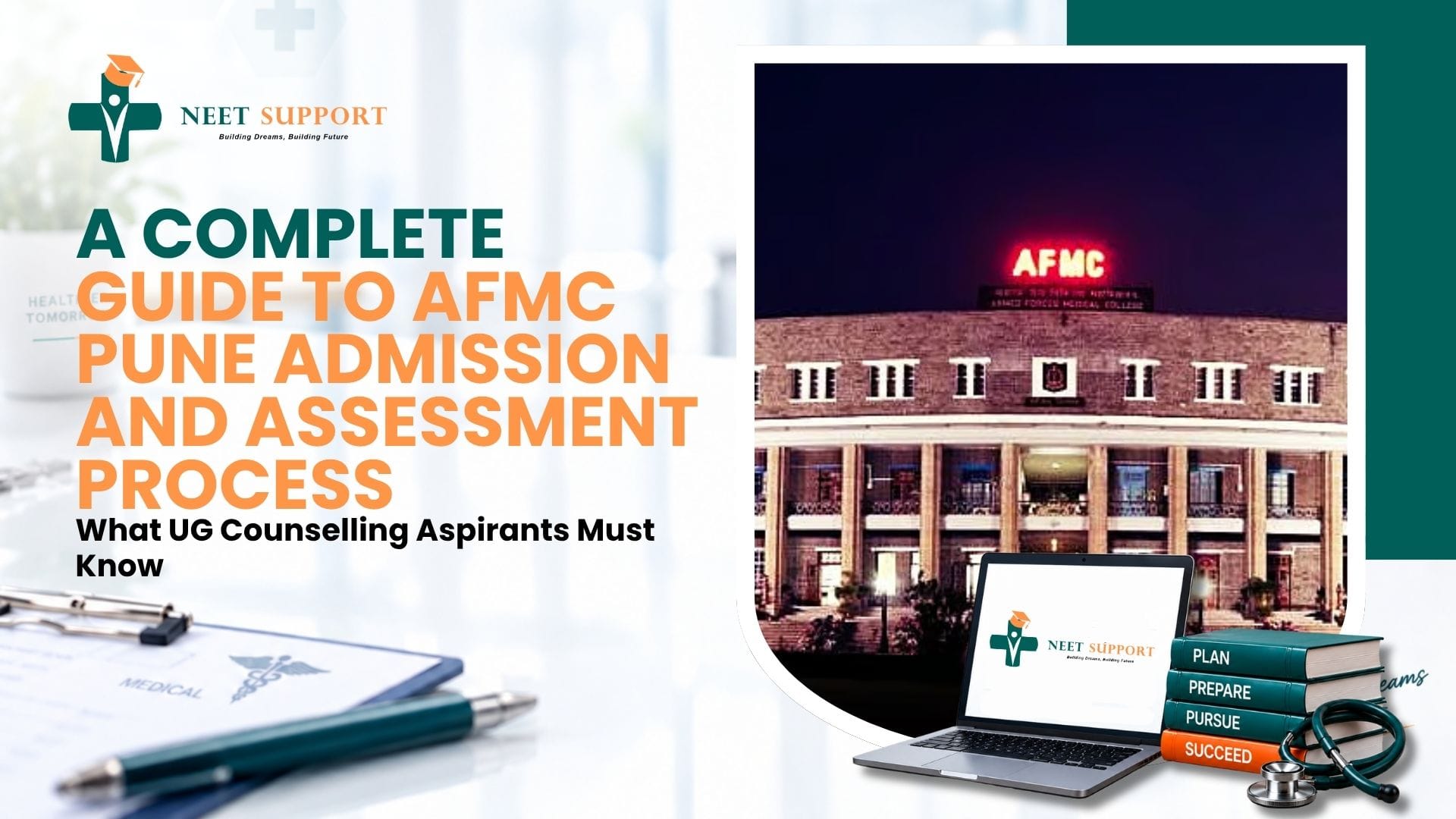
A Complete Guide to AFMC Pune Admission and Assessment Process: What UG Counselling Aspirants Must Know
Nishat
 WhatsApp
 Email
 Facebook
 Twitter/X
 LinkedIn
Table of Contents
Predict Your Rank Now
Enter your NEET score to get an estimated rank
Find the Best Colleges For You
Based on your NEET rank, Category & more

Get Your Dream Medical College
Secure your seat with expert counselling
Introduction
Ask any NEET topper what the toughest medical seat in India to get into is, and a surprising number will say AFMC Pune — not because the cutoff is impossibly high, but because a good NEET score alone won't get you in. The Armed Forces Medical College is the one institute in the entire Indian medical admission system where your rank only opens the door; what happens after that decides whether you actually walk through it.
If AFMC is on your list during UG counselling, this guide walks you through the entire journey — from NEET-based shortlisting, to the ToELR test, to the interview and psychological assessment, to the medical fitness standards, and finally to the service bond that comes with wearing both a white coat and a uniform.
Why Is AFMC Different From Every Other Medical College?
At every other government or private medical college in India, your final seat is decided almost entirely by your NEET rank against the seat matrix. At AFMC, NEET is just the entry ticket. Unlike every other medical college in India, NEET score alone doesn't determine admission — the selection process has four distinct components layered on top of it: NEET qualification, an on-campus written test, a personal interview, and a strict medical fitness evaluation. Each stage can eliminate candidates who were otherwise strong performers.
This is because AFMC isn't just training doctors — it's training commissioned officers of the Armed Forces Medical Services (AFMS). Every cadet who graduates goes on to serve as a uniformed officer, which is why the college evaluates far more than academic ability.
Step 1: NEET Qualification and MCC Registration
There's no separate application form for AFMC. Registration for AFMC MBBS admission is done through the standard MCC/DGHS counselling portal, using your NEET UG roll number after results are declared, and you simply select AFMC Pune among your counselling preferences. Basic eligibility criteria include:
- Qualifying NEET UG conducted by the NTA.
- Minimum 60% aggregate in Physics, Chemistry, and Biology, with at least 50% in English and 50% in each science subject at the qualifying examination.
- Age between 17 and 24 years at the time of admission.
- Candidates must be unmarried at the time of admission.
Step 2: Screening Shortlist Based on NEET Merit
Once NEET results are out, AFMC doesn't call every registered candidate for the next round. Based on NEET performance, approximately 2,000 candidates — roughly 1,600 boys and 400 girls — are shortlisted for screening, with separate merit lists maintained for each gender. This shortlist and the screening schedule are published on AFMC's official channels, and only those above this cutoff proceed to the on-campus assessment.
Step 3: The ToELR Test — The Part Most Students Underestimate
This is the stage that genuinely surprises a lot of high-NEET-scorers. ToELR stands for Test of English Language, Comprehension, Logic and Reasoning, and it's conducted as a computer-based test at AFMC Pune itself. Here's how it's structured:
- 40 multiple-choice questions, each worth 2 marks, to be completed in 30 minutes.
- Negative marking of 0.5 marks for every wrong answer.
- Maximum possible score: 80 marks.
- The test evaluates English proficiency and logical reasoning — it has nothing to do with Physics, Chemistry, or Biology.
The scoring formula that follows is where things get interesting: your NEET score and ToELR score are combined and divided by 4 to arrive at a Written Examination Score out of 200. So, for example, a NEET score of 600 combined with a ToELR score of 60 gives (600+60)/4 = 165 out of 200. This means a strong ToELR performance can meaningfully boost a candidate whose NEET score alone might not have been decisive, and conversely, a poor ToELR score can drag down even an excellent NEET rank.
Step 4: Psychological Assessment Test (PAT)
Alongside the written test, candidates undergo a Psychological Assessment Test, which is explicitly a non-scoring, qualifying test — it doesn't add or subtract marks from your final merit, but you must clear it to proceed. This assessment is meant to gauge mental and emotional stability, an important consideration given that AFMC graduates go on to serve in demanding military environments. The general advice from those who've been through it is simple: be natural and honest, since there are no "correct" personality traits being tested for — the assessment is looking for consistency and stability, not a particular type of answer.
Step 5: The Personal Interview
Candidates who clear ToELR and the PAT move to a panel interview conducted by Armed Forces officers, worth 50 marks out of the total 250. The interview covers general awareness, personality, interests, and hobbies — but its scope goes well beyond casual conversation. Physical fitness and extracurricular achievements, including NCC and sports background, carry visible weight in this evaluation, well beyond what your NEET marksheet shows. Unlike MCC counselling, where rank alone decides an outcome, AFMC's interview can genuinely make or break an admission — it's entirely possible for a candidate with a comfortably high combined written score to lose their place here.
Step 6: The Medical Examination
After the interview, candidates undergo a thorough medical examination, and only those declared medically fit move into the final selection pool. This is one of the most important distinctions to understand: AFMC applies Armed Forces medical fitness standards, not ordinary civilian medical college standards. Candidates are assessed for physical fitness, vision, hearing, absence of deformities, psychological stability, and overall suitability for military medical service — standards that are meaningfully stricter than what any other civilian MBBS admission requires. It's entirely possible for a candidate to ace the written test and interview and still be ruled out at this stage on medical grounds.
Step 7: Final Merit List and Document Verification
The final selection formula pulls everything together: Written Score (NEET + ToELR, divided by 4) + Interview Marks = Final Score out of 250, with separate merit lists prepared for male and female candidates, plus a waitlist. Before final confirmation, candidates must produce original documents, including:
- NEET UG admit card and scorecard
- Class 12 marksheet and pass certificate
- Proof of date of birth
- NCC/sports certificates, where applicable
Any discrepancy, false information, or missing documentation at this stage can lead to outright cancellation of candidature — so this isn't a step to treat casually.
The Seat Structure
AFMC Pune offers 145 MBBS seats in total, split as 115 seats for boys and 30 seats for girls, along with a small number of reserved and foreign-sponsored seats. This gender-wise seat split is also reflected earlier in the shortlisting stage, where the roughly 2,000-candidate screening pool itself is proportioned along similar lines.
The Service Liability Bond: What You're Actually Signing Up For?
This is the part every family needs to understand clearly before choosing AFMC, because it's a genuinely significant, binding commitment — not a formality buried in fine print.
- Every AFMC MBBS graduate is required to serve 7 years as a commissioned officer in the Armed Forces Medical Services, either under Short Service Commission or until superannuation under Permanent Commission, depending on the specific service terms.
- To back this commitment, cadets and their guardians sign a service liability bond. The exact figure has been rising year on year — reported figures across recent cycles range from roughly ₹67 lakh to ₹71 lakh, so always confirm the current, exact amount directly from AFMC's official notification rather than relying on last year's figure.
- The bond activates under specific conditions: if a cadet withdraws after the initial joining window (commonly cited as within 7 days of joining), or fails to complete the full 7-year service obligation after graduation.
- There's an important, separate provision for medical unfitness during training: candidates declared unfit and given a Non-Service Liability (NSL) declaration during the course are not liable for the full bond amount, but instead pay a proportional weekly training-cost recovery — reported at roughly ₹28,166 per week from the date of the NSL declaration, rather than the full bond figure.
- Legal disputes arising from this bond fall under the jurisdiction of Pune/Maharashtra specifically, which is worth knowing if you're located elsewhere and considering the commitment.
The logic behind the bond is straightforward: the government heavily subsidises the medical education, military training, accommodation, and facilities provided at AFMC, and the bond exists to protect that investment against candidates who might otherwise walk away from the service obligation after receiving a heavily subsidised, prestigious medical degree.
What Makes the Trade-Off Worth It for Many Candidates?
For those who do complete the full commitment, AFMC offers something civilian MBBS programmes generally can't:
- Heavily subsidised education, with tuition, boarding, and messing costs far below private or even most government college fees.
- A guaranteed career path immediately after graduation, with no post-MBBS job search — commissioning into AFMS is built into the programme itself.
- Reserved postgraduate seats specifically for AFMS officers, giving a clearer, more structured route into specialisation compared to the general NEET PG scramble.
- An extraordinary, tightly bonded peer group — every batch consists of top NEET performers who additionally cleared the interview and psychological assessment, which shapes a distinct campus culture.
- Doctors who join through Short Service Commission routes, including those pursuing military postgraduate training later, generally receive military pay scales, which tend to be meaningfully higher than typical civilian PG stipends, along with accommodation and other service benefits.
A Quick Checklist Before You Choose AFMC in Your Counselling Preferences
- Confirm your NEET score realistically sits above recent years' screening shortlist thresholds — remember, this cutoff is only for shortlisting, not final admission.
- Start reasoning and English comprehension practice early — ToELR is a distinct skill from NEET's Biology-heavy preparation, and many strong NEET candidates underprepare for it.
- Take the psychological assessment and interview seriously — brush up on general awareness and be ready to speak genuinely about your interests, sports, and NCC background if applicable.
- Get a realistic sense of your medical fitness against Armed Forces standards well in advance — vision, hearing, and any physical condition should be checked early, not discovered at the final medical board.
- Have an honest family conversation about the 7-year service bond before locking AFMC as a preference — this is a serious, multi-year commitment with a substantial financial penalty attached if it isn't honoured.
- Always verify the current-year bond amount and exact terms directly from AFMC's official notification, since the figure is revised almost every year.
FAQs
Is NEET score alone enough to get into AFMC Pune?
No. NEET score only helps you get shortlisted for further screening; final admission depends on the ToELR test, psychological assessment, interview, and medical fitness evaluation.
How many candidates are shortlisted for AFMC screening based on NEET?
Approximately 2,000 candidates — around 1,600 boys and 400 girls — are shortlisted for on-campus screening based on NEET merit.
What is the ToELR test?
ToELR (Test of English Language, Comprehension, Logic and Reasoning) is a 40-question computer-based test held at AFMC Pune, assessing English proficiency and logical reasoning rather than medical knowledge.
How is the final merit score calculated at AFMC?
The written score is calculated as (NEET score + ToELR score) divided by 4, out of 200, and interview marks (out of 50) are added to this to get a final score out of 250.
Is the Psychological Assessment Test (PAT) scored?
No, the PAT is a qualifying, non-scoring test used to assess mental and emotional stability; you must clear it, but it doesn't add marks to your final score.
How much weight does the interview carry?
The interview is worth 50 marks out of the total 250, and it can significantly affect your final ranking regardless of a strong written score.
What medical standards does AFMC follow?
AFMC follows stricter Armed Forces medical fitness standards rather than ordinary civilian medical college standards, assessing vision, hearing, deformities, and psychological suitability.
How many MBBS seats does AFMC Pune offer?
AFMC Pune offers 145 MBBS seats, split as 115 for boys and 30 for girls, along with a few reserved and foreign-sponsored seats.
What is the AFMC service bond amount?
Recent figures cited range from roughly ₹67 lakh to ₹71 lakh, with the exact amount revised most years — always confirm the current figure from AFMC's official notification.
When does the service bond get activated for withdrawal?
The bond typically activates if a cadet withdraws after an initial short joining window (commonly around 7 days) or fails to complete the full 7-year service obligation after graduation.
The Bottom Line
AFMC Pune isn't just another name on your UG counselling choice list — it's a fundamentally different admission philosophy, one where your NEET rank earns you a chance, not a seat. Between the ToELR test, the psychological assessment, a genuinely consequential interview, and Armed Forces-grade medical standards, the selection process filters for far more than academic strength alone. If you clear all of it, you're not just getting into a top medical college — you're signing up for a structured, secure, and genuinely distinctive career as both a doctor and a military officer, backed by a serious multi-year service commitment that deserves an honest family conversation before you rank it in your preferences.
Reviews
No reviews yet. Be the first to write one!